
Last Updated on November 2, 2026 by Luis Cooper
Alex finished his last 100-mile race wearing a watch that died somewhere around mile 87.
It did not stop beeping when he pressed anything.
It just went dark.
Thirteen hours of GPS data, his split times, his heart rate through the night climb, his course progress through the fog on the ridgeline where he took the wrong turn and added four miles to his race- all of it gone when the battery gave out three miles from the finish.
He did not buy the same watch again.
People who run ultras, hike for three or four days straight, cycle across borders, or spend weeks on expeditions where a power outlet is something you read about in a news article aren’t shopping for a pretty wrist display.
They are shopping for a tool that will still be working when they need it most.
A watch that quits before the race does is not a sports watch. It is a liability.
The Garmin Enduro 4 was designed for exactly that kind of person.
It is Garmin’s answer to the one question endurance athletes never stop asking: how long does this thing actually last? Garmin’s answer with the Enduro 4 is longer than you will be moving.
And in the world of GPS watches, that answer is genuinely rare.
This is a complete review of the Garmin Enduro 4.
We break down every feature, every spec, what is genuinely new compared to what came before, who should buy it, and who should look somewhere else.
Garmin Enduro 4 Review

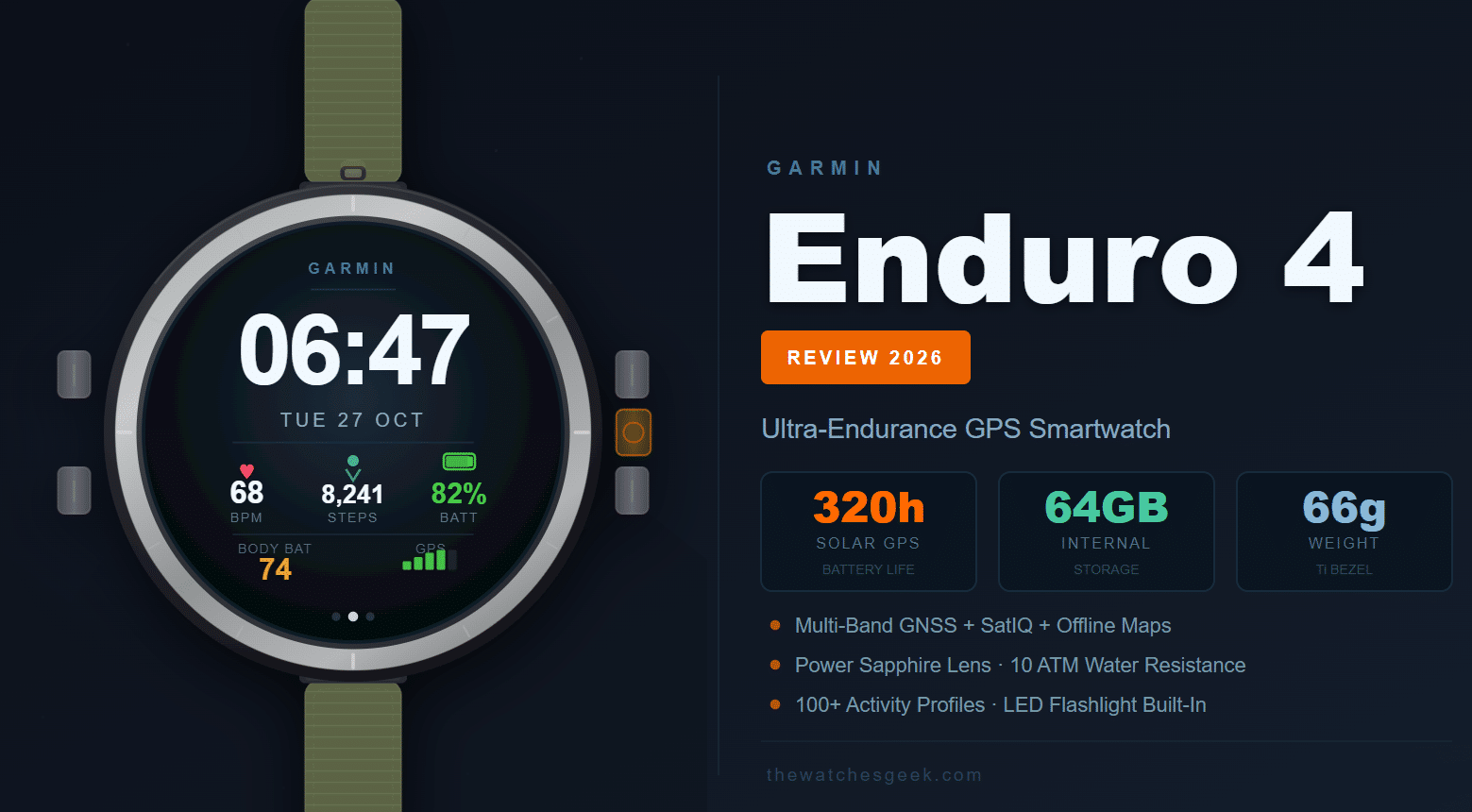
- Rugged GPS smartwatch built for ultra-endurance athletes, with a lightweight design, scratch-resistant sapphire lens, built-in LED flashlight and ComfortFit fabric band for comfortable long-distance wear
- Comprehensive power mode enhancements provide up to 90 days of battery life in smartwatch mode (assumes all-day wear with 3 hours per day outside in 50,000 lux conditions) and 320 hours in activity mode (extended battery) (assumes continuous use for entire period in 50,000 lux conditions)
- There are 100+ activity profiles and advanced training and performance tools to help you perform your best on your next big adventure
- Grade-adjusted pace-based workout targets help ensure you exert the proper energy on uphills and downhills
- Grade-adjusted rolling pace provides continually adjusted average pace data so you get a better understanding of your pace on all terrain types

What Is the Garmin Enduro 4?
The Garmin Enduro 4 is an ultra-endurance GPS smartwatch released in October 2026.
It sits at the top of Garmin’s endurance-focused lineup, built specifically for athletes and adventurers who need days, not hours, of reliable GPS tracking without access to a charger.
It runs on the same proven Garmin platform as the Fenix and Forerunner lines but strips away certain features, like the AMOLED display and satellite messaging, in order to prioritize one thing above all others: battery life.
The result is a watch that can track your GPS location for up to 120 continuous hours without solar, and up to 320 continuous hours with solar under strong conditions.
That is not a misprint.
The watch arrived in October 2026 as the successor to the Enduro 3 and brought with it a faster processor, doubled storage, a new band, and a collection of new training and navigation software.
The hardware frame stayed largely the same, a deliberate choice rather than an oversight.
Because the Enduro 3’s standout features were its chassis and battery system, changing either one carries real risk.
Garmin kept what worked and improved what could be improved without touching the core formula.
Design and Build Quality
Hold the Enduro 4 in your hand, and the first thing you notice is how light it feels for something this large.
The case measures 51mm across, which is wide. It is undeniably wide.
But at 66 grams with the band, and just 57 grams for the case alone, it carries on your wrist with a lightness that the size does not suggest.
The secret is the materials.
The case body is made from fiber-reinforced polymer, a fancy way of saying a high-grade plastic composite that is rigid, lightweight, and resistant to the knocks and scrapes of outdoor use.
The bezel is titanium, adding structural strength to the most exposed part of the watch without the weight penalty of a fully titanium case.
The caseback is also titanium.
The lens is Power Sapphire, which is Garmin’s hardened solar glass.
Sapphire rates just below diamond on the hardness scale, so it resists surface scratches that would eat through mineral glass in weeks of trail use.
The overall aesthetic is minimal and purposeful.
The Enduro 4 does not try to look like a dress watch or pretend it belongs in a conference room.
It looks like something built for a purpose, because it is.
The buttons have firm, tactile feedback, which matters when you are running in the rain, wearing gloves on a mountain descent, or operating the watch with cold, tired hands at 3 am during the night section of a race.
The band included in the box is Garmin’s new ComfortFit fabric, which wicks moisture and fits wrists from 145mm to 220mm.
It is comfortable for all-day wear and handles sweat during long efforts without becoming uncomfortable.
The QuickFit system lets you swap any 26mm band in seconds without tools, so you can switch to silicone or nylon for different activities.
The LED flashlight on the face of the watch sounds gimmicky on paper, but it earns its place immediately in the field.
It has two modes: white light for general illumination and red light for preserving night vision.
For runners doing pre-dawn start lines, hikers navigating a campsite at midnight, and athletes on multi-day races who need hands-free light to check a map or find food in a pack, it is genuinely useful.
The Display: Why MIP Instead of AMOLED
The display on the Garmin Enduro 4 is a 1.4-inch color transflective Memory-in-Pixel display at 280 by 280 pixels.
If you read smartwatch reviews regularly, you know most premium watches in 2026 have shifted to AMOLED displays with thousands of nits of brightness, deep blacks, and vivid color rendering.
The Garmin Enduro 4 hasn’t made that shift, and the reason is simple and correct.
AMOLED displays consume significantly more power than MIP displays.
The battery numbers that define the Enduro 4’s identity- 36 days, 90 days solar, 120 hours GPS, 320 hours solar GPS- are only possible because the watch is using a MIP screen that draws a fraction of the power an AMOLED panel would require.
Choosing an AMOLED display would mean cutting battery life in half, and cutting the Enduro 4’s battery life in half would make it a different product with a different purpose.
The MIP display has its own genuine advantage: it uses ambient light to become more readable, not less.
In direct sunlight, where endurance athletes spend most of their time, the MIP panel stays clear and easy to read without shading it with your hand. AMOLED screens can wash out in strong sunlight even at high brightness settings.
On a trail run at noon in clear weather, the Enduro 4 screen is one of the easiest to read of any watch available.
The MIP display falls short everywhere else.
Indoors, in low light, and at a glance in a dim gym, the screen looks less vibrant and less sharp than the AMOLED panels on the Samsung Galaxy Watch 8 or Apple Watch.
The colors are muted. The resolution feels modest.
If you primarily use your watch indoors or care deeply about how your watch face looks, this is a real trade-off to acknowledge.
For outdoor athletes, the MIP display is not a compromise. It is the right choice.
Battery Life: The Headline Feature Explained

Battery life is the reason the Enduro 4 exists. Every other spec decision flows from the goal of keeping this watch running longer than any activity you could possibly do.
Here is what Garmin officially rates for the Enduro 4:
In smartwatch mode with all-day monitoring, the Enduro 4 lasts up to 36 days without any solar.
With solar charging in strong sunlight (3 hours per day at 50,000 lux), the battery lasts up to 90 days.
In Low Power Watch Mode, the watch reaches up to 92 days without solar, and with adequate solar charging reaches what Garmin calls unlimited runtime.
For active GPS use, the numbers are equally impressive.
Standard activity tracking lasts up to 80 hours without solar and up to 144 hours with solar.
The Extended Battery GPS mode stretches runtime to 120 hours without solar and up to 320 hours with solar.
The Max Battery mode, which reduces some tracking functions, pushes to 210 hours without solar.
The Max Accuracy mode, which uses all satellites simultaneously for the most precise tracking, lasts 60 hours without solar and up to 90 hours with solar.
Two things are important to understand about these numbers.
First, the solar figures depend heavily on real-world sun exposure. Garmin’s 50,000 lux benchmark represents direct, clear sunlight. Cloudy days, shade, forests, and winter sun contribute less.
Real-world solar contribution will be lower than the rated figures on most outings and much lower in northern regions or during winter months.
Second, activating music, maps, the backlight, and many sensors simultaneously drains the battery faster than single-mode use.
Independent testing of the Enduro 3, which shares the same battery hardware and power system, found that Extended Battery GPS mode ran about 70 hours under real trail-running conditions rather than the claimed 120 hours.
The Max Accuracy GPS mode lasted about 50 hours in the same testing, rather than the claimed 60 hours. Use these real-world findings as the more conservative planning target.
Even at the conservative real-world estimate of 70 hours in Extended Battery GPS mode, the Enduro 4 outlasts any 100-mile trail race, any single-stage bike packing route, any thru-hike day, and any conceivable single-session athletic effort.
For multi-day races and expeditions that run past 70 hours, the watch includes multiple battery modes you can cycle through strategically, swapping accuracy for longevity as needed.
No other consumer smartwatch in its price range competes with these numbers.

The Garmin Enduro 4 uses multi-band GNSS with SatIQ, which means it pulls satellite signals from GPS, GLONASS, Galileo, QZSS, and BeiDou simultaneously in its most accurate mode.
SatIQ is Garmin’s system for automatically selecting the right combination of satellite systems based on your current environment, using multi-band when it improves accuracy and dropping to single-band in open terrain to preserve battery.
Independent testing on the Enduro 3, which uses identical GPS hardware, rated GPS accuracy at 8.5 out of 10. Track recordings in forests and near tall buildings in multi-band mode came back clean with minimal drift.
For the environments ultrarunners and hikers spend their time in, this is solid, reliable performance.
The maps are where the Enduro 4 makes a meaningful step forward from its predecessor.
The Enduro 4 ships with 50% more RAM than the Enduro 3 and uses the same map engine as the Fenix 9 Pro.
This combination makes map panning approximately 30% faster and route calculation quicker.
In practice, this means the map moves with your input rather than catching up to it.
When you are at a trail junction and need to orient yourself quickly, responsive maps aren’t a luxury.
They are a safety feature.
The watch comes preloaded with TopoActive maps covering multiple continents.
These are genuine routable topographic maps, not simplified trail overlays.
You can navigate turn by turn on hiking trails, fire roads, and unmarked mountain routes.
The maps include trail names, elevation data, points of interest, and distance markings.
The Enduro 4 also introduces Perspective view.
This tilts the map to show a more natural, three-dimensional representation of the terrain ahead, similar to how you might look at a landscape with your own eyes rather than straight down at a paper map.
For riders and runners approaching a complex descent or a river crossing, the added terrain context is useful.
ClimbPro shows real-time grade, total ascent remaining, and distance to the next significant climb on a course.
When you are 40 miles into a trail race and know there is another 2,500-foot climb ahead, seeing exactly when it starts, how steep it is, and how long it runs helps you manage effort instead of being surprised by it.
PacePro takes a course you load and calculates adaptive pace targets adjusted to the actual elevation profile of your specific route.
Rather than giving you a flat average pace, it tells you the appropriate effort-equivalent pace for each section based on whether you are going uphill, downhill, or running on flat.
For a hilly race course, this is genuinely more useful than a generic pace target.
Up Ahead shows you checkpoints, aid stations, water sources, and waypoints on your route before you reach them so you can plan fuel and hydration without pulling out your phone.
For ultramarathon runners managing nutrition across 100 miles, this level of navigation detail makes a material difference in race execution.
Training Features in Detail
The Garmin Enduro 4 is not a basic step counter with GPS bolted on.
It runs the full Garmin training platform, which is the most detailed and comprehensive training analysis available on any consumer GPS watch.
Here is how each major feature works in practice.
Training Readiness
Each morning, the Enduro 4 gives you a Training Readiness score from 0 to 100, combining your sleep quality and duration, HRV Status, Body Battery level, recent training load, and recovery time from your last hard session.
A score above 67 means your body is ready for a hard effort.
A score below 33 means a rest day or easy run is the smarter choice.
This is not a gimmick. Studies on HRV-based readiness monitoring show consistent correlation between low readiness scores and degraded performance outcomes.
For athletes managing training across multiple days during a build phase, this daily snapshot helps prevent the overtraining that causes injuries and forces the long unplanned breaks that kill fitness development.
Body Battery
Body Battery tracks your energy reserves throughout the day using heart rate variability, stress levels, sleep quality, and activity data.
It runs on a scale from 5 to 100 and updates in real time.
High activity, mental stress, and poor sleep deplete it. Rest, quality sleep, and recovery activities rebuild it.
For athletes trying to decide whether today is a good day for a long training run or a better day for something easy, Body Battery provides an objective data point rather than a gut feeling.
Over time, most users report that the Body Battery score accurately reflects how they feel and how they perform.
Garmin Epic
Garmin Epic is a new feature introduced with the Enduro 4.
It groups activities that span multiple days, weeks, or even months into a single connected record in the Garmin Connect app.
You can add photos to your Epic, share it with others, and see aggregated health and performance data across the entire period.
For a 200-mile thru-hike broken into 12 days of walking, or a multi-day bike packing race with overnight camps, Garmin Epic collects everything into one story.
It is both a practical tracking tool and a record of an experience worth keeping.
Grade-Adjusted Pace
Standard pace on hilly terrain is a poor measure of actual effort.
Running a 9-minute mile uphill is not the same as running a 9-minute mile on flat ground.
Grade-Adjusted Pace converts your actual running pace into an effort-equivalent flat pace, allowing you to compare efforts across different terrain types.
The Enduro 4 takes this further with grade-adjusted pace workout targets.
When you have a structured training session with pace targets, the watch adjusts those targets in real time based on the gradient you are actually running, so you maintain the intended effort rather than blowing up on a climb trying to hit a flat-terrain pace.
This feature has been available in some form on Garmin watches for several years, but the Enduro 4 refines it and integrates it more deeply into the structured workout experience.
Stamina Zones and Stamina Curve
Stamina is your available energy reserve for sustained endurance effort.
The Enduro 4 shows stamina during activities as a real-time bar that depletes as you work harder or go longer, giving you a visual representation of how much you have left before you hit the wall.
New to the Enduro 4 are Stamina Zones, which divide your stamina into ranges that indicate what kind of effort you can currently sustain.
Running high in your stamina reserve means you can keep pushing.
Running low warns you to back off before the reserve is gone.
The Stamina Curve goes further, showing you a personal model of how your endurance changes over time based on your fitness level and training history.
This is useful for long-term planning, showing you how improving your aerobic base changes your capacity for sustained effort over months of training.
Running Tolerance
Running Tolerance measures the cumulative stress your body accumulates from running over time and compares it against your personal pattern. High running tolerance means your body is adapting positively to your training load.
Low running tolerance, especially if it stays low for extended periods, is an early warning signal of overtraining, underrecovery, or injury risk.
VO2 Max and Race Predictor
The Enduro 4 estimates your VO2 max from GPS pace data and heart rate.
With a calibrated VO2 max estimate, the watch predicts your potential finish times for common race distances including the 5K, 10K, half marathon, and marathon, based on your current fitness.
These predictions get more accurate the more the watch learns your individual relationship between heart rate and pace.
Most users find that after several weeks of data collection, the race predictions fall within a realistic range of actual race performance.
Rucking
The rucking profile is new to the Enduro 4.
It lets you enter your pack weight at the start of a session and adjust it mid-activity if your load changes, for example when you consume water or food during a long backcountry trip.
The watch incorporates pack weight into calorie calculations, pace targets, and effort estimates. This is a genuinely useful feature for military personnel, mountaineers, and backpackers who regularly hike under load.
Indoor Rowing
The indoor rowing profile on the Enduro 4 now supports VO2 max calculation and power curve analysis for rowing machines, matching the capability available on the Fenix 9.
For cross-training athletes who row between running seasons, this expansion means the watch captures rowing fitness data at the same level of detail as running.
Activity Profiles
Over 100 activity profiles cover trail running, road running, cycling, swimming, hiking, skiing, snowboarding, golf, climbing, surfing, paddleboarding, kayaking, boxing, and dozens more.
Garmin has also added ArcheryX and adventure racing profiles to the Enduro 4 lineup.
For athletes who cross-train across multiple disciplines, this breadth means the Enduro 4 handles it all without requiring a separate device.
Health Monitoring
The Enduro 4 uses Garmin’s Elevate wrist-based heart rate sensor, which measures continuous heart rate during activities and rest.
Heart rate data feeds directly into training load calculations, recovery estimates, and Body Battery tracking.
Pulse Ox measures blood oxygen saturation and is particularly useful at altitude, where lower oxygen levels affect performance and can indicate the need for acclimatization rest before ascending further.
Skin temperature monitoring tracks your core body temperature trend over time.
Changes in baseline skin temperature are associated with illness, stress, and hormonal fluctuations, making it a useful input to overall health tracking alongside the other sensors.
The ECG app uses the electrical sensors in the titanium caseback to record an electrocardiogram.
ECG availability varies by region and requires validation for medical use, but the data can be shared with a cardiologist and the watch uses it to detect potential irregular heart rhythms.
HRV Status tracks your Heart Rate Variability over a rolling four-week window and shows whether your current HRV is within, above, or below your personal baseline.
HRV is one of the most accurate objective indicators of nervous system recovery and training adaptation.
Athletes with HRV trending below baseline are typically undertrained or overloaded, and those with HRV trending above baseline are typically well-recovered and adaptable.
Sleep tracking records sleep duration, sleep stages (light, deep, and REM), breathing rate, and restlessness.
The Sleep Coach feature uses your sleep data and current training load to generate a personalized sleep need estimate, telling you not just how much sleep you got but how much sleep your current situation calls for.
Body Battery, which runs throughout the day, builds on all of these inputs to give you a single energy reserve estimate.
The number is not just a guess.
It is the output of a model trained on millions of data points correlating sensor readings with self-reported energy levels and athletic performance.
Morning Report gives you a quick health and readiness summary the moment you raise your wrist after waking.
Training Readiness, Body Battery, HRV Status, and your planned workout for the day are all there before you have made coffee.
The navigation side of the Enduro 4 goes deeper than the headline specs suggest.
Here is what each tool does in real use.
ClimbPro activates automatically when you are following a loaded course and a significant climb is ahead.
The screen switches to a ClimbPro view showing the climb start, total elevation gain, average gradient, distance remaining to the top, and your current position on the climb profile.
You do not have to do anything. It appears when it is relevant and disappears when the climb ends.
For runners managing effort on a course with multiple climbs, this is one of Garmin’s most useful navigation features.
Knowing that the climb ahead is 800 vertical feet with an average grade of 12% and starts in 1.4 miles gives you the information to adjust your current pace and fuel intake before the hard section begins.
PacePro generates a pacing strategy for a loaded course before you start the activity.
You set a goal time, and the watch calculates the pace you need to run each segment of the course, adjusted for that segment’s actual gradient, to finish in your target time.
During the run, it shows you whether you are ahead of or behind your PacePro strategy in real time.
Together, ClimbPro and PacePro give you a personal pacesetter that knows your specific course, not a generic flat-terrain pace calculator.
Up Ahead shows your next checkpoints along a loaded course before you reach them.
For ultramarathon runners, you can add aid stations, crew access points, and drop bag locations as waypoints.
As you run, Up Ahead tells you how far you are from the next aid station, how long ago you passed the last one, and what is at each upcoming stop.
Managing a 100-mile race over 20 hours of moving, with nutritional needs every 45 minutes and pacer exchanges at specific checkpoints, is far more manageable when the watch handles the logistics for you.
The race planner feature lets you import a race course and set expected arrival and departure times at each checkpoint.
The watch then tracks your actual pace against that plan in real time, showing you whether you are on, ahead of, or behind your intended race schedule.
Music and Connectivity
The Enduro 4 has 64GB of internal storage and supports offline music through Garmin’s Connect IQ platform.
Spotify, Amazon Music, and Deezer all have Connect IQ apps available for compatible Garmin watches.
YouTube Music is also available via the Connect IQ store.
The way music works on Garmin is different from Wear OS or Apple Watch.
Instead of installing a full streaming app on the watch, Connect IQ music apps sync downloaded tracks from your phone to the watch’s storage over Wi-Fi.
Once the music is downloaded, you pair your Bluetooth earphones directly to the watch and play the music without needing your phone nearby.
For athletes who leave their phone at home or at the start line during a race, this phone-free playback is exactly what they need.
Load your playlists the night before, pair your earphones in the morning, and your music is there for the full event.
The Activity Mode with Music battery rating is 22 hours without solar and up to 25 hours with solar.
This is significantly shorter than the standard GPS activity ratings because Bluetooth and the music processor draw substantial power.
For activities longer than 22 hours, the practical approach is to use music for parts of the activity and battery-conserving modes for the rest.
Smart notifications are supported for calls, texts, and calendar alerts from a paired smartphone over Bluetooth.
The Enduro 4 does not have a microphone or speaker, so you can read notifications on the watch and dismiss them, but you can’t take calls or use voice assistants from the watch itself.
Garmin Pay contactless payments are available in supported regions.
Wi-Fi connectivity lets the watch sync data and download maps and music without needing the phone nearby.
ANT+ and Bluetooth connectivity support a full range of external sensors, including power meters, cadence sensors, heart rate chest straps, and compatible running footpods.
What Is New Compared to the Enduro 3

The Enduro 3 was already an excellent watch when it launched, and Garmin didn’t change its core hardware much.
Here is an honest breakdown of what actually changed.
The storage doubles from 32GB to 64GB.
This is a meaningful improvement for athletes who carry large map datasets and offline music libraries simultaneously. 32GB fills up. 64GB gives you genuine room.
The processor is faster, with 50% more RAM than the Enduro 3. Garmin claims 30% faster map panning as a result.
Independent testing hasn’t yet verified this exact figure, but the faster processor should also improve app loading times and overall navigation responsiveness.
The software gains are the most significant updates.
Garmin Epic is entirely new and lets you combine multi-day activities into one connected record.
Grade-adjusted pace workout targets, Stamina Zones, the Stamina Curve, and the Perspective map view are all exclusive to the Enduro 4 at launch and not available on the Enduro 3.
The rucking and rowing improvements are also new.
The band switches to the new ComfortFit fabric material, a genuine improvement in daily wearability and moisture management.
The titanium bezel changes color from black to grey.
What did not change: the case size, the display, the GPS hardware, the battery capacity, the battery life ratings, the lens, the caseback, the water resistance rating, and the sensors.
The Enduro 4 is 3 grams heavier than the Enduro 3, entirely because of the new band.
If you already own an Enduro 3 and it works well for you, this isn’t a compelling upgrade unless you regularly hit the storage limit or specifically want the new software features.
If you are new to the Enduro line or upgrading from an Enduro 1 or Enduro 2, the Enduro 4 is the right version to buy.
Garmin Enduro 4 vs. Its Closest Competition
[Garmin Enduro 4 vs Fenix 9 | Garmin Enduro 4 vs COROS Vertix 2S | best ultramarathon watch comparison 2026]
Garmin Enduro 4 vs. Garmin Fenix 9 Pro Solar
The Fenix 9 Pro Solar is the premium option in Garmin’s sport watch lineup.
It has an AMOLED display on the non-Solar Pro models, more titanium casing options, and a broader smartwatch feature set, including a speaker and additional daily-use functions.
The Enduro 4 wins on battery life.
The Fenix 9 Solar has up to 29 days in smartwatch mode and around 80 hours of standard GPS.
The Enduro 4 hits 36 days and 80 hours of standard GPS without solar, and doubles that with solar active. For endurance athletes, the Enduro 4’s power system is more capable.
The Fenix 9 Pro Solar also starts at $200 more than the Enduro 4.
For athletes who primarily care about battery life and endurance performance tracking, the Enduro 4 offers the same training platform at a lower price.
For athletes who also want a watch that handles daily life, smart notifications, and a beautiful display for non-athletic use, the Fenix 9 is the more rounded choice.
Garmin Enduro 4 vs. COROS VERTIX 2S
The COROS VERTIX 2S offers competitive GPS accuracy, offline maps, and up to 118 hours of standard GPS battery at a significantly lower price.
It is a genuine contender in the long-battery endurance watch category.
The Enduro 4 wins on battery life, solar charging, training feature depth, and the built-in LED flashlight. The VERTIX 2S wins on price.
For athletes who need the flashlight for night use and want the full Garmin training platform including Training Readiness, Body Battery, PacePro, and ClimbPro, the Enduro 4 earns the premium.
For athletes who primarily want long GPS battery and offline maps and are comfortable with the COROS training platform, the VERTIX 2S delivers that at a lower price.
Garmin Enduro 4 vs. Apple Watch Ultra 2
The Apple Watch Ultra 2 is built for iPhone users who want a durable premium sport watch.
It has excellent health tracking, YouTube Music streaming, the Workout app, and a polished interface. Its battery lasts 36 hours standard and up to 72 hours in Low Power Mode.
The Garmin Enduro 4 lasts 120 hours in GPS tracking mode with no solar.
That is not a close comparison on battery.
The Enduro 4 also offers more detailed training analytics, better navigation tools, and built-in offline maps.
The Apple Watch Ultra 2 has a better display, a more polished daily smartwatch experience, and native iPhone integration.
For endurance athletes who need days of GPS, the Enduro 4 is the choice.
For iPhone users who want a smartwatch that handles both sport and daily life with excellent health monitoring, the Ultra 2 is the choice.
Real-World Comfort and Daily Wear
The Enduro 4 is a 51mm watch.
That is large, and itis fair to say so.
On smaller wrists, this watch will feel prominent.
On larger wrists, it sits comfortably and carries its weight well, thanks to the fiber-reinforced polymer case.
The ComfortFit band is noticeably better for long-term wear than rubber silicone bands.
It breathes during sweaty activities, dries quickly, and does not leave the skin feeling clammy after a two-hour run.
The moisture-wicking material matters during long trail runs and multi-day hikes where the band stays on continuously.
For sleeping with the watch for overnight tracking, some users find the 51mm size awkward.
This is personal and worth testing before committing. The watch is light enough that most endurance athletes report sleeping with it comfortably for the sleep tracking data.
The physical buttons and their tactile feedback work well with gloves, wet hands, and mid-effort operation.
The display responds to touch, but the buttons handle most navigation.
For athletes who have struggled with touchscreen-only watches missing inputs during a run, the Enduro 4’s button-driven interface is a feature, not a limitation.
Who Should Buy the Garmin Enduro 4
This is the watch for endurance athletes who want their GPS to outlast them. Ultrarunners aiming for 24-hour, 48-hour, or multi-day events. T
hru-hikers on the Pacific Crest Trail or the Appalachian Trail. Long routes for multi-day bike riders.
Mountaineers on a week-long expedition.
Adventure racers crossing multiple disciplines over several days without access to charging infrastructure.
It is also a strong choice for anyone who is tired of managing daily charging on their sports watch and wants a device they can ignore for weeks between charges during lower-activity periods.
Athletes upgrading from an Enduro 1 or Enduro 2 will find the Enduro 4 a meaningful improvement across every dimension.
Athletes coming from Wear OS or Apple Watch who want Garmin’s training depth and battery life will find the transition straightforward.
Who Should NOT Buy the Garmin Enduro 4
If you primarily use your watch for casual daily tracking, step counting, and smartwatch notifications, the Enduro 4 is more watch than you need.
A Garmin Forerunner or a Wear OS watch will serve that use case better and cost less.
If you want the sharpest, most vivid display and a polished daily smartwatch experience with app store access and a broad ecosystem of third-party apps, the Garmin platform and MIP display will feel limiting compared to Wear OS or Apple Watch.
If you need cellular connectivity or built-in satellite messaging for safety in remote areas, the Enduro 4 does not have either.
The current solution is a separate Garmin inReach device paired via Bluetooth, which adds cost and a second thing to carry.
If your wrist is smaller and you find 51mm cases uncomfortable, this watch will not be a pleasant daily wearer.
The Verdict
The Garmin Enduro 4 does the thing it was designed to do better than almost anything else available. It tracks your activity, navigates your route, monitors your health, and plays your music, for longer than you are going to be doing any of those things.
The improvements from the Enduro 3 are incremental rather than transformative. Faster maps, doubled storage, new training software, and a better band are meaningful additions rather than a reinvention.
Existing Enduro 3 owners with functioning watches may not find the upgrade immediately necessary. Everyone else shopping for a long-battery endurance GPS watch should give this watch serious consideration.
The MIP display is the Enduro 4’s biggest concession to reach those battery numbers.
If that trade-off works for how you use your watch, the Enduro 4 is a compelling and durable tool that will still be tracking your run when every other watch has already given up.
Check the Garmin Enduro 4 on Amazon
FAQ
How long does the Garmin Enduro 4 battery last in GPS mode?
Up to 80 hours in standard GPS activity mode without solar. In Extended Battery GPS mode, up to 120 hours without solar. With solar charging in strong sunlight, extended battery GPS reaches up to 320 hours. Real-world GPS use on the trail is typically somewhat shorter than the rated maximum figures.
Does the Garmin Enduro 4 play music?
Yes. The Enduro 4 has 64GB of storage and supports offline music via the Connect IQ platform including Spotify, Amazon Music, Deezer, and YouTube Music. Music plays via Bluetooth earphones directly from the watch without needing your phone.
Is the Garmin Enduro 4 waterproof?
Yes. It is rated to 10 ATM, which means it handles swimming, surfing, and water activities confidently. It is not rated for scuba diving.
What is the difference between Garmin Enduro 4 and Enduro 3?
The Enduro 4 doubles storage to 64GB, adds 50% more RAM for faster maps, introduces the Garmin Epic feature, grade-adjusted pace workouts, Stamina Zones, the Stamina Curve, Perspective Maps, improved rucking and rowing profiles, and a new ComfortFit band. Battery life is the same as the Enduro 3 in every mode.
Is the Garmin Enduro 4 worth buying over the Enduro 3?
For new buyers, yes. For current Enduro 3 owners, it depends. If you regularly hit the 32GB storage limit, need the new software features, or want the newer band and bezel design, the upgrade makes sense. If your Enduro 3 is working perfectly for you, the core experience is very similar.
Does the Garmin Enduro 4 have a heart rate monitor?
Yes. It uses Garmin’s Elevate optical heart rate sensor on the wrist, along with ECG capability using the sensors in the caseback. It also supports external heart rate chest straps via ANT+ for more precise measurement during hard efforts.
Can I use the Garmin Enduro 4 for daily wear?
Yes. Most endurance athletes wear it daily. The lightweight case and long battery mean it does not demand attention for weeks at a time. The 51mm case size is something to consider if you prefer a more compact watch for everyday wear.
Related Articles:
Best World Time Watches for Travelers
Best Womens Watches Under $300
Best Smartwatches for Diabetes Patients
Luis Cooper

Hi, I'm Luis, the guy behind this site. I love wearing watches, especially ones that look great on small wrists (mine are about 6.3" around). The Watches Geek is dedicated to helping you learn about and buy watches that you will love wearing. I want this website to be the last destination for people to pick the best watches to fit their needs. You can find our unbiased reviews here on Thewatchesgeek.