
Last Updated on October 25, 2026 by Luis Cooper
Most running watches fall into one of two traps.
Either they are so basic that you outgrow them in six months, or they are so advanced that you spend your first three months just learning the menus instead of running.
The Garmin Forerunner 170 sits in the gap between those two extremes.
It launched in May 2026 as the successor to the Forerunner 165, and Garmin made a deliberate choice: rather than adding new hardware, they loaded it with the training intelligence previously reserved for watches costing twice as much.
Whether that makes it worth buying depends entirely on what you run for.
This review covers everything, from daily comfort to GPS accuracy to the features Garmin quietly left out.
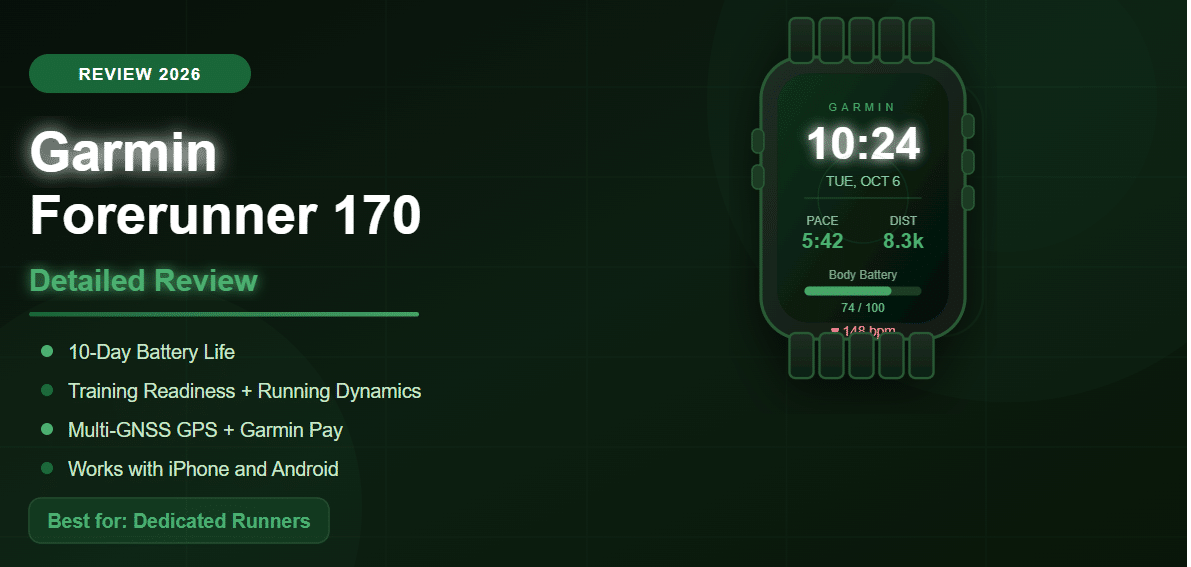
Garmin Forerunner 170 Review


Who Is the Garmin Forerunner 170 For?
Before anything else, it helps to understand what kind of runner this watch is designed around.
The Forerunner 170 is built for someone who runs three to five times a week, wants to get better at it, and needs a watch that can tell them whether today is a good day to push hard or a day to take it easy.
It handles the analytics side seriously.
It does not pretend to be a triathlon watch or a hiking computer.
If you are training for your first 5K, your third half marathon, or simply want to understand your fitness in a way a basic fitness tracker cannot offer, this watch was designed for your kind of running.
Design and Build Quality
The Forerunner 170 is a 43mm watch in a fibre-reinforced polymer case.
At around 41 to 43 grams depending on the band, it is light enough to forget you are wearing it during a long run.
The profile is slim: 11.9mm thick, which means it slides under a jacket sleeve without snagging.
Garmin kept the five-button layout that Forerunner users are familiar with: two buttons on the left side for back and laps, three on the right for up, down, and select.
The touchscreen works well in dry conditions and remains usable in light rain, though heavy rain occasionally registers false touches mid-run.
The five physical buttons mean you can navigate everything without relying on the touch layer, which matters when your hands are cold or sweaty.
The case uses chemically strengthened glass over the display.
It handles everyday wear without issues, though it will scratch faster than sapphire crystal alternatives found on pricier Garmins.
The silicone band is comfortable and uses a standard 20mm quick-release pin, so swapping it is straightforward and inexpensive.
The Forerunner 170 comes in four colours on the Music edition: Black/Amp Yellow, Whitestone/Cloud Blue, Teal, and Red Pink.
The standard model offers Black and Whitestone.
Layla, a teacher who runs after school three times a week, found the Whitestone/Cloud Blue version comfortable enough to wear straight through from morning classes to her afternoon run without it feeling out of place.
She appreciated that it looks like a watch before it looks like a tracker.
Water resistance is rated 5 ATM, meaning it handles swimming, rain, and sweat without concern. Dedicated swim tracking is included.
Display

The 1.2-inch AMOLED display runs at 390×390 pixels with a peak brightness of around 1,500 nits.
It reads clearly in direct sunlight, which is the one test that matters most for a running watch.
Colours are vivid, and text is sharp.
The Garmin interface uses high-contrast layouts that are readable at a glance during a run, which is exactly what you need when you are checking pace without breaking stride.
The always-on display mode is available but comes at a cost: with it active, battery life drops from 10 days to roughly 3.5 to 4 days.
Most runners keep the screen in raise-to-wake mode and never miss the always-on setting.
Battery Life

Garmin rates the Forerunner 170 at 10 days in smartwatch mode.
Real-world testing from The Run Testers, who ran it with daily health tracking active and three to four GPS sessions per week, confirmed this holds reasonably well with the screen in raise-to-wake mode.
With the always-on display enabled, expect 3.5 to 4 days. With GPS active for running, the watch runs for up to 20 hours in GPS-only mode and up to 14 hours in All-Systems GNSS mode (using every satellite network simultaneously for maximum accuracy).
The Music edition drains faster during active music playback: expect around 7.5 hours of GPS plus music combined.
For most runners doing 30- to 60-minute runs daily, the 10-day rating translates to roughly 6 to 8 days of real use before charging.
That is a clear advantage over smartwatches that require nightly charging.
One honest note: competitors at a similar price point, including the Coros Pace 4, offer longer battery life.
The Forerunner 170 trades some of that battery runway for the brighter AMOLED display and smart features.
GPS Performance
The Forerunner 170 uses Garmin’s Multi-GNSS system: GPS, GLONASS, Galileo, BeiDou, and QZSS in single-frequency mode. The important qualifier is single-frequency.
It does not have multi-band GPS, which is the technology found on higher-end Garmins and some competitor watches.
In practice, single-frequency GPS performs excellently on roads, tracks, and open trails. Testing from multiple reviewers, including The Run Testers who compared it against the Forerunner 970 and Coros Pace 4, found accuracy within a few meters on standard routes.
For most running conditions, the difference between single-band and multi-band GPS is not meaningful.
Where it matters is in dense urban environments with tall buildings, or under heavy tree cover, where satellite signals bounce unpredictably.
In those conditions, a multi-band watch will track more cleanly. If you run regular city loops through skyscraper corridors, that is worth knowing.
If you run suburban roads, parks, or trails, it will not affect you.
Heart Rate Accuracy

The Forerunner 170 uses Garmin’s Elevate Gen 4 optical sensor.
This is not the latest hardware: Garmin’s Forerunner 570 and higher models carry the newer Gen 5 sensor.
In real-world testing, the Gen 4 sensor performs reliably during steady-state runs and moderate tempo sessions.
It matched chest strap readings closely under normal conditions across multiple weeks of testing.
The gap appears during high-intensity interval training, where the optical sensor responds slightly slower than a chest strap due to the physics of wrist-based optical reading.
For runners who do intervals or track workouts regularly and want precise heart rate at peak intensity, pairing the watch with an external ANT+ or Bluetooth heart rate strap solves the limitation entirely.
The Forerunner 170 supports both ANT+ and Bluetooth chest straps and footpods natively.
If heart rate accuracy during high-intensity sessions is your main concern, our guide to the best heart rate monitor watches covers dedicated options across every budget.
Training Features
This is where the Forerunner 170 earns its place in the lineup.
Garmin gave it training tools that were not available on any sub-$300 Garmin watch before the 170.
Training Readiness
Training Readiness is a daily score from 0 to 100 that tells you how prepared your body is for a hard workout.
It draws from four inputs: sleep quality from the previous night, your heart rate variability trend, your recent training load, and your current stress level.
A score above 70 means your body is in a good state to push.
Below 40 means a recovery run or rest day would serve you better.
For runners who train by feel and regularly overtrain or undertrain without realising it, Training Readiness provides a concrete signal that removes guesswork.
Training Status
Training Status looks at your fitness trend over time.
It classifies your current state as Peaking, Productive, Maintaining, Recovering, Unproductive, or Detraining based on your training load and VO2 Max trend.
Seeing “Unproductive” on the watch face two weeks before a race is exactly the kind of signal that prompts a runner to adjust their plan before the damage is done.
Quick Workout
Quick Workout generates a running session on the watch itself based on how much time you have and what intensity you want to work at.
Tell it you have 45 minutes and want a moderate effort, and it builds a structured workout around your current fitness level.
This is genuinely useful on days when you have limited time and no plan loaded.
Running Dynamics
The Forerunner 170 tracks wrist-based Running Dynamics without any additional accessories.
This includes cadence, stride length, and vertical oscillation. Cadence, the number of steps per minute, is one of the most actionable metrics in running: most coaches recommend 170 to 180 steps per minute as a target range for injury reduction and efficiency.
Research published by the American College of Sports Medicine supports cadence monitoring as part of form-based injury prevention programs. Seeing your live cadence during a run lets you make real-time adjustments.
Vertical oscillation measures how much you bounce with each step.
A lower number generally means more efficient running form.
These are metrics that running coaches use during gait analysis; having them available on a $300 watch is notable.
Garmin Coach
Garmin Coach provides free structured training plans that sync directly to the watch.
You set a goal distance (5K, 10K, half marathon) and a target date, and the plan adjusts based on your current fitness and available training days.
Every scheduled workout appears on the watch automatically.
For a runner following a goal race plan, this replaces the need for a separate running app entirely.
Garmin Cycling Coach
New on the 170 compared to the 165, Garmin Cycling Coach adds structured cycling workouts with power-meter support via ANT+.
For runners who cross-train on the bike, this adds meaningful functionality without needing a separate cycling computer.
Body Battery
Body Battery is Garmin’s energy reserve score, running from 0 to 100 throughout the day.
It factors in sleep, HRV, stress, and activity to give you a running estimate of how much energy you have left.
A Body Battery of 30 at 3 pm means a hard evening run is likely to feel harder than usual.
It works alongside Training Readiness rather than replacing it.
Health Tracking
The Forerunner 170 tracks continuous heart rate, SpO2 throughout the day and during sleep, stress monitoring, skin temperature via the barometric thermometer sensor, and sleep stages including light, deep, REM, and awake time.
Sleep Coach provides specific suggestions for improving sleep quality based on your patterns.
Sleep Score gives a simple daily number with supporting detail on what affected it.
Women’s health tracking covers menstrual cycle logging with temperature data from the wrist sensor, which the Forerunner 70 does not offer.
Pregnancy tracking is also included.
One clear limitation: there is no ECG for irregular heart rhythm detection, no blood pressure monitoring, and no galvanic skin response sensor.
These are health monitoring tools found on smartwatches like the Pixel Watch 5 and Samsung Galaxy Watch.
The Forerunner 170 is not that kind of watch. It tracks fitness and recovery health; it is not a clinical health monitor.
Smart Features
Garmin Pay
Garmin Pay works via NFC for contactless payments at any terminal that accepts them.
Setup requires adding your card through the Garmin Connect app.
Not all banks and cards are supported, so checking compatibility before relying on it is recommended.
Music (Music Edition Only)
The Music Edition adds 4GB of internal storage for offline music, which holds approximately 500 to 800 songs.
Spotify, Amazon Music, and Deezer are supported for playlist sync over Wi-Fi.
Personal MP3 and M4A files load via Garmin Express on a desktop computer. Apple Music is not supported.
One important note on setup: music syncs over Wi-Fi, not Bluetooth.
The sync is faster over Wi-Fi, but the Music edition does require Wi-Fi access, which the standard model does not.
Pairing Bluetooth headphones works straightforwardly through the watch settings.
Battery life during GPS runs with active music playback is around 7.5 hours, a meaningful reduction from the GPS-only figure.
Runners who run over two hours regularly with music should be aware of this.
Notifications
Calls, texts, and app notifications mirror from your phone.
The notification system works reliably but is not interactive beyond dismissal. You cannot reply to messages from the watch.
LiveTrack and Safety Features
LiveTrack shares your real-time location with contacts during a run, accessible through a browser link without requiring them to install any app.
Incident Detection uses the watch’s sensors to identify a potential fall or collision and automatically sends an alert with your GPS location to emergency contacts.
These are genuinely useful features for solo runners, particularly on trails.
Connect IQ
The Connect IQ app store offers third-party watch faces, data fields, and basic apps. The selection is smaller than Google Play or Samsung’s Galaxy Store, but the core functionality most runners need is available natively without needing third-party apps.
Forerunner 170 vs. Forerunner 165: Is It Worth the Upgrade?
If you already own a Forerunner 165, the case for upgrading is limited.
The hardware is nearly identical: same 43mm case, same 1.2-inch AMOLED display, same single-frequency GPS, and the same Gen 4 heart rate sensor. Battery life is comparable at 10 to 11 days.
What the 170 adds over the 165: Training Readiness, full Training Status, Quick Workout, Garmin Cycling Coach, power-meter support, Garmin Pay, a compass, and gyroscope sensors.
The updated operating system also brings a more polished interface with new widgets including Health Status, Sleep Coach, and Lifestyle Logging.
For a new buyer choosing between a discounted Forerunner 165 and a full-price 170, the training tools justify the price difference if you follow a structured plan.
For an existing 165 owner, upgrading for the training metrics alone is a harder sell.
Forerunner 170 vs. Forerunner 570: When to Step Up
The Forerunner 570 is the next model up in Garmin’s 2026 lineup.
It adds multi-band GPS, the newer Elevate Gen 5 heart rate sensor, a speaker and microphone for phone calls and voice commands, a larger display option, full offline maps with turn-by-turn navigation, and ClimbPro for real-time gradient analysis on climbs.
The Forerunner 170 matches the 570 on training software: Training Readiness, Training Status, Quick Workout, Running Dynamics, and Garmin Coach are all present on both.
The step up to the 570 makes sense for trail runners who need maps, urban runners who need multi-band GPS for accuracy, and athletes who want on-wrist navigation.
For road runners focused on training load and performance data, the 170 provides the same intelligence at a lower price.
Who Should Buy the Garmin Forerunner 170
The Forerunner 170 makes the most sense for:
- Runners training for a goal race who want structured guidance without managing a separate training app.
- People upgrading from a basic fitness tracker and ready for real running data.
- Athletes who cross-train on the bike and want cycling metrics on the same device.
- Runners who want a week-plus battery life and cannot tolerate daily charging.
- Anyone who wants Garmin Pay and NFC payments on a running watch under $350.
- Women who want skin temperature-based cycle tracking that the cheaper Forerunner 70 does not offer.
Who Should NOT Buy the Garmin Forerunner 170
Skip the Forerunner 170 if:
- You need ECG or blood pressure monitoring. This watch does not have either.
- You run regular routes through dense city centres where multi-band GPS would make a meaningful difference.
- You train for triathlons or multi-sport events. The Forerunner 170 has no multisport mode and cannot smoothly transition between swim, bike, and run segments.
- You want offline maps or turn-by-turn navigation for trail running.
- You are an existing Forerunner 165 owner looking for a hardware upgrade. The hardware is largely the same.
- You primarily want a smartwatch with a rich app ecosystem. The Connect IQ store is limited compared to Wear OS alternatives.
Real People, Real Use Cases
Riya, 28, training for her second half marathon. She runs five days a week after work and has struggled to know when she is overtraining. Training Readiness gives her a daily signal she trusts. When it drops below 40, she runs easy. When it is above 70, she hits the tempo session. She does not need maps or ECG. The Forerunner 170 fits her training without overwhelming her with features she will never use.
Marcus, 35, runs three times a week and cycles on weekends. He wanted one device that tracked both without needing two subscriptions. Garmin Cycling Coach and power-meter support via ANT+ turned the Forerunner 170 into his daily driver across both sports. The 10-day battery means he charges once a week regardless of what he is doing.
James, a casual runner who wants to get more serious. He bought the Forerunner 170 Music edition to leave his phone at home during runs. Spotify playlists sync over Wi-Fi before he leaves the house. Bluetooth earbuds pair in seconds. He runs with no phone, no distraction, and a watch that tells him whether he pushed too hard yesterday.
Frequently Asked Questions
Does the Garmin Forerunner 170 work with iPhone?
Yes. The Forerunner 170 pairs with both Android and iOS via the Garmin Connect app. Unlike Wear OS watches, it is not limited to one mobile platform. All features including notifications, smart alerts, and training data sync work on iPhone.
Does the Garmin Forerunner 170 have music storage?
Only the Music edition has internal storage for offline music. The standard model does not. The Music edition supports Spotify, Amazon Music, and Deezer over Wi-Fi sync, plus personal MP3 and M4A files via Garmin Express.
Can I swim with the Garmin Forerunner 170?
Yes. It is rated 5 ATM, which covers pool and open water swimming comfortably. It includes dedicated pool swim and open water swim profiles with lap counting and stroke detection.
Does the Forerunner 170 have maps?
No. The Forerunner 170 supports breadcrumb trail navigation and course following, but it does not have offline topographic maps or turn-by-turn street navigation. If maps are a priority, the Forerunner 570 or higher is the right choice.
Is the Forerunner 170 good for beginners?
Yes, with a note. The watch offers more training intelligence than a beginner will use immediately. But that is a feature, not a problem: you grow into it rather than outgrowing it in six months. The interface is straightforward for daily use; the advanced training metrics reveal themselves naturally as you run more.
What is the difference between Training Readiness and Training Status?
Training Readiness is a daily score showing how prepared your body is for a hard workout today, based on last night’s sleep, HRV, and current stress. Training Status is a longer-term view of whether your overall training is building fitness, maintaining it, or heading toward overtraining. Both are on the Forerunner 170 and work together.
Does the Garmin Forerunner 170 support ANT+ accessories?
Yes. It supports ANT+ and Bluetooth heart rate straps, footpods, and power meters. This is meaningful for cyclists who already own an ANT+ power meter and want to use it with the watch.
Final Verdict
The Garmin Forerunner 170 is a well-balanced running watch that delivers training intelligence previously found only on more expensive Garmins. Training Readiness, Training Status, Running Dynamics, and Garmin Coach turn it into a genuine training partner rather than just a GPS tracker.
It is not a perfect watch. Single-frequency GPS has real limitations in urban canyons. The Gen 4 heart rate sensor is not the newest hardware Garmin offers. There is no multisport mode, no ECG, and no offline maps.
But for a runner who trains three to five times a week, wants to get better at it, and does not want to pay for features they will never use, the Forerunner 170 hits the target. It does what running watches are supposed to do: help you run smarter without getting in the way of the run itself.
Check Amazon for current price
Luis Cooper

Hi, I'm Luis, the guy behind this site. I love wearing watches, especially ones that look great on small wrists (mine are about 6.3" around). The Watches Geek is dedicated to helping you learn about and buy watches that you will love wearing. I want this website to be the last destination for people to pick the best watches to fit their needs. You can find our unbiased reviews here on Thewatchesgeek.