Last Updated on April 23, 2026 by Luis Cooper
Stress is invisible until it starts showing up in places you cannot ignore.
A short fuse with people you care about.
Sleep that leaves you more tired than when you went to bed.
A feeling of running at full speed toward nothing in particular.
What a smartwatch actually measures is not stress itself.
No sensor on your wrist can read your emotional state.
What these watches track is heart rate variability, the tiny fluctuations in time between each heartbeat.
When your nervous system is under load, whether from a deadline, a difficult conversation, poor sleep, or physical exertion, those intervals become less variable.
The gaps between beats even out.
The watch notices this pattern and translates it into a stress score you can read on your wrist.
That number is not a diagnosis.
It is a signal. Used correctly, it shows you patterns across days and weeks that you would never catch by feel alone.
A busy Monday might not register as stressful in the moment, but if your HRV has been trending downward for ten days straight, your body has been keeping score even when your mind was not.
The watches on this list were chosen because they measure this reliably, explain what the data means, and give you something practical to do with it.
Some have guided breathing sessions built in. Some track the relationship between sleep quality and next-day stress.
Some catch acute stress spikes in real time during your workday.
Every watch on this list has been reviewed by people who wore them daily and compared their readings against clinical-grade trackers.
That real-world testing matters more than spec sheets when it comes to the health data you are going to make decisions based on.
Which are the Best Smartwatches for Monitoring Stress?
Here are my recommended top 10 Best Smartwatches for Monitoring Stress:-


![Samsung Galaxy Watch 8 40mm Bluetooth Smartwatch, Cushion Design, Quick Button, Sleep Coaching, Now Bar, Running Coach, Energy Score, Graphite [US Version, Amazon Exclusive 2Yr Warranty]](https://m.media-amazon.com/images/I/41pVUmtVzHL._SL160_.jpg)


![Apple Watch Ultra 2 [GPS + Cellular 49mm] Smartwatch with Rugged Titanium Case & Blue/Black Trail Loop S/M. Fitness Tracker, Precision GPS, Action Button, Extra-Long Battery Life](https://m.media-amazon.com/images/I/41ZpqNIND6L._SL160_.jpg)

Amazfit Active 2: (Best Budget Smartwatch for Stress Monitoring)

A freelance writer who started tracking her stress after a burnout episode described the moment she realised the watch was actually useful.
She had been thinking she was managing well, sleeping reasonably, and staying on top of work.
The readiness score on her watch disagreed.
It had been flagging elevated stress for five days in a row.
She looked back at the week and realised she had been running on adrenaline, not recovery.
The watch caught what she had rationalised her way past.
The Amazfit Active 2 launched at the start of 2025 and immediately drew attention from reviewers who expected to find corners cut at this price point.
How the Stress Tracking Works:
The Active 2 monitors stress continuously through the day using heart rate and HRV data from the optical sensor on the back of the case.
A stress level appears on the watch face and in the Zepp app, and you can see how it has shifted across the day in graph form.
The app also runs a readiness score each morning that pulls together the previous night’s HRV data, resting heart rate, skin temperature, and sleep quality to tell you how prepared your body actually is for the day’s demands.
One reviewer who wore the Active 2 alongside a premium ring tracker for six months noted that the readiness scores aligned on most days, occasionally running slightly higher on the watch than on the ring.
That mild tendency toward optimism is worth knowing.
The data is directional rather than clinical.
Trend lines across a week tell a more honest story than a single day’s number.
The one-tap health snapshot is a standout convenience feature.
A single press reads SpO2, heart rate, breath rate, and stress simultaneously in under a minute.
For someone who wants a quick read on how their body is doing without navigating through menus, this is genuinely useful and not a feature you typically find at this price.
What Makes it Worth Recommending Here:
The Active 2 uses a round stainless steel case design that reviewers across multiple publications specifically called out as punching far above its price in terms of feel and finish.
The AMOLED display reaches close to 1900 nits of brightness, which in practical terms means it reads clearly in direct sunlight without cupping your hand over the screen.
GPS is built in with five satellite positioning systems, which means outdoor activity tracking works without a phone.
Battery runs for approximately ten days under typical use with stress monitoring, heart rate, and SpO2 active.
Turning off continuous blood oxygen tracking extends this further.
The honest limitation is stress accuracy during movement.
As with all wrist-based optical sensors, motion introduces noise into the heart rate signal, which makes stress readings during activity less reliable than resting readings.
The most accurate data comes from overnight HRV tracking and from readings taken seated and still.
That limitation applies to every watch on this list to varying degrees, not just this one.
The Zepp app behind this watch is more capable than most first-time users expect.
Readiness, sleep stages, stress graphs, VO2 max, and training load all live in one place with actual explanatory text rather than just raw numbers.
For someone building their first relationship with HRV data, the app does a good job of explaining what the numbers mean.
Who Should Not Buy This:
If you need regulated medical-grade health monitoring rather than wellness guidance, no consumer smartwatch qualifies for that purpose.
If continuous stress tracking throughout intense exercise sessions is the primary use case, the optical sensor limitations during movement are a real concern.
And if you want NFC contactless payments as a standard feature, that requires the premium version of this watch.
Specifications:
| Feature | Details |
|---|---|
| Display | AMOLED, up to 1900 nits |
| Case | Stainless steel, round |
| Battery Life | Up to 10 days typical use |
| GPS | Five satellite positioning systems |
| Stress Features | Continuous HRV monitoring, daily readiness score, one-tap health snapshot, stress trend graph |
| Health Sensors | Heart rate, SpO2, skin temperature, breath rate |
| Water Resistance | 5 ATM |
| Compatibility | iOS and Android |
| Sports Modes | 164 activities |
Venu 4: (Best Stress Watch for Lifestyle Logging and Health Pattern Discovery)
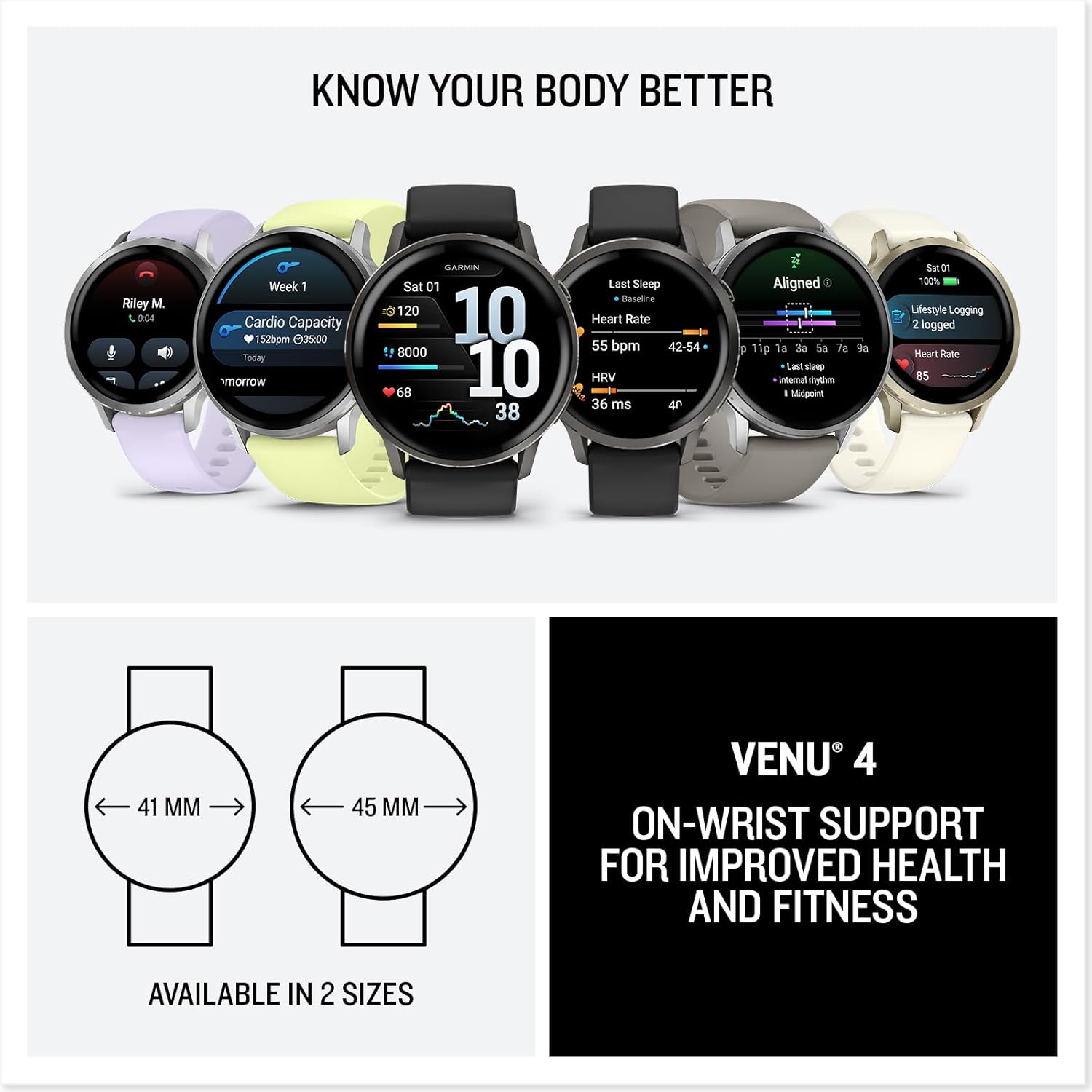
A reviewer who tested the Venu 4 for several weeks described logging his morning coffee and evening wine throughout testing, then opening the Garmin Connect app to see how those two habits were affecting his HRV, sleep quality, and next-day stress scores.
The coffee showed a modest impact.
The wine showed up clearly in suppressed overnight HRV within hours of consumption.
He wrote that he already knew wine affected sleep.
Seeing the actual numbers on a graph attached to specific evenings was a different thing entirely.
That is the specific problem the Venu 4 was built to solve.
Most stress-tracking watches tell you how you are.
The Venu 4 is increasingly focused on showing you why.
Health Status and What Makes It Different:
Health Status is the Venu 4’s signature feature and the most notable addition it brings over the Venu 3.
The system takes three to four weeks of your nightly readings across HRV, resting heart rate, SpO2, respiration, and skin temperature, and establishes a personalised baseline range for your body.
Once that baseline is set, the watch alerts you whenever your overnight readings drift outside your normal range.
The distinction from ordinary trend monitoring is that this alert fires even when you are not consciously tracking anything.
You do not need to remember to check your scores.
If something is off, the watch surfaces it.
Reviewers noted it picks up the early signatures of illness before symptoms appear, flags the impact of travel and altitude on the body, and catches overtraining patterns that gradually slip past conscious awareness.
A November 2025 firmware update extended a version of Health Status to older Garmin watches, but the most complete implementation remains on the Venu 4.
Lifestyle Logging:
Lifestyle Logging allows you to manually record specific daily events directly from the watch: caffeine consumption, alcohol, late meals, poor sleep, and time spent in stressful situations.
These entries get matched against your health metrics in Garmin Connect, which then shows you which specific behaviours are consistently associated with changes in your sleep score, Body Battery, and HRV status.
The patterns that emerge over weeks give you a personalised map of your own stress triggers that no automated sensor can produce alone.
One reviewer described the circadian rhythm Sleep Alignment feature as the element that changed her sleep most practically.
The watch analyses your natural sleep and wake times over weeks and aligns its sleep coaching recommendations to your circadian pattern rather than applying a generic target.
Consistently sleeping against your natural rhythm is a significant source of chronic stress, and seeing the data confirm what you already suspected makes the habit change easier to commit to.
Multi-Band GPS and Elevate 5 Sensor:
Multi-band dual-frequency GPS in the Venu 4 is a genuine upgrade over the Venu 3’s single-band positioning.
Route traces in dense urban environments and under heavy tree cover held tight in testing, matching the accuracy of significantly more expensive watches.
For the stress tracking use case, accurate outdoor activity tracking means the watch correctly attributes physical exertion as a positive recovery stimulus rather than mischaracterising it as a stress event, which produces cleaner Body Battery calculations.
Battery runs to approximately six days in realistic mixed use with daily GPS activity and the always-on display off.
Turning the always-on display on drops this to around four days.
Specifications:
| Feature | Details |
|---|---|
| Display | AMOLED, 1.4 inch (45mm) or 1.2 inch (41mm) |
| Battery | Up to 12 days rated, approximately 6 days mixed real use |
| GPS | Multi-band dual-frequency |
| Stress Features | Body Battery, continuous HRV, Health Status baseline monitoring, Lifestyle Logging, guided breathing, Sleep Alignment, circadian rhythm coaching, nap detection |
| Health Sensors | Elevate 5, SpO2, skin temperature, ECG |
| Water Resistance | 5 ATM |
| Compatibility | iOS and Android |
Google Pixel Watch 4: (Best Stress Watch for Android Users)

An Android user who reviewed the Pixel Watch 4 after spending four years rotating through fitness trackers described the experience of finally having a health watch that did not feel like a workaround.
Previous options required installing third-party apps to access meaningful data, or accepting that Google’s ecosystem would not talk to them properly.
The Pixel Watch 4 resolved both problems in a single device.
cEDA and What Makes the Stress Approach Different:
The Pixel Watch 4 uses a continuous electrodermal activity sensor alongside HRV for stress detection.
Electrodermal activity measures small changes in the skin’s electrical conductance caused by sweat gland activity, which is controlled by the autonomic nervous system.
When your stress response activates, sweating increases at a measurable level before it becomes visible, and the cEDA sensor picks this up.
Combined with HRV data, this produces stress readings that draw on two independent physiological signals rather than one alone.
Wareable’s review noted that while the cEDA approach is technically interesting, the system’s actionability lags behind competitors who have developed richer stress response guidance over more years of software iteration.
The raw data is there, and the readings are consistent.
What the platform is still building is the layer of interpretation and recommendation that turns a stress reading into a behaviour change.
If you compare it to dedicated recovery platforms that have iterated on HRV insight delivery for a decade, the gap is visible.
For casual users managing everyday wellness rather than performance recovery, the current implementation is sufficient.
Gemini and Sleep:
The Pixel Watch 4 runs Wear OS with Gemini AI integrated as the default assistant.
Within the health context, this means you can ask the watch conversational questions about your sleep data, your stress trends, or your readiness score in natural language rather than navigating menus.
For users who find data dashboards overwhelming, the ability to simply ask what their sleep score means and receive an explanatory answer changes how accessible the information feels.
Sleep tracking accuracy sat close to clinical reference devices in independent testing, with only a few minutes difference in total sleep time across reviewers who tested it against premium sleep trackers.
Sleep stage tracking showed some variation, which is expected given the algorithmic differences between different devices.
As with all watches on this list, trends across weeks are more informative than individual night accuracy.
Battery life runs to approximately 24 hours on the 41mm model and up to 40 hours on the 45mm model with mixed use, including the always-on display.
This is better than previous Pixel Watch generations, but still requires daily charging for most users, which interrupts the overnight HRV tracking that these watches do best.
Specifications:
| Feature | Details |
|---|---|
| Display | AMOLED Actua 360 domed, 3000 nits, 10% larger than previous generation |
| Battery | 30 hours (41mm), up to 40 hours (45mm) mixed use |
| GPS | Dual-band dual-frequency |
| Stress Features | cEDA continuous electrodermal activity, HRV, guided breathing, readiness score, sleep score |
| Sensors | Heart rate, SpO2, ECG, skin temperature, cEDA |
| Compatibility | Android only |
| Water Resistance | 5 ATM, IP68 |
Garmin Venu 3: (Best Overall Stress Tracking Smartwatch)

A fitness writer who wore the Venu 3 for thirty consecutive days kept a daily log of his Body Battery readings alongside his actual energy levels each morning.
On day twelve, he woke up to a Body Battery score of 38, unusually low for him.
The watch flagged elevated overnight stress and suggested lighter activity.
He pushed through an intense training session anyway.
By noon, he was exhausted, and his productivity had dropped noticeably.
The following week, when the same pattern appeared, he listened and chose yoga instead.
The difference, he wrote, was remarkable.
That willingness to follow the data takes time to develop, and the Venu 3 builds it by giving you enough context to understand what the numbers actually mean.
Body Battery and What Sets It Apart:
Body Battery is Garmin’s proprietary energy tracking system, and the Venu 3 version is more communicative than previous generations.
Rather than just showing a number between 5 and 100, it now tells you exactly what influenced the score.
Swipe up, and you see a breakdown: this workout cost you 18 points, poor sleep quality cost you another 12, and a stressful afternoon call took a further 8.
That specificity changes how you respond to the data.
The watch runs all-day HRV monitoring, a feature previously reserved for Garmin’s more expensive outdoor and performance watches.
Overnight HRV feeds into your morning HRV Status, which rates whether your baseline variability is balanced, low, or unbalanced based on your personal five-week rolling average.
This trend matters far more than any single night’s number.
Sleep Coach and Nap Detection:
The Sleep Coach gives personalised recommendations for how many hours you need based on your recent training load and recovery data.
It adjusts this recommendation dynamically, so heavy training weeks prompt longer sleep suggestions, and lighter weeks scale it back.
In one documented case, a reviewer found the watch recommended 8.5 hours during a hard training block and noticed measurably improved recovery scores when they followed it.
Automatic nap detection logs rest periods from five minutes upward and factors them into your recovery data.
Afternoon naps that genuinely helped recovery show up as positive contributions to Body Battery rather than lost time.
This makes the watch’s picture of your day more complete than devices that only track nighttime sleep.
The guided breathing exercises respond to detected stress elevation. When the watch sees your stress score rising over a period of time, it prompts a breathing session.
Multiple reviewers noted that the three-minute guided sessions produced a measurable drop in their stress score afterward, typically between 8 and 12 points.
For the watch to be most accurate on overnight HRV, it needs to be worn consistently during sleep, which the slim 45mm case and lightweight construction make comfortable enough to sustain.
Who Should Not Buy This
If offline music storage matters to you, this watch supports it through Spotify, Deezer, and Amazon Music subscriptions.
If you want a thinner profile for formal occasions, the 45mm case at 12.4mm thick is noticeable under shirt cuffs.
And if your primary goal is high-performance running analytics rather than stress and wellness monitoring, Garmin’s Forerunner line is more purpose-built for that use case.
Specifications:
| Feature | Details |
|---|---|
| Display | AMOLED 1.4 inch (45mm) or 1.2 inch (41mm) |
| Battery | Up to 14 days smartwatch, 20 hours GPS |
| Stress Features | Continuous HRV, Body Battery with event breakdown, stress score, guided breathing, Sleep Coach, nap detection, Morning Report |
| Sensors | Elevate Gen 5, SpO2, skin temperature, pulse ox |
| Water Resistance | 5 ATM |
| GPS | Yes, standard single-band |
| Weight | 47g (45mm) |
Apple Ultra 2: (Best Stress Watch for iPhone Users in Demanding Environments)

A surgeon who wore the Apple Watch Ultra 2 through both twelve-hour operating days and weekend ultra trail runs described it as the only watch that did not create a decision point in either context.
She did not need to take it off at the scrub sink.
She did not worry about it during a river crossing on a trail.
She did not think about the battery mid-race.
The watch simply continued collecting data through all of it, and that uninterrupted data stream was what made its stress and recovery insights trustworthy.
Stress Tracking Through the Health Ecosystem:
Apple Watch’s stress monitoring works through the combination of heart rate, HRV, respiratory rate, and blood oxygen data fed into the Mindfulness app and the broader Health ecosystem on iPhone.
The watch does not produce a single stress score in the way that Garmin’s Body Battery does.
Instead, it provides the underlying metrics and surfaces patterns through the Health app’s trends view and through Mindfulness session history.
This approach suits users who want to see their own raw data and draw conclusions from it.
It suits people who want the watch to synthesise a single daily number and tell them what to do less well.
If you fall into the second camp, Garmin’s platform is more prescriptive, and the Venu 3 earlier on this list is likely the better fit.
The Apple Watch Ultra 2’s optical heart rate sensor has been evaluated in independent testing as among the most accurate wrist-based sensors available.
During steady-state activities, the accuracy holds close to chest strap measurements.
During high-intensity interval work with rapid heart rate changes, all optical wrist sensors lag slightly on the recovery side of intervals, and this one is no exception.
Battery and Durability for Uninterrupted Tracking:
Battery life on the Ultra 2 reaches 36 hours in standard use and extends to 60 hours in low-power mode.
For a stress tracking watch, continuous overnight wearing without charging anxiety is the practical advantage.
The 49mm titanium case with 100-metre water resistance handles immersion, ocean water, and surgical scrubbing without any adjustment to how you wear it.
The Action Button is a hardware shortcut you can assign to open the Mindfulness app directly, start a breathing session, or begin a workout.
For stress management use, this means a two-second press can start a guided breathing session rather than navigating through menus.
In high-stress moments when you actually need the feature, that friction reduction matters.
Retrospective Heart Rate Notifications alert you when your heart rate remains elevated while you have been inactive, which is a passive stress detection mechanism that works without any conscious interaction with the watch.
If you have been sedentary and your heart rate stays high, the watch notices and tells you.
Who Should Not Buy This
This watch works only within the Apple ecosystem.
Android users should look at the Pixel Watch 4 instead.
If you want a detailed single daily wellness score that synthesises all your data into one actionable number, Garmin’s Body Battery system does this more directly.
And if the large 49mm case size feels too prominent for your daily wear context, the standard Apple Watch Series 11 provides the same core health platform in a considerably smaller case.
Specifications:
| Feature | Details |
|---|---|
| Case | 49mm titanium |
| Display | Always-On Retina LTPO, 3000 nits |
| Battery | 36 hours standard, 60 hours low power mode |
| Water Resistance | 100m, EN13319 diving certified |
| Stress Features | HRV, heart rate, respiratory rate, Mindfulness app, guided breathing, retrospective heart rate notifications |
| Health Sensors | ECG, blood oxygen, skin temperature, crash, and fall detection |
| Compatibility | iPhone only |
Garmin Vívoactive 5: (Best Stress Watch for First-Time HRV Users)

A woman managing a thyroid condition described wearing the Vivoactive 5 for over two years and still reaching for it every morning.
What kept her was not GPS accuracy or workout tracking.
It was the HRV data.
She could see in the numbers how her body responded to stress, to food choices, to disrupted sleep, and to treatment adjustments in ways that felt invisible before the watch made them visible.
Her HRV had improved steadily across those two years.
She could see the line moving upward in Garmin Connect.
That is a different relationship with health data than most smartwatches create.
What Body Battery Teaches You Over Time:
The Vivoactive 5 carries the same Body Battery system as the Venu 3.
What differs is the price and the build.
The Vivoactive 5 comes in lighter and slimmer, at 36 grams and 11.1mm thick, which makes it the watch on this list that disappears most completely on the wrist during all-day and overnight wear.
That comfort makes consistent wearing more likely, and consistent wearing is exactly what produces accurate HRV trend data.
The Health Snapshot feature takes a two-minute reading that measures average heart rate, HRV, stress, SpO2, and respiration simultaneously.
This reading can be shared directly with a healthcare professional, which is practically useful for people managing conditions where these metrics matter to their doctor. No other watch at this price point makes the data this transferable.
HRV tracking begins collecting baseline data from day one and builds meaningful trend insights after approximately 19 nights of overnight readings.
The first three weeks of data should be treated as calibration rather than conclusions. Once the baseline is established, deviations become genuinely informative.
What It Does Not Have:
No altimeter means no floor counting and no elevation data.
This is the trade-off Garmin made to keep the watch slim and the price reasonable.
Reviewers who primarily walk and run in flat environments report never missing it.
Trail runners and hikers who need elevation data should step up to the Forerunner or Fenix lineup instead.
No ECG capability.
The Elevate V4 optical sensor lacks the hardware required for electrocardiogram recording.
Stress and HRV tracking work well through the optical sensor in resting and sleep conditions, but if ECG is on your requirements list, other options on this list provide it.
Battery reaches around five to six days in real mixed use with daily GPS activity, not the eleven days the spec sheet claims.
That figure assumes minimal GPS and no always-on display.
For a stress tracking watch where overnight sleep data matters, charging every four to five days is the realistic expectation.
Who Should Not Buy This
Trail runners and outdoor enthusiasts who need altitude data and topographic context during activities will find the missing altimeter a significant limitation.
If you want ECG capability, this watch cannot provide it.
And if offline music storage is part of your daily workout routine, the Vivoactive 5 supports it via streaming apps, which requires the subscription.
Specifications:
| Feature | Details |
|---|---|
| Display | AMOLED 1.2 inch |
| Battery | Up to 11 days rated, 5 to 6 days real use with GPS |
| Weight | 36g |
| Thickness | 11.1mm |
| Stress Features | Body Battery, continuous HRV, stress monitoring, guided breathing, Sleep Coach, nap detection, Health Snapshot |
| Water Resistance | 5 ATM |
| Sports Modes | 30 plus |
Galaxy Watch 8: (Best Stress Watch for Android Users Who Want AI-Driven Insights)

An executive who managed a team across multiple time zones described what changed after three months of wearing the Watch 8 consistently.
She had always known travel and deadline weeks were stressful.
What she had not known was how specifically the vascular load data revealed which parts of those weeks were costing her the most recovery.
A particular type of late-night video call, regardless of content, showed up as an elevated vascular load every time.
Changing the timing of those calls by two hours produced a measurable change in her sleep recovery score within two weeks.
That granularity of insight is what the Watch 8 is built around.
Vascular Load and Antioxidant Index:
The Galaxy Watch 8 introduced two health features that no other mainstream smartwatch currently offers.
Vascular load monitoring tracks the cumulative stress placed on the cardiovascular system during sleep by measuring the interplay between HRV, heart rate, and sympathetic nervous system activity.
When the body is in restorative sleep, all three are reduced.
When sleep is disrupted by stress, alcohol, temperature, or illness, vascular load rises, and the watch quantifies how much.
The Antioxidant Index measures the body’s ability to neutralise oxidative stress using the BioActive sensor.
It is improved by consistent exercise, better sleep quality, and stress reduction, which means the metric reflects lifestyle choices over time rather than just today’s reading.
Seeing this score move over weeks gives you a longer-horizon view of whether your stress management habits are working.
The AI-powered Energy Score combines physical and mental health metrics to produce a daily vitality indicator that goes beyond the simple readiness scores on most wellness watches.
Gemini AI, integrated into Wear OS 6 on the Watch 8, allows conversational queries about your health data through natural language, the same capability available on the Pixel Watch 4.
High Stress Alerts and Mindfulness Tracker:
High Stress Alerts notify you when the watch detects sustained elevated stress during the day, prompting a guided breathing session.
The Mindfulness Tracker allows mood logging alongside the physiological data, pairing subjective experience with objective measurement.
Over time, comparing mood entries against HRV and stress score patterns reveals which life situations genuinely affect your nervous system versus which ones feel stressful but are not showing up in the body.
Sleep apnea detection is FDA-authorised on the Watch 8, monitoring oxygen saturation dips that indicate moderate to severe obstructive sleep apnea.
For stress management purposes, this matters because untreated sleep apnea is a major driver of chronically elevated HRV suppression and next-day cortisol, meaning it masks stress monitoring data and prevents meaningful recovery.
Having this screen built in serves people who have never been formally assessed.
For anyone tracking the relationship between heart health and stress over time, the broader context of how smartwatches measure these metrics is covered rigorously in a published study in the journal Sensors, which evaluated multiple HRV monitoring approaches across clinical and consumer-grade devices.
The full research is available at ncbi.nlm.nih.gov/pmc/articles/PMC10490434.
Specifications:
| Feature | Details |
|---|---|
| Display | AMOLED 1.5 inch (44mm) |
| Battery | Up to 40 hours standard |
| GPS | Dual-band dual-frequency L1 and L5 |
| Stress Features | HRV, vascular load monitoring, Antioxidant Index, AI Energy Score, High Stress Alerts, Mindfulness Tracker, guided breathing |
| Health Sensors | ECG, BioActive sensor, SpO2, skin temperature, bioelectrical impedance |
| Sleep Features | Sleep apnea detection FDA-authorised, Bedtime Guidance, sleep stages, vascular load during sleep |
| Water Resistance | 5 ATM, IP68, MIL-STD-810H |
Suunto 9 Peak Pro: (Best Stress Watch for Endurance Athletes)

Battery Designed Around Multi-Day Use:
The Suunto 9 Peak Pro delivers up to 40 hours of continuous GPS tracking in the most accurate mode, and up to 300 hours in the most power-efficient setting.
For an endurance athlete whose stress management is inseparable from training load management, a watch that can cover an Ironman, a multi-day trail event, or an open-water expedition without dying mid-race is categorically different from one that needs charging every day.
Stress monitoring uses heart rate variability captured continuously, feeding into recovery insights that tell you how adapted your body is to recent training.
The watch tracks your personal HRV baseline over time and flags days where your recovery is lagging behind your planned workload.
For an athlete alternating heavy and light training days, this information shapes session intensity decisions more reliably than subjective self-assessment.
Sleep and Recovery Together:
Sleep tracking covers stages, duration, and quality with Suunto’s recovery analysis overlaid.
The watch does not have the same depth of sleep coaching as Garmin’s dedicated wellness line, but for athletes whose primary concern is whether their body has recovered from physical stress rather than psychological stress, the overnight HRV data and recovery time recommendations cover the essential ground.
Altitude tracking via barometric altimeter and atmospheric pressure trend monitoring adds a layer of environmental context that pure wellness watches miss.
Training in changing weather, at altitude, or across multiple time zones creates physiological stress that most watches cannot contextualise.
The Suunto measures all of these environmental factors and their effect on your body simultaneously.
Build quality is certified to US military standard 810G covering shock, thermal extremes, and vibration.
The sapphire lens resists the kind of daily contact scratching that accumulates on mineral glass over months of outdoor use.
Water resistance reaches 100 metres.
For athletes who use their watch in genuinely demanding conditions, the construction matches the activity demands rather than simply tolerating them.
Who Should Not Buy This
If you are a casual user who wants a wellness watch for office and daily life, the Suunto’s depth and complexity will likely feel like more than you need.
If guided breathing sessions and mood logging are important parts of how you manage stress, Garmin’s and Samsung’s platforms offer more interactive stress management tools.
And if battery life beyond three days is not a priority for your use case, there are options on this list that deliver more daily smartwatch polish at a lower cost.
For a broader look at how high-performance watches handle the combined demands of hiking, endurance sport, and health tracking together, the comparison at best-smartwatches-for-hiking covers this intersection in detail.
Specifications:
| Feature | Details |
|---|---|
| Display | 1.43 inch MIP transflective |
| Battery GPS | Up to 40 hours maximum accuracy, up to 300 hours tour mode |
| Water Resistance | 100m |
| Crystal | Sapphire |
| Build | Military MIL-STD-810G |
| Stress Features | Continuous HRV, recovery analysis, sleep tracking, training load status |
| Sensors | Barometric altimeter, compass, GPS and GLONASS |
Fitbit Charge 6: (Best Stress Watch for Simplicity and Everyday Wear)

A primary school teacher described Charge 6 as the watch she finally stopped taking off.
Previous smartwatches felt like a second job. Checking data meant opening apps, navigating dashboards, and trying to interpret numbers that never quite explained themselves.
The Charge 6 showed her three things each morning: readiness, sleep score, and stress management level.
She understood all three immediately.
She acted on them daily.
That simplicity is not a compromise.
For the majority of people who want to manage stress without becoming data analysts, it is exactly the right approach.
Daily Readiness and Stress Management Score:
Fitbit’s Daily Readiness Score synthesises overnight HRV, recent activity level, and sleep quality into a score between 1 and 100 that tells you whether to push, maintain, or recover.
This score has been refined across many years of Fitbit’s platform development and remains one of the clearest single-number wellness indicators available on a consumer smartwatch.
The Stress Management Score goes a step further, measuring six factors: exertion balance, sleep patterns, heart rate variability, responsiveness, and resting heart rate, combining them into a score that reflects how your body is coping with its total stress load rather than any single session.
Unlike raw HRV numbers, which require interpretation, this score reads as a meaningful signal from the first day you wear the watch.
Body Response detection identifies moments during the day when your heart rate, HRV, skin conductance, and other signals suggest a stress response is happening.
The watch buzzes gently to notify you, then asks whether you want to start a breathing exercise or simply acknowledge the alert.
This passive stress detection during the day is more consistent than manually checking a score, because stress rarely announces itself at a convenient moment.
EDA Scan and Physical Wellness:
The Charge 6 includes an EDA scan feature that requires you to hold your fingers on the watch face for a two-minute mindfulness session.
The watch detects small electrodermal activity changes during the session and produces a graph showing your stress response during the breathing exercise.
Seeing your own physiological response to a breathing session makes the practice feel concrete rather than abstract, and reviewers who used it regularly reported that the sessions became easier to commit to because the feedback was immediate and visible.
For people who want to leave the phone behind, any Garmin on this list is better equipped.
The slim 22mm by 36mm form factor means this watch is genuinely unobtrusive, fitting under shirt cuffs and fading from awareness during daily wear in a way that 44mm round watches simply cannot match.
Who Should Not Buy This:
If GPS-independent outdoor tracking is a priority, this watch relies on phone GPS and is not the right choice.
If you want a full app ecosystem on your wrist, a round watch with Wear OS or watchOS covers that need.
And if you train seriously and want the deep running metrics, training load analysis, and recovery time calculations that Garmin builds for performance athletes, the Charge 6 is focused on wellness rather than performance training.
Specifications:
| Feature | Details |
|---|---|
| Form Factor | Fitness tracker, 22mm x 36mm |
| Battery | Up to 7 days |
| GPS | Phone GPS (no built-in GPS) |
| Stress Features | Stress Management Score, Daily Readiness Score, Body Response detection, EDA scan mindfulness sessions, guided breathing |
| Health Sensors | Heart rate, HRV, SpO2, skin conductance, skin temperature |
| Water Resistance | 50m |
| Compatibility | iOS and Android |
Polar Vantage V3: (Best Stress Watch for Serious Athletes Who Want Clinical-Grade HRV Testing)
The Orthostatic Test and What No Other Watch Offers:
The orthostatic test is Polar’s most distinctive contribution to stress and recovery monitoring. No other mainstream smartwatch implements this test in any form. The test takes four minutes each morning. You lie still for two minutes while the watch’s wrist ECG measures your heart rate and HRV in a supine position, then stand for two more minutes while the same measurements are taken again. The difference between lying and standing HRV reveals the current state of your autonomic nervous system, including the effects of training fatigue, sleep quality, illness, and psychological stress simultaneously.
After two tests it begins comparing your results against population norms. After four tests it compares them against your own personal baseline. The longer you use it, the more precise the signal becomes. DC Rainmaker, one of the most respected technical reviewers of sports watches, noted that the Vantage V3’s overnight HRV readings aligned near-identically with Garmin, Suunto, and other wearables he tested simultaneously, confirming the sensor accuracy is genuine rather than a claimed specification.
Recovery Pro and the Cardio and Muscle Load Split:
Recovery Pro synthesises the orthostatic test results with your training history, recent session loads, and subjective recovery rating into a daily verdict on whether your cardiovascular system is ready for hard training. This is not a generalised wellness score. It is a sport-specific assessment for athletes managing structured training loads.
Polar also separates cardio load from muscle load in a way other watches do not. The Vantage V3 includes a leg recovery test where you jump in place three times and the watch analyses the movement pattern to assess neuromuscular recovery. A hard tempo run stresses your cardiovascular system. A hill sprint session stresses your muscles. These are different forms of fatigue that require different recovery inputs, and having them measured separately allows more precise training decisions.
SleepWise and Nightly Recharge:
SleepWise predicts your daytime alertness based on your recent sleep history and circadian patterns. If you have accumulated sleep debt over several nights, SleepWise shows you the projected impact on your mental performance and alertness for the coming day. This connects sleep quality directly to cognitive function rather than just physical recovery, which is particularly useful for athletes managing both training load and professional performance simultaneously.
Nightly Recharge measures the quality of your overnight autonomic recovery, with Polar’s optical HRV reading during sleep matching clinical-grade chest strap results across independent testing. The watch builds a personalised picture of what a fully recovered night looks like for your specific body.
One area to set expectations: Polar’s app, Polar Flow, is functional but less visually polished than Garmin Connect or Samsung Health. The data depth is exceptional but the presentation requires more navigation to access it. For athletes who genuinely want to engage with the detail, this is not a problem. For casual users who want quick morning readouts, the learning curve is steeper than on other watches in this list. For anyone managing training-driven stress alongside daily life, the detailed perspective on how heart rate variability connects to both forms of fatigue is covered further in the research collection at best-heart-rate-monitor-watches.
Related Articles:
Best Watches for Running and Swimming
Best Watches to Track Calories Burned
Luis Cooper

Hi, I'm Luis, the guy behind this site. I love wearing watches, especially ones that look great on small wrists (mine are about 6.3" around). The Watches Geek is dedicated to helping you learn about and buy watches that you will love wearing. I want this website to be the last destination for people to pick the best watches to fit their needs. You can find our unbiased reviews here on Thewatchesgeek.