

Last Updated on April 24, 2026 by Luis Cooper
A bike computer mounted on your handlebars tells you what is happening on this ride.
A smartwatch tells you what is happening to your body across every ride you have ever done, and uses that history to predict what is going to happen on your next one.
That difference matters more than most cyclists realise when they first start looking at wrist-based GPS.
The debate between a dedicated cycling computer and a smartwatch is real, and for pure data density on a long road stage or a technical trail, a bar-mounted computer wins.
It has a larger screen, a longer battery, and a view you can read without taking your eyes off the road for more than a second.
But the smartwatch does something a computer never can.
It goes home with you.
It tracks your sleep the night before a ride.
It measures your heart rate variability while you are lying in bed and produces a recovery score before you have even decided whether today is a training day or a rest day.
It pairs to your power meter on the bike and then takes that data back off the bike, comparing it against your training history to tell you whether your fitness is building, holding, or declining.
The watches on this list were chosen specifically for cyclists, not general fitness users.
Every watch here connects to ANT plus and Bluetooth cycling sensors, including power meters, cadence sensors, and speed sensors.
Every watch here has a dedicated cycling activity mode with relevant data fields.
And every watch here has been reviewed by cyclists who wore them across real rides and offered the kind of feedback that spec sheets do not capture, what the display is like in direct sun at speed, how navigation alerts work when you have both hands on the drops, and whether the recovery data actually changes how you train.
Which are the Best Smartwatches for Cycling?
Here are my recommended top 9 Best Smartwatches for Cyclists:-


![Apple Watch Ultra 3 [GPS + Cellular 49mm] Running & Multisport Smartwatch w/Rugged Titanium Case w/Black Ocean Band. Satellite Communications, Advanced Health & Fitness Tracking](https://m.media-amazon.com/images/I/41H6S7vjc+L._SL160_.jpg)


Garmin Forerunner 970: (Best Smartwatch for Cycling Overall)

A mountain bike reviewer who tested the Forerunner 970 for several months described a specific realisation that changed how he used it.
He had a habit of beating himself up on slow days, assuming poor motivation or fitness was the cause.
The watch consistently showed him otherwise.
On days when his Body Battery score was low after poor sleep or a hard previous ride, his pace and power output were objectively reduced.
On days when recovery was complete, his numbers came back.
He described the process of seeing this pattern repeat across weeks as the first time a watch had genuinely changed how he thought about training rather than just logging it.
That is the specific value the Forerunner 970 offers cyclists beyond any other watch at a comparable price point.
Why It Works For Cycling Specifically:
The Forerunner 970 was positioned as a running watch when it launched in May 2025, and that framing undersells it badly for cyclists.
The watch connects to power meters via both ANT plus and Bluetooth, displaying real-time watts, normalised power, power zones, and cadence.
It builds a power curve from your ride history, tracking your peak power output across different durations from five seconds to twenty minutes and updating it automatically as you set new numbers.
After enough riding with a power meter, it categorises your rider type, whether you are built for short punchy efforts, sustained climbs, or long aerobic endurance work, and adjusts training suggestions accordingly.
FTP testing is built in.
You can perform an FTP test directly from the watch and have the result feed automatically into every subsequent training recommendation and power zone calculation without touching the Garmin Connect app.
That closed-loop approach to power data management is something that previously required a dedicated cycling computer from another brand, and the Forerunner 970 handles it entirely from the wrist.
ClimbPro and Navigation on the Bike:
The AMOLED display at 47mm produces one of the most readable screens of any GPS watch in direct sunlight.
A reviewer who used the watch for navigation during a trip to the Alps described the map display as clear enough that he did not reach for his phone to cross-reference position at any point during the ride.
Contour lines, trail junctions, and turn-by-turn prompts were all readable at a glance.
ClimbPro automatically detects climbs on a loaded route and displays the remaining elevation, current gradient, and distance to the top for each ascent.
One reviewer who used this during a sustained Alpine climb described it as both useful and sobering, the remaining elevation bar telling him precisely how much effort remained when his legs were already asking the same question.
The navigation alert volume is configurable, which matters on group rides where an audible junction alert at full volume creates its own problems.
Recovery Data That Changes Daily Decisions:
Training Readiness pulls overnight HRV data, sleep quality, Body Battery level, and recent training load into a single morning score.
A reviewer who monitored this alongside actual performance data across several months noted the readiness score correlated closely with how his rides felt. Low readiness scores preceded sluggish rides.
High scores preceded sessions where the legs came on without coaxing.
Using the watch to decide between an easy spin and a structured interval session rather than relying on subjective feel produced more consistent training outcomes over the period.
The watch is 56 grams. For all-day wear, including sleep tracking, this weight becomes irrelevant within the first day.
The sapphire glass has shown no scratching across months of daily use in multiple long-term reviews.
Battery runs to approximately 31 hours in GPS mode and 23 days in smartwatch mode.
For most cyclists whose longest single ride falls well under a full day, the GPS battery is never a real concern.
For brevets or ultra-distance events, planning is needed.
Specifications:
| Feature | Details |
|---|---|
| Case | 47mm, sapphire crystal |
| Display | AMOLED, brightest in any Garmin watch to date |
| Battery GPS | Up to 31 hours |
| Battery Smartwatch | Up to 23 days |
| GPS | Multi-band dual-frequency |
| Cycling Features | Power meter support, FTP test, power curve, cadence, ClimbPro, power guide, cycling ability score |
| Connectivity | ANT plus and Bluetooth dual sensor support |
| Navigation | Preloaded maps, turn-by-turn, ClimbPro |
| Weight | 56g |
| Water Resistance | 10 ATM |
Fenix 8: (Best Premium Cycling Watch for Gravel and Mountain Bikers)

A mountain biker who tested the Garmin cycling ecosystem for several months, including the Fenix 8 alongside power meter pedals, described a specific shift in how he used training data.
Before the watch, power numbers were things he checked on a bike computer screen.
After wearing the Fenix 8 continuously, the same power data became part of a larger picture that included sleep, recovery, and readiness.
Seeing how a poor night’s sleep affected his average power output on the following day’s climb, across months of data, was something a bike computer mounted to his bars could never have shown him.
What the Fenix 8 Adds Over the Forerunner 970 for Cyclists:
The Forerunner 970 is a better pure training data watch for cyclists who do not need anything beyond road and trail.
The Fenix 8 is the watch for cyclists who also hike, who go on multi-day bikepacking trips, who fish or dive or ski, and who want one device to cover all of it without compromise.
Preloaded TopoActive maps make the Fenix 8 a genuine navigation device on gravel routes and mountain trails where the road simply ends, and the terrain takes over.
ClimbPro displays the profile, gradient, distance, and remaining elevation for every climb on a loaded route.
For gravel cyclists riding unfamiliar routes in remote areas, the combination of topo maps and climb data removes the anxiety of navigating unknown terrain without a phone signal.
The Fenix 8 connects to ANT plus and Bluetooth cycling sensors with the same complete support as the Forerunner 970.
Power meters, cadence sensors, speed sensors, and smart trainers all pair reliably.
One reviewer noted that when using ANT plus, some Fenix 8 units have occasionally shown lower-than-expected average power readings compared to a paired Garmin Edge computer.
Pairing via Bluetooth resolved this for most users.
If power data accuracy is the priority on every ride, setting the power meter to connect via Bluetooth rather than ANT plus removes that variable.
The built-in speaker and microphone are genuinely useful on a bike.
Stopping to take a call without removing gloves or reaching for a pocket is a small but practical convenience that desk reviewers tend to undervalue.
The LED flashlight at the top of the case provides real brightness for pre-dawn starts and trail navigation at dusk, unlike the screen-based flashlight workaround on other watches.
Battery life on the 47mm AMOLED reaches 16 to 18 days in smartwatch mode.
With active GPS and maps during a full cycling day, plan to charge every two to three days on bikepacking trips.
Who Should Not Buy This:
If you ride exclusively on roads and use a dedicated Garmin Edge computer for navigation, the premium over the Forerunner 970 does not produce cycling-specific value.
If battery life for extended bikepacking beyond three days without charging is the priority, the Garmin Enduro 3 with solar is the more appropriate choice.
And if the price is a significant obstacle, the Forerunner 970 delivers 90 percent of the cycling capability at a lower cost.
Specifications:
| Feature | Details |
|---|---|
| Case Sizes | 43mm, 47mm, 51mm |
| Display | AMOLED 454×454 pixels |
| Battery Smartwatch | 16 to 18 days (47mm) |
| Battery GPS | 10 plus hours with maps active |
| GPS | Multi-band dual-frequency |
| Maps | Preloaded TopoActive |
| Cycling Features | Power meter, cadence, ClimbPro, cycling dynamics, FTP, Varia radar compatible |
| Connectivity | ANT plus and Bluetooth dual |
| Speaker/Mic | Yes |
| Flashlight | Yes, LED |
| Water Resistance | 10 ATM |
Apple Watch Ultra 3: (Best Cycling Watch for iPhone Users)
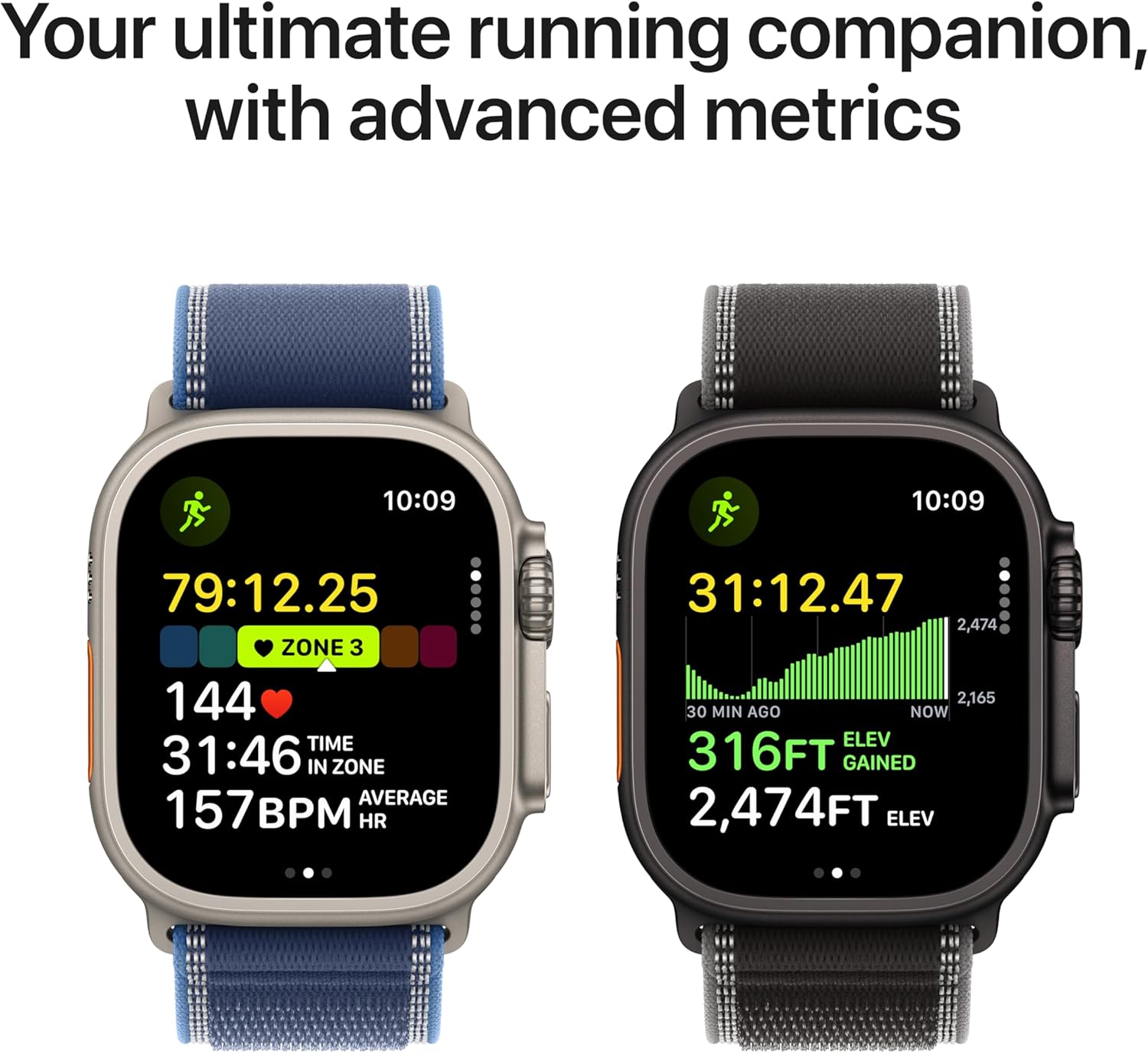
A road cyclist who reviewed the Ultra 3 after using it across a 77-mile London ride described one specific outcome from that test.
At the end of 12 hours of continuous GPS recording, the watch had consumed 87 percent of its battery.
The claimed GPS battery life is 14 hours.
That test confirmed the specs were accurate, which is not something you can say about every GPS device.
He compared it directly against a dedicated GPS cycling computer and a Garmin watch on the same ride, and described the Ultra 3 as matching or exceeding the accuracy of both for route tracking across the full distance.
Power Meter and FTP on Your Wrist:
The Ultra 3 connects to Bluetooth-enabled power meters and displays real-time watts, cadence, and power zones during a cycling workout.
When you start a ride on the watch, it automatically appears as a Live Activity on your iPhone, filling the full screen.
For cyclists who mount their phone on the handlebars, this means the watch starts the workout, and the phone becomes the display, giving you a full-screen view of your metrics without carrying a separate bike computer.
FTP estimation is built in.
After enough riding with a connected power meter, the watch calculates your FTP automatically and uses it to set your Power Zones.
This is a feature that previously required a dedicated cycling computer from another brand, and the Ultra 3 handles it from the wrist without any manual input.
GPS accuracy in the Ultra 3 was tested at a perfect 2.0 miles on a known 2-mile test course in an independent evaluation, making it one of the most accurate GPS watches tested in 2025.
The dual-frequency GNSS system locks faster than the Ultra 2 and holds signal better in wooded climbs and urban areas with tall buildings on both sides.
Apple claims the Ultra 3 doubles the signal power of the Ultra 2, and the independent test data support that claim.
Battery Life: Real-World Numbers for Cyclists:
The Ultra 3 delivers 42 hours in standard smartwatch mode and 14 hours with continuous outdoor GPS active.
For most road cyclists whose longest single ride falls under 10 hours, the GPS battery is never a concern on any single day.
For ultra-endurance events or bikepacking days that extend toward the 14-hour mark, planning a charge between riding days is necessary.
The S10 chip makes the interface noticeably faster than the Ultra 2.
Menus open instantly, and workout screens load without lag when switching mid-ride.
Turn-by-turn navigation through AirPods Pro works well for city navigation, with one reviewer describing successful navigation through central London using only AirPods audio prompts.
Satellite Emergency SOS is now two-way on the Ultra 3.
You can send and receive messages via satellite without any cellular signal.
For cyclists venturing into remote gravel and trail environments, this is a meaningful safety addition over the Ultra 2.
One honest limitation: offline topo maps on the Ultra 3 lack the terrain detail available on Garmin’s TopoActive maps.
For visual map exploration and climb profiling, Garmin’s implementation is more detailed.
For cyclists who primarily need navigation through pre-planned routes, the Ultra 3 handles this competently through third-party apps.
For a broader comparison of how the Ultra 3’s health ecosystem performs across cycling recovery and sleep tracking together, the analysis at best-smartwatches-for-sleep-tracking covers the Apple health platform in detail.
Who Should Not Buy This:
Android users cannot pair this watch with their phones.
If advanced analytics, including Training Readiness, Body Battery, and power curve tracking, are priorities, Garmin’s platform provides more depth.
And if bikepacking days regularly exceed 14 hours without access to charging, the Garmin Forerunner 970 or Enduro 3 are better equipped for the endurance requirement.
Specifications:
| Feature | Details |
|---|---|
| Case | 49mm titanium |
| Display | Wide-angle OLED LTPO3, 3000 nits |
| Battery Smartwatch | Up to 42 hours |
| Battery GPS | Up to 14 hours, 35 hours low power GPS |
| GPS | Dual-frequency GNSS, doubled signal power vs Ultra 2 |
| Cycling Features | Power meter support, FTP estimation, Power Zones, cadence, Live Activity on iPhone |
| Emergency | Two-way satellite SOS and messaging |
| Water Resistance | 100m, dive certified to 40m |
| Compatibility | iPhone only |
COROS PACE 3: (Best Budget Cycling Watch)

A cyclist who switched to the COROS PACE 3 from a daily-charging smartwatch described the first week of ownership as the period where she stopped thinking about charging.
She wore it to track four rides that week, wore it overnight for sleep tracking every night, and still had meaningful battery remaining after seven days.
That shift from managing a device to simply wearing it is exactly what the PACE 3 delivers for cyclists who want capable training data without the premium price.
Cycling Sensor Support:
The PACE 3 connects to all major Bluetooth cycling sensors, including power meters, cadence sensors, speed sensors, and heart rate chest straps.
ANT plus support was removed from the PACE 3 relative to the PACE 2, so if you have older ANT+-only sensors, confirm compatibility before purchasing.
For cyclists with modern Bluetooth-enabled sensors, all pairing worked reliably in independent reviews with no connection drops reported during long rides.
Dedicated cycling activity modes cover road cycling, mountain biking, gravel, and indoor cycling separately.
Each mode has independently configurable data screens, so your mountain bike view can show different metrics from your road ride view without manual changes each time you switch bikes.
Route navigation uses breadcrumb trails synced from the COROS app, Strava, or Komoot.
Turn-by-turn prompts work on pre-synced routes with deviation alerts if you go off course.
There are no onboard topographic maps. For cyclists who plan routes in advance and follow them, this is entirely sufficient.
For exploratory riding in unfamiliar terrain, the Garmin options on this list provide more capable navigation.
Weight and Comfort on the Bike:
At 39 grams with a 41.9mm case and 11.7mm thickness, this is one of the lightest GPS watches on the market.
Multiple reviewers specifically mentioned that after extended road rides, they forgot the watch was there.
For cyclists who find heavier watches create wrist pressure over long hours in a bent-forward position, this weight advantage is real and practical.
Battery runs to 38 hours in GPS mode and 15 days in standard daily use. In practice across actual testing, ten days of daily wear with four GPS-tracked activities before charging is a consistent real-world result.
The proprietary charging cable charges from flat to full in under two hours.
A 20-minute charge before heading out provides enough power for a full day’s ride if you forget to charge overnight.
One important limitation: the PACE 3 supports only Bluetooth sensors, not ANT plus, and can only pair one sensor per type during a workout.
This means you cannot simultaneously connect a Bluetooth power meter and a Bluetooth cadence sensor if your power meter does not also transmit cadence separately.
Most modern dual-sided power meters transmit cadence as part of the power data, so this is not an issue for most cyclists, but it is worth confirming with your specific setup.
Specifications:
| Feature | Details |
|---|---|
| Case | 41.9mm |
| Weight | 39g |
| Display | 1.2 inch MIP with touchscreen |
| Battery GPS | Up to 38 hours |
| Battery Daily | Up to 15 days |
| GPS | Dual-frequency multi-GNSS |
| Cycling Sensors | Bluetooth only (power meter, cadence, speed, heart rate) |
| Cycling Modes | Road, mountain bike, gravel, indoor cycling |
| Navigation | Breadcrumb trails, turn-by-turn, deviation alerts |
| Music | MP3 files only |
| Water Resistance | 5 ATM |
Samsung Galaxy Watch 8: (Best Cycling Watch for Android Users)

A cyclist who commuted and trained on his bike described what the Galaxy Watch 8 changed about his daily riding.
He had been using a fitness tracker that counted steps and logged heart rate without any sense of how those numbers connected to each other or to his riding.
The Galaxy Watch 8 introduced an Energy Score each morning that synthesised his sleep, overnight heart rate, and training load into a single number that told him whether pushing on today’s ride made sense or whether backing off was the better choice.
He described the first time the score told him to take it easy, and he ignored it, then had his worst ride in weeks, as the moment he started paying attention.
Cycling Mode and Sensor Connectivity:
The Galaxy Watch 8 has a dedicated cycling activity mode with configurable data screens covering speed, distance, heart rate, cadence, and elevation.
It connects to Bluetooth cycling sensors, including cadence and speed sensors.
Power meter support is available through the watch’s sensor connectivity, but it is less comprehensively integrated than Garmin’s platform.
Cyclists who use power meters as a primary training tool will find Garmin’s power data management more developed.
The watch’s primary advantage for cyclists is the health ecosystem around recovery and readiness.
Vascular load monitoring during sleep measures the cardiovascular system’s nightly recovery in a way no other mainstream watch in this list currently provides.
The Antioxidant Index tracks whether your lifestyle choices, including training load, sleep quality, and stress, are improving or degrading your body’s recovery capacity over weeks.
For a cyclist who trains consistently and wants data on whether the cumulative load is sustainable, these metrics add context that standard training watches do not provide.
AI-powered Gemini integration allows natural language questions about health data.
Asking why your Energy Score is low and receiving an explanation that references the previous day’s training load, poor sleep quality, and elevated overnight heart rate is a different kind of interaction with recovery data than navigating menu hierarchies.
The dual-frequency GPS tracks routes accurately in urban commuting environments where single-band watches produce drift.
For cyclists who mix city commuting with weekend training rides, the GPS performance handles both without concern.
Battery life reaches approximately 40 hours in standard use.
For cycling use with a continuous GPS active, most riders charge the watch every night or every other night, depending on ride duration.
Who Should Not Buy This:
Full feature access is optimised for Samsung Android phones.
iPhone users and non-Samsung Android users lose some functionality.
If dedicated cycling analytics, including power curves, FTP management, and training load specific to cycling, are the priority, Garmin’s platform is more purpose-built.
And if ANT plus sensor compatibility is required for older cycling equipment, the Galaxy Watch 8 does not support ANT plus.
Specifications:
| Feature | Details |
|---|---|
| Display | AMOLED 1.5 inch (44mm) |
| Battery | Up to 40 hours standard |
| GPS | Dual-frequency L1 and L5 |
| Cycling Features | Dedicated cycling mode, cadence, speed, elevation, Bluetooth sensor support |
| Health Features | Vascular load, Antioxidant Index, AI Energy Score, HRV, ECG, sleep apnea detection |
| AI | Gemini integration, natural language health queries |
| Water Resistance | 5 ATM, IP68, MIL-STD-810H |
| Compatibility | Best on Samsung Android, limited on other platforms |
Garmin Forerunner 570: (Best Mid-Range Cycling Watch)

Cycling Features at a Mid-Range Price:
The Forerunner 570 is Garmin’s 2025 update to the Forerunner 565, sitting between the entry-level 265 and the flagship 970 in Garmin’s lineup.
It supports power meter connectivity, cadence, ClimbPro for loaded routes, and the same Training Readiness and Body Battery framework that makes Garmin’s health monitoring platform useful for cyclists.
Multi-band dual-frequency GPS provides accuracy across the environments where single-band watches produce drift, including city streets with tall buildings and forest trails with dense canopy.
The AMOLED display reads clearly in outdoor light during rides, making data legible at a glance without adjusting brightness or shielding the screen.
Battery life runs to approximately 20 days in smartwatch mode and 16 hours in GPS mode with music active.
For cyclists whose rides fall under a full day, a GPS battery is never a concern.
For back-to-back cycling days without access to a charger, charging every two to three days is the realistic pattern.
Where the 570 falls short of the 970 is in the depth of cycling analytics.
Power curve tracking across ride history, the automated rider type categorisation, and the Power Guide feature for race-day pacing are exclusive to the 970.
For a serious cyclist who uses power as a training tool and wants the watch to analyse that data over time, the 970 is worth the additional cost.
For cyclists who want power zone data on the screen during rides without the deeper analytics suite, the 570 covers the fundamentals reliably.
Who Should Not Buy This:
If you want power curve tracking, automated rider type analysis, and the Power Guide feature, those are exclusive to the Forerunner 970 and the Fenix 8.
If you need preloaded topographic maps for trail and gravel navigation, both the 970 and Fenix 8 on this list provide those.
And if premium construction with a titanium case and sapphire crystal matters, the 970 adds those too.
Specifications:
| Feature | Details |
|---|---|
| Display | AMOLED |
| Battery Smartwatch | Up to 20 days |
| Battery GPS | Up to 16 hours with music |
| GPS | Multi-band dual-frequency |
| Cycling Features | Power meter, cadence, ClimbPro, cycling dynamics, Training Readiness, Body Battery |
| Connectivity | ANT plus and Bluetooth |
| Water Resistance | 5 ATM |
Amazfit T-Rex 3: (Best Budget Rugged Cycling Watch)

A cyclist and hiker who reviewed the T-Rex 3 specifically because he was tired of worrying about his expensive watch described the shift in mindset it produced.
He wore it on a gravel route through rocky terrain, dropped it during a bike dismount onto hard ground, picked it up, and kept riding.
No case cracked.
No screen cracked.
No function lost.
He described the watch as the first one he had used where he genuinely stopped thinking about it at all, which he found was exactly what he wanted from a piece of kit that spends its life on a wrist in outdoor conditions.
Rugged Build at a Budget Price:
The T-Rex 3 is rated to 10 ATM water resistance and tested to 15 military standards covering shock, temperature extremes, sand, salt mist, and vibration.
The 1.5-inch AMOLED display is protected by a tempered glass lens that has shown resilience in drop tests across multiple independent reviews.
Offline topographic maps are available through the Zepp app and downloadable for offline use without a subscription.
For a watch at this price, topo map access is genuinely uncommon and represents real value for cyclists who also hike or ride gravel routes in unfamiliar terrain.
GPS uses a dual-frequency GNSS chipset covering five satellite systems.
Route accuracy in forest and urban environments held consistently in independent reviews, matching the performance of watches costing significantly more.
Battery life reaches 27 days in smartwatch mode and 42 hours in standard GPS mode.
For cyclists doing multi-day trips, the battery endurance removes charging anxiety across back-to-back riding days.
The cycling activity mode supports cadence tracking and route navigation from synced GPX routes.
Power meter connectivity is not supported. For cyclists who train with power meters as a primary data source, the T-Rex 3 is not the right tool.
For cyclists who want GPS tracking, cadence, and heart rate with excellent durability and battery at a low price, it covers those needs well.
For a broader look at how the Amazfit platform connects daily health tracking to training data, including stress monitoring across cycling and daily life, the full comparison at best-smartwatches-for-monitoring-stress covers the Zepp ecosystem in detail.
Who Should Not Buy This:
If power meter connectivity is part of your training setup, this watch does not support it.
If the Garmin Connect or Polar Flow ecosystems are important to you because other devices in your setup use them, the Zepp platform operates independently.
And if you want the deep training analytics, including Training Readiness, power curves, and interval-specific recovery data, the Garmin options on this list are built for those needs.
Specifications:
| Feature | Details |
|---|---|
| Case | 47mm |
| Display | 1.5 inch AMOLED |
| Battery GPS | Up to 42 hours |
| Battery Smartwatch | Up to 27 days |
| GPS | Dual-frequency, five satellite systems |
| Durability | 10 ATM, 15 military standards |
| Maps | Offline topo maps via Zepp app |
| Cycling Features | Cycling mode, cadence, route navigation from GPX |
| Power Meter | Not supported |
Garmin Venu 3: (Best Everyday Cycling Watch for Casual and Commuter Cyclists)

A cyclist who also worked a desk job described why she chose the Venu 3 over a pure sports watch.
She needed a watch that tracked her lunch rides and commutes but also looked appropriate in meetings, showed her notifications clearly, and gave her useful health data throughout the day.
The Venu 3 covered all three.
On her Tuesday recovery ride, it showed her that her Body Battery score of 42 made a hard interval session inadvisable.
On her Friday commute, it connected to her cadence sensor automatically and logged the ride without any setup.
In the conference room, it looked like an everyday watch rather than a piece of sports equipment.
Cycling Features for Regular Riders:
The Venu 3 connects to ANT plus and Bluetooth cycling sensors, including cadence, speed, and power meters.
The cycling activity mode logs all standard metrics and syncs to Garmin Connect. ClimbPro is available on loaded routes.
Body Battery and Training Readiness work identically to the higher-tier Garmin watches, producing the same morning readiness score that tells you whether today’s cycling session should be pushed or backed off.
The AMOLED display at 1.4 inches is sharp enough for data reading during rides and attractive enough for all-day wear and office situations.
Watch face options are broader than on sport-focused Garmin models, and the build at 47 grams is light enough to stop noticing after the first week of daily wear.
Battery runs to 12 days in smartwatch mode and 20 hours in GPS mode.
For cyclists who commute daily and do one longer GPS ride on the weekend, charging once every four to five days is a realistic pattern.
Lifestyle Logging is the Venu 3’s standout feature for cyclists who want to understand how their off-bike behaviour affects their riding.
Log your morning coffee, a late meal, or a poor night’s sleep, and the Garmin Connect app shows you how those inputs correlate with your heart rate trends, Body Battery, and recovery quality.
Over a few months, this data builds a genuinely personalised map of which lifestyle choices affect your cycling performance most.
The Venu 3 does not have preloaded topographic maps.
Navigation for cycling uses synced routes with breadcrumb trails and turn-by-turn prompts.
For commuting and familiar routes, this is entirely sufficient. For exploratory gravel riding, the Forerunner 970 or Fenix 8 provides richer navigation.
Who Should Not Buy This:
If serious training analytics with power curve tracking, FTP management, and deep cycling performance data are the priority, the Forerunner 970 is built for that use case.
If preloaded topo maps for gravel and trail navigation matter, the Fenix 8 or Forerunner 970 covers that.
And if battery life beyond a week without charging is important, the COROS PACE 3 offers more in a lighter and smaller package.
Specifications:
| Feature | Details |
|---|---|
| Case Sizes | 41mm and 45mm |
| Display | AMOLED 1.4 inch (45mm) |
| Battery Smartwatch | Up to 12 days |
| Battery GPS | Up to 20 hours |
| GPS | Multi-band dual-frequency |
| Cycling Features | Power meter, cadence, speed, ClimbPro, Body Battery, Training Readiness, Lifestyle Logging |
| Connectivity | ANT plus and Bluetooth |
| Navigation | Synced routes, breadcrumb, turn-by-turn |
| Weight | 47g |
| Water Resistance | 5 ATM |
Polar Grit X: (best multisport GPS smartwatch)

The Polar Grit X is an absolute must-have for outdoor enthusiasts.
With a keen focus on durability, extensive battery life, and advanced features, it’s the ideal companion for your adventures, whether you’re traversing the trails, exploring the wilderness, or conquering mountains.
In this product, let’s dive into the key features, pros, and cons of the Polar Grit X.
Features:
Ultra-Long Battery Life:
The Grit X boasts an impressive battery life of up to 40 hours with full GPS and heart rate tracking. You can even extend it to a remarkable 100 hours with power-saving options.
In watch mode with 24/7 heart rate tracking, the watch can last up to 7 days.
Despite its extended capabilities, it remains remarkably lightweight at just 64 grams, which is 20-30% lighter than typical outdoor watches.
Military-Level Durability:
The Grit X is built to withstand tough conditions.
It has passed several MIL-STD-810G tests for durability and is water-resistant up to 100 meters (10ATM), ensuring it can handle whatever the outdoors throws at it.
Navigation:
You’ll never lose your way with real-time turn-by-turn route guidance and route import from Komoot.
The watch features a compass and barometric altitude data (in training mode), along with Polar’s unique training features, helping you aim higher in your adventures.
Hill Splitter:
The watch automatically detects uphill and downhill stats, providing insights into your performance during ascent and descent sections of your route.
This data is derived from your speed, distance, and altitude information.
Overnight Recovery Measurement:
The Polar Nightly Recharge feature assesses your overnight recovery status, letting you know when it’s safe to push your body further in your training and adventures.
Sport Profiles:
With over 130 sports profiles, the Grit X is ready for a wide range of activities, ensuring it’s your go-to watch no matter what you do.
Polar Flow:
The Polar Flow platform enables you to plan and analyze your training sessions, providing valuable insights into your performance.
Final Words:
The Polar Grit X is the ultimate companion for outdoor enthusiasts and athletes who demand rugged durability, extensive battery life, and advanced features.
With its military-level toughness, impressive battery endurance, and comprehensive tracking capabilities, it’s your trusted companion for all your adventures.
While it may have a learning curve for beginners, the Grit X is an invaluable asset for those who demand the best in their outdoor pursuits.
It’s like having a GPS, personal trainer, and adventure guide all on your wrist.
FAQs
Do I need a dedicated bike computer or will a smartwatch do the job?
For most cyclists, a smartwatch handles everything a bike computer does during the ride, and adds the health and recovery tracking that a computer cannot provide off the bike. The practical differences appear in specific situations. A bike computer has a larger display that is easier to read at a glance while riding, particularly for data-heavy screens with multiple fields. For race-day riding where reading watts and gradient simultaneously while in a bunch matters, a bar-mounted computer is the more practical display. For training rides, commuting, gravel adventures, and any situation where the watch is going from the bike to the rest of your day, a smartwatch covers the cycling function without the additional hardware. Most serious cyclists use both. The computer handles race day and primary training rides. The watch handles everything else and provides the recovery and sleep data the computer cannot.
Can I connect my power meter to a smartwatch?
Yes, all of the Garmin, Apple, Polar, and Samsung watches on this list connect to Bluetooth-enabled power meters. Garmin watches additionally support ANT plus, which covers older power meters that predate widespread Bluetooth adoption. The COROS PACE 3 supports Bluetooth-only sensors. The Amazfit T-Rex 3 does not support power meters at all. Before purchasing, confirm whether your power meter transmits via Bluetooth, ANT plus, or both, and match that to the sensor connectivity of the watch you are considering. For a deeper look at how power and heart rate data interact with recovery tracking on the watches in this list, the British Cycling Federation publishes guidance on training with power at britishcycling.org.uk.
What GPS accuracy should I expect from a cycling smartwatch?
Modern dual-frequency GPS watches deliver route accuracy that tracks closely with dedicated cycling computers in real-world testing. The Apple Watch Ultra 3 matched a known 2-mile test course exactly in independent evaluation. The Garmin Forerunner 970 matched its stated GPS battery life to within the measurement error of the test. Single-band GPS watches perform well on open roads and clear terrain but can drift in dense city environments with tall buildings on multiple sides and in heavy forest with closed canopy. If the majority of your riding is urban or through dense forest, a dual-frequency GPS watch produces noticeably cleaner route traces and more consistent pace data, which matters particularly if you use pace or speed zones as training targets.
Related Articles:
Best GPS Fitness Trackers for Soccer Players
Best Military and Tactical Watches
Google Pixel Watch 4 vs. Samsung Galaxy Watch 8 Classic
Luis Cooper

Hi, I'm Luis, the guy behind this site. I love wearing watches, especially ones that look great on small wrists (mine are about 6.3" around). The Watches Geek is dedicated to helping you learn about and buy watches that you will love wearing. I want this website to be the last destination for people to pick the best watches to fit their needs. You can find our unbiased reviews here on Thewatchesgeek.