
Last Updated on October 1, 2026 by Luis Cooper
A project manager who works with teams across London, Dubai, and Singapore described the single most embarrassing professional moment of her remote-work career as joining a client call 45 minutes late — not because she forgot about the meeting, not because she overslept, but because she had done the time zone calculation in her head at midnight and made an arithmetic mistake.
She was in New York. London was five hours ahead, she reasoned. The meeting was at 9 am London time. That made it 4 am her time.
She set her alarm. What she forgot was that the UK had moved its clocks forward for summer, making it a four-hour difference that week, not five. She woke at 4 am feeling smug, fell back asleep, and joined the call during the final four minutes while her London colleague was wrapping up.
She bought a world time watch the following morning.
What Is a World Time Watch and Do You Actually Need One?
Before the list, a brief explanation that makes every watch on it easier to understand and compare.
A GMT watch displays two time zones at once — your current local time on the standard hour and minute hands, and a second time zone tracked by a dedicated fourth hand that points to a 24-hour scale on the bezel or dial. Turning the bezel or adjusting the crown lets you set the second time zone to home, your destination, or wherever the next meeting is. You read both times at a glance without arithmetic.
A world timer goes further. Instead of tracking two zones, it displays multiple time zones — sometimes all 24 — referenced against city names printed around the bezel or dial. You find the city whose time you need, read the corresponding hour, and have your answer in under three seconds, no matter how many time zones separate you from the person you need to call.
Both are dramatically faster and more reliable for travellers than doing time zone arithmetic in your head or reaching for a phone, particularly when you are crossing time zones frequently, sitting in airport lounges trying to figure out what time it is at home, or running a remote team whose members live in three different continents.
The watches below cover both types across seven different price points and use cases.
What to Look For Before Buying a World Time Watch
How you will actually use the second time zone is the most important question. If you travel to the same destination repeatedly—visiting family in one city, flying to one international office regularly—a GMT watch that tracks one additional fixed zone is faster and simpler than a world timer with twenty-four cities to scan. If you travel internationally across different destinations each trip, the world timer’s ability to reference any city name immediately is the more useful tool.
Quartz versus automatic matters for a watch you rely on professionally. A quartz movement keeps time to within fifteen to thirty seconds per month without any maintenance. An automatic movement winds from wrist movement, requires no battery, and varies in daily accuracy between minus ten and plus fifteen seconds depending on the calibre. Both are appropriate for travel. Your choice depends on whether you want the traditional mechanical experience or the set-it-and-forget-it reliability of quartz.
Water resistance matters for a watch worn daily across different climates and activities. Fifty metres covers rain, handwashing, and most everyday water contact. A hundred metres extends this to swimming. Two hundred metres and above cover diving and water sports without any concern.
Which are the Best World Time Watches for Travelers?
Here are my recommended top 7 Best World Time Watches for Travelers:-



1. SEIKO SSK001: (Best GMT Watch for Travelers Who Want Automatic)

Seiko released the 5 Sports GMT collection in 2021 to answer a question the brand had been asked repeatedly over the previous decade: why don’t you make an automatic GMT watch at an everyday price?
The SSK001 is that answer. It is an in-house automatic GMT movement in a sports-capable stainless steel case, at a price that doesn’t require the kind of commitment Swiss GMT watches at the same capability level typically demand.
Seiko has made watches since 1881 and has manufactured its own movements in-house since 1895 — the movement engineering behind the SSK001 draws on over a century of in-house caliber development rather than a purchased component from an external supplier.
How the GMT Function Works on the SSK001
The SSK001 carries Seiko’s 4R34 calibre, which has a dedicated GMT hand in addition to the standard hour, minute, and seconds hands. This fourth hand tracks your second time zone.
Here is how it works in practice. Before a flight from Karachi to London, set the GMT hand to London time and align the bidirectional rotating bezel with the 24-hour markings.
Once set, the GMT hand completes one full rotation every 24 hours rather than every 12, so it points to the correct London hour at any point during the day, whether London is in AM or PM.
Your regular hour and minute hands continue showing local time wherever you are.
Both time zones appear on the dial simultaneously, with no mental arithmetic required.
Adjusting between time zones when you land takes seconds.
Pull the crown out one click, rotate the local hour hand forward or back in one-hour increments to match local time, and push the crown in again.
The GMT hand stays fixed on your reference time throughout.
The 4R34 Movement and What 41 Hours of Power Reserve Means
The 4R34 calibre provides 41 hours of power reserve, the time the watch continues running after being left unworn and fully wound.
For a traveler whose watch is consistently on the wrist during the day, the power reserve rarely becomes relevant because wrist movement continuously rewinds the mainspring through the automatic rotor.
The 41-hour reserve matters specifically for the gap between finishing wearing the watch on a Friday evening and picking it up again on Sunday morning — a 38-hour window that sits within the reserve without the watch stopping.
The movement has hacking — the seconds hand stops when the crown is pulled out — which allows precise time setting to the exact second rather than approximating on the fly.
The Case and What 200 Metres Water Resistance Covers
The SSK001 is 42.5mm across and sits at 13.4mm thick. The stainless steel case and bracelet carry a combination of brushed and polished surfaces that catch light differently across the case’s facets without looking overly formal.
Water resistance at 200 metres is substantially higher than most dress watches and sufficient for swimming, snorkelling, and recreational water sports without precaution.
For a traveler who might encounter water across a range of activities on the same trip, not having to think about the watch and water at the same time is a practical benefit that lower-rated watches cannot provide.
The Seiko brand name carries recognition in professional and casual settings internationally — not the kind that provokes questions or draws attention, but the kind that signals considered choice to someone who knows watches and reads as a quality timepiece to someone who does not.
Specifications:
| Feature | Details |
|---|---|
| Movement | Seiko 4R34 — in-house automatic GMT |
| Power Reserve | 41 hours |
| Hacking | Yes — seconds stop for precise time setting |
| Case | 42.5mm stainless steel |
| Crystal | Hardlex — scratch resistant |
| GMT Function | Dedicated 4th hand + rotating bezel |
| Water Resistance | 200 metres |
| Brand Heritage | Seiko, Tokyo, since 1881 |
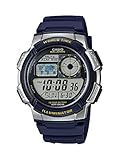
2. Casio AE-1000W: (Best Budget World Time Watch for Travelers)

A software developer who manages three remote teams described his morning routine before buying a world time watch as the most mentally draining part of his workday.
His London team started at 9am. His Singapore team started at 9am their time. His New York team started at 9am their time.
Three cities, three time zones, three separate calculations every single morning before he had finished his first cup of tea.
He bought the Casio AE-1000W for under twenty dollars.
He set London, Singapore, New York, and his own city into the four selectable city slots. Now he presses a button to cycle between all four in under three seconds, no arithmetic required.
48 City Time Zones in a Watch That Costs Less Than a Restaurant Meal
The Casio AE-1000W supports 48 city-based time zones. You select up to four cities from that list and save them to the watch.
Pressing a button cycles through your saved cities one at a time, each showing the current time in that location on the analog subdial at the top of the watch face while the main digital display continues showing your local time.
The AE-1000W takes visual inspiration from aircraft cockpit instruments.
Casio designed it to feel like a pilot’s tool rather than a budget digital watch, and the layered display with multiple information zones gives it a technical character most digital watches at this price point don’t attempt.
Casio launched the AE-1000W in May 2025 in two colorways. The 5AV features a teal-and-green color combination.
The 8AV is a more conservative black and grey that reads as professional in any setting.
10 Years of Battery Life
The AE-1000W runs on a single CR2032 battery rated to last approximately 10 years under normal use.
For a traveler, 10-year battery life means this is essentially a watch you buy once and wear for a decade without thinking about the battery.
There are no charging cables to pack. No charging dock to remember. No anxiety about the watch dying in the middle of a business trip.
The battery will outlast most international travel careers before needing replacement.
The amber LED backlight with afterglow illuminates the display at the press of a button, making the time readable in a darkened airplane cabin, a dimly lit restaurant, or anywhere else where checking the time discreetly matters.
100 Metres Water Resistance and 5 Alarms
At 100 meters water resistance, the AE-1000W handles swimming, snorkeling, and rain without any concern. For a digital watch in this price range, 100-metre water resistance is genuinely strong. Most fashion watches and many mid-range options offer 30 to 50 metres only.
Five independent alarms let a traveler set wakeup calls in different time zones across the same trip without resetting anything between them.
Landing in Dubai, setting one alarm for a morning meeting in local time, and setting a second alarm for when the London office opens requires no reconfiguration because both alarms sit independently on the watch.
The 1/100-second stopwatch and 24-hour countdown timer round out the feature set for travelers who time layovers, track elapsed meeting time, or manage structured daily routines across changing time zones.
Specifications:
| Feature | Details |
|---|---|
| World Time | 48 city time zones, 4 selectable |
| Display | Digital main + analog subdial |
| Battery | CR2032, 10-year life |
| Water Resistance | 100 metres |
| Alarms | 5 independent alarms with snooze |
| Backlight | Amber LED with afterglow |
| Launch | May 2025 |
| Brand Heritage | Casio, Japan, since 1946 |
3. Citizen Promaster: (Best Solar Travel Watch)

A freight logistics manager who flies between Chicago, Amsterdam, and Tokyo twelve times a year described the battery problem with his previous travel watch as minor until it happened at the worst possible time.
He landed in Tokyo after fourteen hours in the air. His watch was dead. He had forgotten to charge it before the flight.
He spent the first three hours of a critical supplier meeting unsure whether the delivery windows he quoted were in Tokyo time or Chicago time, because he was working entirely from his phone and couldn’t remember whether he had updated it to local time at the airport.
He bought the Citizen Promaster GMT BJ7150 the following week.
Eco-Drive means it charges continuously from any light source. On a fourteen-hour flight with reading lights on and cabin windows occasionally open, the watch charges itself. It has never been dead since.
How the GMT Function Works
The BJ7150 carries four hands. Three of them work like any standard watch, showing hours, minutes, and seconds in your current local time.
The fourth hand is the GMT hand, which points to a 24-hour scale around the dial and shows a second time zone simultaneously.
Setting it takes under a minute. Before a flight from Chicago to Amsterdam, pull the crown, move the GMT hand to Amsterdam time, and the watch now shows Chicago time on the main dial and Amsterdam time on the GMT hand at all times.
After landing, a quick crown adjustment moves the main time to local time and the GMT hand automatically becomes the reference for Chicago.
The Eco-Drive Advantage for Long-Haul Travelers
Citizen’s Eco-Drive technology converts any light source into electrical energy stored in a secondary cell.
The B878 calibre inside the BJ7150 runs for nine months in complete darkness on a full charge.
In normal wearing conditions with regular exposure to light, the watch charges continuously and never needs a battery.
For travelers, Eco-Drive removes one item from the mental checklist before every departure. No cable. No charge time.
No uncertainty about whether the watch will last through a two-week trip.
Sapphire Crystal and the Textured Dial
The BJ7150 uses a sapphire crystal, which is the same material used in high-end watches regardless of price point.
Sapphire rates 9 on the Mohs hardness scale, second only to diamond, and resists scratching from virtually every material a watch encounters in daily life.
The textured dial is the design detail that makes this watch visually distinctive among tool watches at this level.
Most GMT sport watches use flat-printed dials.
The BJ7150 uses a raised texture that catches light differently across the surface, giving the dial depth that photos don’t fully capture.
Three versions are available: burgundy with a classic tone, green with an orange GMT hand, and blue with a yellow accent hand.
Who this is not for:
Travelers who want a purely digital display with city names rather than a traditional analog GMT hand should look at the Casio AE-1000W above.
The BJ7150 requires reading a 24-hour scale rather than selecting a named city, which is slightly less immediate for travelers working across many different destinations.
Specifications:
| Feature | Details |
|---|---|
| Movement | Eco-Drive B878, light powered |
| Dark Reserve | 9 months on full charge |
| GMT | Dedicated 4th hand, 24-hour scale |
| Crystal | Sapphire |
| Case | Stainless steel |
| Colors | Burgundy, Green, Blue |
| US Launch | January 2026 |
| Brand Heritage | Citizen, Japan, since 1918 |
4. Mido Ocean Star GMT: (Best Swiss Automatic GMT Watch for Travelers)

Mido was founded in Le Locle, Switzerland, in 1918 — the same Swiss watchmaking valley that produced some of the most respected names in the industry.
The company has been part of the Swatch Group since 1983, sitting within the same manufacturing infrastructure as Tissot, Longines, and Omega.
The Ocean Star GMT builds on that foundation and delivers Swiss Automatic GMT capability in a package that earns its place in any serious conversation about travel watches.
The GMT Function on a Swiss Automatic Movement
The Ocean Star GMT carries a Swiss automatic movement with a dedicated GMT hand that completes one full rotation every 24 hours.
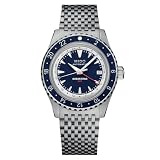
This hand reads against the blue rotating bezel, which is graduated in 24-hour segments rather than the standard 12.
To set the GMT function, rotate the bezel to align the reference time zone; then both time zones remain permanently visible on the dial.
To change the local time after landing, advance the hour hand in one-hour increments via the crown, leaving the GMT hand and reference time untouched.
A traveler who flies between two cities regularly sets the reference once and never adjusts it again.
200 Meters Water Resistance for Travelers Who Do More Than Travel
The Ocean Star GMT is rated to 200 metres of water resistance with a screw-down crown.
The screw-down crown is the specific mechanism that delivers this rating — rather than simply pushing in, it threads into the case to create a sealed chamber that withstands the pressure equivalent of 200 metres of water depth.
For a travel watch, 200-metre water resistance addresses a set of activities that most travel watches at this level cannot.
A beach holiday, a snorkeling session, a dive to 20 meters, a swim in any conditions — the Ocean Star GMT handles all of these without any precaution from the wearer.
The watch can go where the traveler goes, which is exactly what a travel watch should do.
The Blue Dial and Rotating Bezel
The combination of a blue sunray dial and a blue aluminum rotating bezel creates a visual coherence that makes the Ocean Star GMT immediately identifiable as a well-considered design rather than a functional tool with aesthetics as an afterthought.
The blue bezel insert is aluminum, which is lighter than ceramic and develops a very slight visual patina over years of wearing that many watch owners find appealing.
The 24-hour markings on the bezel are clear and legible in the conditions a traveler actually reads them — in transit, in poor terminal lighting, at a desk in a hotel room at an unfamiliar hour.
Who this is not for: Travelers who want solar or battery-powered accuracy without a mechanical movement should look at the Citizen Promaster GMT above. The Ocean Star GMT is a Swiss automatic and carries the hallmarks of automatic watches—it needs regular wearing or occasional manual winding to maintain power.
Specifications:
| Feature | Details |
|---|---|
| Movement | Swiss Automatic with GMT hand |
| Case | 40.5mm stainless steel |
| Bezel | Blue aluminum, 24-hour scale, rotating |
| Dial | Blue sunray |
| Bracelet | Stainless steel |
| Water Resistance | 200 metres, screw-down crown |
| Group | Swatch Group |
| Brand Heritage | Mido, Le Locle Switzerland, since 1918 |
5. Casio G-Shock: (Best Rugged Travel Watch)

Multi-Band 6 Atomic Sync
The GW-M5610U receives radio signals from atomic clock transmitters located in Japan, the United States, Germany, the United Kingdom, and China.
Each night, while the watch is at rest, it searches for and locks onto the nearest transmitter signal and adjusts itself to the exact correct time.
This accuracy is not a marketing figure.
Atomic clocks operate on the vibration frequency of cesium atoms, which is so consistent that a cesium clock would drift by less than one second across 100,000 years. These clocks generate the radio signals that the GW-M5610U receives.
For a traveler, this means the watch adjusts itself automatically when entering a new time zone covered by the transmitter network.
Time zone changes that require manual crown adjustments on conventional watches happen on the GW-M5610U without any input from the wearer.
Tough Solar in Practical Terms
The Tough Solar system charges from any light source. An afternoon outdoors, a day under office lighting, a morning near a window — all of these charge the secondary cell that powers the watch.
Once fully charged, the cell holds enough charge to run the watch for about six months in complete darkness.
For a traveler moving across climates, job sites, and unpredictable schedules, this combination of atomic accuracy and solar charging creates a watch that operates correctly and continuously without requiring any maintenance decision.
No battery to track, no charging cable to carry, and no manual time adjustment needed after crossing international date lines or time zone boundaries.
52 Grams and 200 Meters
The GW-M5610U weighs 52 grams. Every other watch in this guide is heavier.
The combination of a resin case, resin strap, and compact 35.5mm square profile makes a watch most wearers stop noticing within the first hour.
The 200-metre water resistance rating makes the GW-M5610U the most water-capable watch in this guide.
Submersion to depth, swimming in rough water, extended rain exposure — none of these require any consideration.
This rating sits above the 100-meter and 50-meter ratings of most travel watches because the G-Shock was originally designed in 1983 to withstand physical impacts, including drops and submersion, that would destroy conventional watches.
Who this is not for: Travelers who want an analog dial that suits formal or professional settings should look at the Seiko, Citizen, or Mido options in this guide. The G-Shock GW-M5610U is a digital sports watch with a square case and a resin construction that reads as casual and rugged. It belongs on a job site, a trail, or a backpack trip, not in a boardroom.
Specifications:
| Feature | Details |
|---|---|
| Time Sync | Multi-Band 6 atomic radio control |
| Power | Tough Solar, 6-month dark reserve |
| Case | 35.5mm square resin |
| Weight | 52 grams |
| Water Resistance | 200 metres |
| World Time | Multiple zones |
| Brand Heritage | Casio G-Shock, Japan, since 1983 |
6. Garmin Instinct 3 AMOLED: (Best GPS Smartwatch for Adventure Travelers)

Every watch on this list so far tracks time across time zones in some form.
The Garmin Instinct 3 does that too.
The difference is everything else it does.
A wildlife photographer who travels to remote locations across three continents described the Instinct 3 as the first watch that genuinely replaced a backpack full of individual instruments. The compass he used to carry. The altimeter for elevation readings.
The GPS tracker his expedition company required. The emergency notification device. The heart rate monitor for high-altitude acclimatization tracking. One watch, one wrist.
The Instinct 3 launched in January 2026 as the first Instinct generation with a true AMOLED display, fundamentally changing the watch experience compared to the MIP displays of previous Instinct models.
The AMOLED Display and What It Changes
Every previous Instinct used a MIP display, which is a low-power technology that reflects ambient light to produce a readable image.
MIP displays work well outdoors in strong daylight but look dim and basic in poor light.
The Instinct 3 AMOLED produces its own light per pixel.
The display is vivid, high-contrast, and readable in any lighting condition, from bright mountain sun to a dark campsite.
Maps, health data, notifications, and the world time display all read clearly at a glance without adjusting the screen angle or pressing a backlight button.
For a traveler navigating unfamiliar cities at night, checking arrival times in a dark airport terminal, or reading map data before dawn on a trail, the AMOLED display removes the friction that MIP alternatives consistently create in those conditions.
World Time and GPS Combined
The Instinct 3 handles time zone tracking differently from any other watch in this guide.
Rather than a dedicated GMT hand or a city-based bezel, it uses the Garmin Connect platform and the watch’s GPS location awareness to show the correct local time automatically when you arrive in a new region, and to display any additional time zone through the world clock function accessible from the watch face.
The multi-band GPS uses Garmin’s SatIQ technology to simultaneously receive signals from GPS, GLONASS, Galileo, and BeiDou satellite systems.
SatIQ selects the most efficient combination of signals at any given moment, which improves both positioning accuracy and battery efficiency compared to single-band systems.
In dense city environments or under heavy tree cover where single-band GPS struggles, the Instinct 3 maintains reliable tracking.
The Metal-Reinforced Bezel:
Every previous Instinct used a polymer bezel. The Instinct 3 introduces a metal-reinforced bezel that protects the AMOLED display from direct impact.
This is a meaningful structural upgrade for a watch worn on trails, at job sites, and through the physical demands of adventure travel.
The overall construction meets US military standard 810, which covers testing against shock, vibration, high and low temperature extremes, humidity, and altitude. Water resistance is rated to 100 metres.
The built-in flashlight is a practical addition that experienced outdoor travelers find genuinely useful rather than novelty. Navigating camp in darkness, reading a map or signpost at night, signalling position, locating gear in a dark tent — the flashlight addresses the specific situations where a watch-mounted light is more immediately useful than reaching for a headlamp.
Health Monitoring for Jet Lag and High Altitude
The Instinct 3 monitors heart rate, blood oxygen levels, sleep quality, and Body Battery continuously throughout the day and night.
For travelers crossing multiple time zones, the Body Battery reading provides a practical daily reference for when rest and when activity make physiological sense, informed by the watch’s data rather than by guesswork based on local clock time.
At altitude, blood oxygen monitoring tracks how the body is adjusting to elevation.
Climbers and trekkers approaching high-altitude destinations use this to identify acclimatisation patterns and to make informed decisions about pace and rest days before symptoms of altitude sickness develop.
For a closer look at how Garmin’s full outdoor platform performs across training, navigation, and music on the flagship Fenix series, the full review at garmin-fenix-9-review covers the top of the Garmin range in detail. For travelers who want their Garmin to double as a music player on long journeys, the full guide at best-garmin-watches-with-music covers every music-capable Garmin currently available.
Who this is not for: Travelers who want a traditional analog watch face for formal or professional settings should look at the Seiko, Citizen, or Mido options earlier in this guide. The Instinct 3 is a GPS smartwatch built for outdoor and active travel and reads accordingly on the wrist.
Specifications:
| Feature | Details |
|---|---|
| Display | 1.2 inch AMOLED |
| Battery | Up to 18 days smartwatch mode |
| GPS | Multi-band GNSS with SatIQ |
| Bezel | Metal-reinforced |
| Water Resistance | 100 metres |
| Flashlight | Yes, built-in |
| Health | Heart rate, Pulse Ox, sleep, Body Battery |
| Launch | January 2026 |
| Compatibility | iOS and Android |
7. Apple Watch Series 12: (Best Smartwatch for Travelers Who Use iPhone)

- STAY CLOSER TO YOUR HEART HEALTH—The most accurate heart rate sensing in a wearable,* Series 12 now measures HRV as often as every five minutes for insights on stress and recovery, and takes background heart rate readings every five seconds.
- A FULL-FEATURED HEALTH TRACKER—Better understand your body with invaluable health insights. View your overnight health metrics with the Vitals app and get a daily sleep score,* track your menstrual cycle,5 and take readings of your blood oxygen.*
- CHECK YOUR READINESS FOR THE DAY—Know when to rest or put yourself to the test. The readiness experience can help you determine your capacity to take on the day by analyzing your recent activity, vitals, and sleep.
- A POWERFUL FITNESS TRACKER—With advanced metrics and motivating features like Pacer, Heart Rate Zones, and Workout Buddy powered by Apple Intelligence from your nearby iPhone8—Series 12 helps you stay active, from running to hiking to strength training.
- KEEP HELP CLOSE AT HAND—A smartwatch that puts your safety first. Series 12 can detect a hard fall or severe car crash, automatically help connect you with emergency services, and notify your emergency contacts.*

A marketing consultant who travels between New York, London, and Singapore every month described his relationship with time zone tracking as the part of his job that no watch had ever fully solved until he stopped looking at it as a watch problem.
The difficulty was not reading two time zones. It was the third, fourth, and fifth.
Before a client call, he needed to know if London was available, whether Singapore had already closed for the day, and what time his New York team would be in the office — simultaneously, quickly, without arithmetic.
The Apple Watch Series 12 solved this with a single watch face complication that shows as many cities as he needs arranged across the display, each updating in real time as his own time changes.
He taps Siri and says a city name, and the watch tells him the time there in under two seconds.
He has not done time zone arithmetic since.
The World Clock Complication
The Apple Watch Series 12 handles world time differently from every other watch in this guide. There is no GMT hand to set, no bezel to rotate, no city ring to scan.
The World Clock complication on the watch face shows multiple cities at once, each displaying the current local time with an AM or PM indicator.
Adding a city takes fifteen seconds. Removing one takes five.
The list rearranges automatically by time difference from the current location. On a flight from New York to Singapore, the watch face shows whatever cities matter to the traveler that week rather than a fixed reference chosen when the watch was purchased.
Siri integration adds a further layer of practical convenience.
Saying “What time is it in Dubai?” to the watch returns the current Dubai time without unlocking anything, opening an app, or pressing a button.
For travelers who need quick answers to time zone questions across multiple destinations during a busy day, this verbal query system is faster than any mechanical GMT complication.
Readiness Score for Jet Lag Management
The Apple Watch Series 12 launched on September 18, 2026, with a new Readiness Score that updates throughout the day based on heart rate variability, sleep quality, and recent activity.
For a traveler crossing multiple time zones, the Readiness Score is the most practically useful health feature the watch provides beyond time zone tracking.
Jet lag produces specific patterns in the body’s biometric data — depressed HRV, disrupted sleep staging, elevated resting heart rate — that the Readiness Score captures and summarises as a daily number.
When the score is low after a long-haul flight, it confirms what the body already feels and gives specific context for why.
When it recovers to normal, it signals that the body has adjusted to the new time zone regardless of what the local clock says.
iPhone Only — The Most Important Caveat
The Apple Watch Series 12 works exclusively with iPhone. It does not connect to Android phones.
A traveler who uses an Android device cannot use the Apple Watch, no matter how well it suits every other aspect of their travel style.
Answer this first before reading further. Every other watch in this guide works with both iPhone and Android. The Apple Watch does not.
For iPhone users, the integration between the watch and the phone during travel is seamless in a way that cross-platform wearables cannot replicate. Flight notifications, calendar reminders, maps, payments through Apple Pay, cellular calls when the phone is stowed in carry-on — the watch and phone operate as a single connected system rather than two devices synchronised over Bluetooth.
For a full breakdown of every health feature the Apple Watch Series 12 carries alongside the world time and Readiness Score, the complete review at apple-watch-series-12-review covers every specification and real-world capability in detail.
For travelers choosing between the Apple Watch Series 12 and the Ultra 4, the full comparison at apple-watch-ultra-4-review covers both models side by side.
Who this is not for: Android users cannot use this watch at all. Travelers who want an analog dial for formal or dress occasions should look at the Mido or Seiko options earlier in this guide. The Apple Watch is a smartwatch with a square display that reads as modern and casual rather than traditional.
Specifications:
| Feature | Details |
|---|---|
| World Time | World Clock complication, unlimited cities |
| Siri | Voice time zone queries |
| Launch | September 18, 2026 |
| Health | Readiness Score, ECG, sleep apnea, fall detection |
| Payment | Apple Pay |
| Compatibility | iPhone only |
| Water Resistance | 50 metres |
FAQs
What is the difference between a GMT watch and a world time watch?
A GMT watch tracks two time zones at once using a dedicated fourth hand that points to a 24-hour scale. You set one time zone on the main hands and a second on the GMT hand, and both are visible at once. This is the most common type of travel watch and suits travelers who mainly need to track one reference time alongside local time.
A world time watch displays multiple time zones at once, typically using city names printed on a rotating bezel or dial ring. Rather than setting a specific reference, you find the city name you need and read the corresponding hour. True world time watches are less common and generally more expensive than GMT watches. The digital alternatives in this guide, such as the Casio AE-1000W with 48 cities, deliver world time functionality at a fraction of the price of a mechanical world timer. For travelers who regularly work across more than two time zones, the digital or smartwatch options in this guide are more practical than a traditional two-zone GMT.
Do I really need a dedicated travel watch or can I just use my phone?
A phone answers most time zone questions accurately. The reason experienced travelers invest in a dedicated watch comes down to three specific situations where a phone creates friction that a watch removes. The first is long-haul flights, where the phone may be in airplane mode, stowed, or simply inconvenient to reach repeatedly during a multi-hour journey. The second is the delay between landing and connectivity, when local time confirmation is immediate on the wrist but requires network reconnection on the phone. The third is professional and social situations where reaching for a phone to check the time reads as inattentive or rude in a way that glancing at a wrist does not. None of these situations is impossible to navigate with a phone. Together they explain why a watch worn during travel removes a specific category of small friction that accumulates meaningfully across frequent travel. For a full guide on how to choose between the watches in this guide based on your specific travel style, the comparison at first-smartwatch-buying-guide covers the key questions to answer before buying.
Which watch in this guide is best for business travelers who attend formal meetings?
The Mido Ocean Star GMT and the Seiko SSK001 are the two watches in this guide that suit formal business settings most naturally. Both carry analog dials, stainless steel cases and bracelets, and a traditional round watch profile that reads as a considered professional accessory rather than a sports or technology device. The Mido’s Swiss Made credentials and 40.5mm case suit buyers who want their watch to communicate quality in a boardroom setting. The Seiko SSK001’s in-house automatic movement and Japanese heritage suit buyers who want the mechanical watch experience at a more accessible investment. The Garmin Instinct 3 and the Casio G-Shock, while technically capable, read as outdoor and sport watches in formal settings. The Apple Watch Series 12, while the most functionally flexible, carries a square smartwatch profile that some professional cultures read as too casual for formal meetings. The choice between formal and functional is the single most important decision to make before selecting a travel watch, and the answer depends on the specific professional contexts the watch will spend most of its time in.
Ending Paragraph:
We’ve wrapped up our discussion of the Best World Time Watches for Travelers.
Do you guys have experience with the Best World Time Watches for Travelers?
What are your thoughts on them?
Are there any watches I missed in this article?
Kindly drop your comments below.
Related Articles:
Best Survival Watches for Outdoor Adventures
Best Watches for Running and Swimming
Best Watches to Track Calories Burned
Best Watches For Kayaking and Canoeing
Luis Cooper

Hi, I'm Luis, the guy behind this site. I love wearing watches, especially ones that look great on small wrists (mine are about 6.3" around). The Watches Geek is dedicated to helping you learn about and buy watches that you will love wearing. I want this website to be the last destination for people to pick the best watches to fit their needs. You can find our unbiased reviews here on Thewatchesgeek.