

Last Updated on October 7, 2026 by Luis Cooper
Garmin didn’t choose the name of its Fenix 9 launch event by accident.
Play Harder.
Not train smarter. Not perform better. Play harder. The two words tell you exactly what kind of person Garmin built this watch for.
Someone who treats the outdoors as the point, not the backdrop.
Someone who runs trails, climbs peaks, dives in the sea, and reads topographic maps the way other people read menus.
Someone who does not want a watch that keeps up with their life — they want a watch that is genuinely useful during the most demanding parts of it.
The Garmin Fenix 9 launched on August 25, 2026, and it is the most refined version of the flagship Fenix line Garmin has produced. The screen is meaningfully brighter.
The maps respond to your touch like a modern smartphone. The storage has doubled.
Titanium — previously only on the expensive Pro models — now comes on the standard Fenix 9.
And for the first time, you can answer a phone call from your wrist without reaching for your phone.
This is not a revolution.
It is refinement done properly.
Garmin Fenix 9 Review
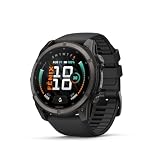
- Premium multisport GPS smartwatch for athletes and adventurers features a bright 1.4" AMOLED display with a scratch-resistant sapphire lens, high-strength titanium bezel and built-in LED flashlight with variable light intensities and a red safety light
- Enhanced stamina metrics, including stamina curve and stamina zones, help you visualize how far, how fast and how long you can go based on your fitness gains and training history
- Garmin Epic feature lets you showcase your adventures; record multiple days of activities — such as epic trail runs, backpacking trips and more — and share photos, as well as health and performance stats, in a cohesive story of events over time
- Push your limits and cross-train with 100+ activity profiles, featuring enhancements to the rowing and rucking activities — as well as advanced fitness and performance tools
- Enhanced activity profiles for both indoor and outdoor rowing help monitor your fitness progress and dial in the intensity of workouts; indoor rowing introduces VO2 max to help gauge cardiovascular fitness and training impact on performance (requires a power meter-equipped rowing machine)

The Honest Verdict First
The Garmin Fenix 9 is the right watch if you own a Fenix 7 or an older model.
The brighter AMOLED display, doubled storage, faster maps, titanium construction, and the new speaker and microphone add up to a meaningful generational step.
If you own a Fenix 8, the decision is more specific.
The GPS accuracy is essentially identical.
The heart rate sensor is the same.
The base battery life in smartwatch mode is the same across equivalent sizes.
The Fenix 9’s brighter screen and faster map engine are real improvements, but they improve something that was already excellent.
Unless you specifically want satellite messaging, the Pro’s extreme battery life, or the new ArcheryX sport mode, the Fenix 8 still serves well.
For anyone buying their first premium outdoor GPS watch, the Fenix 9 is the correct choice.
Everything that made the Fenix line the most respected outdoor watch platform in the world is here, and every component has been improved from where it was.
The Display: The Biggest Change You Notice Every Day

The most noticeable improvement from the Fenix 8 to the Fenix 9 isn’t in the specifications.
It is in how the watch looks on the wrist.
The Fenix 9‘s AMOLED display is the brightest Garmin has put on a standard Fenix.
In direct midday sunlight — when AMOLED displays typically struggle most because bright ambient light competes with screen brightness — the Fenix 9 stays comfortably readable without shading the screen with your hand or squinting.
The Fenix 9 Pro pushes this further with a 3,000-nit display, three times brighter than the standard Fenix 8’s screen.
For buyers who spend extended time at altitude, on the water, or anywhere with intense reflected sunlight, the Pro’s display is the detail that makes checking navigation data mid-activity practical rather than frustrating.
The screen size also increased.
The 47mm Fenix 9 carries a 1.4-inch display.
The 51mm model carries a 1.5-inch display — the largest screen Garmin has ever put on a Fenix. For buyers who rely on on-watch topographic maps during technical navigation, the larger display area means more map visible at once without zooming out.
Maps: The Improvement That Changes Daily Use More Than Any Specification
The Fenix 9 has 50 percent more RAM than the Fenix 8.
That number is a specification.
What it means in practice is something different.
Map panning on the Fenix 8 had a small but noticeable lag.
You would drag the map with your finger, and it would follow a fraction of a second behind.
On technical terrain, when you are trying to understand where a trail goes relative to a ridge line, or when you are verifying a junction while moving, that lag made navigation feel slightly uncertain.
Map panning on the Fenix 9 responds immediately.
The map moves with your finger, like a smartphone map.
Zoom responds the same way.
Garmin confirmed in its launch material that panning is now 30 percent faster, and real-world testing during extended hiking and gravel cycling sessions confirmed this as a genuine daily improvement, not just a benchmark figure.
The Fenix 9 also introduces Perspective View — a new way of seeing the map that tilts the view slightly, like looking at Google Maps in 3D angle mode.
Instead of looking straight down at the terrain, you see the map from a shallow angle, which shows you what is ahead with more spatial context.
It shows what comes after the next ridge, where the trail descends before the next climb, and where the valley opens up.
For technical outdoor navigation, this additional spatial awareness is genuinely useful.
Storage: 64GB and What It Actually Means
The Fenix 8 came with 32GB of storage. The Fenix 9 comes with 64GB. Doubling the storage sounds significant on paper, but the practical applications are worth explaining specifically.
The first application is maps. Garmin’s preloaded TopoActive maps cover large geographic areas but do not cover every corner of the world in equal detail.
Many Fenix owners download additional detailed regional maps before hiking trips, cycling events, or multi-day expeditions.
With 64GB, you can store twice as many map regions as the Fenix 8 — covering a full hiking season across different locations without needing to manage and delete map files between trips.
The second application is music.
The Fenix 9 can store up to 7,000 songs directly on the watch — music that plays through earbuds without a phone.
A full marathon, a 10-hour bikepacking day, a day on the ski mountain: the music never runs out because the phone is not involved.
Titanium on the Standard Model: Why This Matters
Every previous standard Fenix used stainless steel for the bezel and case.
Titanium was reserved for the more expensive Pro versions.
The Fenix 9 changes this. The standard Fenix 9 comes in a titanium case across all three sizes.
Titanium is stronger than stainless steel and significantly lighter for the same strength.
A titanium watch that weighs the same as a stainless steel watch would require more metal in the case because titanium can provide the same protection with less material.
The practical result is a watch that feels lighter and more comfortable during extended daily wearing and multi-day outdoor use than the equivalent stainless steel construction.
For buyers who previously found the weight of the Fenix series a limiting factor for comfortable daily wearing, the titanium construction on the standard Fenix 9 addresses this directly without requiring the premium investment of the Pro tier.
Speaker and Microphone: Answer Calls Without Reaching for Your Phone
The standard Fenix 8 did not have a built-in speaker. The Fenix 9 does.
This means you can answer a phone call directly from your wrist, hear the caller through the watch speaker, and speak through the watch microphone without taking your phone out of your pocket, bag, or vest.
For trail runners who carry a phone in a vest pocket, for cyclists who keep a phone in a jersey pocket, for hikers with a phone in a pack — handling a call without stopping and reaching for it is a practical convenience, not a novelty.
The speaker also enables voice prompts for navigation, workout guidance, and alerts that previously could only be delivered silently through the watch display.
GPS Accuracy: Already Excellent, Consistently Excellent

One honest thing to say about the Fenix 9’s GPS accuracy is that it doesn’t represent a meaningful improvement over the Fenix 8 — because the Fenix 8’s GPS accuracy was already at a level where further improvement is difficult to measure in real-world conditions.
Independent real-world GPS testing during a 6-mile interval run in urban conditions showed only 5.5 metres of total drift compared to the reference route. Off-route alerts were triggered within 5 to 10 feet of the trail edge during hiking.
The multi-band GNSS system simultaneously receives signals from GPS, GLONASS, Galileo, and BeiDou satellite constellations, and the SatIQ system automatically selects the most power-efficient combination of satellite signals that maintains accuracy at any given moment.
For running, hiking, cycling, and any outdoor activity where knowing where you are and where you have been matters, the Fenix 9’s GPS accuracy is excellent.
Battery Life: Honest Real-World Numbers
Garmin’s battery specifications for the Fenix 9 standard are the same as the Fenix 8 at equivalent sizes — 10 days for the 43mm, 16 days for the 47mm, and 29 days for the 51mm in smartwatch mode.
These figures assume approximately 30 minutes of GPS activity per day.
Real-world use with 1 to 2 hours of GPS-tracked activity per day brings these figures closer to 5 days on the 47mm model.
That is the honest figure for a user who wears the watch continuously, tracks a morning run or workout, uses the always-on display, and receives notifications throughout the day.
In a 2-hour mountain run test at maximum accuracy settings, the Fenix 9 Pro used 4 percent of battery.
The Fenix 8 under identical conditions used 5 percent — a modest efficiency improvement that reflects slightly better power management in the Fenix 9’s processor.
The Fenix 9 Pro models extend battery life significantly.
The 51mm Pro Solar, with outdoor wear that exposes the solar charging element to natural light, reaches up to 57 days of normal use and up to 291 days in power-saving mode.
For buyers where multi-week expedition capability matters, these figures are genuinely significant.
ArcheryX: The New Sport Mode Worth Knowing
ArcheryX is a new sport mode on the Fenix 9 that does not appear on any previous Garmin watch and that almost no review has explained properly.
ArcheryX uses the Fenix 9’s sensors to track archery training sessions specifically.
It monitors heart rate during the aim-and-release cycle, records session data including shot timing and stress response, and provides biometric feedback on how physical and mental stress affect performance during competition and training.
For competitive archers who train seriously, having a watch that understands their sport specifically rather than treating archery as a generic activity is a meaningful addition.
For most Fenix 9 buyers who don’t do archery, this feature exists quietly alongside 100 other sport modes and costs them nothing. But for the archery community, it is the first time a mainstream premium GPS watch has acknowledged their sport with dedicated tracking.
Garmin Fenix 9 vs Garmin Fenix 8
| Feature | Garmin Fenix 8 | Garmin Fenix 9 |
|---|---|---|
| Display | AMOLED | Brighter AMOLED |
| Pro brightness | Standard | 3,000 nits (Pro) |
| Storage | 32GB | 64GB |
| RAM | Baseline | 50% more |
| Map panning | Small lag | 30% faster |
| Perspective View | No | Yes |
| Case material | Steel (standard) | Titanium (standard) |
| Speaker | Pro only | All models |
| Microphone | Pro only | All models |
| ArcheryX | No | Yes |
| Dynamic Battery GPS | No | Yes |
| Battery (47mm) | 16 days | 16 days — same |
| GPS accuracy | Excellent | Excellent — same |
| HR sensor | Gen 5 | Gen 5 — same |
| Water resistance | 100m | 100m — same |
Who Should Buy the Garmin Fenix 9
You own a Fenix 7 or any older Garmin and you want the current flagship platform with all its training features, navigation depth, and the improved display and map engine.
You are buying your first premium outdoor GPS watch, and you want the most capable version available.
You need 64GB of storage for extensive regional map downloads or music.
You train for and compete in events that run long enough to benefit from the satellite messaging on the Pro inReach models. You specifically want titanium construction without paying for the Pro tier.
For a closer look at how the Garmin Fenix 9 compares with the Garmin Quatix 8 for buyers who want marine-specific features on the Fenix platform, the full guide at garmin-quatix-8-vs-fenix-8 covers both lines in detail.
Who Should Not Buy the Garmin Fenix 9
You own a Fenix 8 and your primary use is training analytics and daily health monitoring — the GPS, HR sensor, and base battery life are unchanged, and the brighter display and faster maps are improvements but not transformative ones at the Fenix 8’s already high baseline.
If you’re looking for a watch primarily for notifications, calls, and daily health tracking rather than outdoor sport, the Garmin Venu 4 or Forerunner 165 serve that use case better at a fraction of the investment. You specifically need the satellite messaging capability on a budget — the inReach version adds meaningfully to the base price.
Full Specifications
| Feature | Garmin Fenix 9 (47mm) |
|---|---|
| Pro ASIN | B0HGG2WM1D (Pro 47mm) |
| Launch | August 25, 2026 |
| Case | 47mm titanium |
| Display | 1.4″ AMOLED |
| Storage | 64GB, up to 7,000 songs |
| RAM | 50% more than Fenix 8 |
| Battery smartwatch | Up to 16 days |
| Battery GPS | Up to 30 hours normal, 81 hours max battery |
| GPS | Multi-band GNSS + SatIQ |
| Water resistance | 100 metres |
| Dive rating | 40 metres |
| Speaker | Yes |
| Microphone | Yes |
| New features | Perspective View, ArcheryX, Dynamic Battery GPS |
| Sport modes | 100+ |
| Compatibility | iOS and Android |
FAQs
Is the Garmin Fenix 9 worth upgrading from the Fenix 8?
The honest answer depends on what specifically changed between the two models and how those changes apply to your daily use. The brighter display is noticeable and useful every day. Faster map panning can make navigation during technical outdoor activity feel less uncertain and more responsive. The titanium case on the standard model reduces weight and improves durability compared to the stainless steel of the equivalent Fenix 8. The doubled storage is practical for buyers who load regional maps or music. The speaker and microphone are genuinely useful for riders, runners, and hikers who want to handle calls without stopping. These are real improvements. What didn’t change is the GPS accuracy, the heart rate sensor, and the base battery life at equivalent sizes. For Fenix 8 owners whose primary frustrations are those three areas, the Fenix 9 doesn’t address them because they didn’t need addressing—they were already excellent. For Fenix 8 owners who find the map lag noticeable, the storage limiting, or who specifically want satellite messaging on the Pro, the Fenix 9 provides those specific improvements.
What is the difference between the Garmin Fenix 9 and Fenix 9 Pro?
The standard Fenix 9 and Fenix 9 Pro share the same titanium case, GPS system, sport modes, and core training platform. The differences are display brightness, satellite connectivity, and battery life. The Fenix 9 Pro carries a 3,000-nit AMOLED display that is about three times brighter than the standard Fenix 9 in maximum brightness mode — a display that stays fully readable in the most intense direct sunlight, including high-altitude and open-water environments. The Pro inReach variant adds satellite and LTE messaging through Garmin’s inReach system, enabling two-way text messaging via satellite when beyond mobile phone range—a key capability for expeditions, remote trail running, and any outdoor use where genuine off-grid communication matters. The Pro Solar variant replaces the AMOLED display with Garmin’s Power Glass Solar MIP display, extending battery life significantly through solar charging — up to 57 days of normal use and 291 days in power-saving mode on the 51mm version.
Does the Garmin Fenix 9 work with iPhone?
Yes. The Garmin Fenix 9 connects to both iPhone and Android phones through the Garmin Connect app. The full feature set — training analysis, health monitoring, map downloads, music syncing from streaming services, notifications, and Connect IQ app downloads — is available on both platforms. Garmin’s ecosystem doesn’t restrict features by phone brand, so the Fenix 9 delivers the same experience whether your phone is an iPhone or Android. Garmin Connect has supported both iOS and Android since its introduction, and the Fenix 9 benefits from the platform’s full depth on either phone. For a broader look at how the Garmin Fenix 9 compares against Apple Watch Ultra 4 for buyers choosing between the two premium outdoor platforms, the full guide at best-smartwatches-for-hiking covers both platforms across outdoor use cases in detail.
Luis Cooper

Hi, I'm Luis, the guy behind this site. I love wearing watches, especially ones that look great on small wrists (mine are about 6.3" around). The Watches Geek is dedicated to helping you learn about and buy watches that you will love wearing. I want this website to be the last destination for people to pick the best watches to fit their needs. You can find our unbiased reviews here on Thewatchesgeek.