
Last Updated on September 29, 2026 by Luis Cooper
Every runner, cyclist, and hiker eventually reaches a specific moment.
You are three kilometers into a run. Your playlist is exactly right. The pace feels good.
And then your phone buzzes in your armband, the screen lights up, and the rhythm breaks. You slow down slightly to check if it was important. It was not. The moment is gone.
A Garmin watch with music eliminates this problem completely. You download your playlists directly to the watch before you leave.
You pair your earbuds to the watch rather than your phone. Your phone stays home. Your run stays uninterrupted from start to finish.
Every Garmin watch on this list stores music directly on the device. Every one of them connects to Bluetooth earbuds.
And every one of them supports Spotify, Amazon Music, and Deezer — meaning you can sync your existing playlists to the watch over Wi-Fi before heading out rather than building a separate library from scratch.
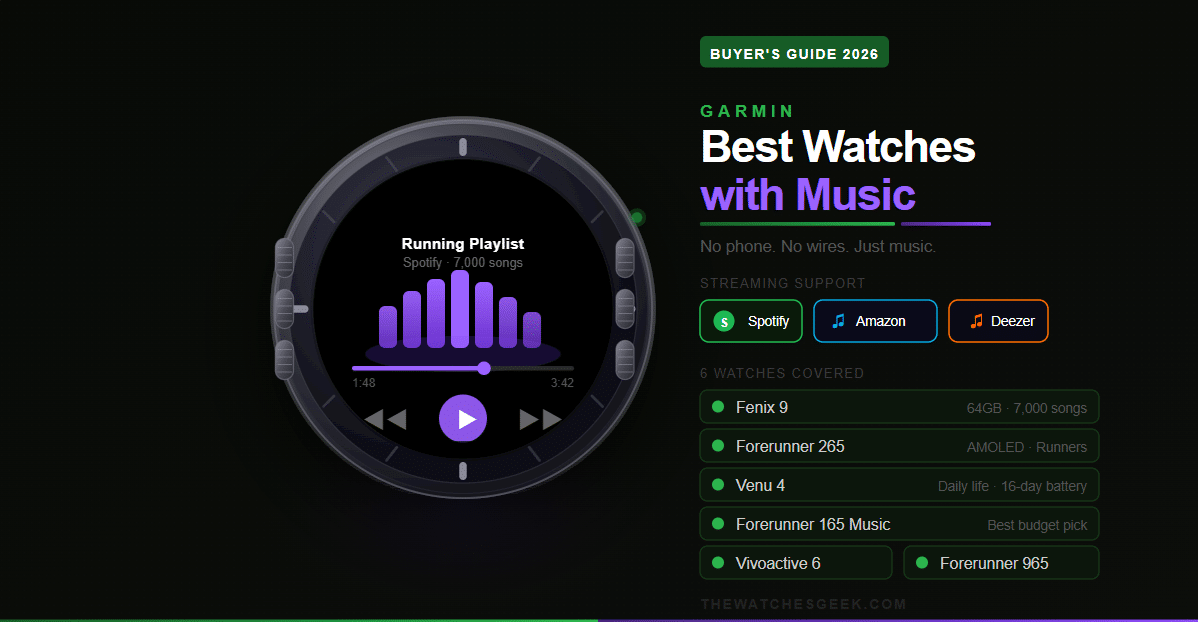
The six watches below cover every type of Garmin buyer — from someone who wants a budget running watch with enough storage for a few playlists, to someone who wants 7,000 songs on their wrist alongside full topographic navigation for multi-day expeditions.
Before the list, one quick note. Garmin’s music feature works through Wi-Fi sync rather than real-time streaming over cellular.
You sync your playlists to the watch at home, then play them from the watch’s internal storage during your activity.
This is better than streaming for athletes because it uses no data, drains less battery, and works in areas with no phone signal.
Which are the Best Garmin Watches with Music?
Here are my recommended top 6 Best Garmin watches with Music:-



Garmin Fenix 9: (Best Garmin Watch with Music for Serious Athletes)

A trail ultramarathon runner who regularly competes in events lasting over 12 hours described the moment she switched from carrying her phone in a vest pocket to leaving it at home as the moment running finally felt completely free.
She had been carrying the phone for the music.
Once the Garmin Fenix 9 was on her wrist, the phone had no role to play on race day.
The music was already there.
The navigation was already there. The heart rate monitoring, the training load tracking, the hydration reminders — all on the watch.
She described finishing her first phone-free ultra as the most uncomplicated race she had ever run.
64GB of Storage — What It Actually Means:
The Garmin Fenix 9 comes with 64GB of internal storage.
At typical music file sizes, that holds approximately 7,000 songs.
For context, a full day of running at one song per four minutes covers around 360 songs.
With 7,000 songs stored, you could run every day for three weeks without hearing the same track twice, with storage still remaining. For most people, 64GB means you never have to think about which playlist to sync before a workout — everything fits.
The previous generation Fenix 8 came with 32GB.
The Fenix 9 doubled that, the biggest storage upgrade in the Fenix line’s history.
For athletes who listen to audiobooks, podcasts, and music across different training modes, the extra space fits all three without having to manage what gets deleted to make room.
Syncing Spotify, Amazon Music, and Deezer
All three major streaming services integrate with the Fenix 9 through the Garmin Connect IQ app.
The process is straightforward. Connect the watch to Wi-Fi, open the Spotify, Amazon Music, or Deezer app on the watch, select the playlists you want to download, and let the watch sync them overnight or during a period when you are not training.
The downloaded playlists sit on the watch’s internal storage and play from there. No phone signal required.
No cellular data. No buffering. During a trail run in an area without mobile coverage, the music works exactly the same way it does in an urban park — because the files are already on the watch.
Garmin Pay is also available on the Fenix 9, so you can handle a post-run coffee purchase, a locker fee, or a race registration top-up from the wrist without a wallet or phone in the car park.
The Speaker — A New Addition to the Base Model
The Fenix 8 required the more expensive Pro model to get a built-in speaker.
The Fenix 9 includes a speaker on the standard model for the first time.
For music specifically, this means workout audio prompts come through the watch speaker when earbuds are not paired.
For runners who train without earbuds — trail running in remote areas where hearing the environment matters for safety, for example — audio cues for pace, distance, and heart rate zones can be delivered without earbuds.
The speaker also handles incoming calls.
When your phone is nearby, you can answer a call from your wrist without stopping or reaching into a vest pocket.
This is the feature most Fenix 9 owners didn’t realize they needed until they used it on their first long run.
Music for Multi-Day Expeditions
Most music discussions focus on workout duration — enough songs for a marathon, a long cycle, a gym session.
The Fenix 9 extends this to territory most music watches cannot reach.
In GPS mode with music playing through Bluetooth earbuds, the Fenix 9 47mm model runs for approximately 14 hours before needing a charge.
The 51mm model extends this to around 20 hours under similar conditions.
The Low Power GPS mode, which reduces satellite frequency while maintaining useful tracking, extends these figures meaningfully for multi-day expeditions where a charging opportunity may not occur daily.
For fastpacking, bikepacking, and multi-day trail events where athletes move for 10 to 16 hours across multiple days, having music available for the full duration without battery anxiety is a capability no other Garmin model in this guide matches.
For a closer look at every new feature the Garmin Fenix 9 introduced, including the titanium case, faster map rendering, and the full specification comparison with the Fenix 8, the full review at garmin-fenix-9-review covers the watch in complete detail.
Who this is not for: The Fenix 9 is a premium outdoor GPS watch, and its price reflects its full capability. Buyers who specifically want music for casual daily use and shorter workouts will find the same Spotify, Amazon Music, and Deezer integration on the Garmin Venu 4 and Vívoactive 6 lower in this guide at a significantly lower investment.
Specifications
| Feature | Details |
|---|---|
| Music Storage | 64GB — approximately 7,000 songs |
| Streaming | Spotify, Amazon Music, Deezer |
| Speaker | Yes — built-in on standard model |
| Battery with music | 14-20 hours GPS + music (size dependent) |
| GPS | Multi-band GNSS |
| Water | 100 metres |
| Case | Titanium, 43mm / 47mm / 51mm |
| Compatibility | iOS and Android |
Garmin Forerunner 265: (Best Garmin Music Watch for Runners)

A marathon runner who trains six days a week described the Forerunner 265 as the first watch that genuinely understood the difference between the music she needed for easy recovery runs and the music she needed for hard interval sessions.
Not because the watch chose her music — it did not.
But because the Training Readiness score it generated each morning told her before she left the house whether today was an easy day or a hard one, which changed which playlist she synced before heading out.
The watch shaped how she used the music as much as it stored it.
AMOLED Display That Changes How Music Controls Feel
The Forerunner 265 uses a bright AMOLED touchscreen, which changes the music control experience during a run compared to button-only navigation.
Skipping a track, adjusting volume, or switching playlists mid-run is a single tap on the screen rather than a sequence of button presses while moving.
In the rain, with gloves on, or at speed, the touchscreen with large music control icons is faster and more reliable than navigating button menus.
For runners who actively manage their music during workouts rather than setting a playlist and leaving it alone, this practical advantage compounds across every training session.
Music Storage and Streaming
The Forerunner 265 stores up to 1,000 songs internally.
Spotify, Amazon Music, and Deezer all sync to the watch over Wi-Fi using the same process as the Fenix 9.
Select your playlists in the streaming app on the watch, connect to Wi-Fi, and the download runs in the background while you do something else.
Battery life in GPS mode with music running is about 20 hours—enough for any marathon training run, race day, and recovery run the following day without charging in between.
Training Readiness synthesizes your overnight HRV, sleep quality, and recent training load into a morning score that tells you whether today is appropriate for a hard session or whether your body needs something easier.
Daily Suggested Workouts then recommends a specific session based on that score.
For runners who use music to match their training intensity, having the watch tell you the intensity before you choose the soundtrack is a genuinely useful pairing.
Who this is not for: Runners who want topographic maps and multi-day expedition battery life should look at the Fenix 9 above. The Forerunner 265 is a running-first watch — the navigation is breadcrumb-level rather than full topographic mapping, and that is the appropriate trade-off for its price and intended use.
Specifications:
| Feature | Details |
|---|---|
| Music Storage | Up to 1,000 songs |
| Streaming | Spotify, Amazon Music, Deezer |
| Display | AMOLED touchscreen |
| Battery GPS + music | Approximately 20 hours |
| Training | Training Readiness, Daily Suggested Workouts |
| Water | 5 ATM |
| Compatibility | iOS and Android |
Garmin Venu 4: (Best Garmin Music Watch for Daily Life)

A hospital pharmacist who commutes by train, works a nine-hour shift, hits the gym three evenings a week, and fits a morning run in when she can described the Garmin Venu 4 as the first watch she has owned that handled every part of her day without feeling like it belonged only to one part of it.
The gym sessions, the commute playlist, the sleep tracking overnight, the Body Battery reading before deciding whether the morning run was worth attempting — all covered by one watch that looked appropriate in every context she wore it.
Music Across Every Part of the Day
Most music watch conversations focus on workout use. The Venu 4 extends this to the full day in a way that genuinely changes how useful the music feature is.
The watch connects to Bluetooth earbuds and plays stored music with equal ease during a commute, a gym session, a lunch-break walk, or a recovery run.
Spotify, Amazon Music, and Deezer all sync over Wi-Fi to the internal storage. Garmin Pay handles the coffee purchase on the way to the train without reaching for a phone. The always-on AMOLED display shows the current track and controls without waking the screen first.
For someone whose day moves continuously between professional, fitness, and personal contexts, the Venu 4 offers a watch that covers all three without looking like a sports device in a professional setting.
Body Battery and Music Together
The Venu 4 tracks Body Battery continuously throughout the day — a score from zero to one hundred that reflects your current energy level based on sleep quality, stress, heart rate variability, and physical activity since your last full recovery.
For music specifically, this creates a genuinely useful daily dynamic.
A Body Battery of 80 at 6am means an energetic playlist and a hard run before work makes sense. A Body Battery of 34 at 6am means the easy recovery playlist and a shorter session is the smarter choice.
The watch gives you that information before the earbuds go in, which shapes how you use the music as much as what you listen to.
The 16-day smartwatch battery means the Venu 4 charges roughly twice a month for buyers who wear it all day and overnight for sleep tracking.
Music syncing happens during the brief charging window without disrupting the continuous wear that makes the health data meaningful.
Who this is not for: Runners who specifically need advanced running metrics, including Training Readiness, Daily Suggested Workouts, and VO2 max tracking, should look at the Forerunner 265 above. The Venu 4 is a health and lifestyle watch with strong fitness features, not a dedicated running platform.
Specifications:
| Feature | Details |
|---|---|
| Music Storage | Spotify, Amazon Music, Deezer via Wi-Fi sync |
| Display | AMOLED, 1.4 inch, always-on |
| Battery Smartwatch | 16 days |
| Battery GPS | 20 hours |
| Health | Body Battery, HRV, sleep coaching, stress |
| Payment | Garmin Pay |
| Water | 5 ATM |
| Compatibility | iOS and Android |
Garmin Forerunner 165 Music: Best Budget Garmin Watch with Music

A university student who runs four mornings a week said her budget for a Garmin watch was what kept her from buying one for two years.
Every Garmin with music she looked at cost more than she was prepared to spend on her first proper running watch.
She had been using her phone in an armband, and the armband had started chafing on longer runs.
She needed the phone off her wrist but couldn’t justify the premium models.
The Forerunner 165 Music was the watch that ended the search.
The Same Streaming, A Fraction of the Price
The Forerunner 165 Music supports Spotify, Amazon Music, and Deezer through exactly the same Wi-Fi sync process as the Fenix 9 and Forerunner 265.
You install the streaming apps from the Garmin Connect IQ store; select your playlists on the watch, connect to Wi-Fi, and the download runs in the background.
The experience of listening to music from the watch during a run is identical regardless of which Garmin model you own.
The earbuds connect to the watch via Bluetooth. The phone stays home.
The playlist plays from internal storage, with no mobile signal required.
At this price, the change is storage capacity rather than streaming access.
The Forerunner 165 Music holds enough songs for most training sessions without being able to store an entire music library the way the Fenix 9 can.
For a buyer who runs for 45 minutes to two hours and uses one or two playlists, the storage is more than adequate.
AMOLED at the Budget Price Point
Previous budget Garmin running watches used MIP displays — readable outdoors but visually dated compared to modern smartwatches.
The Forerunner 165 broke this pattern by introducing AMOLED at the entry level of Garmin’s music-capable running range.
The display is vivid, the track information is clearly readable mid-run, and the music controls look current rather than functional-but-basic.
For a buyer who previously hesitated on budget Garmins because the screen looked old-fashioned, the Forerunner 165 removes that objection.
Training Readiness gives a morning recovery score. Daily Suggested Workouts recommends a specific session based on that score. VO2 max tracks fitness progression over months.
All three carry over from more expensive Garmin models, without the premium price tag.
The 19-hour GPS battery covers any realistic training run or race without concern. The 11-day smartwatch battery handles two full weeks of daily wearing between charges.
Who this is not for: Buyers who want to store their entire music library on the watch should look at the Fenix 9 with its 64GB storage. The Forerunner 165 suits buyers who use one or two playlists per training session rather than needing their full collection available.
Specifications:
| Feature | Details |
|---|---|
| Music Storage | Internal storage for training playlists |
| Streaming | Spotify, Amazon Music, Deezer |
| Display | AMOLED colour |
| Battery GPS | 19 hours |
| Battery Smartwatch | 11 days |
| Training | Training Readiness, Daily Suggested Workouts, VO2 max |
| Water | 5 ATM |
| Compatibility | iOS and Android |
Garmin Vívoactive 6: (Best Garmin Music Watch for Beginners)

A primary school teacher who had never owned a smartwatch before said her decision to buy the Vívoactive 6 came down to one conversation with a colleague who had owned three different smartwatches from three different brands.
The colleague had tried them all.
She said the Vívoactive 6 was the only one that felt designed for someone who wanted it to work, not someone who wanted to learn how it worked.
That description settled it immediately.
Music Without the Learning Curve
Setting up music on the Vívoactive 6 takes one evening the first time and no time at all after that.
Download the Spotify, Amazon Music, or Deezer app through the Garmin Connect IQ store on your phone.
Connect the watch to your home Wi-Fi from the settings menu. Open the streaming app on the watch, select the playlists you want to download, and leave the watch charging overnight.
By morning, the music is on the watch and ready to play.
Pair your Bluetooth earbuds to the watch rather than the phone. Press play. The phone stays home.
That is the complete setup.
No ongoing management, no syncing before every run, and no decisions to make once the initial playlists are downloaded.
The music is there every time you pick up the watch.
11 Days of Battery Means Music Is Always Ready
The Vívoactive 6 runs for 11 days in smartwatch mode between charges.
For a first-time smartwatch owner, this changes your relationship with the device.
A watch that charges every night is a device you manage. A watch that charges every 11 days is something you put on and forget about — and that difference in mental load matters enormously for someone establishing the habit of wearing a smartwatch for the first time.
The music is always synced and ready because the watch is almost always charged.
No morning routine is disrupted by a dead watch, no scramble to charge before a run, and no decision about whether to skip the music today because the battery is low.
In GPS mode with music through Bluetooth earbuds, the battery lasts about 17 hours—enough for any run, cycle, or outdoor session a beginner would realistically attempt.
80 Sport Modes and Garmin Pay
The Vívoactive 6 includes 80+ sport modes, covering everything from walking and running to swimming, yoga, strength training, cycling, and dozens of activities in between.
For a first-time Garmin owner who is not yet sure which activities they will settle into, having every option available without needing to add them later removes a future limitation before it arrives.
Garmin Pay handles contactless payments from the wrist.
For someone running or cycling without a wallet or phone, being able to buy a drink, pay for parking, or grab something after a workout from the watch is the convenience that makes leaving the phone at home feel genuinely practical rather than slightly risky.
For a closer look at how the Vívoactive 6 performs across health monitoring and daily wellness tracking beyond the music features, the full guide at best-smartwatches-under-300 covers it alongside every current mid-range smartwatch in detail.
Who this is not for: Runners who want advanced training metrics, including Training Readiness, VO2 max tracking, and Daily Suggested Workouts, should look at the Forerunner 165 Music above. The Vívoactive 6 is the right choice for buyers who want a capable everyday smartwatch with music — not a dedicated running platform.
Specifications:
| Feature | Details |
|---|---|
| Music Streaming | Spotify, Amazon Music, Deezer |
| Display | AMOLED, 1.2 inch |
| Battery Smartwatch | 11 days |
| Battery GPS | 17 hours with music |
| Sport Modes | 80 plus |
| Payment | Garmin Pay |
| Health | Body Battery, sleep, HRV, stress |
| Water | 5 ATM |
| Compatibility | iOS and Android |
Garmin Forerunner 965: Best Premium Garmin Music Watch for Competitive Runners

A 41-year-old civil engineer who runs half marathons on weekends described his decision to buy the Forerunner 965 as the first time he had spent money on a watch and felt no regret the following morning.
He had owned cheaper running watches. They tracked his runs. They counted his kilometres.
They told him his heart rate. But they never told him anything he could actually act on — nothing that changed how he trained the following week or explained why a Tuesday session felt harder than an identical Wednesday session four days later.
The Forerunner 965 changed that. And the music storage meant he stopped noticing the phone was at home within three runs.
The Premium Running Platform With Music Built In
The Forerunner 965 sits at the top of Garmin’s dedicated running watch lineup and offers the full depth of training analytics serious recreational and competitive runners use to improve, not just record.
Training Readiness synthesizes overnight HRV, sleep quality, and recent training load into a morning score that tells him specifically whether today is appropriate for a hard session or whether his body is signaling it needs something easier.
Daily Suggested Workouts then recommends a specific session — not a generic suggestion but a structured workout calibrated to his current fitness and recovery state.
Race Predictor uses his recent training data to estimate his finish time across distances from 5K to marathon, updating as his fitness changes.
For a runner who races with specific time goals rather than simply finishing, these features provide the analytical depth that justifies the premium tier.
Music storage makes it all available from a single watch that can also replace the phone on every training run.
Music Storage and the AMOLED Display Together
The Forerunner 965 stores music directly and supports Spotify, Amazon Music, Deezer, and YouTube Music through Wi-Fi sync.
The AMOLED touchscreen makes changing tracks during a run as fast as on a smartphone—a single tap rather than button navigation while maintaining stride.
The display is bright enough to read the current track name, heart rate zone, and pace simultaneously in direct afternoon sunlight without adjusting the screen angle.
For a runner who checks multiple data fields during an interval session while managing music between reps, having everything clearly visible without pausing matters more across a two-hour session than it sounds in a specification.
Battery life in GPS mode with music running sits at approximately 19 hours — enough for any competitive training run and most race events including marathon distance without charging between the warm-up and the finish line.
Who this is not for: Runners who train primarily outdoors on technical terrain and need topographic maps alongside music should look at the Garmin Fenix 9 at the top of this guide. The Forerunner 965 is a road and track running watch with breadcrumb navigation rather than full topo mapping.
Specifications:
| Feature | Details |
|---|---|
| Music Storage | Yes — Spotify, Amazon Music, Deezer, YouTube Music |
| Display | AMOLED touchscreen, bright outdoor visibility |
| Battery GPS + music | Approximately 19 hours |
| Training | Training Readiness, Daily Suggested Workouts, Race Predictor |
| Navigation | Breadcrumb, colour maps |
| Payment | Garmin Pay |
| Water | 5 ATM |
| Compatibility | iOS and Android |
Quick Comparison — All 6 Watches
| Watch | Best For | Storage | Battery GPS | Streaming |
|---|---|---|---|---|
| Fenix 9 | Outdoor athletes | 64GB — 7,000 songs | 14-20 hours | Spotify, Amazon, Deezer |
| Forerunner 265 | Runners | 1,000 songs | 20 hours | Spotify, Amazon, Deezer |
| Venu 4 | Daily life | Playlist sync | 20 hours | Spotify, Amazon, Deezer |
| Forerunner 165 Music | Budget buyers | Training playlists | 19 hours | Spotify, Amazon, Deezer |
| Vívoactive 6 | Beginners | Playlist sync | 17 hours | Spotify, Amazon, Deezer |
| Forerunner 965 | Competitive runners | Full sync | 19 hours | Spotify, Amazon, Deezer, YouTube |
FAQs
Do Garmin watches support Spotify and music streaming?
Yes — but with one important clarification that makes a real practical difference. Garmin watches do not stream music live over the air the way you stream on a phone with a data connection. Instead, Spotify, Amazon Music, Deezer, and YouTube Music all sync their playlists directly to the watch’s internal storage over Wi-Fi before the workout. Once downloaded, those playlists play from the watch itself with no phone signal, no cellular data, and no buffering. This is actually better for athletes than live streaming because the music works in areas with no mobile coverage, uses no data, and drains the battery less than streaming would. The process takes one setup evening and runs automatically in the background during charging after that.
Which Garmin watch has the most music storage?
The Garmin Fenix 9 has the largest music storage of any current Garmin watch at 64GB, which holds approximately 7,000 songs. This is double the storage of the Fenix 8’s 32GB and significantly more than any other model in this guide. For buyers who want their full music library — including albums, playlists, audiobooks, and podcasts across multiple streaming services — on the wrist simultaneously, the Fenix 9 is the only Garmin model that accommodates everything without managing what gets deleted to make space.
Can you control music on a Garmin watch without storing it on the watch?
Yes. Every Garmin watch, including models that do not have onboard music storage, can control music playing on a paired smartphone. This means skipping tracks, adjusting volume, and pausing and playing from the watch display even when the music itself is playing through the phone. However, this requires the phone to be nearby and connected via Bluetooth, which defeats the phone-free workout experience that most buyers want from a music-capable Garmin. All six watches in this guide store music directly on the watch, which means the phone is genuinely optional rather than required within Bluetooth range. For a closer look at how the Garmin health platform works across sleep tracking, recovery, and daily wellness monitoring beyond music, the full guide at best-smartwatches-for-sleep-tracking covers Garmin alongside every major smartwatch platform in detail.
Related Articles:
Best Smartwatches Without Nickel
Smartwatches With The Best Battery Life
Best Fossil Smartwatches Under $250
Luis Cooper

Hi, I'm Luis, the guy behind this site. I love wearing watches, especially ones that look great on small wrists (mine are about 6.3" around). The Watches Geek is dedicated to helping you learn about and buy watches that you will love wearing. I want this website to be the last destination for people to pick the best watches to fit their needs. You can find our unbiased reviews here on Thewatchesgeek.