
Last Updated on November 26, 2026 by Luis Cooper
You found the perfect watch. The photos look great. The price feels right. And then you read the description.
“Swiss automatic movement with a sapphire crystal, exhibition caseback, and 300m water resistance.”
What does any of that actually mean?
Watch brands use a lot of technical language — and most of it goes unexplained. As a result, buyers end up guessing, overpaying for things they don’t need, or missing features that actually matter.
This watch glossary fixes that. Below, you’ll find 52 of the most important watch terms, explained in plain English. No experience required. Each term also includes a short note on why it matters when you’re shopping — because knowing a word and knowing when it matters are two different things.
Bookmark this page and come back any time a watch listing leaves you scratching your head.
Watch Glossary: 52 Watch Terms Every Buyer Must Know
How to Use This Glossary
Terms are organized by category so you can jump straight to what you need:
- Movement Terms — The engine inside the watch
- Case & Dial Terms — What you see from the outside
- Complications — Extra functions beyond telling time
- Water Resistance Terms — How waterproof is waterproof?
- Crystal Types — What protects the watch face
- Strap & Bracelet Terms — What holds the watch on your wrist
- Materials & Finishes — What the watch is made of
- Certifications & Industry Terms — What those stamps and labels mean
Movement Terms
The movement is the engine inside a watch. Everything the watch does — keeping time, running complications, lasting years — depends on the movement. Here are the key terms you need to know.
1. Automatic Movement
What it means: An automatic watch winds itself using the natural movement of your wrist. Inside the watch is a small weighted piece called a rotor. Every time your arm moves, the rotor spins and tightens the mainspring, keeping the watch running.
Why it matters: You never need to wind an automatic watch as long as you wear it regularly. If you take it off for a few days, it may stop — that’s normal. It doesn’t mean the watch is broken. Just wind the crown a few times by hand to restart it.
Automatic watches are a type of mechanical watch. The two terms are sometimes used interchangeably, but they’re not the same — see Manual Movement below.
2. Manual (Hand-Wound) Movement
What it means: A manual movement requires the wearer to wind the watch by hand, usually every day or every few days, by turning the crown. There’s no rotor inside to do it automatically.
Why it matters: Manual watches are often thinner and simpler than automatic watches because they don’t need a rotor. Watch enthusiasts love the ritual of winding, but for everyday buyers, an automatic is usually more convenient.
3. Quartz Movement
What it means: A quartz watch runs on a battery. Inside, an electric current passes through a tiny piece of quartz crystal, which vibrates 32,768 times per second. Those vibrations are counted electronically to keep time very accurately.
Why it matters: Quartz watches are the most accurate and the most affordable. They lose or gain about 15 seconds per month on average — far less than a mechanical watch. If accuracy and low maintenance are your priorities, quartz is the right choice.
4. Solar-Powered Movement
What it means: A solar watch charges its battery using light — sunlight or even indoor light — through a photovoltaic cell hidden beneath the dial. The stored power keeps the watch running even in the dark.
Why it matters: Solar watches are practically maintenance-free. You never need to replace a battery. A full charge on some models can power the watch for months without any light at all. Good for people who hate the idea of ever taking their watch to a shop.
Citizen (Eco-Drive) and Seiko (Solar) are the most well-known solar watch brands.
5. Caliber
What it means: Caliber is another word for the movement—the internal mechanism that powers the watch. Watch brands assign model numbers to their movements, and those numbers are called caliber references. For example, Seiko’s caliber 4R36 is a specific automatic movement they use across several watches.
Why it matters: When a brand says “in-house caliber,” it means they designed and built the movement themselves, which is considered a sign of quality and craftsmanship. When they use an “ETA” or “Miyota” caliber, they’re using a movement made by a third-party supplier — which isn’t a bad thing, as these are reliable, proven movements.
6. Rotor
What it means: The rotor is a half-moon-shaped metal weight inside an automatic watch that spins freely as your wrist moves. The spinning motion winds the mainspring, keeping the watch powered.
Why it matters: If you turn an automatic watch over and it has a transparent (exhibition) caseback, you can often see the rotor spinning as you move the watch. It’s one of the most satisfying things to watch in a mechanical timepiece.
7. Power Reserve
What it means: Power reserve is how long a fully wound watch will continue running without being worn or wound again. It’s measured in hours or days.
Why it matters: Most automatic watches have a power reserve of 38 to 48 hours. That means if you take the watch off Friday evening, it may stop by Sunday morning. Some watches have longer reserves — 72 hours, 7 days, or even more. If you rotate between watches, look for a longer power reserve or consider a watch winder.
8. Jewels
What it means: Watch jewels are small synthetic rubies or sapphires used as bearings inside the movement. They reduce friction between metal parts, helping the watch run smoothly and last longer.
Why it matters: A common question is “are more jewels better?” The answer is: not necessarily. Most watches need 17 jewels to run properly. Extra jewels in a basic watch are sometimes added for marketing rather than function. In a high-quality watch, more jewels can serve real purposes — but don’t judge a movement by jewel count alone.
9. Frequency (Beat Rate)
What it means: Frequency describes how fast the balance wheel inside a mechanical movement oscillates back and forth. It’s measured in beats per hour (bph) or Hertz (Hz). Common frequencies are 21,600 bph (6 Hz), 28,800 bph (8 Hz), and 36,000 bph (10 Hz).
Why it matters: A higher frequency generally means smoother seconds-hand movement and better accuracy, but it also means the movement wears out faster if not serviced regularly. For most buyers, frequency is a background technical detail — what matters more is the overall quality of the movement.
10. Hacking Seconds
What it means: A watch with hacking seconds has a feature that stops the seconds hand the moment you pull the crown out to set the time. This lets you sync the watch exactly to a reference time — like your phone’s clock — before pushing the crown back in.
Why it matters: It’s a small but useful feature. Without it, you can only get your watch within about 30 seconds of the correct time. With hacking, you can set it to the exact second. Most modern watches have this, but some older or simpler models don’t.
11. Mainspring
What it means: The mainspring is a long, coiled metal spring inside a mechanical watch. It stores energy when wound (either by hand or by the rotor) and releases that energy slowly to power the watch.
Why it matters: This is the reason a mechanical watch doesn’t need a battery. The mainspring is the energy source. When it’s fully wound, the watch runs. When it runs down, the watch stops. Simple as that.
12. Escapement
What it means: The escapement is the mechanism that controls how the mainspring’s energy is released. It works by locking and unlocking a gear train in a precise, rhythmic way — producing the ticking sound you hear in mechanical watches.
Why it matters: The escapement is essentially the heartbeat of a mechanical watch. The quality and design of the escapement directly affects how accurately the watch keeps time. This is why fine watchmaking is considered an art — the escapement must be perfectly made and adjusted.
Case & Dial Terms
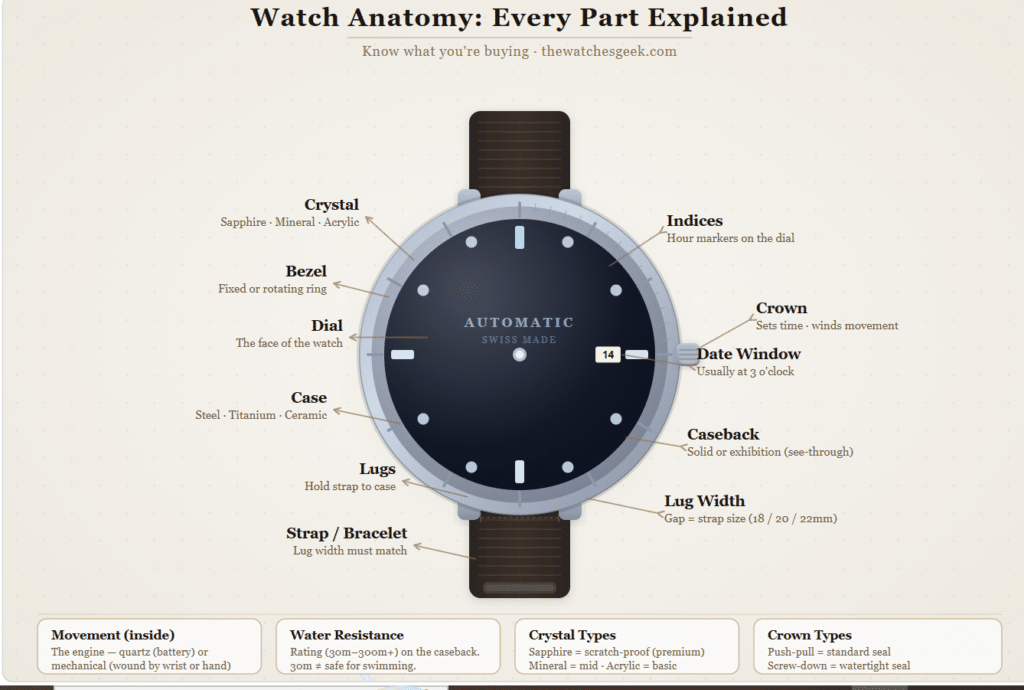
The case is the outer shell of the watch. The dial is the face. Here’s the vocabulary you need to understand what you’re looking at.
13. Case
What it means: The case is the metal (or ceramic, or plastic) body that houses and protects the movement. It’s what gives the watch its shape and size. Cases come in round, square, rectangular, and other shapes.
Why it matters: Case size (measured in millimeters across the dial) dramatically affects how a watch looks and feels on the wrist. For most women, 34–38mm is comfortable. For most men, 40–44mm works well — but personal preference matters more than any guideline. Read our watch size guide for a full breakdown.
14. Dial
What it means: The dial is the face of the watch — the part you look at to read the time. It displays the hour markers, hands, and any additional information the watch shows (date, day, seconds, etc.).
Why it matters: Dial design is hugely personal. Some people want a clean, minimal dial. Others want a busy, detailed one. Neither is wrong. What matters is that the dial is legible in the conditions you’ll wear the watch in. Dark conditions? Look for good lume (see below). Bright outdoor use? High contrast between hands and dial helps.
15. Bezel
What it means: The bezel is the ring that surrounds the crystal (the glass cover over the dial). It can be fixed (decorative only) or rotating (functional, used for timing or tracking a second time zone).
Why it matters: A rotating bezel adds function to the watch. A unidirectional rotating bezel (turns only counterclockwise) is standard for dive watches—it’s designed so that if you accidentally knock it, the bezel can only move in a direction that overestimates remaining dive time, never underestimates it. That’s a safety feature, not a quirk.
16. Crown
What it means: The crown is the small knob on the side of the watch case, usually at the 3 o’clock position. You pull it out and turn it to set the time, date, or wind the mainspring.
Why it matters: The crown is also the main point where water can enter the watch. A push-pull crown simply pulls out and pushes back in. A screw-down crown threads into the case like a bottle cap, creating a much more secure seal against water. If water resistance matters to you, check whether your watch has a screw-down crown.
17. Lugs
What it means: Lugs are the four small protrusions at the top and bottom of the watch case that hold the strap or bracelet in place. They’re connected to the strap via small metal pins called spring bars.
Why it matters: Lug width — the distance between the two lugs on the same side — determines what size strap fits your watch. This is usually 18mm, 20mm, or 22mm for most watches. When replacing a strap, the lug width is the measurement you need.
18. Caseback
What it means: The caseback is the back cover of the watch case. It can be solid metal (you can’t see inside) or transparent (you can see the movement through a glass window).
A solid caseback protects the movement from light and dust, and often has the brand name and model details engraved on it. An exhibition caseback (also called an open caseback) has a sapphire window so you can see the movement working inside.
Why it matters: Exhibition casebacks are popular with mechanical watch fans because watching the movement is part of the pleasure of owning a mechanical watch. If you’re buying a quartz watch, there’s less reason to pay extra for one — there’s nothing particularly exciting to see inside.
19. Crystal
What it means: The crystal is the transparent cover over the watch dial — it’s the “glass” of the watch, though it may not actually be glass. The three main types are sapphire, mineral glass, and acrylic. See the Crystal Types section below for a full explanation.
20. Indices
What it means: Indices (pronounced IN-di-seez) are the hour markers on the dial. They can be applied (raised metal pieces glued to the dial), printed, or recessed. Common styles include simple dots, rectangles, Roman numerals, or Arabic numerals.
Why it matters: Applied indices add depth and a premium look to a dial. They also catch light differently at different angles, making the watch look more dynamic. Printed indices are flatter but can be very precise and legible.
21. Luminescence (Lume)
What it means: Luminescence — often shortened to “lume” — is a glow-in-the-dark material applied to watch hands and indices so the time is readable in dark conditions. The watch “charges” under light and glows afterward.
The most common modern lume material is Super-LumiNova, developed by a Swiss company and used by hundreds of brands. Some dive watch brands use tritium gas tubes (T25 or T100 markings) for a constant glow that doesn’t need charging.
Why it matters: If you need to read your watch at night — whether you’re a diver, nurse, camper, or just checking the time without turning on a light — the quality of the lume matters a lot. A watch that claims luminescence but glows for only 10 minutes isn’t particularly useful.
22. Subdial
What it means: A subdial (also called a sub-register or auxiliary dial) is a small dial within a watch’s main dial. It displays secondary information — a running seconds hand, a chronograph counter, an AM/PM indicator, or a power reserve level.
Why it matters: Watches with multiple subdials can look complex. If you only need basic timekeeping, a watch with one or two clean hands on a simple dial is easier to read at a glance. If you want a stopwatch function (chronograph), subdials are where you’ll read the results.
23. Rehaut
What it means: The rehaut (pronounced reh-OH) is the sloped metal ring between the dial and the crystal, on the inside of the case. It’s usually engraved with the brand name, minute markers, or serial numbers.
Why it matters: The rehaut is mostly a finishing detail — it doesn’t affect the watch’s function. But it’s one of the things watchmakers look at when authenticating a watch. Counterfeit watches often get the rehaut wrong. On many Rolex watches, for example, the serial number is engraved on the rehaut.
Complications
A complication is any feature a watch has beyond simply displaying hours and minutes. Here are the most important ones.
24. Complication
What it means: In watchmaking, a “complication” is any function that goes beyond basic timekeeping. A date display is a simple complication. A stopwatch (chronograph) is a moderate one. A perpetual calendar or minute repeater is a grand complication.
Why it matters: Complications add cost and sometimes thickness to a watch. Buy a complication because you’ll actually use it — not just because it looks impressive. A chronograph you never start, or a GMT hand for a city you’ve never visited, adds nothing to your daily experience.
25. Chronograph
What it means: A chronograph is a watch with a built-in stopwatch function. It’s operated by pushers — small buttons usually found at 2 o’clock and 4 o’clock on the case. One pusher starts and stops the timer; the other resets it.
The word comes from the Greek chronos (time) and grapho (write). Early chronographs literally wrote a mark on paper.
Why it matters: Chronographs are popular because they look sporty and functional. But think honestly: will you use the stopwatch? If you’re a pilot, racer, athlete, or doctor timing pulses — yes, absolutely. If you’re mostly in an office and want something that looks active, consider whether you need this feature.
A chronograph watch has at least two or three extra subdials to display elapsed minutes and sometimes hours.
26. GMT
What it means: GMT stands for Greenwich Mean Time — the global time reference point. A GMT watch has an additional hand that tracks a second time zone on a 24-hour scale (day/night), usually alongside a rotating bezel marked with 24 hours.
Why it matters: If you travel frequently, work with people in different time zones, or simply want to track home time while abroad, a GMT watch is genuinely useful. If you don’t do any of that, the extra hand on the dial is just visual noise.
27. Tachymeter
What it means: A tachymeter is a scale on the bezel or dial that lets you calculate speed using a chronograph. You start the timer when a moving object passes a known point, stop it when it reaches another point exactly one mile or one kilometer away, and the tachymeter scale tells you the speed.
Why it matters: Tachymeters were originally designed for automotive racing and aviation. Today they appear mostly for aesthetic reasons on sport and pilot watches. Very few people use them actively, but they give a watch a purposeful, technical look.
28. Moon Phase
What it means: A moon phase display shows the current phase of the moon — new moon, full moon, and everything in between — through an aperture (small window) in the dial, usually showing a painted or printed moon against a star-filled sky.
Why it matters: Moon phase complications were once practical tools for sailors and farmers. Today they’re purely romantic and decorative. They’re one of the most beautiful complications in watchmaking. The tradeoff: they need to be reset manually every few years as they slowly fall out of sync with the actual lunar cycle (every 2.5 years or so for most consumer watches, every 122 years for high-end versions).
29. Perpetual Calendar
What it means: A perpetual calendar watch automatically tracks the date, day, month, and year—including months with 28, 29, 30, and 31 days, and even leap years. You should never need to adjust the date.
Why it matters: A regular date watch shows only the number 1–31 and needs correction at the end of every short month. An annual calendar needs one correction per year (at the end of February). A perpetual calendar needs no correction at all — theoretically until the year 2100. These watches are extremely complex mechanically and therefore expensive, but for collectors, they represent one of watchmaking’s greatest achievements.
30. Tourbillon
What it means: A tourbillon (pronounced tur-bee-YON) is a rotating cage that holds the balance wheel and escapement of a watch. It rotates once per minute, compensating for gravity’s effect on the movement’s accuracy.
It was invented in 1801 by Abraham-Louis Breguet, a French-Swiss watchmaker considered one of the greatest in history.
Why it matters: Tourbillons are among the most difficult and expensive complications to make. They were genuinely useful when pocket watches were held vertically in a waistcoat pocket all day. In a wristwatch worn at different angles, the accuracy benefit is minimal. Today a tourbillon is primarily a showcase of extreme craftsmanship — and a price tag that reflects that. Expect to spend at least $5,000, and often far more.
31. Minute Repeater
What it means: A minute repeater is a watch that chimes the time on demand — hours, quarter hours, and minutes — using tiny hammers striking gongs inside the case. You activate it by pressing a slide on the side of the case.
Why it matters: Minute repeaters are considered one of the ultimate complications in watchmaking. They let the owner tell the time in complete darkness without looking at the watch—originally invented for use at night before electric lighting existed. Today they’re exceptionally rare, extraordinarily expensive, and owned almost exclusively by serious collectors.
Water Resistance Terms
Water resistance is one of the most misunderstood areas in watches. These terms can help you understand exactly what a watch can and can’t handle. For a full breakdown, read our guide to the best water-resistant watches.
32. Water Resistance
What it means: Water resistance refers to how well a watch is sealed against water entering the case. It’s measured in meters (m), feet (ft), or atmospheres (ATM or bar). These ratings reflect pressure tests done in laboratories — not real-world activities.
Why it matters:
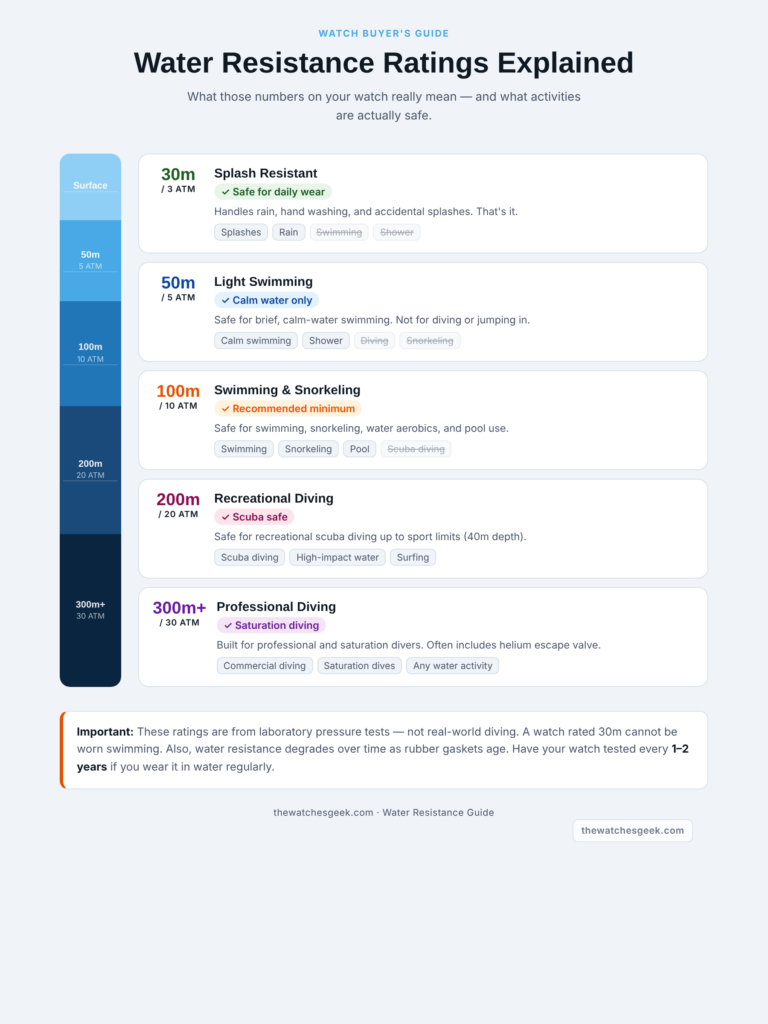
Here’s the key thing most people get wrong: the number on the watch does not mean you can dive to that depth. A 30m rating means the watch passed a static pressure test — it can handle splashes and brief contact with water, but should not be worn for swimming. A 100m rating is the minimum safe for recreational swimming and snorkeling.
| Rating | Real-World Use |
|---|---|
| 30m / 3 ATM | Splashes, rain, hand washing only |
| 50m / 5 ATM | Light swimming in calm water |
| 100m / 10 ATM | Swimming, snorkeling, water aerobics |
| 200m / 20 ATM | Recreational scuba diving |
| 300m+ / 30 ATM+ | Professional diving, saturation diving |
Water resistance also degrades over time as gaskets age. Have your watch pressure-tested every 1–2 years if you wear it regularly in water.
33. ATM (Atmospheres)
What it means: ATM stands for atmosphere — a unit of pressure equal to the atmospheric pressure at sea level (approximately 14.7 PSI or 1 bar). Watch water resistance is often expressed in ATM. 1 ATM equals approximately 10 meters of water pressure.
Why it matters: Knowing that 10 ATM = 100 meters helps you quickly decode water resistance specs. A watch rated 5 ATM is good for light swimming; 20 ATM is suitable for diving.
34. Screw-Down Crown
What it means: A screw-down crown (also called a screw-in crown) threads into the case like a screw, compressing gaskets and creating a watertight seal. You have to unscrew it before you can pull it out to set the time, then screw it back in afterward.
Why it matters: A screw-down crown is essential for any watch you plan to wear swimming or in the water. A regular push-pull crown, even on a “water resistant” watch, is much more vulnerable to water entry if the crown isn’t pushed all the way in. Many people leak their watches simply by forgetting to push the crown back in before getting wet.
35. Dive Watch
What it means: A true dive watch meets the requirements of ISO 6425 — an international standard. To qualify, a watch must have: at least 100m water resistance, a unidirectional rotating bezel, legible hands and markers in complete darkness (via lume), a clear 5-minute indicator on the bezel, resistance to magnetic fields, and a secure strap or bracelet.
Why it matters: Many watches are marketed as “dive watches” without meeting ISO 6425. If you need a watch for actual scuba diving, look for one that explicitly meets this standard. If you just want the look of a dive watch for daily wear, any watch with good water resistance and a rotating bezel will work fine. See our guide to the best dive watches.
36. Helium Escape Valve
What it means: A helium escape valve is a one-way valve on the side of a watch case. It’s designed for saturation divers — professionals who live in pressurized underwater chambers for days at a time. During decompression (when they slowly return to normal pressure), helium gas that seeped into the watch during the dive needs an escape route. Without the valve, the gas can blow off the crystal.
Why it matters: Unless you’re a professional saturation diver, you will never need this feature. It’s sometimes included in dive watches as a marketing element. For recreational divers and everyday swimmers, it’s completely unnecessary.
Crystal Types
The crystal is the transparent cover that protects the watch dial. It’s one of the most important choices in a watch — it affects scratch resistance, legibility, and long-term appearance.
37. Sapphire Crystal
What it means: Sapphire crystal is made from synthetic sapphire—the second-hardest material after diamond, rating 9 on the Mohs scale. It’s nearly impossible to scratch under normal wear.
Why it matters: Sapphire crystal is the premium choice. Almost every luxury watch uses it. It stays scratch-free through years of daily wear. The main downside is that it can shatter on a hard impact — but under normal use, it will outlast the watch. When comparing watches, sapphire crystal is a sign of higher quality.
38. Mineral Glass
What it means: Mineral glass is heat-treated or chemically strengthened glass, used in mid-range watches. It’s significantly more scratch-resistant than acrylic but much more vulnerable to scratching than sapphire. It rates around 5 on the Mohs hardness scale.
Why it matters: Mineral glass is a reasonable middle ground. It resists daily scratches fairly well, is less likely to shatter than sapphire on impact, and costs much less. Most watches in the $50–$300 range use mineral glass.
39. Acrylic Crystal (Hesalite)
What it means: Acrylic crystal is a form of plastic. It was used on most watches before the 1980s and is still used on some vintage-style pieces and affordable modern watches. It scratches very easily — but it also polishes out, meaning you can buff scratches away with toothpaste or a polishing cloth.
Why it matters: Acrylic is not ideal for everyday wear if you want your watch to look pristine. It also cracks more easily under impact than glass. However, it has one advantage over sapphire: in an extreme impact, acrylic cracks in a controlled way rather than shattering. That’s why astronauts originally wore it on the Apollo missions — a cracked dial is better than flying shards of crystal in zero gravity. Hesalite is Omega’s brand name for their specific acrylic formulation.
Strap & Bracelet Terms
40. Lug Width
What it means: Lug width is the distance in millimeters between the two lugs on the same side of the case—the gap the strap or bracelet fits into. Common sizes are 18mm, 19mm, 20mm, 22mm, and 24mm.
Why it matters: This number matters most when you want to change your watch strap. If your watch has 20mm lugs, you need a 20mm strap. Using the wrong size looks wrong and won’t secure properly. Always check lug width before ordering replacement straps.
41. NATO Strap
What it means: A NATO strap is a one-piece nylon strap that threads under and around the watch’s spring bars, rather than attaching to each end separately. Originally issued to British NATO military personnel in the 1970s.
Why it matters: NATO straps are popular because they’re durable, comfortable, inexpensive, and colorful. They also keep the watch on your wrist even if a spring bar breaks — the strap loops under the caseback and continues to hold. They’re casual and sporty in appearance.
42. Deployment Clasp
What it means: A deployment clasp (also called a deployant clasp or butterfly clasp) is a type of fastening for watch straps or bracelets that unfolds and locks shut, rather than threading through a buckle hole. It wraps around the wrist and snaps closed with a button press.
Why it matters: Deployment clasps feel more secure and look cleaner than a traditional buckle. They also reduce leather wear because the strap opens from a fold rather than being pulled through a hole each time. Most metal bracelets use some form of deployment clasp.
43. Spring Bar
What it means: A spring bar is the small metal pin that connects the watch strap to the lugs. It’s spring-loaded — push the small protruding ends in and the bar compresses, releasing the strap. A spring bar tool removes and replaces straps without damaging the watch.
Why it matters: Spring bars let you swap straps on most watches without tools — just a small spring bar tool, available for a few dollars. Knowing this means you can buy one watch and multiple straps to change the look for different occasions.
Materials & Finishes
44. Stainless Steel (316L and 904L)
What it means: Stainless steel is the most common case material in watches. It’s durable, corrosion-resistant, affordable to work with, and looks good. Two grades are commonly used in watches:
- 316L stainless steel: The industry standard. Used in the vast majority of watches from affordable to mid-range luxury. Corrosion-resistant and durable.
- 904L stainless steel: A higher-grade steel used exclusively by Rolex. It’s more corrosion-resistant and polishes to a shinier finish, but it’s also harder to machine, which is why few other brands use it.
Why it matters: For most buyers, 316L is perfectly adequate. The difference between 316L and 904L will not affect your daily experience.
45. Titanium
What it means: Titanium is a metal that’s as strong as steel but roughly 40–45% lighter. It’s also hypoallergenic, meaning it’s suitable for people with metal allergies. It’s harder to machine than steel, which makes titanium watches more expensive to produce.
Why it matters: If you have sensitive skin or allergies to metals, titanium is an excellent choice. If weight on the wrist bothers you, titanium feels noticeably lighter than steel. The tradeoff: titanium scratches more easily than steel and can be harder to polish.
46. Ceramic
What it means: In watchmaking, ceramic refers to a high-tech material (usually zirconia-based) used for bezels, cases, or entire watch bodies. It’s extremely hard — harder than steel — scratch-resistant, and maintains its color without fading.
Why it matters: Ceramic bezels stay pristine-looking for years because they don’t scratch easily. The main downside is brittleness — ceramic can chip or crack on a hard impact in a way steel would not. Ceramic is especially popular in luxury sports watches.
47. PVD Coating (Physical Vapor Deposition)
What it means: PVD is a process where metal (often gold or black titanium) is bonded to the surface of a stainless steel case using high-heat vaporization. The result is a thin but hard coating that changes the color of the watch.
Why it matters: PVD is the reason “gold” watches in the mid-range price category don’t cost as much as actual gold watches — the base is steel with a gold-colored coating. PVD is significantly more durable than simple gold plating. A good PVD coating can last years without flaking. However, it will eventually wear through at high-friction points like the strap attachment areas and crown.
Certifications & Industry Terms
48. Chronometer
What it means: Chronometer is a precision rating — not just a word for any watch that tells time accurately. In Switzerland, the COSC (Contrôle Officiel Suisse des Chronomètres) certifies movements as chronometers after testing them for 16 days across five positions and three temperatures. A COSC-certified watch must be accurate to within -4/+6 seconds per day.
Why it matters: A chronometer certification means the movement was independently tested and verified. It’s a mark of quality. Many watch buyers assume “chronometer” just means “good watch” — it means more than that. Look for “COSC Certified” or “Officially Certified Chronometer” on the dial or caseback.
49. Swiss Made
What it means: Under Swiss law, a watch can only be labeled “Swiss Made” if: the movement is Swiss (assembled and controlled in Switzerland), the casing is done in Switzerland, and at least 60% of the total manufacturing cost is Swiss. The laws have tightened over time and are strictly enforced.
Why it matters: “Swiss Made” carries a quality premium — and with it, a price premium. It’s a genuine signal of manufacturing standards. However, excellent Japanese, German, and American-made watches rival Swiss quality. Swiss origin alone doesn’t guarantee a better watch for your needs.
50. Manufacture (Manufacture d’Horlogerie)
What it means: A manufacture is a watchmaking company that designs, engineers, and produces its own movements in-house — rather than buying them from third-party suppliers like ETA or Miyota.
Why it matters: “Manufacture movement” or “in-house movement” is a marketing phrase that brands use with pride — it signals that the brand has genuine watchmaking expertise. However, many superb watches use third-party movements. An in-house movement is an achievement, but it doesn’t automatically make a watch better than one using an ETA or Miyota caliber.
51. Microbrand
What it means: A microbrand is a small, independent watch company — usually with a small team, a focused product line, and direct-to-consumer sales online. They often don’t have retail stores and use third-party movements, but they compete on design, value, and community.
Why it matters: Microbrands have exploded in the past decade because they offer watch enthusiasts excellent quality at fair prices, without paying for retail markup or brand prestige. Brands like Seestern, Baltic, Halios, and Farer have enthusiastic followings. If you’re open to exploring, microbrands are worth looking at.
52. Horology
What it means: Horology is the science and art of measuring time and making timepieces — watches, clocks, and other timekeeping instruments. Someone who studies or works in horology is called a horologist.
Why it matters: This one isn’t strictly necessary for buying a watch, but knowing the word can help you find deeper information. Watch enthusiast communities, restorers, and educators often use the term. If you find yourself curious about how watches actually work, you’ve entered the world of horology.
Quick Reference: All 52 Terms at a Glance
| # | Term | In One Line |
|---|---|---|
| 1 | Automatic Movement | Self-winding via wrist motion |
| 2 | Manual Movement | Requires hand winding each day |
| 3 | Quartz Movement | Battery-powered, most accurate, lowest maintenance |
| 4 | Solar Movement | Charges from light, never needs a battery |
| 5 | Caliber | The movement’s model name or number |
| 6 | Rotor | Spinning weight that winds an automatic watch |
| 7 | Power Reserve | How long the watch runs without winding |
| 8 | Jewels | Synthetic bearings that reduce movement friction |
| 9 | Frequency | How fast the balance wheel oscillates |
| 10 | Hacking Seconds | Seconds hand stops to allow precise time-setting |
| 11 | Mainspring | Coiled spring that stores the watch’s energy |
| 12 | Escapement | Controls how energy is released — creates the tick |
| 13 | Case | Outer body protecting the movement |
| 14 | Dial | The face of the watch |
| 15 | Bezel | Ring around the crystal, fixed or rotating |
| 16 | Crown | Side knob for setting and winding |
| 17 | Lugs | Protrusions that hold the strap to the case |
| 18 | Caseback | The back cover, solid or exhibition (transparent) |
| 19 | Crystal | Transparent cover over the dial |
| 20 | Indices | Hour markers on the dial |
| 21 | Luminescence | Glow-in-the-dark coating on hands and markers |
| 22 | Subdial | Small secondary dial within the main dial |
| 23 | Rehaut | Inner sloped ring between dial and crystal |
| 24 | Complication | Any function beyond hours and minutes |
| 25 | Chronograph | Built-in stopwatch |
| 26 | GMT | Second time zone display |
| 27 | Tachymeter | Speed calculation scale |
| 28 | Moon Phase | Display showing the moon’s current phase |
| 29 | Perpetual Calendar | Auto-adjusting date, accounts for all month lengths |
| 30 | Tourbillon | Rotating escapement cage countering gravity |
| 31 | Minute Repeater | Chimes the time on demand |
| 32 | Water Resistance | How well-sealed the watch is against water |
| 33 | ATM | Unit of pressure; 10 ATM = 100m rating |
| 34 | Screw-Down Crown | Threaded crown for a watertight seal |
| 35 | Dive Watch | Meets ISO 6425 standards for diving use |
| 36 | Helium Escape Valve | Releases helium during saturation dive decompression |
| 37 | Sapphire Crystal | Near-scratch-proof; premium crystal material |
| 38 | Mineral Glass | Mid-range crystal; more scratch-resistant than acrylic |
| 39 | Acrylic / Hesalite | Plastic crystal; scratches easily but polishes out |
| 40 | Lug Width | Gap between lugs; determines strap size needed |
| 41 | NATO Strap | One-piece nylon military strap |
| 42 | Deployment Clasp | Folding, button-release strap clasp |
| 43 | Spring Bar | Pin connecting strap to lug |
| 44 | Stainless Steel | Standard case material; 316L vs 904L (Rolex) |
| 45 | Titanium | Lighter than steel, hypoallergenic |
| 46 | Ceramic | Hard, scratch-resistant, can chip on impact |
| 47 | PVD Coating | Bonded color coating; more durable than plating |
| 48 | Chronometer | COSC-certified; accurate to -4/+6 sec per day |
| 49 | Swiss Made | Legally protected label for Swiss-manufactured watches |
| 50 | Manufacture | Brand that makes its own movement in-house |
| 51 | Microbrand | Small independent watch brand, usually online-only |
| 52 | Horology | The science and art of timekeeping |
Frequently Asked Questions
What is the most important watch term for a first-time buyer?
If you’re buying your first watch, the two most important terms to understand are movement type and water resistance. Movement type (quartz vs. automatic) affects cost, maintenance, and how the watch feels to wear. Water resistance tells you what activities the watch can safely handle. Get those two right, and everything else is secondary.
What’s the difference between automatic and mechanical?
All automatic watches are mechanical, but not all mechanical watches are automatic. A mechanical watch runs on a manually wound mainspring. An automatic watch is a type of mechanical watch that winds itself through wrist motion using a rotor. When people say “mechanical” they usually mean the watch has no battery — it could be automatic or manual.
Does water resistance rating decrease over time?
Yes. The gaskets (rubber seals) that create a water-resistant seal inside a watch degrade over time due to age, heat, and exposure to chemicals like chlorine or perfume. A watch rated 100m when new may no longer hold that rating after several years without servicing. If you swim regularly with your watch, have it pressure-tested every 1–2 years by a watchmaker.
What does “Swiss Made” actually guarantee?
Under Swiss law, Swiss Made means the movement is Swiss, the watch is cased in Switzerland, and at least 60% of manufacturing costs are incurred in Switzerland. It guarantees origin and a minimum quality standard, but it’s not the only mark of quality in the world. Excellent watches also come from Japan, Germany, and elsewhere.
Why are tourbillons so expensive?
A tourbillon requires hundreds of extremely small, precisely machined parts that work together inside a rotating cage about the size of your thumbnail. Making one takes a highly skilled watchmaker many hours of painstaking work. Even a modest tourbillon represents thousands of hours of combined manufacturing, design, and finishing time. The price reflects genuine human skill at an extreme level.
What’s the difference between a chronograph and a chronometer?
They sound similar but mean very different things. A chronograph is a watch with a stopwatch function. A chronometer is a precision certification — a watch that has passed strict accuracy tests by an independent organization (usually COSC in Switzerland). A watch can be one, both, or neither. A COSC-certified chronograph watch is both.
What watch terms do I need to know for buying online?
For online shopping, focus on: case size (mm), water resistance rating, movement type, crystal type, and lug width. These five details tell you whether the watch fits your wrist, suits your lifestyle, runs the way you prefer, holds up well, and can be customized with new straps later.
Final Note
Watch terminology can feel overwhelming at first, but you don’t need to memorize it all. Start with the terms relevant to your situation — if you swim, understand water resistance. If you’re buying a dress watch, understand crystal types and movement options. The rest will come naturally as you learn more.
The watch world rewards curiosity. The more you know, the better your choices get — and the more you enjoy wearing what you own.
If you’re ready to start shopping, explore our guides to find the right watch for your style and budget:
- Best Sports Watches for Men
- Best Watches for Ladies Under $2000
- Can a Smartwatch Detect Sleep Apnea
- Browse All Smartwatch Reviews
Luis Cooper

Hi, I'm Luis, the guy behind this site. I love wearing watches, especially ones that look great on small wrists (mine are about 6.3" around). The Watches Geek is dedicated to helping you learn about and buy watches that you will love wearing. I want this website to be the last destination for people to pick the best watches to fit their needs. You can find our unbiased reviews here on Thewatchesgeek.