Last Updated on October 3, 2026 by Luis Cooper
Every smartwatch advertisement makes the same promise.
Buy this watch, and it will monitor your heart. It will track your sleep.
It will measure your stress. It will detect your blood pressure. It will even track your blood sugar.
Some of these claims are completely true. Some are partially true with important limits. And some of them are, to put it plainly, not true at all in the way the advertisement implies.
This isn’t easy to research because the marketing language is deliberately vague.
A watch that says it monitors blood pressure is not lying.
But monitoring blood pressure the way a hospital cuff does and monitoring blood pressure the way a smartwatch does are two very different things, and the advertisement rarely explains that difference.
This guide covers every major health feature smartwatches advertise in 2026 and tells you honestly what each one can do, what it can’t, and whether it is worth paying for. No technical language.
No assumptions about what you already know.
Just a clear answer to the question: does this actually work?
Smartwatch Health Features Explained:

![Samsung Galaxy Watch9, Graphite, 40mm Bluetooth Smartwatch | AI Assistant, Fitness Tracker, Sleep Coaching and Running Coaching with Heart Rate Tracking [US Version, 2 Yr Warranty]](https://m.media-amazon.com/images/I/31Q6G58gP9L._SL160_._SL160_.jpg)


The Quick Answer — Before You Read Everything
If you want the summary first and the detail later:
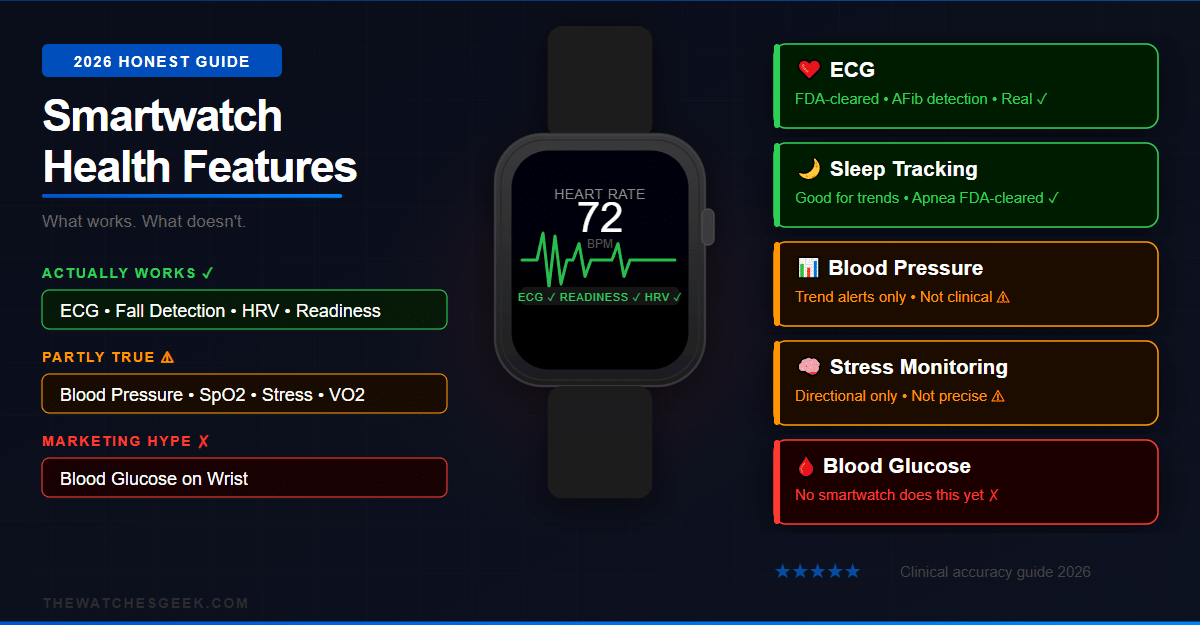
| Feature | Does It Work? | Trust Level |
|---|---|---|
| ECG for irregular heartbeat | Yes | ✅ Real — medically validated |
| Heart rate (resting) | Yes | ✅ Very accurate |
| Fall detection | Yes | ✅ FDA authorized |
| Sleep stage tracking | Mostly yes | ✅ Good for trends |
| HRV and recovery scoring | Yes | ✅ Validated approach |
| Readiness Score | Yes | ✅ Based on real data |
| Loss of Pulse Detection | Yes — Pixel Watch 5 only | ✅ Unique, life-saving |
| Stress tracking | Partly | ⚠️ Directional, not precise |
| Blood pressure monitoring | Partly | ⚠️ Trend alerts only, not clinical |
| SpO2 blood oxygen | Partly | ⚠️ General wellness only |
| VO2 Max estimation | Partly | ⚠️ Estimate, not lab-accurate |
| Blood glucose monitoring | No — not yet | ❌ Pure hype on wrist |
Features That Actually Work
1. ECG — The Feature That Can Genuinely Save Your Life
ECG stands for electrocardiogram.
A hospital ECG machine attaches electrodes across your chest, arms, and legs and records your heart’s electrical activity from twelve angles at once.
This is a comprehensive picture of how your heart is working.
A smartwatch ECG uses one electrode — the sensor on the back of the watch and the crown or side button you touch with your finger — and records your heart’s electrical activity from one angle for thirty seconds.
These two things are not the same.
But the smartwatch version is not useless because of that difference. It is designed to do one specific thing very well, and that thing is detecting atrial fibrillation.
Atrial fibrillation, or AFib, is one of the most common heart rhythm problems in adults. It is when the upper chambers of the heart beat chaotically instead of in an organised rhythm.
It significantly increases the risk of stroke and blood clots, and many people who have it do not feel any obvious symptoms beyond occasional palpitations that come and go.
Studies published in JAMA Cardiology, one of the world’s most respected medical journals, have shown that smartwatch ECG detects AFib with clinically meaningful accuracy.
The Apple Watch, Samsung Galaxy Watch 9, and several other current smartwatches carry ECG that is FDA-cleared specifically for AFib detection.
FDA clearance means a regulatory body has reviewed the evidence and agreed the feature does what it claims to do, in the way it claims to do it.
This is a real feature that has genuinely helped people discover they had AFib before they experienced a stroke.
If you or someone in your family has a history of heart rhythm problems, or simply wants to know if the occasional irregular feeling in the chest is worth mentioning to a doctor, a watch with ECG provides a clinician-ready PDF record in thirty seconds from your wrist.
For a closer look at which smartwatches carry the best ECG platforms, the full guide at best-smartwatches-with-ecg covers every current ECG watch in detail.
2. Heart Rate — Accurate When It Matters Most
The green light flashing on the back of every smartwatch measures your heart rate using a technology called photoplethysmography.
It shines light into the skin and measures how the blood flow changes with each heartbeat.
For resting heart rate — the rate your heart beats while you are sitting, sleeping, or doing ordinary daily activity — this technology is very accurate.
Multiple independent studies have confirmed that smartwatch resting heart rate readings closely match readings from dedicated medical heart rate monitors.
Accuracy decreases during high-intensity exercise, particularly activities with a lot of arm movement.
During a sprint, a jump rope session, or rapid interval training, arm movement can interfere with the sensor’s readings.
The watch may report a heart rate that lags behind your actual heart rate, or briefly misread motion as pulse.
For most everyday purposes — checking your heart rate during a walk, monitoring resting heart rate trends over weeks, using heart rate for sleep analysis — smartwatch heart rate monitoring is accurate enough to be genuinely useful.
For athletes who need precise heart rate data during high-intensity training, a chest strap heart rate monitor worn alongside the watch provides more reliable readings during the workout itself.
3. Fall Detection — FDA Authorized and Genuinely Life-Saving
Fall detection uses the accelerometer and gyroscope inside the watch — the sensors that measure movement and orientation — to detect the specific impact pattern of a hard fall.
If the watch detects what appears to be a fall and the wearer does not respond to an alert within a short period, it contacts emergency services and shares GPS location.
This feature is FDA authorised in the Apple Watch and works across the Samsung Galaxy Watch range as well.
It is not a perfect system — it cannot detect every fall, and it sometimes generates alerts from movements that are not falls — but independent real-world testing and documented cases confirm that it has enabled emergency services to reach people who would otherwise have waited much longer for help.
For elderly users, anyone who lives alone, or anyone who engages in activities where falls carry significant risk, fall detection is the feature that makes a smartwatch more than a convenience device.
4. Sleep Stage Tracking — Useful for Trends, Not Medical Diagnosis
Modern smartwatches track sleep by combining heart rate monitoring, HRV measurements, movement detection, and sometimes skin temperature data throughout the night. From this combination of signals, they estimate how much time you spent in light sleep, deep sleep, and REM sleep.
The honest answer on accuracy is that smartwatch sleep staging is directionally correct but not as precise as a clinical sleep study, called polysomnography, which involves electrodes on the scalp.
If a sleep clinic says you spent 90 minutes in deep sleep last night and your Apple Watch says 75 minutes, the watch is not wrong enough to be useless — it is showing you an estimate that reflects the general pattern of your night.
Sleep tracking is genuinely valuable for observing trends over time rather than treating each night’s data as absolute truth.
If your deep sleep consistently decreases during weeks when you exercise less, that pattern is meaningful.
If your sleep quality improves consistently after you start going to bed earlier, that trend is real even if the exact minute count is approximate.
Sleep apnea detection on the Apple Watch Series 12 has received FDA clearance, meaning it has been validated against clinical standards for identifying breathing-interruption patterns associated with sleep apnea.
This is a meaningfully different claim from general sleep tracking because it has regulatory approval behind it.
5. HRV and Recovery Scoring — Based on Real Science
Heart rate variability, or HRV, measures the tiny variations in the time between consecutive heartbeats.
A heart that beats very consistently — every beat separated by exactly the same interval — actually indicates stress or fatigue.
A heart that shows more variation between beats indicates recovery and readiness.
This may sound counterintuitive, but it’s well established in sports science and cardiology research.
Garmin’s HRV algorithms draw on decades of sports physiology research, and numerous clinical studies have validated the link between low HRV and physical fatigue or illness.
Smartwatches measure HRV most accurately during sleep, when arm movement is minimal and the sensor can capture the subtle variations cleanly.
The recovery and readiness scores on the Apple Watch Series 12, Samsung Galaxy Watch 9, and Garmin watches each morning are built from HRV data combined with sleep quality and recent training load.
These scores are not perfect because HRV is affected by many things — caffeine, alcohol, illness, stress, temperature — and the watch cannot always distinguish between all of them.
But as a daily directional indicator of whether your body has recovered well or needs more rest, the science behind HRV-based recovery scoring is solid.
6. Readiness Score — The Feature That Puts It All Together
The Readiness Score on the Apple Watch Series 12 and Samsung Galaxy Watch 9 combines HRV, sleep quality, and recent activity load into a single daily number.
It updates throughout the day on the Series 12 rather than giving a fixed morning score, which makes it more responsive to how the day actually unfolds.
This feature is built on validated inputs and the logic behind it is sound.
The score isn’t telling you something a blood test would confirm, but it does offer a useful synthesis of information that would take much longer to interpret from individual metrics.
For busy people who want to make better daily decisions about rest and effort, it is a feature that delivers genuine value rather than simply filling a health dashboard with numbers to look at.
Features That Are Partially Real
7. Blood Pressure Monitoring — Trend Alerts, Not Readings
This is the most important distinction to understand about smartwatch blood pressure, and it is the one that the advertising most consistently obscures.
A traditional blood pressure cuff inflates around your arm, restricts blood flow, and measures the pressure at which blood flow resumes as the cuff deflates.
This gives you a specific number — like 128 over 82 — that tells you your systolic and diastolic pressure at that moment.
No smartwatch in 2026 does this. No smartwatch is FDA-cleared to give you a specific blood pressure number.
The Apple Watch Series 12 and Samsung Galaxy Watch 9 provide hypertension trend monitoring.
The watch analyses patterns in your pulse timing over days and weeks and alerts you if those patterns are consistent with possible hypertension, recommending that you see a doctor for a proper cuff measurement.
A 2026 study published in Digital Health followed 37 participants over 28 days, comparing Samsung Galaxy Watch blood pressure monitoring against a validated medical cuff.
The watch demonstrated acceptable accuracy when blood pressure remained near the calibration point, but accuracy decreased when blood pressure moved further from the calibration.
The researchers concluded that cuff-based confirmation is advisable when making any clinical or medication decision.
This is genuinely useful as an early warning system.
If your watch consistently alerts you that your patterns suggest possible hypertension, that is a meaningful signal to act on by booking a doctor’s appointment.
It is not a replacement for the cuff measurement that appointment would provide.
8. Stress Tracking — The Direction Is Right, The Precision Is Limited
Smartwatches measure stress through a combination of HRV, heart rate elevation, electrodermal activity where available, and skin temperature.
Research has confirmed that these signals correlate with stress hormones like cortisol and with self-reported anxiety levels in longitudinal studies.
The limitation is precision in real time. Your watch can observe that your body is in a physiologically elevated state during a particular period.
It cannot always distinguish between the elevated state of a difficult work meeting and the elevated state of an exciting event you are looking forward to. Both produce similar physiological signals.
As a tool for noticing patterns across weeks — understanding that your stress levels are consistently higher on certain days or during certain periods — the stress tracking on Garmin, Apple, and Samsung watches is genuinely informative.
As a real-time readout of how stressed you are right now, treat it as an indicator rather than a measurement.
9. SpO2 Blood Oxygen — Not Reliable Enough for Medical Decisions
Blood oxygen monitors on smartwatches measure the oxygen saturation of your blood — the percentage of haemoglobin carrying oxygen through your bloodstream. A healthy person at sea level typically reads between 95 and 100 percent.
A clinical study across two major hospitals compared the Apple Watch Series 7 and Withings ScanWatch with ward-based oximeters in 200 patients hospitalised with COVID-19. The Apple Watch detected clinically significant low oxygen with a sensitivity of only 34.8 percent.
That means it missed the low-oxygen reading in about two-thirds of cases where low oxygen was actually present.
This isn’t a reason to panic about your watch’s SpO2 readings. For healthy people monitoring general wellness trends, the readings provide useful background context.
But it is a clear reason not to rely on a smartwatch SpO2 reading to make any medical decision, particularly in situations where oxygen levels matter clinically.
10. VO2 Max — A Useful Estimate, Not a Lab Measurement
VO2 max is the maximum amount of oxygen you can use during hard workouts.
It is considered one of the most reliable predictors of cardiovascular fitness. VO2 max testing in a lab involves either cycling or running on a treadmill while wearing a mask that determines how much oxygen you inhale and how much carbon dioxide you exhale.
Smartwatches estimate VO2 max from heart rate data during outdoor runs and walks, using algorithms that infer oxygen consumption from the relationship between effort and heart rate response.
The resulting number is less accurate than a laboratory test.
It’s useful for tracking direction over time.
If your estimated VO2 max on Garmin or Apple Watch rises over three months of consistent training, that rise reflects genuine fitness improvement, even if the absolute number differs from a laboratory reading.
If it falls during a period of illness or inactivity, that fall reflects real change in your fitness.
Treat VO2 max on a smartwatch as a relative fitness trend indicator rather than an absolute measurement, and it provides genuine value.
The Feature That Is Pure Marketing Hype
11. Blood Glucose Monitoring — Not Available on Any Current Smartwatch
This is the area where advertising and reality are farthest apart, and it is worth being completely clear about it.
No smartwatch in 2026 can measure blood glucose from your wrist.
No smartwatch has FDA clearance or any other regulatory authorization for on-wrist blood glucose measurement.
The technology for measuring blood glucose through the skin without a needle or a glucose sensor inserted under the skin does not currently exist in a form that produces clinically meaningful results.
Some watches can display blood glucose readings from a separate, dedicated continuous glucose monitor you wear on your body—devices like the Dexcom G7.
These are established, clinically validated CGM systems that use a tiny sensor inserted under the skin. The smartwatch displays the data from that separate sensor.
This integration is useful, but the watch displays data collected by another device, not glucose measurements itself.
If you see an advertisement for a smartwatch claiming to monitor blood glucose, look carefully at what it actually claims.
If it says it monitors blood glucose from a paired CGM, that is accurate.
If it implies the watch itself measures your glucose, that claim is not accurate, regardless of how the sensor on the back of the watch is described.
Apple has worked on non-invasive glucose sensing technology for several years and has not released it because it has not yet met the accuracy standards required for safe consumer use. When it arrives, it will be a genuinely significant development. It has not arrived yet.
Which Watch Has the Most Genuine Health Features?
If you want the features that have been confirmed to work and are worth having:
For iPhone users: The Apple Watch Series 12 carries FDA-cleared ECG, FDA-authorized fall detection, FDA-cleared sleep apnea detection, validated HRV tracking, the Readiness Score, and Audio Intelligence. Every health feature it advertises is based on validated technology.
For Samsung Galaxy phone users: The Samsung Galaxy Watch 9 includes ECG, Daily Cardio Load equivalent to WHOOP’s recovery tracking, overnight vitals monitoring, and the Antioxidant Index. The blood pressure monitoring provides trend alerts. No subscription required for any of it.
For runners and fitness-focused users on any platform: Garmin’s HRV-based recovery tracking, Body Battery, and sleep coaching draw from decades of sports physiology research and run without any subscription fee.
For the most advanced safety platform: The Google Pixel Watch 5 carries Loss of Pulse Detection — the only mainstream smartwatch feature that monitors for the absence of pulse and contacts emergency services automatically if you do not respond. No other consumer smartwatch offers this.
FAQs
Can a smartwatch replace a doctor’s appointment?
No smartwatch replaces a clinical assessment, and manufacturers don’t try to hide this limitation— they state it in the legal notices for their health features. What smartwatches do well is provide a continuous record of health signals across days, weeks, and months that a clinical appointment cannot capture because an appointment is a snapshot of fifteen minutes. A watch that detects an irregular heart rhythm pattern at 2am on a Tuesday night and prompts you to take an ECG, which produces a PDF that you bring to your doctor, has done something genuinely useful. It has not diagnosed you. It has given your doctor better information than a single clinic visit would have produced. That is the appropriate way to understand what smartwatch health features are for — not as medical instruments, but as monitoring tools that give you and your doctor more information than you would otherwise have.
Is blood pressure monitoring on smartwatches safe to rely on?
For general trend awareness — understanding whether your patterns suggest that your blood pressure may be running high over a period of weeks — smartwatch blood pressure monitoring provides a useful early warning signal. For any decision about medication, diagnosis, or clinical management of blood pressure, a validated arm cuff measurement is required.
A 2026 study in Digital Health showed that smartwatch blood pressure was acceptably accurate near the calibration point, but accuracy fell off as blood pressure values got further from calibration. The American Heart Association has guidelines for proper blood pressure monitoring at heart.org.
Which smartwatch health features are FDA cleared or approved?
FDA clearance means a regulatory body has reviewed clinical evidence and agreed that a feature works as claimed. Currently FDA-cleared smartwatch features include ECG for AFib detection on Apple Watch and Samsung Galaxy Watch, fall detection on Apple Watch, sleep apnea detection on Apple Watch Series 12, and crash detection on Apple Watch and Samsung Galaxy Watch. Blood pressure monitoring on smartwatches is not FDA-cleared for clinical measurement — it is authorized as a wellness trend tool rather than a medical device. Blood glucose monitoring is not FDA-cleared on any current wrist-worn smartwatch. When buying a smartwatch specifically for health monitoring, checking whether the health features you need carry FDA clearance or regulatory authorization in your country is the most important research step you can take before purchase.
Related Articles:
Best Smartwatches Compatible with Dexcom G6 and G7
RingConn Gen 3 Smart Ring Review
Luis Cooper

Hi, I'm Luis, the guy behind this site. I love wearing watches, especially ones that look great on small wrists (mine are about 6.3" around). The Watches Geek is dedicated to helping you learn about and buy watches that you will love wearing. I want this website to be the last destination for people to pick the best watches to fit their needs. You can find our unbiased reviews here on Thewatchesgeek.