Last Updated on October 2, 2026 by Luis Cooper
Smart rings have always had a one-way conversation problem.
The ring collects data all night long while you sleep — heart rate, blood oxygen, temperature, sleep stages, every metric it was built to track.
In the morning you pick up your phone, open the app, and read what the ring found out while you were unconscious.
The ring tells you nothing directly.
It does not buzz, beep, or signal. If the battery dies at 2 am, you find out when you check the app at 7 am. If your heart rate spiked at 3 am, you discover it after the fact. The ring watches. You read.
The RingConn Gen 3 broke this pattern in May 2026 by doing something no mainstream smart ring had done before it.
It vibrates.
A yoga instructor who teaches early morning classes described wearing smart rings for two years as a one-sided relationship.
The rings knew everything that happened overnight and shared it on a screen she checked after the fact.
The Gen 3 changed that: the first morning it buzzed against her finger to warn her the battery was running low before it died.
For the first time, a ring communicated something to her without requiring her to look for it first.
This review covers everything you need to know about the RingConn Gen 3 before buying — how it feels on the finger, what it tracks, how accurate the data is, and whether it makes sense over the Oura Ring 5 and the Samsung Galaxy Ring.
RingConn Gen 3 Smart Ring Review
Design and Build Quality

The RingConn Gen 3 is made from titanium.
Titanium is lightweight for its strength, hypoallergenic, and resistant to the daily scratches and impacts that softer metals show over months of continuous wear.
The Future Silver finish has a brushed texture that reads as refined rather than flashy, which means the ring works in professional and formal settings without drawing attention to itself as a piece of technology.
The ring is slightly thicker and heavier than the RingConn Gen 2 because of the vibration motor built into the body.
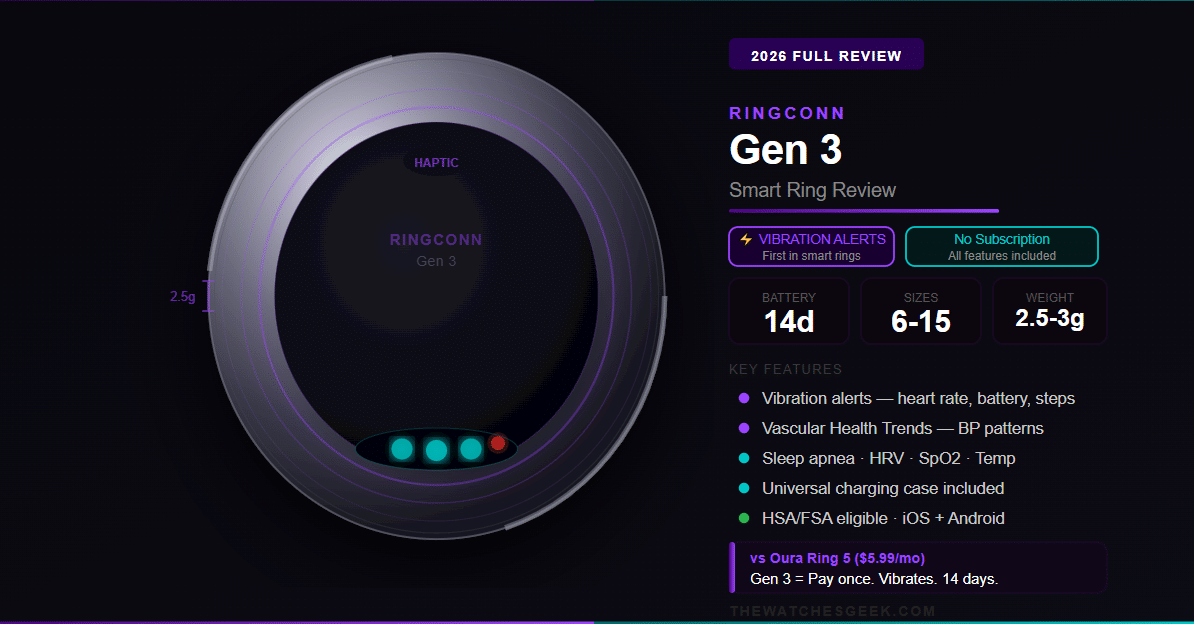
The Gen 3 weighs between 2.5 and 3.5 grams depending on the ring size.
That is a small but noticeable step up from the Gen 2’s approximately 2-gram build. Most wearers adjust within the first day.
Buyers who have previously worn smart rings and specifically valued their near-weightless feel should note this difference before deciding.
The ring’s inner surface has a small raised dome where the optical sensors sit against the skin.
The dome positions the sensors correctly against the finger for accurate readings. Wearing the ring with the dome facing the palm side of the finger gives the most reliable data, and RingConn’s sizing guidance recommends checking this positioning during the initial setup.
Sizing — The Most Important Decision Before You Buy

Smart ring sizing differs from standard jewellery ring sizing because the inner sensor dome adds height to the inner circumference.
A buyer who wears a standard size 8 ring in jewellery may find a Gen 3 size 8 too tight because the dome reduces the available finger space.
RingConn offers a free sizing kit—a set of sample rings in different sizes that you can order before buying the actual ring.
Correct ring sizing affects both comfort and data accuracy.
A ring that is too loose slides around the finger during sleep and produces less accurate overnight readings as the sensor moves away from the skin surface.
A ring that is too tight is uncomfortable to wear continuously, which creates the temptation to remove it at night—defeating the purpose of the overnight tracking the ring exists to provide.
The Gen 3 is available in sizes 6 through 15, which is a wider range than most smart rings currently offer.
Order the sizing kit first.
It takes a few days to arrive but prevents the return process that a mismatched size creates.
Getting Started
Setup takes approximately 10 minutes from unboxing to first sync.
Download the RingConn app on iOS or Android, create an account, and follow the on-screen pairing instructions.
The ring connects via Bluetooth. You enter your physical profile — height, weight, age, biological sex — which the app uses to personalize readiness scores, calorie calculations, and health insights.
You configure vibration alert preferences in the app during setup.
You choose which alerts to enable, the heart rate threshold for the elevated HR alert, and the silent alarm time.
Each alert can be turned on or off independently, so a buyer who wants only the low battery warning can run all other alerts in silent mode.
The ring syncs automatically when the phone is nearby, and the app is open in the background.
Sync time varies from a few seconds to a minute depending on how much data has accumulated since the last connection. Opening the app manually triggers an immediate sync.
The Vibration Motor — In Detail

The micro-vibration motor in the Gen 3 produces a gentle buzz against the finger — similar to the feel of a fitness band or smartwatch vibration but scaled to the smaller mass of a ring. It is subtle enough not to startle you from sleep but noticeable enough to register as a clear signal when the ring uses it.
Elevated heart rate alert. When resting heart rate rises above the personalised threshold set in the app, the ring buzzes. During rest, elevated heart rate can indicate the early stages of illness, dehydration, or physiological stress. Receiving the alert directly on the finger rather than discovering it the following morning in the app data gives the wearer a chance to respond in the moment.
Reminder of idleness. After sitting or lying still for a set period during waking hours, the ring buzzes to prompt movement. Long-term cardiovascular health and blood glucose management can be affected by long periods of inactivity. The reminder is a small nudge that doesn’t require any phone interaction.
Step goal achievement. When the daily step target is reached, the ring buzzes once to confirm it. Simple positive feedback without picking up the phone.
Low battery warning. This is the alert that solves the problem described in the introduction. When the battery drops to a low threshold, the ring buzzes. The wearer has enough time to charge the ring before the next sleep session, keeping overnight tracking uninterrupted. No silent deaths overnight. No blank screen in the morning.
Silent alarm. Set a wake-up time in the app, and the ring vibrates at that time rather than playing a phone sound. For shift workers, early-morning starts, and light sleepers who share a sleeping space, waking from a finger vibration rather than a phone alarm is a genuinely different experience.
With all alerts enabled, the battery lasts 10 to 12 days in real-world use. With alerts switched off, the ring reaches 11 to 14 days. The two-day window within each range reflects the variation between ring sizes — smaller rings have smaller batteries.
Sleep Tracking — What the Ring Measures Overnight

Sleep is where the RingConn Gen 3 earns most of its daily use for most buyers, and the overnight data package covers six distinct measurements.
Sleep stages. The ring tracks light sleep, deep sleep, REM sleep, and awake periods throughout the night using heart rate patterns, heart rate variability, blood oxygen, and movement. The sleep stages appear in the app as a timeline graph showing how the night progressed from falling asleep through the final waking. The app shows the proportion of time spent in each stage alongside average benchmarks.
Sleep score. A single overnight score from zero to one hundred summarises the night’s sleep quality based on total duration, sleep stage distribution, consistency of sleep timing, and overnight HRV. The score contextualises the detailed data into a number that is immediately useful when glanced at in the morning.
Sleep apnea pattern insights. The Gen 3 screens for patterns consistent with sleep apnea using blood oxygen dips and breathing irregularities detected by the optical sensors overnight. This is a pattern detection feature rather than a clinical AHI measurement. A pattern flagged consistently over multiple nights prompts a discussion with a doctor, not a diagnosis. For background on what sleep apnea is and how it is clinically evaluated, the American Academy of Sleep Medicine provides clear guidance at aasm.org.
Overnight HRV. Heart rate variability is the small variation in time between consecutive heartbeats. Higher overnight HRV generally indicates a well-recovered nervous system. Lower overnight HRV indicates stress, fatigue, or early illness. The app tracks overnight HRV across days and weeks and shows the trend line alongside each night’s score.
Overnight SpO2. The app monitors blood oxygen saturation continuously during sleep. Consistent dips below 95 percent during sleep can indicate breathing irregularities. The app shows the overnight SpO2 range and flags nights when readings depart significantly from the baseline.
Overnight vascular load trends. The new Gen 3 feature uses the same optical sensors to track patterns in vascular behaviour during sleep that correlate over time with blood pressure trends. This is covered in full in the next section.
Vascular Health Insights — The Full Explanation

Vascular Health Insights is the headline health feature added in the Gen 3, and it is the one that causes the most confusion about what the ring actually measures.
A clear explanation prevents disappointment after purchase.
The Gen 3 does not measure blood pressure the way a cuff does. No single reading shows your blood pressure as a specific number right now.
Validated blood pressure readings require inflatable cuffs, oscillometric sensors, or complex calibration processes that a ring cannot currently replicate with clinical accuracy.
What the Gen 3 does is use overnight optical sensor data—specifically the pulse waveform shape, timing, and patterns captured by the PPG sensor pressed against the finger during sleep—to identify trends in vascular load over time.
Vascular load describes the overall pressure and resistance in the blood vessels.
When these patterns change consistently over days and weeks in a specific direction, the app surfaces this as a trend insight rather than a specific number.
A consistent upward vascular load trend over several weeks is worth discussing with a doctor.
A stable trend over time provides a baseline picture of overnight vascular behavior.
A downward trend following lifestyle changes like reduced sodium intake, more regular exercise, or weight loss is a meaningful directional signal that the changes are having an effect.
This feature arrived via a software update after the May 2026 launch.
Every Gen 3 owner received it as a free update without new hardware, which is a meaningful signal about how RingConn develops the platform over the product’s lifetime.

HRV Accuracy and SpO2 Accuracy
The Gen 3 uses newer optical sensors than the Gen 2 and tracks HRV every night from the moment the wearer falls asleep until they wake.
In independent testing, the Gen 2’s optical array delivered HRV accuracy within 8 percent of the Polar H10 chest strap.
The Gen 3’s upgraded sensor array targets improved accuracy in the same methodology.
SpO2 blood oxygen monitoring across the Gen 3’s sensor platform follows the same approach as the Gen 2, which achieved 98 percent agreement with reference pulse oximeters in bench testing, with a published study confirming no accuracy reduction across different skin tones.
These figures describe the accuracy ceiling under controlled conditions.
Real-world accuracy depends on ring fit, skin temperature, and how much the finger moves during measurement.
Women’s Health Features
The RingConn app includes menstrual cycle tracking that allows the wearer to log period start and end dates.
From this logged data, the app calculates predicted period dates, fertile window estimates, and cycle phase insights.
The cycle phase context integrates with the readiness and wellness data the ring tracks nightly.
The app notes the current cycle phase alongside overnight HRV, sleep score, and vascular trend data, providing context for why performance, recovery, and energy patterns vary across the month in ways not explained by sleep quality or activity alone.
The cycle tracking requires logging period start dates manually.
The app does not automatically detect cycle phases from sensor data alone — it uses the logged dates combined with individual cycle length patterns to generate predictions that become more accurate over several logged cycles.
Activity and Workout Tracking
The Gen 3 tracks steps, calories burned, active minutes, and activity intensity continuously throughout the day using the accelerometer and heart rate sensor.
Steps and calorie figures appear in the app alongside the overnight health data.
The ring does not have GPS. The ring does not have GPS.
No outdoor runs are maintained. It doesn’t use satellite positioning to estimate distance, but your step count and stride length for walking and running.
Continuous heart rate during high-intensity workouts is limited by the optical ring format. The ring’s sensor sits against the finger, where blood flow is less consistent during vigorous movement than at the wrist.
Heart rate monitoring during intense running, cycling intervals, or weightlifting is less reliable than during rest and moderate activity.
For accurate exercise heart rate monitoring during training sessions, pairing the ring with a chest strap or a sports watch gives a more reliable result.
For everyday activity tracking—steps throughout the day, standing and walking time and general activity levels—the Gen 3 performs reliably and continuously without any manual input from the wearer.
App Experience
The RingConn app opens to a dashboard showing the overnight readiness score, sleep score, and key overnight metrics from the most recent sleep session. Below these headline figures, individual sections cover sleep stages in detail, overnight HRV trend, SpO2 range, and the Vascular Health trend chart.
The Gen 3 app introduces a Health Trends view that aggregates longitudinal data across all tracked metrics into a single scrollable surface.
Sleep scores across the past month, HRV trends across 90 days, vascular load patterns over weeks — all are visible without switching between individual metric screens. This view makes the long-term picture accessible in the way that single-night snapshots cannot.
Sync reliability depends on Bluetooth proximity. Keeping the phone within a few metres of the ring during the morning sync produces consistent results.
The app does not require a constant connection during the day — the ring stores up to 10 days of data locally before syncing, compared to 7 days on the Gen 2.
The app is clean and functional.
It presents data clearly without requiring prior knowledge of health metrics to interpret the headlines.
It is less visually polished than the Oura app, which has a more developed visual design language and more conversational AI-generated insights.
Buyers who want the most refined smart-ring app experience should factor this into the decision.
RingConn Gen 3 vs Oura Ring 5
These are the two most capable no-subscription-required smart rings currently available, though the subscription picture requires clarification: Oura Ring 5 charges a membership fee of a few dollars per month for full access to its insights, while the Gen 3 includes everything in the one-time price.
For a full picture of the Oura Ring 5’s features and health platform, the complete review at oura-ring-5-review covers the ring in detail.
| Feature | RingConn Gen 3 | Oura Ring 5 |
|---|---|---|
| Subscription | None — all features included | Monthly membership for full access |
| Battery | 10-14 days | 6-9 days |
| Vibration alerts | Yes — 4 alert types | No |
| Vascular trends | Yes | No |
| Weight | 2.5-3.5g | From 2g |
| Sleep staging accuracy | Good | Slightly better |
| App polish | Clean and functional | More refined |
| AI insights | Readiness and health trends | Health Radar and AI Advisor |
| Sizes | 6-15 | 4-15 |
| HSA/FSA eligible | Yes | Yes |
The Gen 3 wins on battery life, subscription cost over time, and the vibration alert system that Oura does not offer.
The Oura Ring 5 wins on sleep staging accuracy, app depth, and the Health Radar AI system that surfaces personalised health patterns in more conversational language than the RingConn app currently provides.
For a complete breakdown of how subscription costs across every smart ring and wearable platform compare over two and three years of ownership, the guide at smartwatch-subscription-costs covers every platform in detail.
Who should buy the RingConn Gen 3: Buyers who want a full-featured smart ring platform with no ongoing monthly cost, who want the vibration alert system that makes the ring communicate proactively, who want the longest battery life in the current smart ring category, and who are comfortable with a clean but not visually elaborate app experience.
Who should not buy this: Buyers who want the most polished app experience and the best sleep staging accuracy in the category should look at the Oura Ring 5. Buyers who specifically need validated clinical blood pressure readings should use a cuff-based device alongside any smart ring. Buyers who need GPS tracking, contactless payments, or smartphone notifications beyond health alerts should look at a smartwatch rather than any smart ring.
Specifications
| Feature | Details |
|---|---|
| Announcement | CES January 6, 2026 |
| Launch | May 2026 |
| Material | Titanium |
| Available finishes | Future Silver, Brushed Silver, Brushed Rose Gold |
| Sizes | 6 through 15 |
| Weight | 2.5 to 3.5 grams by size |
| Battery without alerts | 11-14 days |
| Battery with alerts | 10-12 days |
| Charging | Universal wireless charging case included |
| Vibration alerts | Elevated HR, inactivity, step goal, low battery, silent alarm |
| Sleep tracking | Stages, score, apnea patterns, HRV, SpO2, vascular load |
| Vascular Insights | Blood pressure trend patterns — not clinical readings |
| Women’s health | Cycle tracking, period prediction, fertile window |
| Subscription | None |
| HSA/FSA | Eligible |
| Data storage on ring | 10 days without sync |
| Compatibility | iOS and Android |
FAQs
Does the RingConn Gen 3 measure blood pressure?
The Gen 3 tracks vascular health trends rather than measuring blood pressure in the clinical sense. There is no single reading that gives a blood pressure number the way a cuff does. The optical sensors on the ring monitor nighttime pulse waveform patterns and vascular load trends over time, and the app presents these as directional insights — a pattern moving consistently upward or downward over weeks, rather than a specific number today. This feature is useful for monitoring long-term cardiovascular wellness patterns and for noticing directional changes after lifestyle modifications. It is not a replacement for a validated blood pressure measurement device, and buyers who need clinical figures for medical monitoring should continue using a cuff alongside the ring.
How do I find the right RingConn Gen 3 size?
Order the free RingConn sizing kit before purchasing the ring. The sizing kit is a set of sample rings in different sizes that arrive in a few days and allow you to find the correct fit before committing to a purchase. Smart ring sizing differs from standard jewellery sizing because the inner sensor dome adds height to the inner circumference — a buyer who wears a standard size 8 ring may need a size 9 or 10 in the Gen 3. The ring should sit snugly without being tight, with the inner dome resting flat against the skin on the palm-facing side of the finger rather than sliding freely. A well-fitted ring produces more accurate overnight readings because the sensor stays in consistent contact with the skin surface throughout sleep.
Is the RingConn Gen 3 worth buying over the RingConn Gen 2?
The Gen 3 is the better choice for buyers who want the vibration alert system, the vascular health trend insights, the longer battery ceiling, and the universal charging case. The Gen 2 remains the better choice for buyers who specifically want the thinnest and lightest possible smart ring, since the Gen 2’s approximately 2-gram build is lighter than the Gen 3’s 2.5 to 3.5-gram weight. The core health tracking experience — sleep staging, HRV, SpO2, readiness scoring, and women’s health — is similar across both generations. The Gen 3 adds meaningful new capabilities rather than replacing what the Gen 2 did well.
Related Articles:
Best Smartwatches To Monitor Blood Pressure
Best Fitness Trackers to Buy Right Now
Luis Cooper

Hi, I'm Luis, the guy behind this site. I love wearing watches, especially ones that look great on small wrists (mine are about 6.3" around). The Watches Geek is dedicated to helping you learn about and buy watches that you will love wearing. I want this website to be the last destination for people to pick the best watches to fit their needs. You can find our unbiased reviews here on Thewatchesgeek.