Last Updated on September 17, 2026 by Luis Cooper
Walk into any meeting, any dinner, any occasion where people pay attention to details, and a watch with Roman numerals does something that Arabic numerals rarely manage.
It makes the wearer look as if they made a considered choice rather than simply buying a watch.
This is not about age or tradition for its own sake. Roman numerals on a watch face create visual weight and character.
The thick strokes of a well-executed I, V, or X anchor the dial in a way that a printed 3 or 9 does not. They draw the eye across the face differently. They suggest craft. And because they require more skill to execute cleanly than simple Arabic numerals, watches that use them well are generally watches that were designed with some care.
The other practical reality is that Roman numerals read quickly. Contrary to what people sometimes assume, a watch face with clearly executed Roman numerals is easy to read at a glance. The visual distinctiveness of VII versus XII is immediate in a way that 7 versus 12 in a small font is not. That clarity, combined with the visual character they add, is why watchmakers have used them for centuries and why they remain among the most consistently appreciated details in watch design.
This guide covers five watches with Roman numeral dials across different budgets, styles, and movement types. Every watch on this list is from a brand with a documented track record and is available on Amazon. The five watches span the full range, from a genuinely affordable daily-wear choice to a Swiss-made automatic with a heritage dating back over a century. One of them will suit your context specifically.
Which is the Best Wrist Watch With Roman Numerals?
Here are my recommended top 5 Best Wrist Watches With Roman Numerals:-


1. Tissot Le Locle Automatic: (Best Swiss Watch With Roman Numerals)

A solicitor who described buying her first Swiss watch as the decision that took the longest of any purchase she had made that year said the specific moment she chose the Tissot Le Locle was not when she read the specification. It was when she turned the watch over.
She had been holding it in a jeweller in the watch district, reading about the movement through the glass case back, watching the rotor spin when she tilted the watch. She had never seen the inside of an automatic watch before. She described it as the difference between reading that something was well-made and seeing what well-made actually looked like.
She bought it on the spot and has worn it to work every weekday since.
Why Le Locle and Why Roman Numerals:
Le Locle is the town in the Swiss Jura mountains where Tissot has been making watches since 1853. The name on the dial is the name of the place where the watch was made. That is not a marketing decision. It is a provenance statement, and Tissot uses it specifically on the watches that most directly connect to their Swiss watchmaking heritage.
The dial of the Le Locle Automatic is where the Roman numerals do exactly what they should. On a clean white or silver background, the applied Roman numeral indices catch light at an angle.
They are three-dimensional markers rather than printed symbols, raised from the dial surface so they create depth when light hits them from the side. The result is a watch face that reads differently at different times of day as the light changes, which is the quality that makes certain watch dials genuinely interesting to look at rather than simply functional.
The twelve numerals are complete around the dial. Not four at the cardinal positions. All twelve. This is the bolder choice — it takes more discipline to execute twelve clean Roman numerals across a dial than to suggest the same aesthetic with four — and the Le Locle carries it without crowding the face.
The Powermatic 80 Movement:
The movement inside the Le Locle Automatic is Tissot’s Powermatic 80. The specification that matters most for daily use is the 80-hour power reserve.
Most automatic movements provide 42 hours of power reserve. This is the standard. It means that a watch taken off on Friday evening and left on the nightstand runs until sometime on Sunday. That suits a buyer who wears the watch every day without interruption.
For a buyer whose work schedule includes days when the watch is not worn — formal occasions on some days and casual days when they prefer a different watch — 42 hours can mean the Le Locle needs resetting on Monday morning.
80 hours covers the full weekend with significant margin. Put it down after work on Friday. Pick it up Monday morning. It is still running. Still keeping correct time. No setting required before you leave for work.
This practical benefit is the reason the Powermatic 80 appears in Tissot watches across multiple collections. It is not a minor upgrade from the standard. For any buyer who does not wear the same watch every single day, the morning routine changes.
The Exhibition Case Back:
The Le Locle’s case back is transparent. This means the movement is visible through the back of the watch while it sits on your wrist.
Through that window, you can see the rotor spinning when you move your hand. You can see the balance wheel oscillating in the escapement. You can watch the energy from the mainspring being metered out in precise intervals through the gear train.
The watch that reads two o’clock on the dial is powered by nothing except a coiled spring unwinding through a series of gears — no battery, no circuit board, nothing electrical in the system.
For a buyer who has never owned a mechanical watch, this window is the detail that makes the purchase more than just owning a nice watch. It is the beginning of understanding what watchmaking actually involves.
Swiss Made and What It Means Here:
The Swiss Made certification on the Le Locle is the full legal standard. The movement was developed and inspected in Switzerland. At least sixty percent of the manufacturing value is Swiss. The watch was cased and received its final inspection in Switzerland. Le Locle, the town on the dial, is in Switzerland. The certification is not borrowed from somewhere else.
At Le Locle’s price point, no other watch from a comparable heritage brand offers a Swiss-made automatic movement with this power reserve and this level of case and dial finishing.
The integrated Roman numeral dial, the Powermatic 80 movement, and the exhibition case back together make the Le Locle the most complete answer for a buyer who wants a Roman numeral watch that is genuinely worth keeping for a decade.
For a broader look at how Tissot’s full lineup sits within the accessible Swiss watch market alongside Orient, Hamilton, and Longines, the full guide at best-swiss-watch-brands covers the Swiss watch category in detail.
Who this is not for: The Le Locle is a dress watch. Its 39mm case suits most wrist sizes, but the design is specifically formal. Buyers who want a casual, everyday Roman numeral watch, or a chronograph with sub-dials, should look at the Fossil Grant below.
Specifications:
| Feature | Details |
|---|---|
| Movement | Tissot Powermatic 80 automatic |
| Power Reserve | 80 hours |
| Case | 39mm stainless steel |
| Crystal | Sapphire |
| Case Back | Exhibition, movement visible |
| Dial | Roman numerals, applied indices |
| Certification | Swiss Made |
| Water Resistance | 30m |
| Strap | Leather or bracelet options |
2. Fossil: (Best Roman Numeral Watch for Everyday Wear)

A graphic designer described buying the Fossil Grant as the first time he had spent money on a watch and felt no buyer’s remorse the following morning.
He had looked at cheaper watches that looked cheap. He had looked at expensive watches that required more care than he wanted to give a daily wear item. He wanted something that sat in the middle.
Something that looked considered without demanding consideration in return. Something he could wear on a client presentation day and also wear at the weekend without it looking wrong in either context.
He described putting the Grant on for the first time as the moment he understood what the phrase everyday watch actually meant.
The Cream Dial and Why It Works:
Most watch dials are white or black. Both are practical choices. Neither is particularly interesting.
The Fossil Grant’s dial is cream. Not pure white, not ivory, not yellow — cream.
The specific tone sits between white and beige in a way that references the aged dials of vintage watches without looking deliberately distressed or artificially aged.
The Roman numerals on this background are printed in a warm dark tone that complements rather than contrasts the cream surface.
Fossil’s own description of the Grant’s Roman numerals is specific and worth knowing. The company describes them as “modeled after vintage clocks, uniquely designed to provide artistic balance to the dial.” This is not standard watch marketing language.
It reflects that the Roman numeral sizing and spacing on the Grant was actually considered rather than defaulted to a standard font size.
The numerals are proportioned to fill the dial space without crowding it, and the relative weight of I versus VIII across the dial creates the visual balance the company describes.
Under the Roman numerals, three sub-dials sit at twelve, six, and nine o’clock.
The symmetry of three sub-dials on a cream background, set against a stainless steel case with a brown leather strap, is the combination that has kept the Grant in production without design changes since it first appeared. Some watches age out of fashion. The Grant’s aesthetic does not have a date attached to it.
Fossil and the Grant Collection:
Fossil was founded in Texas in 1984 by Tom and Kosta Kartsotis, two brothers who understood that well-designed watches were being sold at prices that bore no relationship to what the manufacturing actually cost.
They built the company on accessible design and accessible pricing, and the Grant collection has been part of Fossil’s core offering long enough to become one of the most recognizable watch designs in the mid-range market.
Over twenty thousand verified buyers have reviewed the Fossil Grant on Amazon.
This is the most substantial volume of real buyer feedback of any watch in this guide by a significant margin.
The consistency of that feedback across years of reviews is what makes it meaningful rather than the volume alone — the Grant’s reputation reflects sustained performance rather than a brief surge of purchases around a specific promotion.
The 22mm lug width is the specific design detail that makes the Grant practically useful beyond its appearance.
Any 22mm strap from any manufacturer fits the Grant without modification. A brown leather strap on a weekday. A black leather strap with evening dress. A NATO nylon strap at the weekend. The watch adapts to the strap rather than requiring specific strap options from Fossil.
The Chronograph Function:
The Grant is a chronograph. The pushers at two and four o’clock on the case side operate a stopwatch function that the sub-dials display. Pressing the top pusher starts the elapsed time counter. Pressing it again stops it. The bottom pusher resets.
For most buyers, the chronograph function is rarely used. The reason to care about it is not frequency of use. It is what the three sub-dials do to the dial design. A single-hand watch with a plain face is clean but simple.
A watch with three sub-dials on a cream Roman numeral dial has layers of visual depth that make the face interesting from a distance in a way a plain dial does not.
The Grant’s three sub-dials are a design element first and a practical tool second. Both things are true simultaneously, and neither cancels out the other.
Water Resistance and Daily Practicality:
The Grant is rated to 5 ATM — 50 metres of water resistance. This covers rain, handwashing, and short periods of recreational swimming. It does not cover diving or snorkelling. The mineral crystal lens resists scratching from standard daily contact including desk work, cuff friction, and the general contact that daily wearing produces.
The leather strap is genuine calfskin with a standard buckle closure. It requires the same basic care that any quality leather strap benefits from — occasional conditioning, avoiding prolonged water submersion. A leather strap worn daily for a year or two will show wear. The 22mm standard width means replacing it is straightforward and inexpensive.
Who this is not for:
The Fossil Grant is a quartz watch with a fashion heritage rather than a Swiss Made mechanical movement. Buyers who specifically want an automatic movement with a visible caseback should choose the Tissot Le Locle above.
The Grant is the right choice for buyers who want a versatile, well-designed Roman numeral watch for everyday wear without the investment or care requirements of a Swiss mechanical watch.
Specifications:
| Feature | Details |
|---|---|
| Model | FS4735 |
| Movement | Quartz chronograph |
| Case | 44mm stainless steel |
| Crystal | Mineral, hardened |
| Dial | Cream with Roman numeral markers |
| Sub-dials | Three, chronograph display |
| Strap | Brown genuine leather, 22mm |
| Water Resistance | 5 ATM, 50m |
| Amazon Reviews | 20,873 verified |
| Strap Width | 22mm, standard, interchangeable |
3. Bulova: (Timeless Roman Numeral Elegance)

The Sunray Dial and Oversized Roman Numerals:
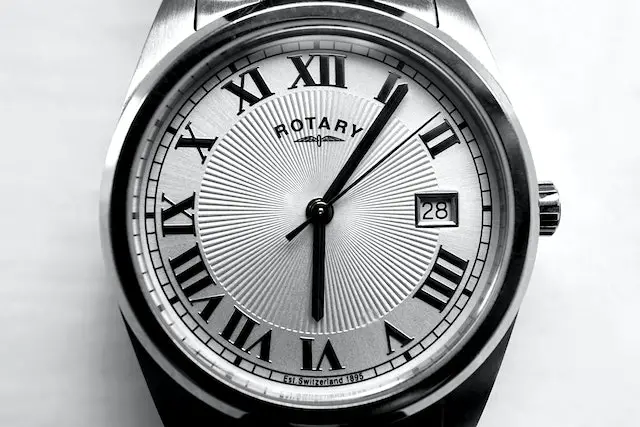
The sunray dial of the Bulova 96A133 is produced through a specific machining technique.
The dial surface is cut in a radial pattern from the centre outward — each cut is aligned with the centre of the dial, producing hundreds of fine parallel lines that radiate like the rays of a sun.
Light hitting this surface reflects differently from different angles rather than bouncing uniformly as it does from a flat or brushed surface.
The result is that the dial changes character in different lighting conditions. In diffused indoor light it reads as a deep silver.
In angled daylight it picks up warmth. Under directional artificial lighting it shimmers in the way the consultant described.
The Roman numerals on the 96A133 are deliberately oversized relative to the 37mm case diameter.
Where many dress watches use slim applied indices as the hour markers and add Roman numerals as a secondary detail, the 96A133 uses Roman numerals as the primary and largest element of the dial design, running closer to the edge of the face than convention dictates and creating a dial that is immediately identifiable as Bulova’s specific approach rather than a generic Roman numeral execution.
The result is a watch that makes a stronger visual statement than its modest case size suggests it should.
Joseph Bulova and 150 Years of American Watchmaking:
Joseph Bulova arrived in New York from Bohemia — present-day Czech Republic — in the 1870s and opened a small jewellery shop in Manhattan in 1875.
The watch company that grew from that shop was manufacturing in Biel, Switzerland within a decade and had become one of the most significant names in American watch retail by the early twentieth century.
In 1926, Bulova placed the first ever radio advertisement broadcast in the United States — a fifteen-second announcement for Bulova watches that established the template for broadcast advertising that industries beyond watchmaking would use for decades. In 1941, Bulova placed the first television advertisement ever broadcast.
The company’s first-mover approach to each new communications medium reflected the same entrepreneurial instinct that had built the business in the first place.
In 1962, Commander Scott Carpenter wore a Bulova Accutron chronograph on the outside of his spacesuit during the Mercury Aurora 7 mission when his NASA-issued watch stopped working. The Bulova kept running.
These are not borrowed associations from someone else’s story. They are documented events in Bulova’s own history, and the 96A133 carries that heritage without requiring the buyer to pay a premium.
The 37mm case is the specification that makes the 96A133 specifically appropriate for buyers who find standard men’s watch sizing — typically 40mm to 44mm — excessive on their wrist.
At 37mm, the case sits within the proportional range that works equally well on smaller male wrists and average female wrists, making the 96A133 one of the few watches in this guide that genuinely suits both demographics rather than defaulting to one or the other.
Quartz Reliability in a Dress Watch Package:
The Bulova 96A133’s quartz movement is the right choice for the watchis intended use.
A dress watch worn to professional environments, formal occasions, and social events benefits from the accuracy and low-maintenance reliability of quartz.
The watch runs precisely to within fifteen seconds per month, requires no winding, and needs nothing from the wearer beyond a battery replacement every few years.
The black genuine leather strap has a standard lug width that accommodates any replacement strap the buyer prefers, giving the 96A133 the same adaptability as the Fossil Grant and Timex Waterbury.
Independent real-world testing described the 96A133 as a watch that feels “familiar and fresh simultaneously” — a combination that is more difficult to achieve in dial design than it sounds, and one that explains why the 96A133 has remained in production with consistent positive buyer feedback rather than cycling through the redesigns that fashion-driven watch designs typically require.
Specifications:
| Feature | Details |
|---|---|
| Movement | Quartz |
| Case | 37mm stainless steel, polished |
| Dial | Sunray silver with oversized Roman numerals |
| Crystal | Mineral |
| Strap | Genuine black leather |
| Water Resistance | 30m |
| Founded | New York, 1875 |
| Heritage | First US radio ad (1926), Mercury mission (1962) |
4. Bulova 97B170: (Best Roman Numeral Dress Watch)

I’ll never forget a moment in a high-rise boardroom when I caught a glimpse of a colleague’s wrist.
He wore a Bulova 97B170, and although it wasn’t the flashiest watch in the room, its Roman-numeral dial and polished metal case caught my eye.
It was understated, but in a room full of technology and noise, that classic design stood out quietly—and left a lasting impression on me.
Why This Watch Stands Out:
Elegant Roman Numeral Dial:
The face is clean and classic, with bold Roman numeral markers that are easy to read.
It brings a sense of quiet sophistication to any outfit, formal or otherwise.
Polished Stainless Steel Case:
The case boasts a refined finish and is protected by a mineral crystal, ensuring you don’t have to worry about minor scratches from daily wear.
Slim, Comfortable Profile:
At about 40mm, the watch feels just right for most wrists and slips effortlessly under a dress shirt cuff.
It’s ideal for office hours or special occasions.
Reliable Quartz Movement:
You get precise timekeeping with minimal fuss—no winding, no power reserve worries.
Just set it and go.
Practical Water Resistance:
The 97B170 handles splashes and light rain, allowing you to wear it day to day without stress (although it’s not designed for swimming).
Conclusion:
The Bulova is the kind of watch that quietly commands respect.
It’s not loud or full of gadgets, but with its Roman numeral dial and polished design, it brings confidence and style to any formal setting.
If you want a dress watch that’s both practical and elegant—one you’ll still love years
Specs:
| Brand | Bulova |
| Model Number | 97B170 |
| Movement | Quartz |
| Case Material | Stainless Steel |
| Case Size | ~40mm |
| Dial | Roman Numerals |
| Crystal | Mineral |
| Band Material | Stainless Steel Bracelet |
| Water Resistance | Splash / Daily Wear Safe |
5. Oupinke: (Best Automatic Luxury Skeleton Stainless Steel Watch)

It’s a multifunctional, versatile product that looks classy with every outfit and occasion.
However, it’s an affordable watch but gives a luxurious look to the whole outfit.
WHAT DO WE GET FROM THESE?
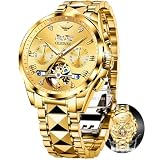
Mechanical Watch with Multifunctional Dial:
This excellent watch is compatible with both automatic and manual winding, eliminating the need for a battery.
It activates automatically with a swing of my wrist.
I have used it for around 8 hours to guarantee the exact time.
It comes with a three-dimensional scale with Roman numerals, making it easy to read, whether it’s a date, year, month, or week.
The 24-hour display gives us more details.
This is a classic men’s watch.
It can be paired with all outfits and is perfect for various occasions.
Luxurious Watch And A Stainless Steel Strap:
This watch features a high-hardness sapphire crystal mirror that is scratch-resistant.
It’s equipped with luminous hands, making the clock easy to read, even in the dark.
Additionally, this chronograph is waterproof, and I wear it daily; however, please note that it’s not suitable for underwater activities.
It features a stainless steel strap with a hidden butterfly closure.
It continues to ventilate and prevents perspiration.
The quality of this product is amazing.
I can also adjust the strap on my wrist using the free adjustment tools.
Conclusion:
However, there are many options available in Roman numerals; this watch, however, has something unique.
Its design is so attractive, and the easily adjustable band works really well.
How to Choose the Right Roman Numeral Watch
Five watches covering five different directions is useful only if you can identify which direction suits your actual situation. These are the four considerations that determine the right choice.
Movement type first. The Tissot Le Locle is the only automatic in this guide. If owning a mechanical watch that runs without a battery and shows its movement through the case back is important to you, the Le Locle is the correct choice and everything else is secondary. If movement type is not a priority, quartz is more accurate day-to-day and requires less attention.
Case shape second. Four of these five watches are round. The Daniel Wellington Quadro is rectangular. If you are drawn to the rectangular shape — lower profile on the wrist, more architectural dial layout, more jewellery-adjacent aesthetic — the Quadro is the only option in this guide. If you want round, you have four to choose from.
Case size third. The Bulova 96A133 at 37mm suits smaller wrists specifically. The Fossil Grant at 44mm suits larger wrists. The Tissot Le Locle at 39mm, the Timex Waterbury at 40mm, and the Daniel Wellington Quadro at 20x26mm cover the middle and smaller range. Measure your wrist before buying — a watch that is proportionally too large or too small for the wrist it sits on undermines every other quality it has.
Heritage versus contemporary design fourth. If knowing where a watch comes from matters to you — the city, the founder, the manufacturing tradition — Tissot (Le Locle, 1853), Timex (Waterbury, 1854), and Bulova (New York, 1875) each carry documented histories that are specific rather than constructed. Fossil (Texas, 1984) is younger but substantial. Daniel Wellington (Sweden, 2009) is the most contemporary brand in this guide and carries the least manufacturing heritage. Neither position is better. They suit different buyers.
FAQs
Are Roman numeral watches still in style in 2026?
Roman numeral watches have never been in or out of style in the way that trend-driven fashion items cycle. They have been on watch dials since the earliest pocket watches and they continue to appear on new releases from every major watchmaker at every price point precisely because they are not a trend — they are a design language with specific aesthetic properties that a certain type of buyer consistently prefers. The five watches in this guide are all currently in production and available on Amazon, which confirms that buyer demand for Roman numeral dials in 2026 is strong enough to sustain active production across multiple brands. A Roman numeral watch purchased today will not read as dated in three years the way a fashion accessory built around a specific trend does.
What size Roman numeral watch works best for formal occasions?
For formal occasions, the most important factor is not the specific size but the proportionality between the watch and the wrist it is on. A 37mm watch on a larger wrist reads as too small in formal settings — it disappears rather than finishing the outfit. A 44mm watch on a smaller wrist reads as overpowering rather than elegant. The general guidance for formal dress watches is a case size between 36mm and 42mm on most wrists, with the lower end of that range for smaller wrists and the higher end for larger ones. The Bulova 96A133 at 37mm suits smaller wrists in formal contexts specifically. The Tissot Le Locle at 39mm and the Timex Waterbury at 40mm cover the middle range proportionally. The Fossil Grant at 44mm is the most versatile size for larger wrists in formal and smart-casual contexts combined. For a broader look at how watch sizing works across different wrist circumferences and case depths, the full guide at how-to-buy-the-right-size-watch covers sizing in detail.
What is the difference between a Roman numeral watch and one with Arabic numerals or indices?
The difference is aesthetic rather than functional — the watch tells the time equally accurately regardless of which numeral system marks the hours. Roman numerals read as more traditional, more formal, and more connected to European watchmaking heritage than Arabic numerals. They create a visual character that Arabic numerals do not — the varying widths of I, V, X, and their combinations produce a dial with more irregular visual rhythm than the uniform weight of 1, 2, 3 through to 12. This irregularity is what makes a Roman numeral dial more interesting to look at for extended periods. Applied indices — the raised metal markers used instead of any numerals on many dress and minimalist watches — read as cleaner and more modern than either numeral system and suit buyers for whom the absence of numbers is itself an aesthetic position. The choice between these three approaches is entirely personal and reflects what the buyer finds visually satisfying rather than any objective advantage of one system over the others. The American Watchmakers-Clockmakers Institute provides historical context on watch dial traditions at awci.com.
Related Articles:
Apple Watch Series 11 Hands-On Review
Best Sweeping Second-Hand Watches
Best Affordable Rolex Alternative Watches
Luis Cooper

Hi, I'm Luis, the guy behind this site. I love wearing watches, especially ones that look great on small wrists (mine are about 6.3" around). The Watches Geek is dedicated to helping you learn about and buy watches that you will love wearing. I want this website to be the last destination for people to pick the best watches to fit their needs. You can find our unbiased reviews here on Thewatchesgeek.