

Last Updated on October 6, 2026 by Luis Cooper
Samsung Galaxy phones run Android, which means they can technically pair with almost any smartwatch on the market.
But technical compatibility and real-world performance are two very different things.
A watch that misses notification categories, struggles to sync health data, or lacks proper Bluetooth support will frustrate you within the first week.
In 2026, the smartwatch landscape has shifted considerably.
Several new flagship models launched this year, battery technology has improved across the board, and health sensors that were once exclusive to clinical devices are now standard on consumer hardware.
Choosing the right watch for your Samsung phone means weighing ecosystem depth, health-tracking accuracy, battery life, and budget at once.
This guide cuts through the noise.
We researched every major Android-compatible smartwatch available through 2026, verified Amazon availability for each, and narrowed the list to six watches that genuinely earn their place. Whether you use a Galaxy S25, a Galaxy Z Fold, or any other Samsung Android device, every watch here will pair, notify, and track without compromise.
Which Watches Are Best Compatible with Samsung?
Here are my recommended top 6 Best Watches Compatible with Samsung:-


1. Samsung Galaxy Watch 9: (Best Overall for Samsung Users)

Ravi works a desk job in the city and uses his Samsung Galaxy S25 for everything — maps, banking, work email.
He wanted a smartwatch that felt like a natural extension of his phone, not a separate device he had to manage.
After two weeks with the Galaxy Watch 9, he stopped thinking of it as a gadget. It just became part of how he moves through the day.
That is the experience Samsung has built here.
The Galaxy Watch 9 isn’t just a watch that works with Samsung phones — it is a watch built around them.
Released in 2026, it runs Wear OS with Samsung’s One UI Watch layer on top, giving you two ecosystems running in parallel.
On the Google side, you get the full Play Store, Google Maps navigation on your wrist, Google Wallet for contactless payments, and Gemini AI for voice queries.
On the Samsung side, you get SmartThings device control, Samsung Health deep sync, Samsung Pay, and exclusive gestures like Double Pinch that only activate when paired with a Galaxy phone.
Display:
Available in 40mm and 44mm, both sizes use Super AMOLED panels that reach 3,000 nits of peak brightness.
That number matters in practice because most smartwatch displays wash out in direct sunlight.
At 3,000 nits, the Watch 9 stays fully readable outdoors without needing to shade the screen.
Gorilla Glass Victus 2 protects the panel, and IP68 waterproofing handles submersion up to five feet for thirty minutes.
Health Tracking:
The BioActive sensor underneath the watch combines three functions in one housing: an optical heart rate monitor, an electrical heart signal sensor for ECG readings, and a bioelectrical impedance analysis sensor for body composition measurements.
This hardware stack lets Samsung pack more health capability into a smaller footprint than most competitors manage with separate sensors.
The ECG function records a single-lead electrocardiogram in about 30 seconds and flags irregular rhythms for review inside Samsung Health.
Samsung makes it clear this is a wellness feature rather than a diagnostic tool, but a timestamped ECG recording to share with a doctor during a consultation is more useful than trying to describe a palpitation from memory.
If ECG monitoring is your main priority, our guide to the best smartwatches with ECG covers every strong option available right now.
Blood pressure trend monitoring is available through the Samsung Health Monitor app after one-time calibration against a standard cuff.
Sleep tracking covers apnea detection across two nights, sleep coaching based on your HRV history, and a Bedtime Guidance feature that calculates your optimal sleep window from accumulated data. SpO2, skin temperature, and respiratory rate round out the sensor suite and update continuously throughout the day.
Performance:
Samsung has not disclosed the specific chipset, but independent reviewers have documented a meaningful performance leap over the Watch 7.
Apps open faster, scrolling is smooth, and concurrent health monitoring tasks run without the battery penalties that affected earlier generations.
Battery:
With always-on display off and continuous health monitoring active, the 44mm model runs approximately 40 hours per charge. Enable always-on display and expect around 24 hours.
The wireless charger takes the watch from empty to full in roughly 90 minutes.
Key Features:
- Super AMOLED display, 3,000 nits peak brightness.
- ECG with irregular rhythm detection.
- Blood pressure trend monitoring (one-time cuff calibration required).
- Sleep apnea detection across two nights.
- Body composition via BIA sensor.
- Continuous SpO2, HRV, skin temperature, respiratory rate.
- Full Google Play Store and Gemini AI.
- Samsung Health deep integration.
- Google Wallet and Samsung Pay NFC.
- SmartThings device control for Samsung Galaxy phones.
- Gorilla Glass Victus 2 and IP68 waterproofing.
- Available in 40mm and 44mm.
Specifications:
| Spec | Details |
|---|---|
| Display | Super AMOLED, 3,000 nits, Gorilla Glass Victus 2 |
| Sizes | 40mm / 44mm |
| OS | Wear OS with One UI Watch |
| Health | ECG, SpO2, BIA, blood pressure, sleep apnea, HRV, skin temp |
| Water Resistance | IP68 |
| Connectivity | Wi-Fi, Bluetooth, NFC, LTE (select models) |
| Compatibility | Android, Samsung Galaxy optimized |
Who Should NOT Buy This: If you do not own a Samsung Galaxy phone, you will miss most of what makes the Watch 9 worth its price. The Samsung-exclusive features simply do not activate on other Android brands. Similarly, if you need a watch that lasts more than two days without charging, the Watch 9 will frustrate you — look at the OnePlus Watch 4 or Garmin Venu 4 instead.
2. Samsung Galaxy Watch Ultra 2: (Best Premium Samsung Watch)

Priya manages a construction team and spends most of her workday outdoors.
She had already gone through two standard smartwatches in eighteen months — one scratched beyond recognition, one that stopped charging properly after a fall.
When she switched to the Galaxy Watch Ultra 2, the first thing she noticed was that she stopped worrying about the watch.
That is the point of the Ultra 2.
It is the Galaxy Watch 9 rebuilt for people who are genuinely hard on their gear.
Samsung launched it in August 2026, aimed at users who want everything the Watch 9 offers, wrapped in a case that can take real punishment without showing it.
How It Is Built:
The case is made from Grade 5 titanium — the same material used in aircraft components and surgical instruments.
It is lighter than steel, harder than aluminium, and does not corrode when exposed to sweat, salt water, or chemicals.
The watch carries a MIL-STD-810H military durability rating, which covers extreme temperature ranges, drops, vibration, altitude, and humidity.
That is not a marketing label. It means the watch was physically tested against each of those conditions before being approved for sale.
Water resistance goes to 10ATM — ten times deeper than the standard Watch 9. You can swim laps, snorkel, or use it in heavy rain without any concern.
Battery Life:
The larger titanium case houses a significantly bigger battery than the standard Watch 9.
Heavy users who needed to charge the Watch 9 every night will typically go two to three days between charges with the Ultra 2.
For Priya, who is often away from a desk for long stretches, that difference matters every single week.
Health and Performance Features:
Every health sensor from the Galaxy Watch 9 carries over: ECG, blood pressure trend monitoring, sleep apnea detection, SpO2, skin temperature, HRV, and body composition.
The Ultra 2 adds enhanced athletic performance metrics, including more detailed training load analysis and recovery recommendations.
If you work out regularly and want data-driven guidance on when to push and when to rest, those metrics make a real difference over time.
Software
The Ultra 2 runs the same Wear OS with One UI Watch setup as the Watch 9.
Google Play, Google Wallet, Gemini AI, Samsung Health, SmartThings, and Samsung Pay all behave identically.
If you are already familiar with the Watch 9 experience, picking up the Ultra 2 is instant.
Key Features:
- Grade 5 titanium case, lighter and harder than steel.
- MIL-STD-810H military durability testing passed.
- 10ATM water resistance, safe for swimming and water sports.
- Extended battery life over the standard Galaxy Watch 9.
- Full ECG, blood pressure, sleep apnea, SpO2, HRV, skin temperature suite.
- Enhanced athletic performance metrics and training load analysis.
- Wear OS with One UI Watch.
- Google Play, Google Wallet, Samsung Pay, Gemini AI.
- Samsung Health and SmartThings integration.
Specifications:
| Spec | Details |
|---|---|
| Case Material | Grade 5 Titanium |
| Durability | MIL-STD-810H |
| Water Resistance | 10ATM |
| OS | Wear OS with One UI Watch |
| Health | ECG, SpO2, blood pressure, sleep apnea, HRV, skin temp, BIA |
| Payments | Google Wallet and Samsung Pay |
| Compatibility | Android, Samsung Galaxy optimized |
Who Should NOT Buy This: The Ultra 2 is not the right pick if you work in an office, rarely exercise outdoors, and already handle your Watch 9 with care. You would be paying a premium for durability features you will never need. The standard Galaxy Watch 9 delivers the same health sensors and software at a lower price for most everyday users.
3. Google Pixel Watch 5: (Best for Android Users Who Want Pure Google Experience)

James switched from an iPhone to a Samsung Galaxy phone last year and has been rebuilding his app setup around Google ever since.
He wanted a smartwatch that felt native to the Google ecosystem — not Samsung’s version of it, not a customized layer on top of it, just Google’s own take on what a smartwatch should be.
The Pixel Watch 5 was the obvious answer.
Not everyone wants a Samsung watch on their Samsung phone.
Some people prefer Google’s cleaner, more straightforward approach — no extra software layers, no brand-specific features, just a well-made watch running the best version of Wear OS available. That is exactly what the Pixel Watch 5 delivers.
Google launched it in 2026 in two sizes, 41mm and 45mm, and it works perfectly with every Android phone on the market, including all Samsung Galaxy models.
The Display:
Both sizes use what Google calls an Actua 360 AMOLED display.
The screen wraps edge to edge across the entire face of the watch, leaving no bezel eating into your viewing area.
Brightness reaches 3,000 nits, so outdoor readability is not a problem.
The refresh rate adjusts automatically between 1Hz and 60Hz depending on what you are doing, which preserves battery life without making the screen feel slow during active use.
Battery Life:
Previous Pixel Watch models were criticized for short battery life. Google has addressed this seriously with the Pixel Watch 5.
The 45mm model runs up to 40 hours with always-on display turned on and stretches to 72 hours in battery saver mode.
The 41mm model runs up to 30 hours with always-on display active.
For most people, that means charging every other night instead of every night.
Health Tracking:
Heart rate monitoring, ECG, SpO2, and skin temperature form the foundation.
Google has added blood pressure trend monitoring, sleep breathing quality analysis, insulin resistance tracking, and smart wake alarms that study your sleep cycles and wake you at the lightest point in your sleep rather than jarring you out of deep sleep.
The GPS system uses dual-frequency tracking, picking up signals from two satellite bands instead of one.
In practice, that means better accuracy when running through city streets, near tall buildings, or under dense tree cover where single-band GPS tends to drift.
Software and AI
The Pixel Watch 5 runs Wear OS 7, the newest version available in 2026.
Because Google makes both the watch and the operating system, software updates arrive faster here than on any other Android smartwatch.
You are not waiting for a third party to test and approve each update before it reaches your wrist.
Google publishes the full Wear OS feature roadmap and platform details at wearos.google.com for anyone who wants to understand what the platform supports.
Gemini AI is built in and handles reminders, quick questions, smart home device control, and context-aware suggestions.
Google has also added personalized widgets that adapt based on your routines, time of day, and recent activity.
The full Google Play Store is available, and Google Wallet handles contactless payments wherever NFC is accepted.
Key Features:
- Actua 360 AMOLED display, 3,000 nits, edge to edge with no bezel.
- Wear OS 7 with Gemini AI built in from the start.
- Up to 40 hours of battery life with always-on display active (45mm model).
- Blood pressure trends, sleep breathing quality, and insulin resistance tracking.
- ECG, SpO2, heart rate, skin temperature sensors.
- Dual-frequency GPS for improved accuracy in urban environments.
- IP68 and 5ATM water resistance.
- Full Google Play Store access.
- Google Wallet NFC payments.
- Available in 41mm and 45mm.
- Works with all Android phones, including every Samsung Galaxy model.
Specifications:
| Spec | Details |
|---|---|
| Display | Actua 360 AMOLED, 3,000 nits, 1-60Hz LTPO |
| Sizes | 41mm / 45mm |
| OS | Wear OS 7 |
| Battery | Up to 40 hrs AOD (45mm) / 72 hrs battery saver |
| Health | ECG, SpO2, BP trends, insulin resistance, sleep breathing, skin temp |
| GPS | Dual-frequency |
| Water Resistance | IP68 and 5ATM |
| Compatibility | All Android phones |
Who Should NOT Buy This: If you rely on Samsung Health for all your fitness data and do not want to split it between two apps, the Pixel Watch 5 will create friction. It also isn’t the right choice if battery life beyond two days matters to you — look at the OnePlus Watch 4 or Garmin Venu 4 for that.
4. OnePlus Watch 4: (Best Battery Life Under Its Price)

Omar is a logistics manager who drives between sites all day and is almost never near a charging cable during work hours.
He had tried three different Wear OS watches before the OnePlus Watch 4. All of them needed charging every night without exception.
The day his Watch 4 hit its sixth consecutive day of battery life without a charge, he texted a friend: “this is the one.”
Battery life is the headline story of the OnePlus Watch 4, but it would not belong on this list if that were the only thing it had going for it.
OnePlus launched the Watch 4 in 2026 with a titanium build, Wear OS 6, and a 632 mAh battery that delivers five days of normal smartwatch use and sixteen days in power saver mode.
For a Wear OS watch, those numbers are genuinely unusual.
Build and Design:
The case is made entirely from titanium alloy and measures 47.4mm across and 11mm thick.
Despite that size, it weighs just 43 grams on the wrist — around 13% lighter than the previous generation.
The display is a 1.5-inch LTPO AMOLED panel with sapphire crystal protection on top.
Sapphire is one of the hardest materials used on watch faces, which means everyday contact with keys, counters, and surfaces leaves no visible marks.
Peak brightness hits 3,000 nits, keeping the screen readable in sunlight.
For durability, the Watch 4 carries IP68 and IP69 ratings, plus MIL-STD-810H military-grade testing.
IP69 is the stricter standard — it means the watch handles high-pressure, high-temperature water jets, not just submersion. It also has full seawater corrosion resistance.
Performance:
Inside the Watch 4 is a dual-engine setup: a Qualcomm Snapdragon W5 chip handles main processing, while a BES2800 co-processor manages background tasks like health monitoring and step counting.
This split helps OnePlus deliver strong battery performance without sacrificing day-to-day speed.
The watch ships with 2GB of RAM and 32GB of storage — enough to hold several hundred songs for offline listening on runs.
Health Tracking:
The Watch 4 includes a 60-Second Wellness Overview that checks nine metrics in one minute: heart rate, stress level, sleep quality, blood oxygen, cardiovascular vitality, and more.
It gives you a useful snapshot of where your body is right now rather than asking you to piece it together from separate readings.
Heart rate monitoring runs continuously throughout the day.
SpO2 and sleep-stage tracking run in the background overnight.
Over 100 sports modes are available, with dedicated professional algorithms built specifically for eleven activities including running, cycling, tennis, badminton, and skiing.
Dual-frequency GPS tracks outdoor routes accurately, even in dense urban areas.
NFC supports contactless payments, and Gemini AI handles voice commands on the wrist.
Charging:
When the battery does need a top-up, 7.5W fast charging delivers enough power for a full day’s use in just ten minutes.
A complete charge from empty takes about 75 minutes.
Key Features:
- Up to 5 days of battery in Smart mode, 16 days in Power Saver mode.
- 1.5-inch LTPO AMOLED display, 3,000 nits, sapphire crystal protection.
- Full titanium alloy case, 43 grams.
- IP68, IP69, and MIL-STD-810H durability ratings.
- Seawater corrosion resistance.
- 60-Second Wellness Overview across 9 health metrics.
- Dual-frequency GPS for accurate outdoor tracking.
- 2GB RAM and 32GB internal storage.
- 7.5W fast charging — full day of use in 10 minutes.
- Wear OS 6 with OxygenOS Watch 8.
- Gemini AI and NFC payments.
- 100+ sports modes, 11 with dedicated professional algorithms.
- Works with all Android phones including Samsung Galaxy.
Specifications:
| Spec | Details |
|---|---|
| Display | 1.5-inch LTPO AMOLED, 3,000 nits, sapphire crystal |
| Case | Titanium alloy, 47.4mm, 43g |
| Battery | 632 mAh — up to 5 days smart mode / 16 days power saver |
| Charging | 7.5W fast charge, full day in 10 minutes |
| Processor | Snapdragon W5 + BES2800 co-processor |
| RAM / Storage | 2GB / 32GB |
| GPS | Dual-frequency |
| Durability | IP68, IP69, MIL-STD-810H |
| OS | Wear OS 6 with OxygenOS Watch 8 |
| Compatibility | All Android phones |
Who Should NOT Buy This: If you have small wrists, the 47.4mm case will likely feel uncomfortable and look oversized. Try it on before buying if possible. The Watch 4 also has fewer dedicated health sensors than the Samsung Galaxy Watch 9—if ECG, blood pressure monitoring, and body composition matter to you, the Watch 9 is the better fit.
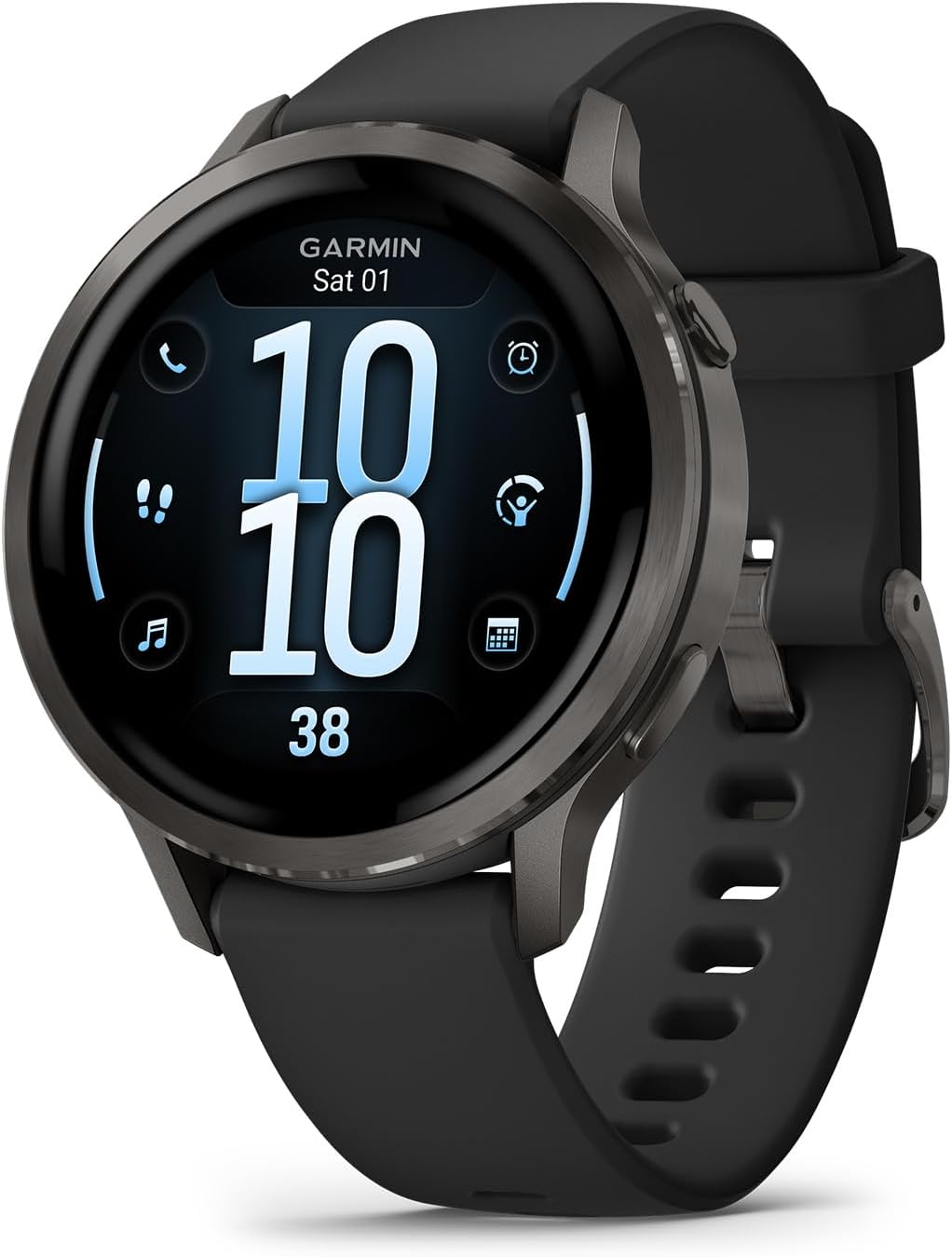
5. Garmin Venu 4: (Best for Health and Fitness Tracking)
Sara runs five days a week and has been tracking her training seriously for two years.
She used Wear OS watches for most of that time and grew frustrated.
The data was there — heart rate, steps, sleep — but she could never tell what it actually meant for tomorrow’s run.
Should she push hard today or take it easy? The numbers never told her.
In her first week with the Garmin Venu 4, her Body Battery read 22 on a Tuesday morning after a poor night’s sleep.
The watch told her clearly: light activity only today. She listened.
Her Thursday long run was one of the best she had logged in months.
That is the difference the Venu 4 makes. It does not just collect data — it tells you what to do with it.
The Venu 4 uses Garmin’s own operating system, which connects to Samsung phones through the Garmin Connect app on Android. Notifications, calls, texts, and app alerts all come through cleanly.
You give up the Google Play Store. What you gain is health and fitness analytics that most dedicated running devices cannot match.
Display and Build:
The Venu 4 comes in 41mm and 45mm. Both use a 1.4-inch AMOLED touchscreen protected by Corning Gorilla Glass 3, with accurate color reproduction and strong sunlight legibility.
The case is full metal construction, which gives it a more premium feel than most watches in its category.
At 51 grams for the 45mm and 42 grams for the 41mm, it wears comfortably for all-day and overnight tracking.
Water resistance is rated at 5ATM, covering swimming, showering, and rain.
Battery Life:
The 45mm model runs up to 12 days in smartwatch mode with continuous health monitoring active.
Real-world use with daily workouts and GPS activity brings most users to seven to nine days before charging.
GPS-only tracking runs for approximately 20 hours.
Always-on display reduces battery life to around four days.
By any measure, it outlasts every Wear OS watch on this list in smartwatch mode.
Health Tracking
Garmin fitted the Venu 4 with its Elevate Gen 5 heart rate sensor — the same hardware found in Garmin’s dedicated triathlon watches.
The difference in sensor quality shows in daily tracking accuracy, particularly during high-intensity workouts where cheaper optical sensors struggle to keep up.
Body Battery runs from 0 to 100 and updates throughout the day.
It combines heart rate variability, stress, sleep quality, and physical activity into a single energy score.
At 85, your body is ready for a hard effort. At 20, it is asking for rest.
Reviewers and athletes consistently describe Body Battery as the most immediately useful number any smartwatch has ever given them.
Training Readiness combines your recent workout load, sleep quality, recovery time, and stress history into a daily readiness score with a plain explanation of what it means.
You do not need to interpret the data — the watch does that part.
Sleep Alignment is a feature unique to Garmin that measures how well your sleep schedule matches your natural circadian rhythm — not just whether you slept enough, but whether you slept at the right time for your biology.
Jet lag advice uses travel history and sleep data to help you adapt faster when crossing time zones.
VO2 Max estimation, recovery time recommendations, and full on-wrist running dynamics — cadence, stride length, ground contact time, and vertical oscillation — complete the fitness picture.
These metrics previously required expensive chest straps or lab testing.
SpO2, skin temperature, a barometric altimeter, and a compass round out the sensor suite.
Music and Connectivity
The Venu 4 stores Spotify, Amazon Music, and Deezer playlists directly on the watch for offline listening.
It has a built-in speaker and microphone for Bluetooth calls and voice control. Garmin Pay handles contactless payments where supported.
Android users on Samsung phones get full text-reply capability from the watch — a detail many health-focused watches sacrifice.
Key Features:
- Up to 12 days battery in smartwatch mode (45mm model).
- Body Battery energy tracking (0 to 100), updated throughout the day.
- Daily Training Readiness and Training Load scores with plain-language explanations.
- Garmin Elevate Gen 5 heart rate sensor.
- Sleep stage detection, Sleep Alignment, and jet lag adaptation advice.
- VO2 Max estimation and on-wrist running dynamics.
- Multi-band GNSS with SatIQ automatic satellite optimization.
- ECG app (regional availability).
- SpO2, skin temperature, barometric altimeter, and compass.
- Offline music via Spotify, Amazon Music, and Deezer.
- Built-in speaker and microphone for Bluetooth calls.
- Garmin Pay NFC.
- 5ATM water resistance.
- Full metal case with Gorilla Glass 3.
- Works with Samsung phones via Garmin Connect app on Android.
Specifications:
| Spec | Details |
|---|---|
| Display | 1.4-inch AMOLED, Gorilla Glass 3 |
| Sizes | 41mm (42g) / 45mm (51g) |
| Battery | Up to 10 days (41mm) / 12 days (45mm) smartwatch mode |
| GPS | Multi-band GNSS with SatIQ |
| Health | HR Elevate Gen 5, SpO2, ECG, skin temp, altimeter, compass |
| Music | Spotify, Amazon Music, Deezer offline downloads |
| Water Resistance | 5ATM |
| Payments | Garmin Pay |
| Compatibility | Android via Garmin Connect app |
Who Should NOT Buy This: If you need Google Maps, Gemini AI, or a wide selection of third-party apps on your wrist, the Venu 4 will disappoint you. It is also not the right fit for casual users who just want notifications and basic step counting — the feature depth is genuinely wasted at that level of use. For those users, the Xiaomi Redmi Watch 5 Lite or Samsung Galaxy Watch 9 is the more sensible choice.
6. Xiaomi Redmi Watch 5 Lite: (Best Budget Pick for Samsung Users)

Fatima bought her first smartwatch two years ago. It lasted six weeks before she stopped wearing it — too heavy on her wrist, too complicated to set up, and the battery died every night before she woke up in the morning.
When her son suggested she try the Xiaomi Redmi Watch 5 Lite, she was sceptical.
Three months later, she still has not taken it off.
Not every Samsung phone user needs ECG sensors, titanium cases, or two weeks of athletic data.
Some people simply want a reliable smartwatch that handles daily notifications, tracks workouts, monitors sleep, and doesn’t demand constant attention.
The Redmi Watch 5 Lite is built for exactly that.
It connects to Samsung phones via Bluetooth and the Mi Fitness app on Android, giving you full notification access, call alerts, and health data in one place.
Setup is quick and works smoothly on any Samsung Galaxy device.
Display
The watch features a 1.96-inch AMOLED screen with 332 pixels per inch — sharper than many mid-range smartwatches.
Always-on display mode is available for users who want the time visible without raising their wrist.
Reviewers who tested it in direct sunlight reported no issues reading notifications or health data on the screen.
At just 29 grams, it is the lightest watch on this entire list.
People who find standard smartwatches too heavy for all-day and overnight wear will appreciate how little they notice it.
Battery Life:
Under normal daily use with health monitoring running, the Redmi Watch 5 Lite lasts up to 18 days.
That is the longest battery life on this list.
Heavy GPS use during daily outdoor workouts brings that figure down to about seven to eight days—still longer than most premium smartwatches manage in full smartwatch mode.
For users who travel, spend time outdoors, or simply do not want to think about charging their watch, this battery is genuinely freeing.
Health and Fitness Tracking:
Built-in GPS covers five satellite systems, so it tracks outdoor runs, walks, and cycling routes accurately without needing the phone nearby.
Independent testers recorded heart rate accuracy within two to three beats per minute of a chest strap reference — a result that holds up well for a watch at this price.
Sleep tracking covers light, deep, and REM stages rather than just total sleep time. Stress monitoring runs through the day.
SpO2 blood oxygen readings are available on demand.
Over 100 workout modes include swimming, covered by the 5ATM water resistance rating.
Bluetooth calling lets you answer and make calls directly from the watch.
Amazon Alexa responds to voice commands, though it displays answers as text on screen rather than speaking them aloud.
What You Should Know:
The case is plastic rather than metal, which keeps it light but means it will not feel as solid on the wrist as the titanium and steel options higher on this list.
It has no NFC, so contactless payments aren’t available. No Wear OS means Google Play apps are not accessible — the Mi Fitness ecosystem is where this watch lives.
None of that matters if your priorities are battery life, lightweight comfort, basic fitness tracking, and value.
For first-time smartwatch buyers, older users who want something simple, or anyone upgrading from a basic fitness band, the Redmi Watch 5 Lite delivers more than its price suggests.
Key Features:
- Up to 18 days battery life under normal daily use.
- 1.96-inch AMOLED display, 332 ppi, with always-on option.
- 29 grams — the lightest watch on this list.
- Built-in GPS covering five satellite systems.
- Heart rate monitoring, SpO2, sleep stage tracking, stress monitoring.
- 100+ workout modes including swimming.
- 5ATM water resistance.
- Bluetooth calling and Amazon Alexa voice commands.
- Full Samsung Galaxy compatibility via Mi Fitness app on Android.
Specifications:
| Spec | Details |
|---|---|
| Display | 1.96-inch AMOLED, 332 ppi, always-on available |
| Weight | 29g |
| Battery | Up to 18 days normal use / 7-8 days heavy GPS |
| GPS | Five satellite systems (GPS, GLONASS, Galileo, BDS, QZSS) |
| Health | Heart rate, SpO2, sleep stages, stress |
| Sports Modes | 100+ |
| Water Resistance | 5ATM |
| Voice Assistant | Amazon Alexa (text responses) |
| Compatibility | Android via Mi Fitness app |
Who Should NOT Buy This: If you need contactless payments, a metal case, or access to Google Play apps, look elsewhere on this list. The Redmi Watch 5 Lite is also not the right choice for serious athletes who need advanced training metrics — the Garmin Venu 4 or OnePlus Watch 4 serve that need far better.
Frequently Asked Questions
Can any smartwatch work with a Samsung phone?
Yes. Samsung phones run Android, which means any Android-compatible smartwatch will pair with them. Wear OS watches connect through Bluetooth and the Play Store. Garmin watches connect through the Garmin Connect app. Xiaomi watches connect through the Mi Fitness app. Every watch on this list works with all Samsung Galaxy models without any technical barriers.
That said, some watches work more deeply with Samsung phones than others. Samsung Galaxy Watches unlock features like SmartThings device control, Double Pinch gestures, and full Samsung Health integration that aren’t available when paired with other Android brands.
Do I need a Samsung watch to get the most out of Samsung Health?
Not entirely. The Samsung Health app is available on all Android phones and records steps, workouts, sleep, and nutrition regardless of which watch you use. However, features like ECG recordings inside Samsung Health, blood pressure trend monitoring, and real-time body composition readings are exclusive to Samsung Galaxy Watches. If those specific health tools matter to you, a Samsung watch is the only way to access them.
Which watch on this list has the best battery life?
The Xiaomi Redmi Watch 5 Lite leads with up to 18 days under normal use. The OnePlus Watch 4 follows with up to 16 days in power saver mode and five days in full smartwatch mode. The Garmin Venu 4 runs 10 to 12 days in full smartwatch mode with all health sensors active. Wear OS watches like the Samsung Galaxy Watch 9 and Google Pixel Watch 5 typically last 1 to 2 days with the always-on display enabled.
Which is the best swim watch?
The Samsung Galaxy Watch Ultra 2 is the toughest around water, with a 10ATM rating and MIL-STD-810H military standard testing. The OnePlus Watch 4 has IP68 and IP69 rating and is rated for 50 meters depth. The Google Pixel Watch 5 (IP68 and 5ATM) can take laps easily. Both the Garmin Venu 4 and Xiaomi Redmi Watch 5 Lite are rated at 5ATM, so they can easily handle casual swimming and showering.
Which watch gives the most detailed fitness tracking?
The Garmin Venu 4 provides the deepest fitness and health analytics of any watch on this list. Body Battery, Training Readiness, Training Load, VO2 Max estimation, running dynamics, and Sleep Alignment give you a complete picture of how your body is responding to training over time. For users who want health data they can act on rather than just collect, the Venu 4 has no equal here.
Do these watches work with iPhones?
Samsung Galaxy Watches are built for Android and have very limited functionality on iPhone. The Google Pixel Watch 5 and Garmin Venu 4 offer basic notification support on iPhone, but their full feature sets require Android. If you use an iPhone, this guide is not the right fit.
Final Verdict
For most Samsung Galaxy users, the Samsung Galaxy Watch 9 is the right starting point. It offers the deepest ecosystem integration, the most complete health sensor suite at its price, and a bright display that works well in everyday life.
Upgrade to the Samsung Galaxy Watch Ultra 2 if you want titanium durability, extended battery life, and serious water resistance without leaving the Samsung ecosystem.
Choose the Google Pixel Watch 5 if you want stock Wear OS without any manufacturer layer on top, the fastest software updates, and Gemini AI working at its best.
Pick the OnePlus Watch 4 if battery life is your number one priority and you want a premium titanium build without paying Ultra 2 prices.
Go with the Garmin Venu 4 if health and fitness data depth matters more to you than app variety. No watch on this list gives you more actionable insight into your body per charge.
Start with the Xiaomi Redmi Watch 5 Lite if you want the longest battery life on this list, accurate health tracking, and a lightweight design at the most accessible price here.
Related Articles:
Garmin Fenix 9 Pro Solar vs AMOLED
Best Smartwatches for Android Under $200
Best Running Watches for Women
Best Luxury Watch Brands To Know
Luis Cooper

Hi, I'm Luis, the guy behind this site. I love wearing watches, especially ones that look great on small wrists (mine are about 6.3" around). The Watches Geek is dedicated to helping you learn about and buy watches that you will love wearing. I want this website to be the last destination for people to pick the best watches to fit their needs. You can find our unbiased reviews here on Thewatchesgeek.
1 thought on “6 Best Watches Compatible with Samsung: (2026 Guide & Reviews)”