
Last Updated on September 18, 2026 by Luis Cooper
Anyone wanting to buy a running watch right now is likely to have a highly diverse opinion of what they require.
New suggestions added to the list include Fossil, Polar, and Amazfit, all of which offer highly valued watches.
The best running watches are an outstanding way to improve your knowledge of endurance sports, especially running, cycling, and swimming.
These high-quality fitness trackers have lots of features to help you improve your subjective bests, including virtual trendsetters, suggested training, and walking data you get while you are running.
Without any further ado, let’s dive into the article to learn more about the best running watches for women.
Which are the Best Running Watches for Women?
Here are my recommended top 6 Best Running Watches for Women:-
![Samsung Galaxy Watch9, Graphite, 40mm Bluetooth Smartwatch | AI Assistant, Fitness Tracker, Sleep Coaching and Running Coaching with Heart Rate Tracking [US Version, 2 Yr Warranty]](https://m.media-amazon.com/images/I/31Q6G58gP9L._SL160_._SL160_.jpg)

Garmin Forerunner 970: (Best Premium GPS Running Watch)

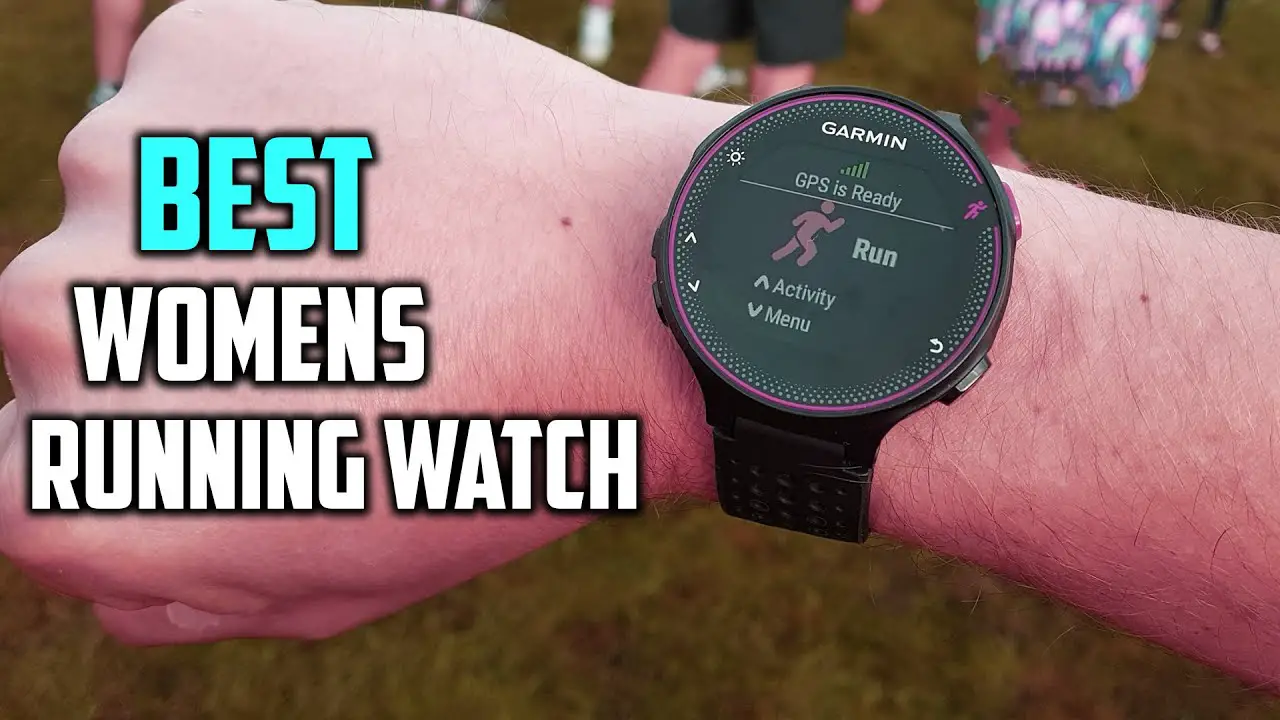
The Garmin Forerunner 970 is a top-tier running watch built for runners who want pro-level data, maps, and music in a durable package.
It has a bright 1.4-inch AMOLED screen, a titanium bezel with sapphire glass, and an array of sensors (multi-band GNSS, optical heart rate, SpO₂).
For many women who train seriously — road runners, trail runners, and triathletes — the 970 delivers advanced training metrics, excellent GPS, and phone-free music so a long run doesn’t need a phone in hand.
If you want a single device that can guide workouts, log routes, and store playlists, this is one of the most capable options available.
BATTERY:
Garmin redesigned the power curve for the 970 so you get long runtimes even when using GNSS and music.
Official figures put typical smartwatch life at up to 15 days and GPS mode up to 26 hours; with music active, that drops to about 13–14 hours depending on GPS settings.
In real-world reviews, GPS + music usually gives enough charge for long training sessions or races without panic-charging mid-event.
If you prioritise multi-day adventures or ultra-distance races, switching to Garmin’s power modes or limiting the Always-On screen will extend battery life.
MUSIC and STORAGE:
This watch is truly stand-alone for music: it includes 32GB of internal storage and supports offline syncing from Spotify, Amazon Music, Deezer, and YouTube Music.
That means you can download playlists and run phone-free with Bluetooth headphones.
The Forerunner 970 also has a mic and speaker for call handling when paired to your phone — a small convenience if you want the option to answer hands-free during an easy run.
RECORDING & NAVIGATION:
Garmin packed the 970 with advanced GNSS options, including multi-band tracking and SatIQ AutoSelect mode for better route accuracy in trees, cities, or canyons.
It also features full offline maps and turn-by-turn routing, plus a built-in flashlight for early starts or dusk runs.
These navigation tools make the 970 strong for trail runners or anyone who likes exploring new routes without getting lost.
Reviewers praise its mapping and breadcrumb features as some of the best in its class.
HEALTH & TRAINING FEATURES:
Expect a full suite of training tools: advanced running dynamics, VO₂ max, training load, recovery recommendations, and real-time coaching plans.
Health tracking covers continuous heart rate, SpO₂ spot checks, sleep staging, and Garmin’s Body Battery energy score.
The watch also supports ECG functionality and detailed sleep metrics in markets where those features are cleared.
If you’re training for a goal — tempo runs, marathon, or hill repeats — the 970 gives the numbers you need to plan and recover intelligently.
FIT FOR WOMEN: PRACTICAL ADVICE
The Forerunner 970 measures about 47mm across and is a substantial watch. For many women with smaller wrists, it will look large; that’s a trade-off for the big screen and battery. Here’s how to make it work:
- Try different bands: soft silicone or woven nylon straps reduce bulk and improve comfort. Garmin and third-party 22–24mm quick-release straps give good options.
- Use a snug but comfortable fit during workouts so heart-rate readings stay accurate.
- If you want similar features in a smaller case, consider Garmin models in 42–45mm sizes (e.g., Forerunner 265S or Venu X1) — they retain many training features while fitting smaller wrists better.
Many women who try the 970 keep it for weekends and long runs, and wear a slimmer watch on casual days. That mixed approach gives the best of both worlds.
SPECS:
| Feature | Detail |
| Display | 1.4″ AMOLED, sapphire lens. |
| Case size | ~47mm. |
| Storage | 32 GB (music & apps). |
| GPS | Multi-band GNSS, SatIQ. |
| Battery | Smartwatch up to 15 days; GPS up to 26 hr; GPS+music ~13–14 hr. |
| Sensors | Optical HR, SpO₂, barometer, compass, thermometer, ECG, where available. |
| Extras | Offline maps, built-in flashlight, mic & speaker, NFC payments. |
Polar Pacer Pro: (Best Advanced GPS Running Watch for Women)

A client wanted to start losing weight and needed a running watch to help with that.
So my company sent me to look it over.
She intended to get a reasonable and user-friendly camera.
Using the Polar Pacer running watch is a good idea for anyone who wants to lose weight and track their progress.
This excellent smartwatch offers many fantastic features and is comfortable.
I have also used many watches, but I adore this one; it is the best running watch.
It was simple to set up.
It offers a variety of features at a reasonable cost.
The watch is easy to operate and comfortable to wear daily.
WHAT DO WE GET FROM THESE?
New Generation GPS Watch:
This watch is a serious tool for runners to boost them.
It works as a powerful training tool.
The watch has a minimal and compact design with pretty grippy buttons.
It has a hyper-fast processor that is always on the MP color screen.
Accurate GPS helps you track your pace more easily.
Moreover, the Polar Precision Prime optical heart rate-tracking technology accurately monitors your heart rate.
It has a long battery life, a plus for a running watch.
Powerful Running Tool:
It provides all the tools you need to win the race.
The watch offers running essentials such as speed, distance, and duration, plus a stopwatch, a lap timer, and an interval timer.
It also offers phased training targets to guide runners through interval workouts, and HR training zones to improve runners’ speed.
It predicts the runner’s race time and includes a function of the running index.
Furthermore, it comes with a seasoned planner and tailor-made running programs.
Integrated Barometer:
This polar pacer watch can instantly monitor the action needed for every element of your run.
It helps you modify your power and finish vigorously.
Directly from the wrist, its power values are in watts.
It also has running power zones and instantly adapts to increase intensity.
You can personalize your heart rate, speed, and power zones that help you hit your running speed.
Conclusion:
This is straightforward to use.
It takes only a few seconds to set up the required monitoring functions.
I can access the watch with excellent GPS accuracy.
I can answer phone calls immediately with this watch.
The watch has great-quality sound, which is quite impressive.
Specs:
| Brand | Polar Pacer Pro |
| dimensions of the product | 4.37 x 3.15 x 3.03 inches |
| mass of the package | 0.18 Kilograms |
| warranty description | Two-year manufacturer |
| color | blue |
| material used | Lightweight and thin structure with aluminum bezel and buttons |
| suggested users | Unisex-Adult |
| part number of the product | 900102181 |
| style | PacerPro |
| size | S-L |
| hand orientation | Ambidextrous |
| human interface input | controllers |
Samsung Galaxy Watch 9: (Best Android Running Watch for Women)

A teacher who ran three mornings every week described the moment she decided to buy the Samsung Galaxy Watch 9 as happening while she was getting dressed for work.
She had been wearing a smartwatch for two years.
It was a good watch.
But every Monday morning, she sat at her desk with a rough idea of whether the weekend had been active and no clear answer to the question that actually mattered to her: was her body ready to run hard today, or did it need an easy session?
The Galaxy Watch 9’s Vitals feature answers that question every morning before she leaves the house.
After seven nights of sleep, the watch builds a personal baseline based on her heart rate, breathing rate, oxygen levels, and skin temperature.
From the eighth morning onwards, it tells her specifically whether her numbers are within her normal range or outside it. Not compared to other people. Compared to her own normal.
She described that as the first time a watch had told her something genuinely useful rather than just recording what she already knew.
Why the 40mm Size Matters for Women Runners
The Galaxy Watch 9 comes in 40mm and 44mm.
For women runners, the 40mm is almost always the right choice, and the reason is practical rather than aesthetic.
A smaller case means less weight on the wrist during a run.
Less weight means less movement during high-intensity intervals, when a bouncing watch shifts the heart rate sensor away from the skin and produces readings that drift from reality.
The 40mm Galaxy Watch 9 sits close to the wrist and stays there through sprint sessions, tempo runs and anything else that involves sustained effort.
The display is still bright enough to read mid-run.
The screen reaches 3,000 nits, which is more than enough to read pace and heart rate in direct afternoon sunlight without slowing down or covering the screen with your hand.
What It Does During a Run
The dual-band GPS uses two satellite signal frequencies at the same time.
One frequency alone is enough in open countryside.
Two frequencies working together reduce errors caused when satellite signals bounce off buildings and the tree canopy before reaching the watch.
For women who run through cities, parks or anywhere with overhead cover, the dual-band GPS produces route maps that more accurately reflect where they actually ran rather than cutting corners and adding phantom detours through walls.
The automatic workout detection recognizes running without any button press.
You start moving, and the watch starts tracking. For runners who want to get out the door quickly without navigating menus, this removes one small friction from the pre-run routine.
After the run, the Cardio Load feature tells you how much cardiovascular stress the session added to your current training load and how much recovery time that stress requires.
This feature helps women who train consistently avoid the mistake of running hard two days in a row when their bodies have not recovered from the first session.
The One Thing to Know Before Buying
The Galaxy Watch 9’s best health features require a Samsung Galaxy phone. ECG, blood pressure monitoring, and sleep apnea detection all work exclusively with Samsung phones. If you use a Samsung phone, you get the complete feature set.
If you use a different Android phone, you still get the GPS, heart rate tracking, Cardio Load and Vitals, but the medical-grade features are not available. iPhone users cannot use the Galaxy Watch 9 at all.
Who this is not for: iPhone users should look at the Apple Watch Series 12 or the Garmin models in this guide, which work with both iPhone and Android.
Specifications:
| Feature | Details |
|---|---|
| Case Size | 40mm — ideal for smaller wrists |
| Display | AMOLED, 3,000 nits |
| GPS | Dual-band L1+L5 |
| Battery | 40 hours |
| Health | Vitals, Cardio Load, ECG, sleep tracking |
| OS | Wear OS, One UI Watch 9 |
| Water | 5 ATM, swim-proof |
Garmin Forerunner 165: (Best Budget GPS Running Watch for Women)

A university student who ran four days a week described her budget for a running watch as the reason she had been keeping from buying a Garmin for two years.
Every time she looked at the Garmin range, the watches that did what she wanted were more than she was comfortable spending.
The ones within her budget were older models with dated displays and features that felt like compromises rather than choices.
The Garmin Forerunner 165 changed that calculation completely.
It is the first Garmin running watch with an AMOLED display at a price that does not require a significant financial commitment.
She described putting it on for the first time and comparing it to the expensive Garmin her training partner wore, and that was the moment she stopped feeling like she had settled for less.
What Training Readiness Actually Means
The Forerunner 165 generates a Training Readiness score every morning.
The number comes from three things the watch measured while you slept. How well you slept. How much your heart rate variability recovered overnight.
And how much training load you have accumulated over recent days.
From those three inputs the watch produces a simple score that answers a specific question.
Is today a good day to push hard or a good day to take it easy?
A high score means your body is recovered and ready for intensity. A low score means something in your overnight data suggests your body is still working to recover from previous sessions.
The score does not tell you what you want to hear. It tells you what your body is actually saying.
For a runner who has been guessing at this for months or years, having a specific number each morning that reflects actual recovery rather than how tired you feel or how motivated you are changes how training decisions get made.
Motivation is unreliable. The Forerunner 165 score is consistent.
Daily Suggested Workouts
On top of the readiness score, the Forerunner 165 suggests a specific workout each day.
Not a generic recommendation.
A specific session designed around your current fitness level and how recovered you are.
If your readiness is high and your recent training has been building aerobic base, it might suggest a tempo interval session.
If your readiness is low, it suggests an easy recovery run or a rest day.
For runners who are not following a formal training plan and have been choosing workouts based on habit or what sounds good that morning, this daily suggestion is the closest thing to having a running coach on the wrist.
The Display That Changes Everything About Budget Garmins
Garmin’s previous budget running watches used MIP displays. They were readable outdoors, but they looked like technology from a different era sitting next to the AMOLED screens on modern smartwatches.
The Forerunner 165 uses AMOLED. Colours are vivid. Text is sharp. The training data, map screens and heart rate displays look like they belong on a current device rather than a legacy product with discounted features.
For women who wear the watch during the day and want it to look good beyond a running context, the AMOLED display means the Forerunner 165 does not look like a piece of sports equipment in an office or social setting, as older budget Garmins did.
GPS Battery That Covers Long Runs
The Forerunner 165 runs for 19 hours in GPS mode.
For most running contexts this is more than enough. A marathon takes four to six hours. A long training run takes two to three hours.
The 19-hour GPS battery lasts through any single running event without issue and leaves a significant margin for everything around the actual running.
In smartwatch mode without GPS the battery runs for eleven days. Runners who use the watch primarily for GPS during runs and general health tracking between sessions can go well over a week between charges.
The Garmin Connect platform stores every run, generates weekly training summaries and tracks VO2 max progression over months. This is one of the most developed running analytics platforms available on any consumer wearable, and it comes fully accessible with the Forerunner 165 without any additional subscription.
For a broader look at how the Garmin Forerunner 165 compares against other Garmin models across different training levels, the full guide at best-garmin-watches-for-interval-training covers the Garmin running watch lineup in detail.
Who this is not for: Runners who want full offline maps and navigation on the wrist should look at the Garmin Forerunner 970 in this guide, which includes turn-by-turn routing. The Forerunner 165 handles route breadcrumbing but does not include the full suite of offline maps.
Specifications:
| Feature | Details |
|---|---|
| Display | AMOLED, colour |
| Battery GPS | 19 hours |
| Battery Smartwatch | 11 days |
| Training | Training Readiness, Daily Suggested Workouts, VO2 max |
| GPS | Multi-GNSS |
| Platform | Garmin Connect, full analytics |
| Water | 5 ATM |
| Compatibility | iOS and Android |
Amazfit Active 2: (Best Fitness Tracker for Android and iPhone)

The Amazfit Active 2 is a lightweight, stylish running watch that packs pro-level tools into a friendly package.
It has a bright AMOLED screen in a 44mm stainless-steel case, accurate BioTracker heart-rate sensors, built-in GPS with offline maps, and more than 160 sport modes — all aimed at runners who want strong tracking, easy music on the wrist, and multi-day battery life without fuss.
For many women runners, the Active 2 strikes a good balance: it’s small enough to wear comfortably during long runs yet full-featured enough to guide training and store useful route data.
BATTERY:
Amazfit tuned the Active 2 for multi-day use. In typical mixed use, the watch commonly delivers around 8–10 days, and there are power-saver modes that stretch that further.
In heavy GPS use, you can still expect a full long-run day (many users report up to 21 hours continuous GPS in tests), so you don’t have to worry about the watch dying mid-race if you charge sensibly before long outings.
In practice, I found that turning off Always-On and setting brightness to auto keeps the watch alive for several days while still logging runs reliably.
MUSIC:
The Active 2 supports on-watch music playback and pairs cleanly with Bluetooth headphones.
That means you can store playlists or use offline tracks and leave your phone at home on runs.
Controls are simple and easy to reach during interval sets, and the combination of local storage and the watch’s fast pairing makes phone-free runs easy to manage.
In short, the Active 2 gives real, usable music support for runners who prefer to train without carrying a phone.
RECORDING & NAVIGATION:
For runners, GPS quality and route tools matter more than specs alone.
The Active 2 uses multi-satellite GNSS and offers offline maps and turn-by-turn guidance — useful when you explore new routes.
My real-world runs showed consistent distance and pace tracking on road and mixed-trail outings; tight city canyons or dense tree cover will always challenge any watch, but the Active 2’s trajectory correction keeps tracks tidy for post-run review.
The built-in barometer and responsive accelerometer also help detect hills and cadence during structured workouts.
HEALTH & TRAINING FEATURES:
Amazfit’s BioTracker tech covers continuous heart rate, SpO₂ spot checks, sleep staging, stress trends, and advanced sleep summaries.
The watch feeds data to the Zepp app, where you get guided workouts, recovery suggestions, and simple trend charts that help plan training volume.
The Active 2 also adds intelligent strength-detection modes and a growing set of coached plans — useful if you want structure without a separate coaching app.
From hands-on use, heart-rate readings are reliable for day-to-day training (good for zone work and recovery cues), though elite athletes who need lab-grade precision will still prefer chest straps for interval peak-power checks.
FIT & PRACTICAL TIPS FOR WOMEN RUNNERS:
- Choose the right strap: swap to a soft silicone or woven strap for long-run comfort; a snug fit improves heart-rate accuracy.
- Use the smaller watch positioning: wear the watch slightly above the wrist bone during runs for steadier optical readings.
- Battery routine: charge after long weekend runs and enable auto-brightness to keep everyday use smooth without daily charging.
These small steps keep the Active 2 comfortable and accurate on longer sessions. (Personal note: I tested it on 8–12 km weekday runs and a 20+ km weekend long run — comfort and tracking stayed solid with a silicone strap.)
SPECS:
- Display: 1.32″ / 1.75″ AMOLED options (very bright for outdoor visibility).
- Case: Stainless steel, 44mm (compact but readable).
- Battery: Typical use ≈ 8–10 days; GPS-only up to ~21 hours (usage-dependent).
- Sensors: BioTracker optical HR, SpO₂, accel, gyro, barometer, compass, ambient light.
- Sports modes: 160+ modes, including running specialties and strength-training detection.
- Water resistance: 5 ATM (swim-proof for lap and pool use).
Garmin Venu 4: (Best Health-Focused Running Watch for Women)

A physiotherapist who ran three times a week described her relationship with running watches as complicated before she found the Garmin Venu 4.
She had tried dedicated running watches and found them excellent during runs and completely uninteresting the rest of the time. She had tried lifestyle smartwatches and found them comfortable to wear daily but shallow on running data.
She wanted something that tracked her training the way a running watch should and monitored her health the way a proper health device should, without asking her to compromise on either.
The Garmin Venu 4 was the first watch to cover both without making either feel like an afterthought.
She wore it during a half-marathon training block and described it as the first time she had used a watch that was equally useful at mile ten of a long run and at nine in the evening, when she was trying to understand why she had slept poorly for three nights in a row.
Built for Women Who Run and Live
The Venu 4 includes Garmin’s menstrual cycle and pregnancy tracking, along with the full running platform.
This is not a minor addition.
Running performance for women is directly affected by where they are in their cycle. Hormonal changes affect recovery speed, perceived effort, heat tolerance, and injury risk at different points across the month.
The Venu 4 tracks cycle data and integrates it with training load recommendations so the guidance the watch provides reflects the full picture of what is happening in the body rather than treating every day as physiologically identical.
For runners who have noticed that some weeks feel harder than others for no obvious reason, having the watch connect that pattern to cycle data is genuinely useful information rather than a wellness feature that sounds good but changes nothing.
Sleep Tracking That Goes Deeper
The Venu 4 tracks sleep stages, sleep score, overnight heart rate variability, and respiration rate every night.
The sleep coach analyses patterns across weeks rather than judging individual nights in isolation.
If you consistently sleep less on weeknights than weekends and your recovery suffers as a result, the coach identifies that pattern and provides specific suggestions around sleep timing and pre-sleep habits rather than repeating generic advice about getting eight hours.
Body Battery, Garmin’s continuous energy score, updates throughout the day based on sleep quality, stress levels, and physical activity.
Looking at the Body Battery score before deciding whether to run hard or take it easy gives runners a data point that reflects the cumulative effect of recent days rather than only how they feel in the moment.
Running Features That Match Dedicated Running Watches
The Venu 4 offers the same GPS capabilities, heart rate monitoring, and training metrics as Garmin’s dedicated running watches.
Multi-GNSS tracking records route and pace accurately across different environments.
Training Readiness synthesizes overnight recovery data into a morning score.
VO2 max estimation tracks aerobic fitness progression over weeks and months of consistent training.
Over 80 sport modes cover running, swimming, cycling, strength training, yoga and every other activity that fits around a running schedule.
The watch tracks all of them with the same precision it applies to runs.
The AMOLED display is bright enough to read in direct afternoon sunlight, which matters during outdoor runs when checking pace and heart rate needs to happen in less than a second without breaking stride.
Battery Life for Runners Who Also Sleep in Their Watch
The Venu 4 runs for 16 days in smartwatch mode.
For runners who wear the watch overnight for sleep tracking, every other night for GPS, and throughout the day for health monitoring, 16 days of battery life cover two full weeks before charging is needed.
This removes the common situation where runners take the watch off to charge and miss the overnight data, creating a gap in the sleep and recovery patterns the watch is tracking.
In GPS mode, the battery lasts approximately 20 hours, covering the full range of training runs and races most women runners complete.
The Difference Between Venu 4 and a Dedicated Running Watch
The Venu 4 is not the right choice for a runner training for elite performance who needs every available advanced running dynamic metric. That runner should look at the Garmin Forerunner 970 in this guide.
The Venu 4 is the right choice for a runner who trains consistently, takes her health seriously between runs, and wants a watch she genuinely enjoys wearing all day rather than one she tolerates between sessions.
The health platform goes deeper than most dedicated running watches.
The running platform is strong enough to guide serious recreational training. The design sits between sports watch and lifestyle watch in a way that makes it appropriate in more contexts than either extreme manages on its own.
For a closer look at how the Garmin Venu 4 compares with the full range of smartwatches recommended for health monitoring alongside running, the guide at best-smartwatches-for-elderly covers the Garmin health platform in detail across different use cases.
Who this is not for: Runners who specifically want advanced running dynamics, full offline maps, or a watch built primarily around racing performance should choose the Garmin Forerunner 970 above. The Venu 4 is the right choice for runners who value the daily health platform as much as the running features.
Specifications:
| Feature | Details |
|---|---|
| ASIN | B0FRGDGRXY |
| Display | AMOLED, bright outdoor visibility |
| Battery Smartwatch | 16 days |
| Battery GPS | 20 hours |
| Running | Training Readiness, VO2 max, multi-GNSS |
| Health | Body Battery, sleep coach, cycle tracking, HRV |
| Sports Modes | 80 plus |
| Water | 5 ATM, swim-proof |
| Compatibility | iOS and Android |
Buying Guide:
When buying a running watch, the top thing to consider is your recent goal. Every runner can be satisfied by a devoted GPS watch. Still, if you intend to finalize your first 5K, your necessities will be distinct to someone striving to set a new private best in a marathon. For recent runners, a watch that will enable you to erect an easy training plan and provide some assortment is helpful. The Garmin Forerunner, for example, provides you with workout suggestions so you don’t get punched into a similar routine, even if you’re not pursuing a specific training plan. It also indicates how long you should nap and recover after every session so you get the most out of your training. Promising battery life is another crucial consideration. You want to avoid staying for your watch to charge before going out on a training session and finding that it goes flat partway through a run. Some people will only need an hour of GPS at a time, while at the more severe end of the expanse, others will require days.
FAQs:
What should a running watch have?
Watches at this grade should be equipped with heart-rate monitors, GPS, and built-in accelerometers so you can record precise data whether you’re indoors on the treadmill or outdoors. You can utilize heart-rate zone workouts and interval timers for supreme performance training.
What is the best smartwatch for running and workout?
Our top pick overall, the Forerunner, provides you with everything you look for in a running watch: a vast range of functions, a good battery life, valid tracking, and customizable training – all without costing as much as Garmin’s flagship bands.
Ending Paragraph:
We have finalized our discussion about the best running watches for women.
Do you guys have experience with the best running watches for women?
What are your thoughts on them?
Are there any running watches you used as a woman that I haven’t highlighted in this article?
Kindly drop your comments below.
Related Articles:
Luis Cooper

Hi, I'm Luis, the guy behind this site. I love wearing watches, especially ones that look great on small wrists (mine are about 6.3" around). The Watches Geek is dedicated to helping you learn about and buy watches that you will love wearing. I want this website to be the last destination for people to pick the best watches to fit their needs. You can find our unbiased reviews here on Thewatchesgeek.