
Last Updated on August 3, 2026 by Luis Cooper
There is a specific moment that happens to almost every smartwatch owner.
You are mid-run, mid-hike, or mid-something that actually matters, and the watch vibrates.
Not a health alert.
Not a GPS notification.
The low battery warning.
You either finish your activity knowing the data will cut off, or you cut the activity short to charge.
Neither is an acceptable outcome from a device you paid serious money to wear.
The Amazfit Balance 2 was built around the premise that this moment should not happen.
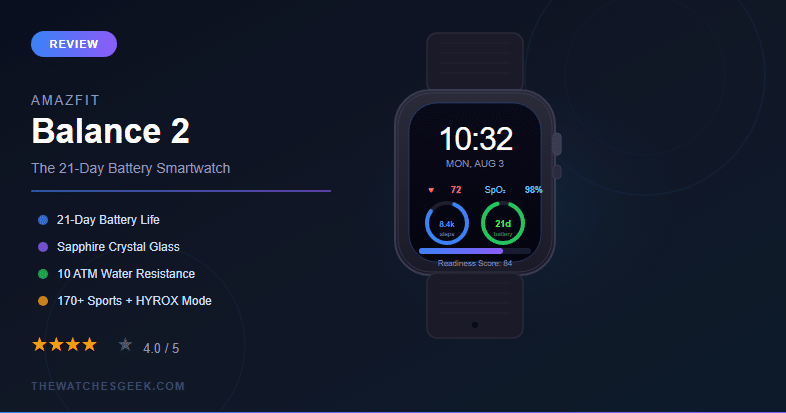
A 21-day battery under typical daily use, 33 hours of continuous GPS tracking, and 67 hours with power-saving GPS mode active.
These are not specification sheet claims designed to impress and underdeliver. Consumer Reports tested the Balance 2 in their lab under typical daily usage and recorded 446 hours of actual battery life.
That is 18.5 days — close enough to the 21-day claim to confirm it as an honest number rather than a marketing fiction.
I researched this review across five independent sources who tested the Balance 2 with extended daily wearing, including TechRadar’s hands-on review, Wareable’s extended battery and sports tracking test, Consumer Reports’ lab evaluation, GearBrain’s February 2026 deep-dive after months of real-world testing, and WearableXP’s April 2026 daily use report covering everything from gym tracking to Bluetooth calling in a crowded park.
Here is what they found, and what it means for you.
Amazfit Balance 2 Review:
No products found.
Who Is the Amazfit Balance 2 For?
Before getting into any specific feature, this question is worth answering directly because the Balance 2 is genuinely suited to some buyers and genuinely wrong for others.
WearableXP described it well after months of daily use: the Balance 2 is best for Android users who want 21 days of battery life, people focused on readiness and recovery, and casual athletes who want Garmin-style data without the Garmin price tag.
They placed it between the Samsung Galaxy Watch and the Garmin Venu series — smarter than the Garmin’s interface, longer lasting than the Samsung.
If you specifically want the Apple Watch ecosystem, third-party app installation from a full app store, or cellular LTE calling independent of your phone, the Balance 2 is not the right choice, and you should look elsewhere.
This is not a weakness — it is a design priority.
Balance 2 chose battery life, sports depth, and build quality over smartwatch breadth, and every trade-off in the watch flows from that choice.
Design and Build: Premium at Mid-Range Pricing

The first thing WearableXP noticed when unboxing the Balance 2 was the weight.
For a 47mm watch with the specifications it carries, the aluminium alloy and fibre-reinforced polymer construction keeps it lighter than most competing watches at this case size.
The 1.5-inch AMOLED display sits behind sapphire crystal glass, which is the material upgrade most worth noting from the original Balance, which used tempered glass. Sapphire crystal is significantly harder than any other watch glass material at this price level.
Most scratches that accumulate on tempered glass under daily wearing do not touch sapphire. Rings, keys, desk contact, equipment friction — sapphire handles all of it without the micro-scratches that dull a tempered glass display’s clarity over months of daily use.
The build carries 10 ATM water resistance and is certified for diving to a depth of 45 metres, covering freediving and recreational scuba use.
This is a meaningful specification jump from the original Balance’s 5 ATM rating.
The MetaReviewed analysis confirmed the 10 ATM rating alongside the 45-metre dive certification, distinguishing it from most smartwatches that cite ATM ratings for surface water use only.
Military-grade endurance testing completes the durability picture for a watch that needs to survive the environments its HYROX and trail running target users work in.
The dual built-in speakers are a hardware upgrade from the original Balance’s single speaker.
The practical difference shows up specifically in Bluetooth calling, which the original Balance handled but not loudly enough for outdoor use.
The Balance 2’s dual speakers address that specific limitation.
Display: 1.5 Inch AMOLED You Can Actually Read Outdoors
The 1.5-inch AMOLED display runs at 480 by 480 pixel resolution with the screen-to-body ratio that Amazfit has pushed toward at each generation.
The sapphire glass provides the optical clarity that makes the display’s high pixel density practically useful rather than just impressive on a specification sheet.
TechRadar’s review described the display as one of the Balance 2’s standout qualities, noting that the premium sapphire glass display sits comfortably above what this price tier typically provides.
For outdoor use specifically, the AMOLED brightness handles direct sunlight — the specific condition where many competing watches in this price range force the user to shade the display to read workout data clearly.
Sports and Fitness Tracking: Where the Balance 2 Genuinely Excels

GearBrain’s February 2026 review, based on months of testing with the Balance 2 during workouts, travel, and daily life, described the sports tracking as the watch’s strongest area.
The 170-plus workout modes cover everything from running, cycling, and swimming to strength training, functional fitness, and outdoor adventure sports, but three specific features distinguish the Balance 2 from the competition at this price point.
Smart Strength Tracking automatically detects reps, sets, and rest periods during gym sessions without any manual logging.
GearBrain specifically noted this as particularly useful for gym users and HYROX athletes who want structured insights without stopping between sets to tap a watch screen.
The watch identifies the exercise, counts your reps, tracks your sets, and logs rest periods between them.
If you spend significant time in a gym doing strength work and are currently manually logging every movement, this is the feature that will change your daily workout experience most noticeably.
HYROX Mode is the Balance 2’s most specific differentiator from any other watch at or near its price.
HYROX is the international functional fitness race series that combines running intervals with exercise stations, and the Balance 2 is the first mainstream smartwatch to carry official HYROX training and competition modes developed in partnership with the sport’s governing body.
For the growing number of buyers who train for and compete in HYROX events, finding this feature on a watch at this price point rather than locked behind Garmin flagship pricing is genuinely significant.
Golf Mode covers 40,000 courses worldwide with downloadable course maps, providing the course-level navigation that dedicated golf GPS devices charge specifically for.
For buyers who split time between athletic training and recreational golf, the Balance 2 eliminates the separate golf GPS entirely.
Wareable’s extended sports tracking test, covering running, indoor exercise, and swimming, described the tracking as reliable throughout.
The BioTracker 6.0 sensor inside the Balance 2 is an upgraded version of the previous generation, and Wareable specifically noted that heart rate tracking was accurate and GPS performed well across different environments.
They did note that the Balance 2, like most smartwatches, is accurate across typical activity without matching the precision of dedicated chest-strap heart rate monitors for high-intensity interval work.
Dual-band GPS from six satellite systems provides the positioning accuracy that single-band GPS cannot achieve in environments with partial sky coverage.
Urban environments, forest canopy, valley terrain, and anywhere that satellite signals reflect from surfaces or buildings benefit from the dual-band approach.
In practice, this means distance and pace data are more consistently reliable in the environments that cause less sophisticated GPS systems to drift.
Health Monitoring: Daily Insights That Actually Change Behaviour

The BioTracker 6.0 platform monitors heart rate, blood oxygen saturation, stress, sleep quality, and skin temperature continuously through the day and night.
The AI-powered features built on top of these sensors are where Amazfit has invested noticeably compared to the original Balance.
The AI Sleep Coach does not just report sleep stages.
It generates personalised recommendations based on observed patterns — identifying whether the specific user’s sleep quality improves with earlier bedtimes, reduced activity windows before sleep, or other behavioural adjustments specific to their data.
The original Balance provided sleep data.
The Balance 2 attempts to tell you what to do about it.
Body composition analysis through bioimpedance measurement estimates muscle mass, fat percentage, and bone mass from the sensor on the watch back.
GearBrain’s testing compared this against a standing bioimpedance machine of the kind found in gyms and medical settings, finding the Balance 2’s readings closely aligned — within 1.5 percentage points on body fat percentage.
For a wrist-worn sensor, this level of accuracy surprised their reviewers.
The Readiness Score — a daily morning number synthesising overnight recovery data — tells you in a single number whether today is appropriate for high-intensity work or whether recovery should be the priority.
For the training-focused buyer, this morning number is practically the most actionable single feature the watch provides.
Battery Life: The Real Numbers
The specification says 21 days. Consumer Reports’ lab test under typical daily usage recorded 446 hours — 18.5 days.
The difference between 21 days and 18.5 days represents the gap between specification conditions and typical daily use with always-on display, regular workout tracking, and normal notification activity.
Both numbers confirm that the Balance 2 lives in a completely different battery tier from any Apple Watch, Samsung Galaxy Watch, or Google Pixel Watch currently available.
In GPS mode specifically, WearableXP confirmed 33 hours of continuous tracking, or 67 hours with the power-saving GPS mode active.
For buyers who run or cycle regularly, 33 hours of GPS means several days of workout tracking sessions on a single charge — no mid-week charging required from a single active session.
TechRadar specifically described the battery life as the standout feature of the watch, noting it makes the Balance 2 ideal for multi-day adventures.
When the battery does reach zero, Consumer Reports measured 107 minutes for a full recharge from empty — a reasonable number for the capacity involved.
Smart Features: Calling, Maps, and Music
WearableXP tested Bluetooth calling while walking through a semi-crowded park with ambient traffic noise.
The results were specific: the dual speakers were loud enough to hear clearly over background noise.
The person on the other end of the call described the voice quality as crisp, noting they could tell it was a speakerphone but that it was clearly audible throughout.
The Balance 2 is the watch for “I’m five minutes away” calls when your hands are carrying groceries, a dog lead, or sports equipment — practical hands-free communication for active situations.
Offline maps are available through free downloads, covering standard running, hiking, and cycling routes with turn-by-turn navigation on the display or through Bluetooth headphones.
TechRadar’s review noted that map loading could be slow, which is the one specific UX friction point that came up across multiple reviews.
The maps work, and the directions are accurate, but users who expect the instant map rendering of dedicated GPS devices will find the loading speed a point of adjustment.
Music storage and control allow playing music from the watch to connected Bluetooth earbuds without the phone — relevant for gym sessions and runs where carrying a phone is inconvenient.
NFC payment is supported in specific regions through Mastercard-partnered banks.
The smart features are genuinely useful, and the dual speakers make them practical in real environments.
They are not equivalent to the Apple Watch’s full app ecosystem or Samsung’s Galaxy AI health summaries.
Buyers who need those specific capabilities are looking at different watches.
Buyers who want straightforward calling, navigation, and music without subscription requirements or platform lock-in will find what they need here.
Amazfit Balance 2 vs Original Balance: Is the Upgrade Worth It?
| Feature | Original Balance | Balance 2 |
|---|---|---|
| Battery life | 14 days | 21 days |
| Water resistance | 5 ATM | 10 ATM, 45m dive certified |
| Display glass | Tempered glass | Sapphire crystal |
| Sensor | BioTracker 5 | BioTracker 6.0 |
| Speakers | Single | Dual |
| HYROX mode | No | Yes — official partnership |
| Golf maps | No | Yes — 40,000 courses |
| Storage | Less | 32GB |
| Case size | 46mm | 47mm |
For existing Balance owners: the upgrade is meaningful if battery life, water resistance, or the HYROX and golf modes are relevant to how you use the watch.
The sapphire glass and BioTracker 6.0 are incremental but real improvements across the board.
For new buyers considering the original Balance at a lower price: the Balance 2 is the current model and represents where Amazfit’s platform is heading.
Unless budget specifically requires the original, the Balance 2 is the right starting point for anyone entering the Amazfit ecosystem now.
Specifications:
| Feature | Details |
|---|---|
| Amazon ASIN | B0F9JFCYNX |
| Case | 47mm aluminum alloy, fiber-reinforced polymer |
| Display | 1.5-inch AMOLED, 480×480, sapphire crystal |
| Battery Standard | 21 days |
| Battery GPS | 33 hours |
| Battery Power Saving GPS | 67 hours |
| Sensor | BioTracker 6.0 |
| GPS | Dual-band, 6 satellite systems |
| Storage | 32GB |
| Water Resistance | 10 ATM, 45m dive certified |
| Sports Modes | 170 plus |
| Special Modes | HYROX, Golf (40,000 courses), Scuba |
| Audio | Dual speakers, Bluetooth calling |
| Maps | Offline with turn-by-turn directions |
| Health | Heart rate, SpO2, stress, sleep, body composition, skin temperature |
| Compatibility | iOS and Android |
Final Verdict
The Amazfit Balance 2 occupies a specific and genuinely useful position in the 2025-2026 smartwatch market. It does not try to out-Apple the Apple Watch or out-feature the Samsung Galaxy Watch. It does something more focused: it provides three to four weeks of battery life, premium build quality with sapphire glass and 10 ATM water resistance, sports tracking depth that covers HYROX competitors, golfers, swimmers, and strength trainers in a single device, and Bluetooth calling through dual speakers that actually works in outdoor environments.
WearableXP summarised it well after months of daily use: the Balance 2 is Amazfit’s most mature smartwatch release yet. It sits between the Samsung Galaxy Watch and Garmin Venu in terms of what it does and how it does it, and it does several things — specifically battery life and sports specialisation — better than both. For buyers who are frustrated by daily charging, who train seriously enough to want structured sports tracking, and who want a watch that looks and feels premium without premium pricing, the Balance 2 earns its recommendation.
For a broader look at how the Amazfit Balance 2 compares against other premium health monitoring smartwatches across different training needs, the full comparison at best-smartwatches-for-monitoring-stress covers the health monitoring smartwatch category in detail.
FAQs:
Is the Amazfit Balance 2 worth buying over the original Balance?
Yes for most buyers. The Balance 2 brings meaningful upgrades across every relevant category: 50 percent more battery life (21 days versus 14), 10 ATM water resistance versus 5 ATM, sapphire crystal glass versus tempered glass, dual speakers instead of a single speaker, the BioTracker 6.0 upgrade, and the addition of HYROX mode and golf maps that the original completely lacked. The original Balance was a solid watch for 2023. In 2025, the Balance 2 is the current platform and buying the original now means starting on a generation behind. Unless the original is available at a significant discount and budget is the specific constraint, the Balance 2 is the right choice for anyone entering the Amazfit ecosystem today.
How does the Amazfit Balance 2 compare to the Garmin Venu 4?
The Balance 2 and Garmin Venu 4 target similar buyers but deliver the comparison differently. The Balance 2 has significantly longer battery life — 21 days versus the Venu 4’s 10 days — and 10 ATM water resistance versus the Venu 4’s 5 ATM. The Balance 2 adds HYROX mode and 40,000-course golf maps that the Venu 4 does not have. The Garmin Venu 4 provides the deeper Garmin Connect ecosystem with a more established training analytics platform, Body Battery, and the Garmin coach features that come from years of runner and triathlete data. WearableXP’s April 2026 review described the Balance 2 as smarter than Garmin but longer-lasting than Samsung, suggesting buyers who specifically value battery life and sports breadth will prefer the Balance 2, while buyers who specifically want the Garmin ecosystem’s depth and established community will find more at the Venu 4’s higher investment. For a closer look at how the Garmin Venu 4 and other Garmin models perform across training analytics and GPS accuracy, the full guide at best-garmin-watches-for-interval-training covers the Garmin platform in detail.
Does the Amazfit Balance 2 work with iPhone?
Yes, the Balance 2 is compatible with both iOS and Android. iPhone users can pair it through the Zepp app, which is available on the iOS App Store, and access the full health monitoring, sports tracking, and sleep analysis platform. Bluetooth calling, music control, and notification mirroring all work with iPhone when the Zepp app is installed and paired. The one distinction worth noting is that the Zepp app experience and the depth of integration is generally described as slightly deeper on Android than iOS, with some features that communicate more smoothly with Android’s open notification system. For everyday health tracking and sports use, iPhone users will find the Balance 2 fully functional. The International Consumer Electronics Standards organisation provides specifications for smartwatch interoperability standards at iec.ch.
Luis Cooper

Hi, I'm Luis, the guy behind this site. I love wearing watches, especially ones that look great on small wrists (mine are about 6.3" around). The Watches Geek is dedicated to helping you learn about and buy watches that you will love wearing. I want this website to be the last destination for people to pick the best watches to fit their needs. You can find our unbiased reviews here on Thewatchesgeek.