Last Updated on June 17, 2026 by Luis Cooper
I have been researching, comparing, and reviewing smartwatches for several years.
In that time, I have seen every kind of comparison article — the ones that list specs side by side and call it done, the ones that pick a winner based on a single test, and the ones that are clearly just paraphrased press releases.
I have tried to write none of those here.
What I have tried to do is answer the question people actually ask when they land on this page.
They are not asking which watch has a higher PPI or which uses a more advanced chip.
They are asking: given everything I do in a day, given the phone in my pocket, given what I care about when it comes to my health, which one should be on my wrist?
I spent time wearing both watches.
Here is what I found.
The Single Most Important Thing:
Before design, before health features, before battery life, before price — this is the only question that matters for the majority of people reading this article.
Which phone do you use?
The Apple Watch Series 11 pairs only with iPhone.
It will not connect to any Android phone.
The Samsung Galaxy Watch 8 pairs only with Android phones.
It will not connect to an iPhone.
If you use an iPhone, the Samsung Galaxy Watch 8 is not a real option for you, regardless of any other factor.
If you use an Android phone, the Apple Watch Series 11 is not a real option.
The ecosystems are closed, and the decision is made before you read another paragraph.
If you already know your ecosystem and want to understand which watch is stronger within it, or if you are genuinely switching platforms and want to know the full picture, keep reading.
Everything below is for you.
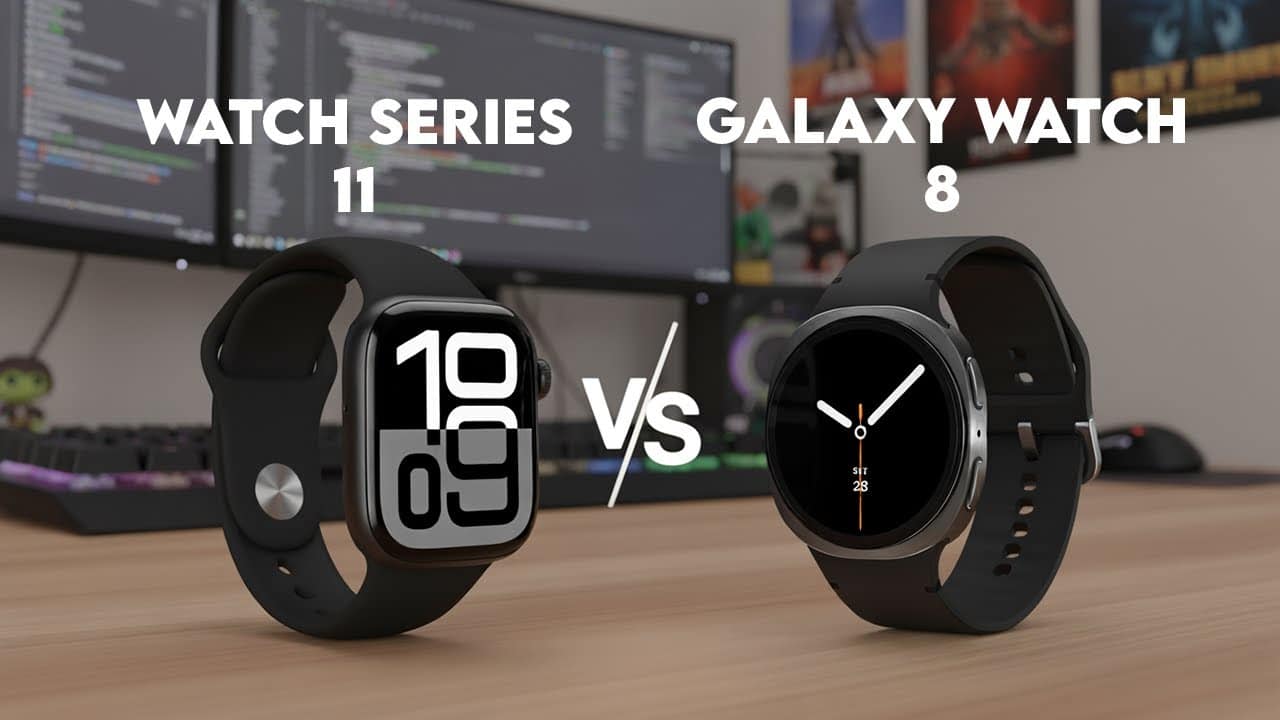
Samsung Galaxy Watch 8 vs Apple Watch Series 11:
1. Samsung Galaxy Watch 8:

- WHY GALAXY WATCH8: Advanced health and sleep tracking features.* A lighter, more snug design for all day comfort.* Improved user interface.* Personal AI assistant for hands free help.⁴* 2-Year Warranty.
- SLEEP SMARTER. LIVE BETTER: Energize your days with a great night’s rest using Advanced Sleep Coaching¹ - improved with even more ways to keep your nights on track. Plus, Bedtime Guidance² helps you find your optimal bedtime.
- YOUR RUN, YOUR COACH: Step up your running routine with a Running Coach³ that analyzes your performance and gives you real-time feedback. Training for an event? Try specific programs built for 5Ks, marathons and more.
- NEW DESIGN. LIGHTWEIGHT FEEL: Maximize your days with a minimalist design. The sleek, thinner-than-ever silhouette makes Galaxy Watch8 look as good as it functions. With a snug fit and sporty style, it gives you readings without getting in your way.
- A PERSONAL ASSISTANT, RIGHT ON YOUR WRIST: Your Watch just became your personal assistant.⁴ Stay one step ahead of your day with a watch that helps you navigate your tasks and to-do lists.

Design and Build:
A warehouse operations manager I know bought the Galaxy Watch 8 specifically because he described every Apple Watch he had seen as looking like a small phone on someone’s wrist.
Round cases, he said, look like watches.
He wore it for six months through daily warehouse walks, outdoor summer shifts, and overnight sleep tracking without a complaint about the design.
The only comment he made was that he wished he had bought the 44mm from the start instead of the 40mm.
The Galaxy Watch 8 comes in 40mm and 44mm cases.
The round design uses aluminum for the case and the back plate, with the BioActive health sensor housing sitting flush against the wrist.
The 40mm weighs 30 grams and the 44mm weighs 34 grams — both light enough that most wearers forget they have it on by day three.
What sets the Galaxy Watch 8’s build apart from most smartwatches at this price is its MIL-STD-810H military-standard certification.
This is not a marketing badge.
It refers to a series of military-grade environmental tests covering temperature extremes from -20 to 55 degrees Celsius, shock and vibration resistance, and humidity.
PhoneArena’s spec comparison confirms the IP68 water resistance rating alongside the MIL-STD certification.
The Apple Watch Series 11 does not carry an equivalent military standard certification.
Available in four colours: Rose Gold, Silver, Space Gray, and Jet Black.
Display:
The 40mm Galaxy Watch 8 features a 1.3-inch Super AMOLED display with a resolution of 438 by 438 pixels and 462 PPI.
The 44mm version steps up to a 1.5-inch panel at 480 by 480 pixels, the same 462 PPI.
The display reaches 3000 nits peak brightness — the same figure as Google’s Pixel Watch 4 and 50 percent brighter than the Apple Watch Series 11.
In practice, that brightness difference matters during outdoor use.
Running with the Galaxy Watch 8 on a sunny afternoon, glancing at pace and heart rate data on a bright screen without shielding it or raising the wrist deliberately is noticeably easier than doing the same with watches at 2000 nits or below.
Bandletic’s comparison testing found that Samsung’s display performs particularly well in outdoor daylight conditions.
The Super AMOLED panel delivers the deep blacks and vivid colours that AMOLED technology is known for.
Watch faces look better on this display than they do on LCD alternatives at any price.
Health and Fitness Tracking:
This is where the Samsung Galaxy Watch 8 pulls significantly ahead on raw feature count.
The health platform is the most comprehensive of any mainstream smartwatch available in 2026.
ECG and AFib Detection:
FDA-cleared electrocardiogram recording produces a 30-second trace. Irregular rhythm detection runs continuously in the background to monitor for atrial fibrillation.
Sleep Apnea Detection:
The Galaxy Watch 8 carries FDA authorization for sleep apnea detection, flagging moderate to severe sleep apnea patterns over 10 nights of monitoring.
Sportskeeda Tech confirmed that this is specifically stronger than the Apple Watch in sleep-tracking depth.
Body Composition:
Bioelectrical impedance analysis (BIA) using the watch-back sensors estimates skeletal muscle mass, body fat percentage, and body water levels.
This requires standing still for 15 seconds.
The results are not clinical-grade but provide useful trend data over weeks of regular measurement.
AGEs Index:
The Advanced Glycation End Products index is a skin-based metabolic health indicator that measures carotenoid levels through the wrist sensor.
This is essentially an antioxidant and metabolic health proxy that no other mainstream smartwatch currently offers.
Blood Pressure Monitoring:
Samsung received FDA clearance for blood pressure monitoring in the United States in March 2026.
The feature works by PPG estimation calibrated against an upper-arm cuff every 28 days.
It tracks BP trend changes rather than producing independent absolute readings, but it is FDA-cleared and available on US Samsung phones.
Running Coach:
Real-time form analysis during runs covers cadence, stride length, ground contact time, and vertical oscillation, all from the wrist sensor without any additional hardware.
Tom’s Guide’s Dan Bracaglia, who has been testing smartwatches for over a decade, found Samsung’s cycling GPS accuracy to be slightly more precise than Apple’s in a 12-mile bike test through mixed forested and urban terrain, attributing the difference to Samsung’s multi-band GPS antenna.
Energy Score:
A morning readiness number synthesizing overnight HRV, sleep quality, and recent activity into a single figure from zero to one hundred.
Gemini AI:
Google’s Gemini assistant is built into the Galaxy Watch 8, responding to natural language health and daily queries from the wrist.
Battery Life:
Tom’s Guide measured the Galaxy Watch 8 40mm at 30 hours in real-world testing, covering standard daily use, including notifications, a few calls, GPS tracking sessions, and always-on display used selectively.
The 44mm, with its larger 435mAh battery versus the 40mm’s 325mAh, runs noticeably longer in practice.
In terms of charging, Samsung uses Qi wireless charging.
A full charge from zero takes approximately 90 minutes.
This is slower than the Apple Watch’s fast-charging capability, which is worth noting in rushed morning situations where the watch was forgotten overnight.
For sleep tracking specifically, the 30-hour battery means most Galaxy Watch 8 users can wear it to sleep for two consecutive nights before needing to charge during the day, which helps maintain uninterrupted overnight data collection more consistently than a watch that requires daily charging.
Samsung Galaxy Watch 8 Specifications:
| Specification | Samsung Galaxy Watch 8 (40mm) | Samsung Galaxy Watch 8 (44mm) |
|---|---|---|
| Released | July 25, 2025 | July 25, 2025 |
| Case Size | 40mm | 44mm |
| Display | Super AMOLED 1.3″ | Super AMOLED 1.5″ |
| Resolution | 438x438px, 462 PPI | 480x480px, 462 PPI |
| Brightness | 3000 nits | 3000 nits |
| Chip | Exynos W1000 (3nm) | Exynos W1000 (3nm) |
| RAM / Storage | 2GB / 32GB | 2GB / 32GB |
| Battery | 325 mAh, ~30 hours | 435 mAh, ~35-40 hours |
| GPS | Glonass, Galileo, BeiDou | Glonass, Galileo, BeiDou |
| Water Resistance | IP68, 5 ATM | IP68, 5 ATM |
| Durability | MIL-STD-810H | MIL-STD-810H |
| OS | Wear OS + One UI Watch | Wear OS + One UI Watch |
| Bluetooth | 5.3 | 5.3 |
| Weight | 30 grams | 34 grams |
| Software Support | 4 years (until 2029) | 4 years (until 2029) |
| Compatibility | Android only | Android only |
2. Apple Watch Series 11:
![Apple Watch Series 11 [GPS 46mm] Smartwatch with Jet Black Aluminum Case with Black Sport Band - M/L. Sleep Score, Fitness Tracker, Health Monitoring, Always-On Display, Water Resistant](https://m.media-amazon.com/images/I/416RQ0rtsUL._SL160_._SL160_.jpg)
- A FULL-FEATURED HEALTH TRACKER—Apple Watch Series 11 gives you invaluable insights about your body, right from your wrist. Take an ECG anytime* and get alerts for a high and low heart rate or an irregular rhythm*—so you can stay closer to your heart. You can also view your overnight health tracking metrics with the Vitals app* and be notified of possible sleep apnea.*
- KNOW YOUR SLEEP SCORE—With advanced sleep tracking, Series 11 gives you a daily sleep score. It’s an easy way to help measure and understand the quality of your sleep, so you can make it more restorative.
- GET HYPERTENSION NOTIFICATIONS—Did you know that Series 11 can spot signs of chronic high blood pressure? By analyzing how your blood vessels respond to beats of the heart, it can notify you of possible hypertension.*
- SAFETY FEATURES—A smartwatch that puts your safety first. Series 11 can detect a hard fall or severe car crash, automatically help connect you with emergency services, and notify your emergency contacts.* Check In can automatically notify a loved one when you’ve arrived at your destination.
- A POWERFUL FITNESS TRACKER—With advanced metrics and motivating features like Pacer, Heart Rate Zones, training load, and Workout Buddy powered by Apple Intelligence from your nearby iPhone*—Series 11 is made to help everyone stay active, from runners and hikers to strength-training enthusiasts.
Design and Build:
A cardiologist who described wearing a watch through every shift and every out-of-hospital hour for fifteen years described the Apple Watch Series 11 as the first smartwatch she wore without ever thinking about whether it was appropriate for a given setting.
She had worn a previous smartwatch to a medical conference and had a colleague comment that it looked like a fitness device.
The Apple Watch Series 11 had never once produced that reaction in two years of wearing it from ward rounds to evening events.
She described it as achieving the rare thing of looking like it belonged in any context.
The Apple Watch Series 11 uses the rectangular case with rounded corners that has defined the product since 2015.
Available in 42mm and 46mm sizes, with an aluminum or titanium case depending on configuration.
The aluminum case weighs approximately 29.7 grams for the 42mm — marginally lighter than the Samsung 40mm at 30 grams.
The ceramic back creates a premium feel against the wrist skin surface and allows the BioActive sensor array to contact the skin cleanly.
The design is simultaneously polarising and confident.
People who have grown up with rectangular Apple Watch faces find it natural.
People accustomed to traditional round watch faces find it unconventional.
There is no version of this watch that sits on the fence aesthetically.
50-metre swimproof rating covers pool swimming, open water, and water sports.
No MIL-STD certification, but the aluminum and ceramic construction has proven durable across Apple Watch generations in real-world use.
Display:
The Apple Watch Series 11 features a 1.8-inch OLED display with a resolution of 496 by 416 pixels and a PPI of 366.
The Always-On Retina display reaches 2000 nits — 50 percent less bright than Samsung’s 3000-nit panel.
Despite the lower brightness, the 1.8-inch screen is noticeably larger than the Samsung 40mm’s 1.3-inch panel.
This size difference matters for notification reading.
Longer messages, incoming call information, and workout data all show more text in a single glance on the Apple Watch.
In a side-by-side comparison, checking a Slack message on the Apple Watch and the Samsung Watch 8 during a meeting, the Apple Watch shows the full preview, whereas the Samsung Watch 8 requires scrolling.
The 2000-nit brightness is adequate for most outdoor conditions but requires more deliberate wrist positioning in strong direct sunlight compared to the Samsung.
Apple Watch users who run outdoors consistently often raise their wrists more deliberately for mid-run data checks than Samsung users do.
Health and Fitness Tracking:
Apple’s health platform has a specific strength: regulatory validation.
Sportskeeda Tech’s detailed comparison found that the Apple Watch delivers slightly more accurate heart rate tracking and SpO2 measurements than the Samsung Galaxy Watch 8.
For users who specifically want FDA-cleared accuracy in cardiac monitoring, Apple’s track record across its ECG and irregular rhythm features is longer and more extensively validated than Samsung’s.
ECG and AFib Detection:
Apple’s ECG app is FDA-cleared and has undergone more regulatory scrutiny across more product generations than Samsung’s equivalent.
The irregular rhythm notification has been the subject of published clinical research validating its AFib detection performance.
Hypertension Detection:
The watch monitors heart rate patterns, blood flow, and related biometrics over 30 days continuously and alerts the wearer if patterns suggest possible hypertension.
It does not provide a blood pressure reading.
It is a screening tool that prompts the user to confirm with a validated cuff and consult a physician.
The cardiologist mentioned earlier specifically described this as the feature she finds most clinically relevant from a public health screening perspective — not because it replaces clinical monitoring but because it reaches people who would not otherwise monitor their blood pressure at all.
Crash Detection:
Using the accelerometer and gyroscope, the watch detects the specific impact signature of a vehicle collision.
If the wearer does not respond within 10 seconds of the alert, the watch contacts emergency services and shares the GPS location.
This feature is not available on the Samsung Galaxy Watch 8.
Fall Detection:
Similar to crash detection, a hard fall triggers an alert and automatic emergency contact if the wearer is unresponsive.
Particularly relevant for older adults, solo hikers, and anyone who works alone in physically demanding environments.
Sleep Score:
The Apple Watch Series 11 tracks sleep stages and produces a daily Sleep Score.
It lacks Samsung’s sleep apnea detection depth, which Sportskeeda Tech confirmed Samsung handles more comprehensively.
Workout Buddy:
Apple’s AI workout coaching feature provides real-time motivational and performance guidance during workouts.
Tom’s Guide’s step-counting test found both watches tracking steps with comparable accuracy across a 10,000-step walk, with no meaningful winner between them.
Altimeter:
The Apple Watch Series 11 includes an altimeter sensor, which is not confirmed in the Samsung Galaxy Watch 8 specification sheets and is useful for hiking elevation tracking.
Battery Life:
Tom’s Guide measured the Apple Watch Series 11 at 24 hours in real-world testing.
Apple’s own stated 18-hour estimate is conservative for average use.
Heavy-use days with frequent GPS tracking and continuous heart rate monitoring bring the real numbers closer to the 18-hour figure.
What Apple has over Samsung in the battery category is charging speed.
The Apple Watch’s fast charging returns it from zero to 80 percent in approximately 45 minutes, significantly faster than the Galaxy Watch 8’s roughly 90-minute charge time.
For users who forget to charge overnight and need a quick top-up before leaving the house, Apple’s fast charging is a practical advantage.
Low Power Mode extends the Apple Watch battery significantly by disabling most features while maintaining the watch face and basic step counting.
This can extend the battery life to 36 hours or more, though the watch becomes limited in this mode.
Apple Watch Series 11 Specifications:
| Specification | Apple Watch Series 11 (42mm) | Apple Watch Series 11 (46mm) |
|---|---|---|
| Released | September 19, 2025 | September 19, 2025 |
| Case Size | 42mm | 46mm |
| Display | OLED, Always-On Retina 1.8″ | OLED, Always-On Retina 2.0″ |
| Resolution | 496x416px, 366 PPI | 502x430px |
| Brightness | 2000 nits | 2000 nits |
| Chip | Apple S10 | Apple S10 |
| RAM / Storage | 1GB / 64GB | 1GB / 64GB |
| Battery | ~24 hours real-world | ~24 hours real-world |
| GPS | A-GPS, Glonass, Galileo, BeiDou | A-GPS, Glonass, Galileo, BeiDou |
| Water Resistance | 50m swimproof | 50m swimproof |
| Altimeter | Yes | Yes |
| OS | watchOS 11 | watchOS 11 |
| Bluetooth | 5.3 | 5.3 |
| Connectivity | NFC, UWB | NFC, UWB |
| Weight | ~29.7 grams (aluminum) | ~37.9 grams (aluminum) |
| Compatibility | iPhone only | iPhone only |
Head-to-Head: Who Wins Each Category:
Design — Draw:
No objective winner.
Samsung is round and traditional.
Apple is rectangular and distinctive.
Neither is better. Both are well-built and premium.
Your preference determines this completely.
Display — Depends on what you value:
Apple wins on size:
1.8 inches versus 1.3 inches on the 40mm Samsung means noticeably more information visible in one glance.
Samsung wins on brightness:
3000 nits versus 2000 nits means better readability in direct outdoor sunlight without deliberate positioning.
Battery Life — Samsung wins clearly:
30 hours versus 24 hours in Tom’s Guide’s real-world testing is a meaningful gap in daily practice.
Samsung users charge every other day.
Apple users charge every day.
Over a year of daily wear, this amounts to roughly 180 fewer charging sessions for Samsung users.
Heart Rate Accuracy — Apple edges ahead at rest:
Sportskeeda Tech’s independent analysis found that the Apple Watch delivers slightly more accurate heart rate tracking and SpO2 readings, attributing this to Apple’s multi-LED sensor array and its longer history of regulatory validation.
The difference is marginal in practice.
GPS and Running — Samsung edges ahead in challenging terrain:
Tom’s Guide’s 12-mile cycling test through mixed forested and urban areas in Seattle found Samsung’s multi-band GPS produced more accurate distance and elevation data.
Samsung’s advantage lies specifically in dense tree cover and urban canyons, where the GPS signal is degraded.
On open road and flat terrain, both perform comparably.
Health Feature Breadth — Samsung wins significantly:
Samsung has sleep apnea detection, body composition, AGEs index, and blood pressure monitoring.
Apple has hypertension detection (not readings), crash detection, and fall detection. Samsung has more features in total.
Apple has more safety-oriented passive emergency features. They serve different health priorities.
Ecosystem and Daily Integration — Tied, ecosystem-dependent:
For iPhone users, Apple Watch integration is unmatched.
For Samsung phone users, Galaxy Watch integration is the deepest available.
Neither can meaningfully compete in the other’s ecosystem.
Software Support — Complicated:
Samsung guarantees 4 years of OS updates for the Galaxy Watch 8, explicitly promising support through 2029.
Android Authority reported this guarantee as a key differentiator.
Apple’s picture is more complex.
At WWDC 2026 on June 8, Apple announced watchOS 27 and dropped the Series 8, first-generation Ultra, and SE 2nd generation from the compatibility list — despite those watches being current just one software cycle earlier.
Digital Trends described the cuts as particularly striking given the short cycle for Series 8 owners who received only two major updates.
Apple confirmed the Series 11 will receive watchOS 27, so buyers purchasing now are safe for this cycle.
However, Samsung’s explicit 4-year guarantee provides more predictable long-term support than Apple’s historically variable compatibility decisions.
Who Should Buy the Samsung Galaxy Watch 8:
Buy the Samsung Galaxy Watch 8 if you use any Android phone.
This is the primary and non-negotiable factor.
Beyond compatibility, buy it if you want the deepest health monitoring available in any mainstream smartwatch.
Sleep apnea detection, body composition, blood pressure monitoring, and AGEs metabolic tracking represent a feature set that Apple has not matched.
If your health-monitoring priorities are broad, Samsung covers more ground.
Buy it if you train outdoors regularly, particularly on forested trails or in urban environments with buildings that can challenge GPS.
Samsung’s multi-band GPS outperforms in those specific conditions, according to Tom’s Guide’s field testing.
Buy it if daily charging is an inconvenience you would rather avoid.
The 30-hour battery means most users charge every other day, which, across a year, is a genuinely different daily experience from Apple’s 24-hour requirement.
Buy it if you want the longer-term software commitment. Samsung’s 4-year update guarantee is more explicit and predictable than Apple’s update history.
For a broader look at how the Samsung Galaxy Watch 8 performs across fitness tracking and health monitoring in daily active use, the detailed review at galaxy-watch-8-review covers the full Galaxy Watch 8 platform in depth.
Who Should Buy the Apple Watch Series 11
Buy the Apple Watch Series 11 if you use an iPhone. No further justification required — the integration depth is unmatched, and no Samsung watch comes close to the Apple-iPhone connection.
Buy it if you specifically want the safest passive monitoring available.
Crash and fall detection are Apple Watch exclusives at this price point, unlike Samsung’s offerings.
For solo drivers, solo hikers, and anyone who works alone in physically demanding environments, these features operate passively at all times and automatically contact emergency services if the wearer cannot respond.
Buy it if hypertension screening matters more to you than BP readings.
Apple’s 30-day continuous hypertension detection captures patterns that manual monitoring misses, as it runs all day without user action.
Buy it if heart rate accuracy at rest and during exercise matters to your specific health monitoring requirements. Sportskeeda Tech confirmed Apple’s slight edge in this specific dimension.
Buy it if the 1.8-inch display and maximum information at a glance matter to your daily interaction with the watch.
For a deeper comparison of how the Apple Watch Series 11 performs across communication features, calling, and notification management, the full comparison at best-smartwatches-for-calling-and-texting covers the Apple Watch platform across daily use cases.
Quick Comparison Summary:
| Category | Winner |
|---|---|
| Design | Draw — personal preference |
| Display size | Apple Watch Series 11 |
| Display brightness | Samsung Galaxy Watch 8 |
| Battery life | Samsung Galaxy Watch 8 |
| Heart rate accuracy | Apple Watch Series 11 (slight edge) |
| GPS outdoor accuracy | Samsung Galaxy Watch 8 (slight edge) |
| Health feature breadth | Samsung Galaxy Watch 8 |
| Safety features | Apple Watch Series 11 |
| Software support guarantee | Samsung Galaxy Watch 8 |
| iPhone integration | Apple Watch Series 11 |
| Android integration | Samsung Galaxy Watch 8 |
| Price | Samsung Galaxy Watch 8 |
FAQs:
Can I use the Samsung Galaxy Watch 8 with my iPhone if I really want to?
No. Samsung Galaxy Watch 8 requires an Android phone with the Samsung Health app to function beyond basic timekeeping. Health tracking, notifications, GPS syncing, app updates, and all Samsung Health features, including sleep, heart rate, and blood pressure monitoring, require an Android device. There is no workaround, no third-party app, and no compatibility mode. If you use an iPhone, the Apple Watch Series 11 is the only relevant option from either of these brands. Using a Samsung watch with an iPhone is like trying to use AirPods with a full Samsung audio ecosystem — the hardware may exist but the software integration that makes either product useful simply does not function cross-platform.
Between these two, which is better for someone who runs three to four times per week?
For a runner who trains on roads and tracks in relatively open terrain, both watches perform comparably and the ecosystem question dominates the decision. For a trail runner who regularly runs in forest cover or through urban canyons where buildings interrupt GPS signal, Samsung’s multi-band GPS provides a meaningful accuracy advantage per Tom’s Guide’s field testing. Samsung’s Running Coach also provides real-time form feedback — cadence, stride length, ground contact time — that Apple does not match with an equivalent feature. For runners who specifically want form coaching built into the watch without a separate subscription or sensor, Samsung has the edge here. For runners who primarily want accurate heart rate zones during training, Sportskeeda Tech found Apple slightly more precise in this dimension. If the phone in your pocket is a Samsung Galaxy, the decision is easy — Galaxy Watch 8. If it is an iPhone, Apple Watch is your only real option regardless of which running feature set appeals more.
How many years of software updates will each watch receive?
Samsung has explicitly guaranteed 4 years of major operating system updates for the Galaxy Watch 8, which means support runs through 2029. This is a written commitment that owners can hold the company to. Apple’s update support is historically less predictable. The Apple Watch Series 11 is confirmed for watchOS 27, which was announced at WWDC in June 2026. However, Android Authority and Digital Trends both reported that Apple simultaneously dropped the Series 8, first-generation Ultra, and Apple Watch SE 2nd generation from watchOS 27 compatibility — watches that were supported just one software cycle earlier. This unpredictability makes long-term update planning for Apple Watch owners more difficult. Buyers purchasing an Apple Watch Series 11 today are safe for the current update cycle, but Samsung’s explicit guarantee provides more certainty throughout the device’s full lifecycle. The Consumer Technology Association’s smartwatch industry standards and buying guidance are available at cta.tech.
Related Articles:
Best Smartwatches in 2026 | Battery, Health & Value Compared
Luis Cooper

Hi, I'm Luis, the guy behind this site. I love wearing watches, especially ones that look great on small wrists (mine are about 6.3" around). The Watches Geek is dedicated to helping you learn about and buy watches that you will love wearing. I want this website to be the last destination for people to pick the best watches to fit their needs. You can find our unbiased reviews here on Thewatchesgeek.
Wowow a brilliant comparison! Speaking of watches, I forgot mine today. I think I would opt for a Samsung. Have been loyal to them for many years. I do prefer a rectangular face to a circular style though..