
Last Updated on June 16, 2026 by Luis Cooper
Before looking at a single watch on this list, one honest thing needs to be said that most smartwatch buying guides skip entirely — because it changes how you evaluate every option here.
There are three fundamentally different ways a smartwatch can measure your blood pressure in 2026, and they are not equally accurate or clinically valuable.
The first is a true cuff-based measurement.
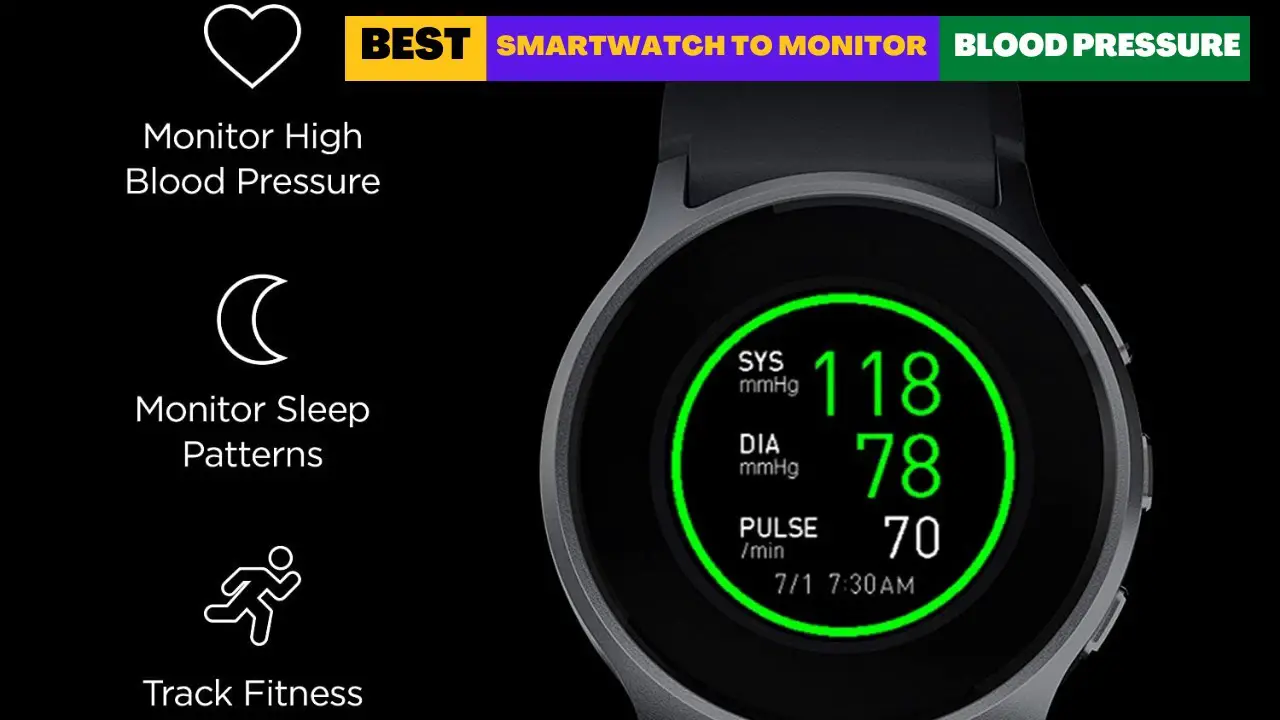
A miniaturized inflatable cuff built into the watch band physically compresses the wrist artery, measures the oscillations as the cuff deflates, and produces systolic and diastolic readings, just like a hospital arm cuff.
This is the most accurate method and the only one that produces actual BP numbers like 120 over 80.
Only two categories of watches on this list do this — the YHE BP Doctor Pro, the YHE BP Doctor Med.
The second is PPG-based estimation.
The watch uses its optical heart rate sensor to detect changes in blood flow and runs an algorithm to estimate blood pressure trends.
Samsung Galaxy Watch 8’s blood pressure feature, which received FDA clearance for US users in March 2026, works this way.
It requires calibration using a traditional upper-arm cuff every 28 days to maintain accuracy.
It does not produce independent readings — it tracks changes from your calibrated baseline.
Samsung itself describes it as monitoring “blood pressure changes” rather than absolute values.
The third is hypertension detection without giving you a number.
Apple Watch Series 11 monitors heart rate patterns over 30 days and alerts you if patterns suggest possible hypertension, prompting you to confirm with a medical device.
It does not tell you your blood pressure reading.
It tells you whether patterns suggest you may have high blood pressure.
Understanding which category a watch falls into before buying is the single most important piece of information in this article.
Every watch below is labeled accordingly.
Important Medical Disclaimer:
No consumer smartwatch — including the most accurate options on this list — should be used as a substitute for clinical blood pressure monitoring. If you have been diagnosed with hypertension, are taking blood pressure medication, or have any cardiovascular condition, always use a validated medical device and consult your doctor before relying on wrist-based readings for health decisions.
Which are the Best Smartwatches To Monitor Blood Pressure?
Here are my top recommended 11 best blood pressure watches you can buy:-

![Samsung Galaxy Watch 8 44mm Bluetooth Smartwatch, Cushion Design, Rotating Bezel, Quick Button, Sleep Coaching, Now Bar, Running Coach, Energy Score,Graphite [US Version,Amazon Exclusive 2Yr Warranty]](https://m.media-amazon.com/images/I/41tViNtwyEL._SL160_._SL160_.jpg)
![Samsung Galaxy Watch Ultra 47mm LTE Smartwatch, Titanium Casing, Advanced Sleep Coaching, Running Coach, Energy Score, GPS, 2025, Titanium Blue [US Version, Amazon Exclusive 2Yr Warranty]](https://m.media-amazon.com/images/I/41zL7T5J4xL._SL160_.jpg)
![Apple Watch Series 11 [GPS 42mm] Smartwatch with Rose Gold Aluminum Case with Light Blush Sport Band - S/M. Sleep Score, Fitness Tracker, Health Monitoring, Always-On Display, Water Resistant](https://m.media-amazon.com/images/I/31caPPnRysL._SL160_._SL160_.jpg)




![Samsung Galaxy Watch FE 40mm Bluetooth AI Smartwatch w/Fitness Tracking, BIA Sensor, Personalized HR Zones, Heart Rate Tracker, Sleep Monitor, 2024, Black [US Version, 1Yr Manufacturer Warranty]](https://m.media-amazon.com/images/I/4159DLX-fZL._SL160_.jpg)
1. YHE BP Doctor: (Best True Cuff Blood Pressure Smartwatch)

A retired cardiologist who described spending forty years telling patients to monitor their blood pressure consistently described the YHE BP Doctor as the first consumer wrist device he had seen that used the same fundamental measurement principle as the devices in his clinic.
He had tested it against a validated arm cuff on himself over three weeks, taking simultaneous readings and comparing the results.
He described the readings as consistently within 5 mmHg of each other for both systolic and diastolic values across the majority of his test sessions.
He described that level of consistency as meaningful, adding that no optical estimation watch he had tested had produced comparable agreement with reference measurements.
How the Cuff Works:
The YHE BP Doctor uses a patented inflatable cuff design built directly into the watch band.
When a reading is initiated, the band physically tightens around the wrist, compresses the radial artery, then releases and measures the oscillations as the pressure drops — exactly the same physical principle used in hospital arm cuffs, miniaturized into a wristband.
TechRadar described the measurement process as taking exactly one minute, noting that the band tightens noticeably and the sensation is unmistakably different from optical watch readings, which do not produce any physical feedback.
The reading at the end of the process produces actual systolic and diastolic numbers — not a trend estimate, not a risk flag, but the same 120 over 80 format used for clinical BP readings.
The watch also tracks HRV, heart rate, SpO2, sleep staging, steps, and sports modes.
App export to Android and iOS allows logs to be shared with a physician, which multiple verified Amazon buyers who use it for regular BP monitoring say is the feature that makes it genuinely useful for health management rather than just data collection.
Who Should Not Buy This:
The measurement process requires sitting still with the wrist at heart level for one minute each reading, which makes passive continuous monitoring impossible.
For buyers who want a watch that passively estimates BP without active measurement sessions, the Samsung Galaxy Watch 8 covers that use case with appropriate limitations.
If wrist circumference is below 13.5cm or above 22cm, the cuff may not fit correctly.
Specifications:
| Feature | Details |
|---|---|
| BP Method | True inflatable cuff, oscillometric |
| Display | 1.95 inch color |
| Health Features | BP, HRV, SpO2, sleep, heart rate, sports |
| App | iOS and Android, data export |
| Wrist Size | 13.5 to 22cm |
2. Galaxy Watch 8: (Best Mainstream Smartwatch with US-Approved BP Monitoring)

A fitness coach with a family history of hypertension described being one of the first users to enable the Samsung blood pressure feature when it rolled out in the United States in March 2026.
She had been watching Samsung’s BP feature exist in South Korea and other markets for two years while the FDA review was pending.
When the notification arrived on her Galaxy Watch 8, she described enabling it the same day, completing the calibration with her arm cuff, and wearing the watch through a week of training sessions and rest days.
She described seeing her BP trend readings rise on high-intensity training days and normalize on recovery days in a pattern that matched what she expected from her training structure, which she described as the first time she had seen her cardiovascular data reflected accurately across the full spectrum of a training week.
Samsung BP in the US — What Changed in 2026:
Android Central confirmed on March 31, 2026, that Samsung rolled out blood pressure monitoring to US Galaxy Watch users following FDA clearance, covering models from the Galaxy Watch 4 through the latest 2025 models.
The Galaxy Watch 8 with its advanced sensor technology and AI-powered Samsung Health platform is among the highlighted devices for this feature.
The feature works via PPG optical sensors cross-referenced with an algorithm trained on a large-population dataset.
It requires calibration using a traditional upper-arm cuff every 28 days.
Tech Advisor specifically noted that Samsung describes the feature as calibrating blood pressure changes from a baseline, meaning readings reflect changes from your calibrated reference value rather than independent absolute measurements.
For the majority of users who want general BP trend awareness integrated into their daily smartwatch experience, the Galaxy Watch 8 provides that now in the US.
For users who need clinical-grade absolute readings, the YHE cuff watches above remain the more accurate option.
ECG recording, irregular rhythm detection, Energy Score, body composition, and the full Samsung Health platform accompany the BP feature.
Android Central’s review found the Galaxy Watch 8 to be among the most capable health smartwatches in its price range, noting the AI-powered health insights as standout additions over previous Galaxy Watch generations.
Who Should Not Buy This:
iPhone users cannot pair the Galaxy Watch 8.
The BP feature requires calibration every 28 days using an upper-arm cuff and produces trend estimates rather than absolute clinical readings — buyers who need absolute cuff-equivalent readings should use the YHE options above.
Full feature access works best on Samsung phones.
Specifications:
| Feature | Details |
|---|---|
| BP Method | PPG-based estimation, calibration required every 28 days |
| FDA Status | Cleared for US use, March 2026 |
| Display | AMOLED 1.3 inch or 1.4 inch |
| Battery | Up to 40 hours |
| Health Features | BP trends, ECG, Energy Score, body composition, HRV, sleep |
| GPS | Multi-band |
| Compatibility | Android, best on Samsung |
3. Samsung Galaxy Watch Ultra: (Best Premium Smartwatch with BP Monitoring)
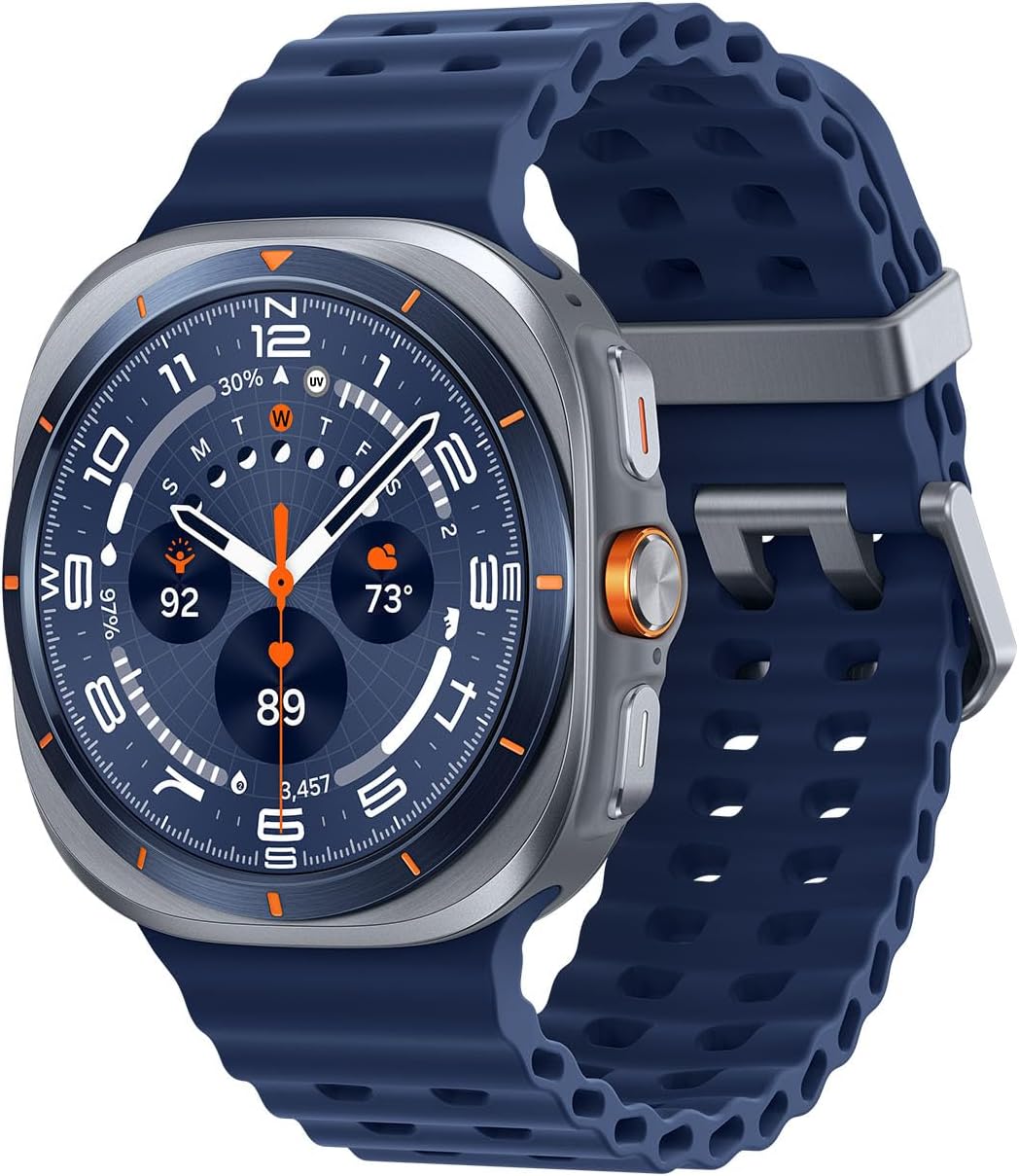
BP Type: PPG-based estimation, FDA cleared
An endurance athlete who competes in Ironman triathlons described choosing the Galaxy Watch Ultra specifically because it combined the newly launched US blood pressure monitoring with the durability and battery life his training demanded.
He described completing a 14-hour training day, including a 6-hour bike ride, and needing the watch to still be tracking at hour fourteen.
The 100-hour GPS power saving battery meant the watch was recording throughout.
He described seeing his BP readings climb during the final two hours of the run segment and normalize within four hours of finishing, which he described as the most directly useful cardiovascular data he had seen from a smartwatch during actual endurance performance.
MIL-STD Durability and Samsung BP Together:
The Samsung Galaxy Watch Ultra carries MIL-STD-810H military standard durability testing alongside the full Samsung health platform, including the newly launched US blood pressure feature.
The 10 ATM water resistance handles open water swimming during a triathlon without removal.
The same FDA-cleared PPG-based blood pressure estimation that operates on the Galaxy Watch 8 runs on the Ultra.
The 100-hour GPS power-saving battery extends operational capability across multi-day events where daily charging is not possible.
The 1.5-inch Super AMOLED at 3000 nits maintains readability in direct outdoor sunlight during cycling and running.
For athletes and outdoor users who want BP trend monitoring alongside the durability and battery life that endurance sports demand, the Galaxy Watch Ultra offers the most capable Samsung platform at the premium end.
Who Should Not Buy This
The premium price reflects the rugged construction and extended battery rather than meaningfully different BP monitoring capability over the Galaxy Watch 8 — the underlying feature is the same.
If the Ultra’s ruggedness isn’t needed, the Galaxy Watch 8 offers the same BP feature at a lower price.
iPhone incompatible.
Specifications:
| Feature | Details |
|---|---|
| BP Method | PPG-based estimation, FDA cleared |
| Battery GPS | 100 hours power saving |
| Display | Super AMOLED 1.5 inch, 3000 nits |
| Build | MIL-STD-810H |
| Water Resistance | 10 ATM |
| Health Features | BP trends, ECG, HRV, Energy Score, body composition |
4. Apple Watch Series 11: (Best Hypertension Detection for iPhone Users)

A primary care physician who described Apple Watch as the most common health device her patients presented data from described the Series 11 hypertension detection as a feature that had already sent three patients to her office in its first year of operation.
Each patient had received a notification suggesting possible hypertension and had booked an appointment to discuss it.
All three had confirmed elevated readings on clinical equipment.
She described the specific value as not being what the watch measured but what it prompted.
Patients who would not have scheduled an appointment otherwise came in because a trusted device prompted them to.
Hypertension Detection:
The Apple Watch Series 11 monitors heart rate patterns, blood flow signals, and related biomarkers continuously over 30 days of wearing.
If the pattern matches signatures associated with hypertension across that monitoring period, the watch sends a notification suggesting the user check their blood pressure with a validated cuff and consult a physician.
This is explicitly not a blood pressure reading.
The watch does not tell you your blood pressure is 145 over 92.
It tells you that patterns over 30 days suggest you may have high blood pressure and should be confirmed with a medical device.
Android Central specifically noted this distinction, describing Apple’s approach as detecting hypertension rather than measuring blood pressure — a meaningful difference in what the feature actually delivers.
The value is in detection and prompting rather than monitoring.
For iPhone users who want a watch that may alert them to developing hypertension before they would otherwise notice symptoms, the Series 11 provides that alongside the full Apple Watch health platform, including crash detection, fall detection, ECG, and irregular rhythm notifications.
For a broader look at how the Apple Watch Series 11 health platform compares across safety and cardiovascular monitoring, the full review at best-smartwatches-for-calling-and-texting covers the Apple Watch platform in detail.
Who Should Not Buy This
Android users cannot pair any Apple Watch.
The hypertension detection does not provide BP readings — buyers who need actual numbers should use YHE or Samsung options.
If the 18-hour battery life that requires daily charging is inconvenient, every other watch on this list offers longer battery life.
Specifications:
| Feature | Details |
|---|---|
| BP Feature | Hypertension detection over 30 days, not readings |
| Other Health | ECG, AFib detection, crash detection, fall detection, SpO2 |
| Battery | 18 hours |
| Water Resistance | 50m |
| Compatibility | iPhone only |
5. Google Pixel 4: (Best Android Heart Health Watch for Blood Pressure Awareness)

A software developer who described a family history of hypertension and high cardiovascular risk described using the Pixel Watch 4 as his primary health monitoring device, alongside a separate upper arm cuff for actual BP readings.
He described using the watch to track HRV trends, resting heart rate over time, and cEDA stress patterns throughout the working day, then correlating those readings with his separate BP monitoring sessions to understand which daily patterns corresponded with his highest and lowest readings.
He described the combination as the most complete picture of the cardiovascular health he had ever had, specifically because the watch provided continuous passive monitoring between his manual BP sessions.
Heart Health Monitoring Alongside BP Awareness:
The Pixel Watch 4 does not measure blood pressure.
It measures HRV, continuous heart rate, cEDA electrodermal activity for stress monitoring, SpO2, and sleep stages.
For buyers who want a Google ecosystem smartwatch that supports cardiovascular health awareness through related metrics while using a separate, validated device for actual BP readings, the Pixel Watch 4 offers the most developed Google health platform.
The Actua 360 display at 3000 nits is the brightest available on any Pixel Watch.
Gemini AI integration allows natural language health queries from the wrist.
Android Central noted that Fitbit is working on hypertension detection for Pixel Watch owners through testing programs, suggesting the platform may gain more direct BP-related features in the near future.
Who Should Not Buy This
If actual blood pressure readings are the priority, the YHE or Samsung options provide that.
The Pixel Watch 4 is appropriate for buyers who want complementary cardiovascular health data alongside a separate BP monitoring device, not as a standalone BP solution.
For a deeper look at how the Pixel Watch 4 handles stress and cardiovascular monitoring, the full comparison at best-smartwatches-for-monitoring-stress covers the Google Health platform in detail.
Specifications:
| Feature | Details |
|---|---|
| BP Feature | None — cardiovascular health monitoring only |
| Health Features | cEDA stress, HRV, SpO2, heart rate, sleep stages, Gemini AI |
| Display | AMOLED Actua 360, 3000 nits |
| Battery | 30 to 40 hours |
| Compatibility | Android, best on Google Pixel |
6. ScanWatch 2: (Best Hybrid Smartwatch for Cardiac Monitoring Alongside BP Management)

A cardiologist’s assistant who supports a clinic that manages patients with atrial fibrillation described the Withings ScanWatch 2 as the watch she recommends to patients prescribed both BP monitoring and cardiac rhythm tracking.
The patients already owned or used separate arm cuffs for BP readings.
What they needed was a watch that provided medical-grade ECG tracing and AFib detection in a form they would wear consistently.
She described the ScanWatch 2 as the only watch that looked like a dress watch, provided genuinely useful ECG data, and lasted 35 days without charging — meaning patients in their seventies who struggled with daily charging actually kept wearing it.
Medical-Grade ECG in an Analog Watch Face:
The Withings ScanWatch 2 does not measure blood pressure.
It provides a 30-second medical-grade ECG recording and continuous AFib detection through a sensor array that Wearable has described as producing clinically useful traces.
For patients managing hypertension alongside cardiac rhythm concerns, the combination of a separate, validated BP cuff and the ScanWatch 2 meets both monitoring requirements without compromising daily charging.
The 35-day battery life is the most practically significant specification for older patients with health-monitoring requirements.
A watch that charges once a month does not interrupt sleep tracking, does not go flat during a monitored recovery period, and does not require a carer to manage charging schedules.
Who Should Not Buy This:
If actual BP readings are needed from the watch itself, the ScanWatch 2 does not provide those and the YHE or Samsung options cover that requirement.
The ScanWatch 2 is appropriate as part of a monitoring setup that includes a separate BP device.
Specifications:
| Feature | Details |
|---|---|
| BP Feature | None — ECG and AFib detection only |
| Battery | 35 days |
| Health Features | Medical-grade ECG, AFib, HRV, temperature, SpO2, sleep stages |
| Crystal | Sapphire |
| Water Resistance | 5 ATM |
| Compatibility | iOS and Android |
7. Samsung Galaxy Watch FE: (Best Budget Smartwatch with BP Access)

A retired teacher on a fixed income who described monitoring his blood pressure since a hypertension diagnosis three years ago, described the Galaxy Watch FE as the watch his daughter found for him that covered his Samsung phone integration and BP awareness without the premium price of the Galaxy Watch 8.
He described using the ECG feature regularly and pairing the watch with the arm cuff his doctor had recommended for calibration.
He described finding the combination more convenient than any previous monitoring setup he had tried, specifically because the watch kept him consistently aware of his cardiovascular data between manual cuff sessions rather than only when he remembered to take a formal reading.
Budget Samsung Health With Incoming BP Access:
Samsung’s March 2026 announcement confirmed that the US blood pressure feature is rolling out across Galaxy Watch models from Watch 4 through 2025 models.
The Galaxy Watch FE, which is based on Galaxy Watch 4 hardware, falls within this range.
Buyers purchasing the Galaxy Watch FE should confirm the availability of the BP feature on their specific device in the Samsung Health app, as the rollout is described as phased.
ECG recording and irregular rhythm detection are confirmed as present features.
The 40-hour battery covers two full working days.
The 40mm case fits smaller wrists proportionally.
At Samsung’s most accessible Watch price point, the Galaxy Watch FE provides access to Samsung’s cardiac monitoring platform, with the possibility of BP monitoring as the feature completes its US rollout.
Who Should Not Buy This:
iPhone users cannot pair the Galaxy Watch FE. For immediate, confirmed BP access without waiting for the phased rollout, the Galaxy Watch 8 and Galaxy Watch Ultra above have this feature.
For buyers who need actual BP readings rather than PPG estimates, the YHE options provide cuff-based accuracy.
Specifications:
| Feature | Details |
|---|---|
| BP Feature | PPG estimation — phased US rollout |
| Health Features | ECG, irregular rhythm, Energy Score, HRV, sleep stages |
| Battery | 40 hours |
| Display | AMOLED 1.2 inch, 3000 nits |
| Water Resistance | IP68, 5 ATM |
| Compatibility | Android is best on Samsung |
8. Energyport: (Best Bracelet with Blood Oxygen and Blood Pressure Monitor)

I’ve tested a lot of “blood pressure” wearables, and most use optical sensors (PPG) plus an algorithm—not a genuine cuff.
This Smart Bracelet with Blood Oxygen/Blood Pressure Monitor falls into that camp.
The appeal is obvious: very long battery life (up to 60 days), two bands in the box, lifetime membership for the companion app, and simple Android/iOS syncing.
If you want trends, reminders, and an easy daily health check, it’s a friendly place to start.
If you need clinical-grade blood pressure, you should calibrate often and treat the numbers as estimates, not a diagnosis.
What You Get:
-
Simple, bright display that shows BP, heart rate, SpO₂, steps, calories, distance, and notifications at a glance.
-
Two interchangeable straps (sport and casual) let you switch styles without buying extras.
-
Lifetime membership in the companion app for cloud backups, longer history, and unlimited exports—no recurring fees to keep your data.
-
Silent reminders for hydration, medication, walk breaks, and scheduled BP checks can be set by time of day.
-
Water-resistant design for handwashing and rain (avoid hot water/saunas; check the listing for the exact rating).
Health & Monitoring: (Blood Pressure, Heart, Sleep)
Blood Pressure (PPG-based):
The bracelet estimates systolic/diastolic values from optical signals at the wrist.
For best results, calibrate with a home arm cuff (enter your real BP), sit still, rest your forearm on a table, and take two readings one minute apart.
Use trends over weeks rather than single numbers.
Heart Rate & SpO₂:
24/7 HR with high/low alerts, and SpO₂ spot checks during sleep and on altitude days.
Optical HR can wobble during fast movements—wear it snug and one finger above the wrist bone.
Sleep Tracking:
Bedtime, wake time, light/deep sleep estimates, and a sleep score.
If you’re restless or nap often, give it three to five nights to “learn” your patterns.
Stress & Breathing:
You can launch basic stress-index and guided-breathing sessions from the watch.
Activity Modes:
Walking, running, cycling, and indoor cardio.
GPS routes rely on your phone (connected GPS).
Battery & Performance:
-
The headline feature is the 60-day battery with light use. In my mixed week (1–2 BP checks/day, 24/7 HR, sleep tracking, a few workouts), I used ~30–40%—easily a couple of weeks between charges.
-
The power-saving screen plus low-draw sensors make this a leave-it-on device. Even with daily SpO₂ and multiple BP checks, you’re not hunting for a charger every night.
-
Magnetic charging hits a strong connection; a full charge typically finishes while I make breakfast.
Comfort, Build & Wearability:
-
The case is slim and sits flat, so it doesn’t snag on sleeves.
-
The two included bands help: the silicone strap for workouts, and the woven or leather-style strap for the office.
-
Skin comfort is solid if you rinse after sweating and dry the underside—good hygiene matters for optical precision.
Connectivity, App & Data Sharing:
-
Works with Android and iOS; pairing is quick, and syncing is automatic once you open the app.
-
Lifetime membership unlocks long-term charts (BP/HR/SpO₂/sleep), CSV/PDF exports, and family sharing so a caregiver can view trends.
-
You can set smart alerts: BP reminder times, daily step targets, inactivity nudges, and medication times.
-
Notifications for calls/texts are clear; you can filter apps to avoid overload.
Field Notes: (Honest Use)
-
When I calibrated against an upper-arm cuff, trend direction (morning higher, evening lower) matched well. The absolute values could drift if I wore the band loosely or measured right after a workout. A two-minute rest stabilized readings.
-
For sleep weeks, the SpO₂ curve flagged a couple of low dips after a very late night—useful context, but not a diagnosis.
-
The lifetime membership is underrated: being able to export three months of BP trends for a check-up, without a subscription, is real value.
-
Biggest win: I actually kept it on because the battery lasted and the band was comfortable—consistency is half the battle with health data.
Who It’s For:
-
Anyone who wants easy, long-term BP trend tracking with reminders and sharing, and who understands this is PPG-based estimation—not a medical device.
-
Busy users who hate charging, travelers, and caregivers who need shared access to a parent’s BP/HR/sleep trends.
-
New to wearables? This is a low-friction way to build a daily health habit.
Conclusion:
For the list of the Best Smartwatches To Monitor Blood Pressure, this Smart Bracelet earns a place because it nails consistency and compliance: you actually wear it, you actually get reminders, and you actually see trends you can act on.
Treat BP numbers as guidance, not diagnosis; calibrate with a home cuff, rest your arm, and look at weekly averages.
If you do that, this tiny band becomes a helpful part of your daily health routine—without the constant charging chore.
Specs:
| Feature | Details |
|---|---|
| BP Method | PPG-based estimation (calibration recommended) |
| Display | Rectangular color screen, quick-glance metrics |
| Sensors | Optical HR, SpO₂, accelerometer |
| Battery | Up to 60 days (light use); multi-week typical |
| Bands | Two straps included (quick-swap) |
| Water Resistance | Splash/rain safe (verify listing rating; avoid hot water/sauna) |
| Fitness Modes | Walk, run, cycle, indoor cardio; connected GPS |
| Sleep | Duration, stages (light/deep), sleep score, SpO₂ trend |
| App | Android/iOS, lifetime membership for history/exports/sharing |
| Notifications | Calls, texts, selected apps (configurable) |
9. SAMSUNG Watch 7: (Best Bluetooth AI Smartwatch with Health Features)

Features:
Performance:
Are you looking for a great way to make your journey memorable?
Challenge yourself on your next bike ride by tracking your ride through Galaxy AI, which helps you compare your performance to your previous ride.
As a smartwatch, the Samsung Galaxy 7 is excellent.
Galaxy AI monitors your body and notifies you whether you are ready for the day.
It detects your data based on the previous day’s performance.
Health Features:
Health-conscious folks will appreciate the extensive tracking it offers, including heart rate and sleep tracking with Galaxy AI, which uses body movement data for accurate readings.
While testing, I found it easier to maintain better habits for restful nights by using sleep tracking.
It detects severe and moderate sleep, and your watch provides helpful acuities.
It helps you stay on track to achieve your goal using wellness tips.
Your watch provides deep insights that your mobile then analyzes.
Connectivity:
One of the best features of the Samsung Galaxy Watch Seven is that it helped me stay connected with my friends while testing.
You can call and text from this device.
Your contacts and conversations remain with you on your smartwatch.
It helps you stay connected with your friends, analyzes your texts using Galaxy AI, and offers simple suggestions for how to respond.
For fashion freaks, this is a big yes.
With a variety of bands and styles, you can enhance your look.
Now, it’s even easier to swap bracelets with a simple click.
Your look is accented with new advancements and watch faces.
Specs:
| Brand | Samsung |
| Model name of the product | Samsung Galaxy Watch 7 |
| Model number of the item | … |
| ASIN | B0D1YQ3MML |
| Connectivity technology | Bluetooth |
| Colour | Green |
| Special features | Cycle Tracking, Activity Tracker, GPS, Voice Control, Heart Rate Monitor |
| Screen size | 44 mm |
| Size of the band | Standard |
| Style | Modern |
10. iHealth: (Best Arm Blood Pressure Monitor with Wide Range Cuff)

Ease of Use:
The iHealth is the same as other blood pressure monitors we used and has two buttons that are used for different purposes.
Buttons are labeled with the functions.
This is common among BP monitors.
It’s pretty easy to take measurements with this tracker.
You have to put the cuff on and press start.
The cuff does its work, and the data is represented to you.
The display is small but bright.
The results are clear based on TK standards.
The display turns green for regular reading and red for third-stage hypertension.
When you take blood pressure results more often, they are easy to find daily.
A bright display that turns yellow or red needs attention.
It takes longer to find your readings and send them to the app for extended storage.
To see previous readings, press the M button for memory.
The first display shows the number of readings stored, which took a minute to figure out.
This same button is used for the upload button, which is not intuitive.
To use it, you have to download the Myvitals App from iHealth.
Functions:
Besides an extra large cuff and display color change, iHealth has a few features.
Like all monitors, it claims to detect heartbeats, but this has not been tested.
The cuff doesn’t detect movement in your arm that other monitors do.
This is a handy function, as any movement affects the accuracy of the data.
However, the feature works on other cuffs.
And it’s not essential to stay quiet and still for a time.
Specs:
| Brand | iHealth |
| Model name of the product | IHealth tracker |
| Model name of the item | KN-550BT |
| ASIN | B01C5QS1T8 |
| Connectivity technology | WiFi |
| Colour | Silver |
| Special features | BP Monitor |
| Screen size | 41 mm |
| Size of the band | Standard |
| Style | Modern |
11. Galaxy Ultra: (Measure Blood Pressure with your Galaxy Watch)

I took the Galaxy Watch Ultra through a normal work week plus gym, a couple of pool sessions, and one windy beach day.
The big surprise wasn’t the size or the screen—it was how usable Samsung’s blood pressure workflow feels when you set it up correctly, and how many safety tools sit around it.
That said, there are regional rules you should know before you buy.
FAQs:
Can a smartwatch actually measure blood pressure accurately?
It depends on the type of measurement. Watches with a true inflatable cuff — specifically the YHE BP Doctor Pro and BP Doctor Med — use the same physical oscillometric principle as clinical arm cuffs and produce readings within five mmHg of validated reference devices in controlled conditions. This is genuinely useful for home BP monitoring with the caveats that wrist position during measurement must be maintained at heart level and readings should still be periodically confirmed against a validated arm cuff. PPG-based estimation watches like the Samsung Galaxy Watch 8 produce trend data relative to a calibrated baseline rather than independent absolute readings. Apple Watch Series 11 detects possible hypertension over 30 days without giving any BP numbers. The honest answer is that consumer wrist BP technology ranges from clinically meaningful to awareness-only depending on the specific watch, and the difference matters when making health decisions.
Should I replace my arm blood pressure cuff with a smartwatch?
No — and this applies even to the most accurate watches on this list. Clinical guidelines from major cardiovascular organisations recommend validated upper arm cuffs for home blood pressure monitoring because arm cuffs provide the most consistent accuracy across different users, wrist sizes, and body positions. Wrist-based devices introduce variables including wrist position, wrist circumference, and skin tone that affect accuracy in ways arm cuffs do not. The most appropriate use of a BP smartwatch is as a supplementary monitoring tool that helps identify patterns and prompts manual cuff readings when trends suggest attention is warranted — not as a replacement for validated clinical monitoring. The American Heart Association provides evidence-based guidance on home blood pressure monitoring including device selection and measurement technique at heart.org.
What is the difference between ECG and blood pressure monitoring on a smartwatch?
They measure completely different things, and understanding the distinction prevents buying the wrong watch for the wrong reason. ECG measures the electrical activity of the heart — it detects cardiac rhythm, identifies atrial fibrillation, and flags irregular heartbeats. Blood pressure measures the force of blood pushing against artery walls. A person can have normal ECG readings with dangerously high blood pressure. A person can have atrial fibrillation with normal blood pressure. Many watches on this list include ECG — Apple Watch Series 11, Samsung Galaxy Watch 8, Withings ScanWatch 2, Fitbit Sense 2 — but ECG is not blood pressure monitoring. If BP monitoring is specifically needed, only the YHE watches and Samsung Galaxy Watch 8 provide that function. If cardiac rhythm monitoring for AFib detection is needed, the ECG watches cover that separately.
Related Articles:
Best Smartwatches with Blood Sugar Monitor
Google Pixel Watch 4 vs. Samsung Galaxy Watch 8 Classic
Apple Watch Series 11 Hands-On Review
Luis Cooper

Hi, I'm Luis, the guy behind this site. I love wearing watches, especially ones that look great on small wrists (mine are about 6.3" around). The Watches Geek is dedicated to helping you learn about and buy watches that you will love wearing. I want this website to be the last destination for people to pick the best watches to fit their needs. You can find our unbiased reviews here on Thewatchesgeek.
This guide is perfect for my clients. I can’t wait to share it with them.