
Last Updated on September 25, 2026 by Luis Cooper
Imagine buying a brand new car and then discovering the steering wheel only works if you pay a monthly fee.
That is not how cars work. But it is exactly how some of the most popular health wearables in the world work in 2026.
You buy the device, you start using it, and then a few days later an email arrives asking for a monthly payment before you can see what your own body data actually means.
Some wearables charge you every single month, forever, just to read the health information that your own wrist already collected.
Others give you everything you paid for on day one and never ask for another rupee, dollar, or pound again.
This guide explains exactly who charges what, what you lose if you stop paying, and which devices give you every feature for a one-time purchase with no monthly fee attached.
The numbers below are all verified for 2026.
Smartwatch Subscription Costs Nobody Tells You
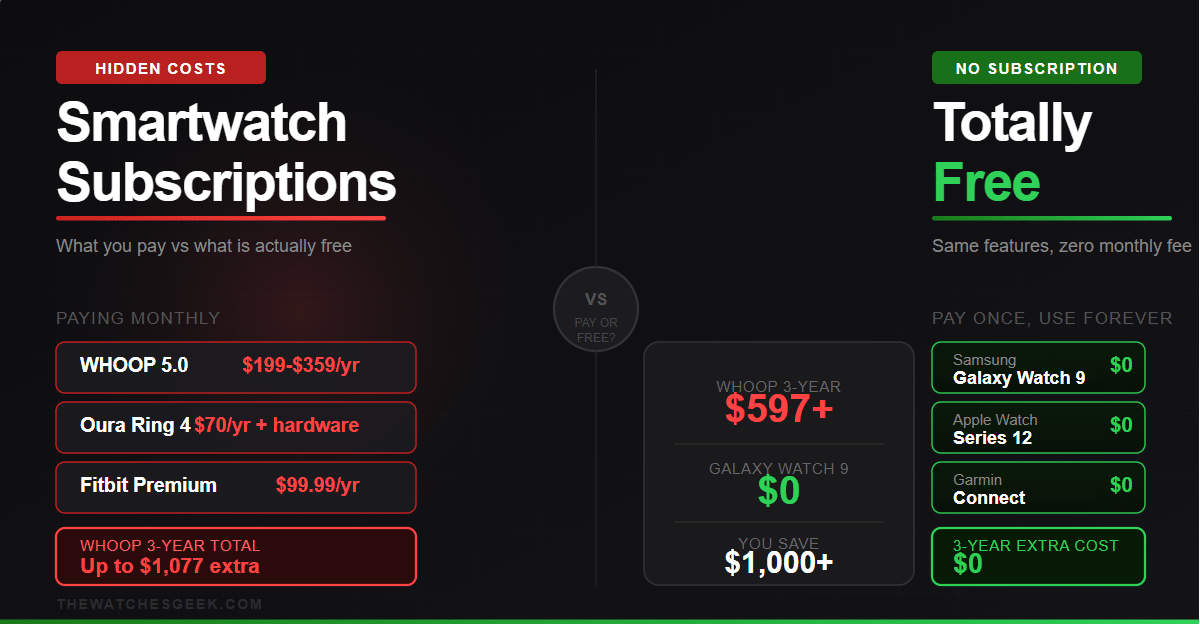
The Quick Answer — What Each Wearable Costs You Per Year
Before the details, here is the full picture in one place:
| Wearable | Hardware Cost | Monthly Fee | Annual Fee | 3-Year Total |
|---|---|---|---|---|
| WHOOP 5.0 | Included in subscription | $25-$40 | $199-$359 | $597-$1,077 |
| Oura Ring 4 | $349-$499 upfront | $5.99 | $69.99 | ~$553 |
| Fitbit/Google Health | Device separate | $9.99 | $99.99 | ~$300+ device |
| Garmin | Device separate | $0 (free) or $6.99 optional | Free or $83 optional | Device only |
| Apple Watch Series 12 | Device separate | $0 | $0 | Device only |
| Samsung Galaxy Watch 9 | Device separate | $0 | $0 | Device only |
| Google Pixel Watch 5 | Device separate | $0 | $0 | Device only |
The difference between the top and bottom of that table over three years is over a thousand dollars.
That is not a small detail buried in a terms and conditions page.
That is a significant financial difference that most people discover only after they have already bought the device.
1. WHOOP: The Wearable That Has No Price Tag — Only a Bill
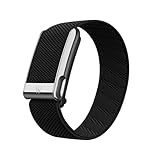
- What’s Included: You only pay for your 12-month WHOOP Life membership. Your WHOOP MG device is included at no additional cost, along with a SuperKnit Luxe band and Waterproof Wireless PowerPack.
- HSA/FSA Eligible: All 12-month WHOOP memberships and battery packs are HSA and FSA eligible and qualify for HSA/FSA reimbursement. Use your HSA or FSA funds by submitting your receipt for reimbursement as a pre-tax qualified purchase.
- AI Coach & Personalized Coaching: In the WHOOP app, WHOOP AI acts as your personal coach, turning 140+ health and fitness metrics into insights on what to do next. Track 160+ daily behaviors in the WHOOP Journal to see how your habits impact your sleep, recovery, and health, and get personalized AI coaching that adapts to you.
- Heart Health, ECG & Health Monitor: WHOOP Life is a heart health wearable for taking an on-demand ECG from your wrist to check for potential signs of AFib (atrial fibrillation). Daily Blood Pressure Insights estimate systolic and diastolic ranges from overnight data. The Health Monitor tracks heart rate, resting heart rate, HRV, respiratory rate, blood oxygen (SpO₂), and skin temperature with 99%+ heart rate and HRV tracking accuracy. Share ECG results with your healthcare provider.
- Track Your Age with Healthspan: See how your daily habits impact your long-term health and how your body is aging. WHOOP Healthspan analyzes 9 key health metrics to calculate your WHOOP Age and Pace of Aging, showing whether your body is aging faster or slower than your chronological age. Get science-backed insights to understand healthy aging, improve longevity, and extend your performance for years to come.
WHOOP works differently from every other wearable on this list.
You do not buy a WHOOP. You subscribe to WHOOP. The band itself comes included in the membership, which means there is no way to own the device without paying the ongoing fee. Stop paying, and the band stops being useful. It is the subscription that is the product. The band is just the hardware that makes it possible to collect the data you are paying to read.
In 2026, WHOOP offers three plans:
WHOOP One is the entry plan at $199 per year, which works out to approximately $16.58 per month when billed annually. It includes the WHOOP 5.0 band, sleep tracking, strain tracking, and recovery scoring — the core features that most people buy WHOOP for.
WHOOP Peak sits in the middle at $239 per year, or around $19.92 per month effectively. It adds stress monitoring and longevity metrics on top of the core features.
WHOOP Life is the top tier at $359 per year, which is approximately $30 per month. This tier ships with the WHOOP MG, which is a medical-grade version of the band that adds ECG, AFib detection, and blood pressure insights.
The monthly billing option that some people see advertised carries a higher effective cost and, importantly, new members cannot sign up monthly — everyone starts on an annual commitment.
Over three years on the entry plan, WHOOP costs approximately $597. On the top-tier plan, that figure climbs past $1,000 before accounting for any price changes WHOOP might make across those three years.
What WHOOP tracks that makes people pay for it:
Heart rate variability every night, daily recovery score, sleep staging, strain measurement during workouts, and a personalised coach that adjusts recommendations based on your data over time.
These are genuinely useful features. The question this guide asks is whether you need to subscribe to get them — and the answer, as you will see below, is no.
2. Oura Ring: Low Monthly Fee, High Hardware Cost, and a Data Paywall That Surprises People

- ACCURACY - SMART SENSING - Oura tracks over 50 health metrics, including sleep, activity, stress, heart health, and women’s health metrics. Oura Ring 4 is powered by Smart Sensing, which adapts to you — delivering accurate, continuous data, day and night
- ACCURATE SIZING ESSENTIAL - Oura Ring 4 uses unique sizing different from standard jewelry rings; use the Oura Ring 4 Sizing Kit to find your perfect fit before purchasing
- LONG LASTING BATTERY - With up to 8 days of battery life, no screens and no vibrations, Oura Ring 4 allows you to focus on the present. From a workout to a night out — you’re free to forget it’s on. Until you start getting compliments
- OURA MEMBERSHIP - First month of membership is included with purchase, for new members only. Subscription is 5.99/mo afterwards. Membership is tied to your account via the Oura App, not your physical ring
- HSA/FSA ELIGIBLE - We can accept HSA or FSA funds for the following: Oura Ring, additional chargers, and shipping

The Oura Ring approach is different from WHOOP but creates a similar surprise for buyers who do not read the small print first.
You buy the ring upfront. The Oura Ring 4 starts at $349 for the basic silver finish and goes up to $499 for gold and ceramic options. That purchase gets the hardware onto your finger. What it does not fully unlock is the data the ring collects.
Without a paid membership, the Oura app shows you three daily scores: your Readiness Score, your Sleep Score, and your Activity Score. Three numbers. Everything behind those numbers — the sleep staging that shows you how much time you spent in REM versus deep sleep, the heart rate variability trends across weeks, the temperature data that detects illness patterns before you feel symptoms, the personalised guidance — is locked behind the membership paywall.
The membership costs $5.99 per month or $69.99 per year. The first month is included free with every new ring purchase.
At $69.99 per year, this is the cheapest subscription on this list by a significant margin. The honest assessment is that if you buy an Oura Ring, the membership is not really optional in any practical sense. Without it, the ring is, as one independent reviewer put it, an expensive step counter.
Over three years with the base ring, the total cost comes to approximately $553. Compared to WHOOP over the same period, Oura is substantially cheaper — but the starting hardware cost means your first year still costs over $400 before any other expenses.
3. Fitbit / Google Health Premium: A Price That Just Got Significantly More Expensive
In 2025, Fitbit Premium cost $79.99 per year. In 2026, following the Google Health rebrand, the annual price increased to $99.99. That is a 25 percent price increase in a single year.
Monthly, Fitbit Premium costs $9.99. The annual plan at $99.99 saves two months of payment compared to paying monthly for twelve months.
What Fitbit Premium adds over the free tier includes the Sleep Profile feature that categorises your sleep pattern type, guided workout videos, mindfulness content, and deeper health insights. The free Fitbit tier is meaningfully more functional than the free Oura tier — you can see sleep stages, heart rate, steps, and basic health trends without paying anything extra. The Premium subscription adds depth and guidance rather than unlocking data that was already collected.
The price increase makes the comparison with alternatives less comfortable than it used to be. Fitbit Premium at $99.99 per year is now more expensive than Oura’s membership at $69.99 per year, despite Oura’s hardware costing hundreds of dollars more upfront. For buyers choosing between these two specifically, that pricing relationship has shifted noticeably in 2026.
4. Garmin: Free Core Features With an Optional Upgrade
Garmin’s approach is the closest among wearable brands to a clear no-subscription model, though the situation is slightly more nuanced than a simple zero monthly fee.
Garmin Connect — the platform that stores your health data, tracks your runs, shows your sleep analysis, monitors your Body Battery, and provides all the health and training analytics — is free. There is no subscription required to access the features that Garmin Connect has always offered.
In March 2025, Garmin introduced Connect+, an optional paid tier at $6.99 per month or $83.88 per year. Connect+ adds AI-powered insights, enhanced race planning tools, and advanced training analytics. These are additions on top of what was already free rather than features moved from free to paid.
The key distinction for buyers is that everything Garmin Connect offered before Connect+ launched remains free. A Garmin Forerunner 165 or Garmin Venu 4 purchased today gives you Body Battery, Training Readiness, sleep tracking, GPS, and the full Garmin health platform without any monthly payment required. The Connect+ subscription is genuinely optional rather than a practical necessity the way Oura’s membership is.
The Free Alternatives: Everything Included, Nothing Extra to Pay
Three of the most capable smartwatches available in 2026 charge nothing monthly. Not for the basic features. Not for the advanced health platform. Not for anything.
Samsung Galaxy Watch 9 launched in August 2026 with Vitals, Daily Cardio Load, Antioxidant Index, and the full Samsung Health platform. Vitals tracks your heart rate, HRV, respiratory rate, blood oxygen, and skin temperature every night and builds a personal baseline after seven nights of data. Daily Cardio Load monitors your cardiovascular training burden and recovery the same way WHOOP does. All of it is included in the watch purchase. Samsung charges nothing monthly for any of it.
This is the comparison that makes the subscription model difficult to justify for many buyers. WHOOP charges $199 to $359 per year specifically for recovery tracking and sleep coaching. The Samsung Galaxy Watch 9 provides equivalent recovery tracking as part of the platform you already paid for when you bought the watch. Over three years, the difference between these two approaches is between $597 and over $1,000 paid to WHOOP, versus zero paid to Samsung beyond the initial hardware.
![Samsung Galaxy Watch9, Silver, 44mm Bluetooth Smartwatch | AI Assistant, Fitness Tracker, Sleep Coaching and Running Coaching with Heart Rate Tracking [US Version, 2 Yr Warranty]](https://m.media-amazon.com/images/I/31KDFsR6CML._SL160_.jpg)
- TRACK HEALTH PATTERNS¹ IN YOUR SLEEP WITH VITALS²: Stay aware of the subtle changes in your body with Vitals¹–it tracks health metrics while you sleep, catches shifts from your usual patterns, and provides tailored guidance based on the insights.²
- A PERSONALIZED COACH FOR YOUR FITNESS GOALS: Whether you're building endurance for a long trek or training to build muscle, Fitness Index³ delivers tailored guidance based on your fitness level goals. Finally, train smarter with your fitness watch.
- EVERYDAY AI ASSISTANCE, SIMPLIFIED: With the Galaxy Watch9, you can just raise your wrist, start talking naturally and get instant AI assistance⁴—no wake phrase needed. This smart watch won’t slow you down.
- ONE PERSONALIZED SCORE TO KNOW YOUR HEART BETTER: Instead of checking multiple metrics separately, track the single Heart Health Score⁵ based on sleep time, BMI, activity and vascular load to stay aware of your wellness.
- TRACK YOUR NIGHTS. OWN YOUR DAYS: Galaxy Watch9 gives you personalized recommendations and habit-building guidance with Advanced Sleep Coaching.⁶ Plus, Bedtime Guidance⁷ helps you find your optimal bedtime so you can wake up feeling refreshed.
Apple Watch Series 12 launched on September 18, 2026 with the Readiness Score, Health Age, Audio Intelligence, and the complete Apple health platform. ECG, sleep staging, heart rate variability, fall detection, and every health feature the watch carries is accessible without any subscription. Apple Fitness+ is available as a paid option for workout videos and guided content, but it is entirely separate from the watch’s health monitoring capabilities and completely optional.

- STAY CLOSER TO YOUR HEART HEALTH—The most accurate heart rate sensing in a wearable,* Series 12 now measures HRV as often as every five minutes for insights on stress and recovery, and takes background heart rate readings every five seconds.
- A FULL-FEATURED HEALTH TRACKER—Better understand your body with invaluable health insights. View your overnight health metrics with the Vitals app and get a daily sleep score,* track your menstrual cycle,5 and take readings of your blood oxygen.*
- CHECK YOUR READINESS FOR THE DAY—Know when to rest or put yourself to the test. The readiness experience can help you determine your capacity to take on the day by analyzing your recent activity, vitals, and sleep.
- A POWERFUL FITNESS TRACKER—With advanced metrics and motivating features like Pacer, Heart Rate Zones, and Workout Buddy powered by Apple Intelligence from your nearby iPhone8—Series 12 helps you stay active, from running to hiking to strength training.
- KEEP HELP CLOSE AT HAND—A smartwatch that puts your safety first. Series 12 can detect a hard fall or severe car crash, automatically help connect you with emergency services, and notify your emergency contacts.*
Google Pixel Watch 5 launched on August 20, 2026 with Loss of Pulse Detection, cloud GPS post-processing, sleep breathing quality monitoring, and the Fitbit health platform built in. The Fitbit features accessible through the Pixel Watch include sleep staging, daily readiness, and heart rate monitoring — and these work without a Fitbit Premium subscription. The Premium subscription adds additional content and depth, but the core health monitoring is included with the watch.

- The new Google Pixel Watch 5 offers a smarter way to a healthier you.[1,2]; Designed for Gemini Intelligence, get proactive help, and personalized insights from Google Health[3,4]; watch is compatible with Android devices only; not compatible with iOS devices
- Precision-crafted to do it all: The Google Pixel Watch 5 features the domed Actua 360 display with scratch-resistant Gorilla Glass and up to 40 hours of battery life[1,5]
- Metrics that matter: Advanced sensors help you stay ahead of your health and wellness; and Google Pixel’s most accurate heart rate tracking is fine-tuned for your activity[6,7]
- Understand your sleep like never before: Your watch captures insights like the time spent in sleep stages to breathing regularity, then summarizes it all in a personalized Sleep Score[8,9]
- Detects loss of pulse, then calls for help: Pixel Watch 5 is the only smartwatch to feature Loss of Pulse Detection, which can prompt a call to emergency services[10]
Who Should Still Pay for a Subscription Wearable
The subscriptions above are not universally wrong choices. They serve specific buyers well.
WHOOP makes sense if you are a serious athlete who trains at high intensity consistently, you specifically want the coaching approach that WHOOP’s platform provides, and you are comfortable with a screen-free band rather than a smartwatch. For this specific buyer the platform’s depth justifies the cost.
Oura Ring makes sense if you specifically want a ring form factor rather than a watch on the wrist, you prioritise sleep and recovery data over workout tracking and GPS, and the $5.99 monthly fee feels proportional to the value the daily insights provide. The ring is genuinely unobtrusive during sleep in a way that a watch is not.
Fitbit Premium makes sense for existing Fitbit device owners who actively use the Sleep Profile, the guided workout library, and the mindfulness content. For new buyers evaluating from scratch in 2026, the value proposition is weaker than it was before the price increase.
Who Should Choose a Free Platform Instead
If you own a Samsung Galaxy phone and want WHOOP-equivalent recovery tracking without a monthly subscription, the Samsung Galaxy Watch 9 is the direct answer.
If you use an iPhone and want comprehensive health monitoring with no ongoing cost, the Apple Watch Series 12 gives you everything except blood glucose monitoring.
If you run or cycle regularly and want GPS, Body Battery, and training analytics at no monthly cost, any current Garmin watch with Garmin Connect covers everything most recreational athletes need.
For a closer look at how the Samsung Galaxy Watch 9’s free health platform compares to paid alternatives across specific health features, the full guide at samsung-galaxy-watch-9-review covers every feature in detail. For Apple Watch buyers, the full comparison of Apple Watch Series 12, Ultra 4, and SE 3 is at apple-watch-series-12-review.
FAQs
Do you need to pay monthly to use a smartwatch?
No. Three of the most capable smartwatches available in 2026 — the Samsung Galaxy Watch 9, Apple Watch Series 12, and Google Pixel Watch 5 — include their full health platforms at no monthly cost. The subscription model is specific to certain wearable brands, primarily WHOOP and Oura Ring, and it is a design choice those companies have made rather than an industry standard. Garmin’s core platform is also free. Before buying any wearable, checking whether the health features you want require an ongoing subscription is one of the most important questions to answer, because the difference between a subscription and a non-subscription device of similar capability can amount to hundreds of dollars over a few years of ownership.
What happens to your Oura Ring data if you cancel the subscription?
Without an active Oura membership, the ring still collects data and the app still shows three daily scores: your Readiness Score, your Sleep Score, and your Activity Score. Everything behind those scores — the detailed sleep staging, the HRV trends, the temperature graphs, the personalised recommendations, and the illness detection — is no longer visible. The ring continues to function as a device, but the depth of information it was designed to provide becomes inaccessible until the membership is reinstated. This is the most important practical reality of the Oura subscription model: the hardware is fully dependent on the software access that the membership provides, and reducing that access reduces the device to a basic activity tracker despite its premium hardware capabilities.
Is WHOOP worth the monthly cost compared to a Samsung Galaxy Watch 9?
The honest answer depends on what you specifically value. WHOOP at $199 per year provides recovery coaching, strain tracking, sleep staging, and HRV monitoring in a screen-free band with no display. Samsung Galaxy Watch 9 at no monthly cost provides Daily Cardio Load, Vitals, the Antioxidant Index, Irregular Heart Rhythm Notifications, GPS, smartwatch notifications, contactless payments, and Gemini AI. The recovery tracking capabilities are comparable between the two platforms. WHOOP provides deeper coaching language around recovery and strain in its app interface. Galaxy Watch 9 provides a much broader device capability that includes everything a smartwatch does alongside the recovery data. Over three years, WHOOP costs between $597 and over $1,000 in subscription fees. Galaxy Watch 9 costs nothing monthly. For buyers who specifically want a dedicated recovery band and are comfortable with the screen-free form factor, WHOOP’s platform depth can justify the cost. For buyers who want recovery tracking as part of a complete smartwatch experience, the Galaxy Watch 9 removes the subscription entirely without meaningfully reducing what the recovery features provide.
Luis Cooper

Hi, I'm Luis, the guy behind this site. I love wearing watches, especially ones that look great on small wrists (mine are about 6.3" around). The Watches Geek is dedicated to helping you learn about and buy watches that you will love wearing. I want this website to be the last destination for people to pick the best watches to fit their needs. You can find our unbiased reviews here on Thewatchesgeek.