
Last Updated on October 3, 2026 by Luis Cooper
The word budget carries a specific feeling when it applies to smartwatches. You expect a dim screen.
You expect a battery that needs charging every few days. You expect a case that feels like it belongs on a cereal box prize rather than a wrist.
You accept these compromises because you are not prepared to spend what the established names charge.
The Xiaomi Redmi Watch 6 does something unusual for a watch in its price tier. It disagrees with most of those expectations.
A 22-year-old nursing student who works part-time shifts described postponing her first smartwatch purchase for two years because every watch she could afford looked like a fitness tracker from a discount bin, and every watch she wanted was beyond what a student budget could justify.
The Redmi Watch 6 was the first watch she found that fit her budget and didn’t immediately feel like a compromise the moment she looked at it.
She has worn it through clinical rotations, overnight study sessions, gym classes, and swimming.
Eight months after buying it, she describes it as the most consistently useful thing she carries.
Xiaomi Redmi Watch 6 Review


Quick Verdict
The Redmi Watch 6 is the right watch for a specific buyer: someone who wants a genuinely good AMOLED display, battery life that does not demand a charging routine, built-in GPS for outdoor activity tracking, and all the essential daily smartwatch features, without spending what Apple, Samsung, or Garmin charge.
It is not the right watch for a buyer who wants ECG monitoring, deep training analytics, music storage on the watch, or a premium metal build throughout.
Those features belong to watches that cost considerably more, and the Redmi Watch 6 is honest about what it is not.
Design and Build Quality:

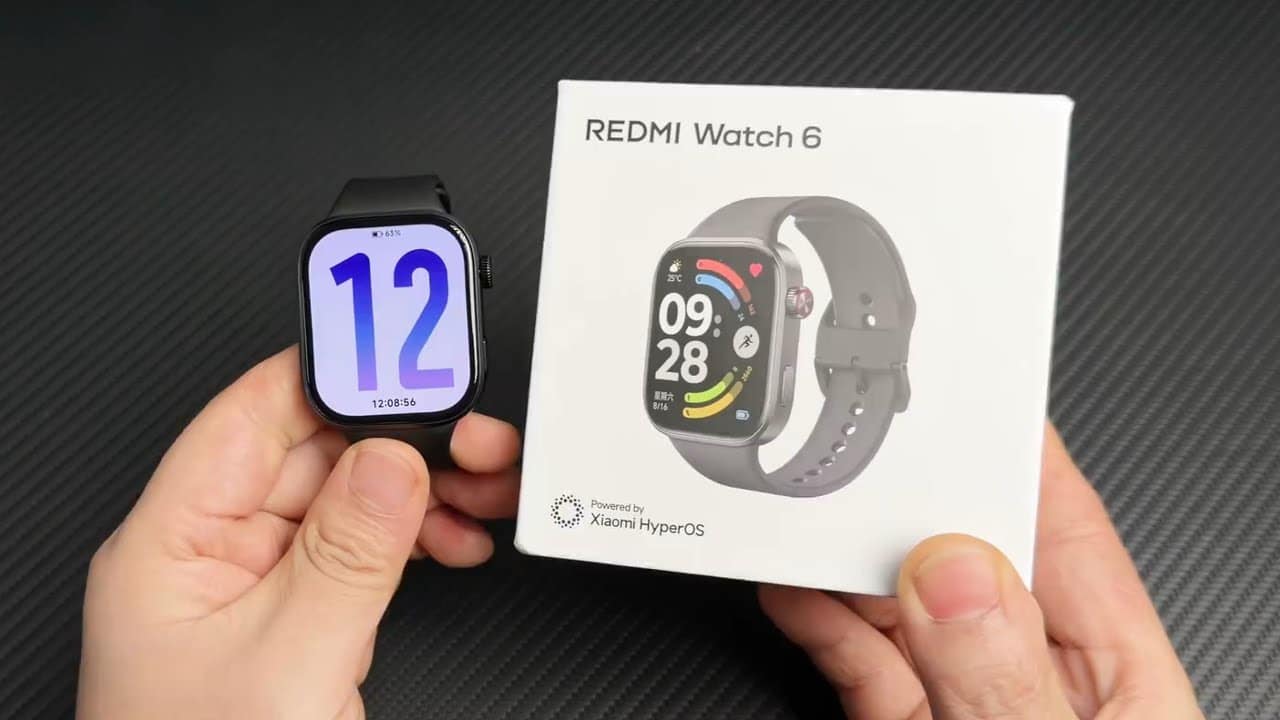
The Redmi Watch 6 measures 46.5 by 40 by 9.9 millimetres and weighs 31 grams without the strap.
Thirty-one grams is genuinely light for a watch with a 2.07-inch screen and a 550mAh battery inside.
For comparison, most smartwatches in this size class weigh between 35 and 50 grams.
The combination of an aluminum alloy frame and a plastic back is what achieves this — the frame provides structural rigidity while the back keeps weight down.
The 9.9-millimetre thickness means the watch sits flat against the wrist rather than protruding above it.
Under a shirt sleeve or a hospital scrub, the profile disappears. This is the specific quality that separates a watch you wear constantly from one you leave on the nightstand because it feels bulky under daily clothing.
The silicone strap is replaceable with any compatible 20mm band, so you can switch between a sporty look for training and a more restrained appearance for professional settings by changing the band rather than the watch.
Water resistance is rated at 5 ATM, which covers swimming in pools and open water, showering, and sustained rain exposure without any concern. The watch can go where the wearer goes without a daily removal routine around water.
The Display — What 2,000 Nits Actually Means
The 2.07-inch AMOLED display is the feature that earns the Redmi Watch 6 its recommendation above everything else.
AMOLED panels use the same technology as premium smartphones — each pixel generates its own light rather than relying on a backlight, producing true blacks and vivid colours that LCD and MIP displays cannot replicate.
At this price point, most competing watches use LCD panels with backlights that wash out blacks and reduce colour depth.
The Redmi Watch 6’s AMOLED delivers a viewing experience that looks more expensive than it is.
At 2,000 nits of peak brightness, the display remains clearly readable in direct outdoor sunlight.
Most budget smartwatches use panels in the 500 to 800 nit range, which require shading the screen with one hand to read in midday light.
The Redmi Watch 6 eliminates this inconvenience — outdoor workout stats, GPS maps, and notification text are all readable without adjusting position or angle.
The always-on display shows the time and basic information without waking the full screen.
Most budget smartwatches skip this feature entirely because always-on mode draws continuous power.
The Redmi Watch 6 includes it but makes the trade-off clear: running the always-on display noticeably reduces battery endurance. The watch lets you choose which matters more on any given day.
The 432 by 514 pixel resolution at 324 pixels per inch produces sharp text and clear icons.
Watch faces, health dashboards, and notification content all look distinct rather than blurry, which matters over the hundreds of daily glances that accumulate across a wearing day.
Battery Life — The Feature That Changes Daily Life

Battery anxiety is the specific feeling that comes from wearing a watch that requires charging every day or every other day.
You check the battery percentage before heading out.
You debate whether to wear the watch to bed for sleep tracking or charge it overnight instead. You carry the charger when travelling because missing a day risks a dead watch mid-trip.
The Redmi Watch 6 removes this feeling through the combination of a 550mAh battery and the efficient Xiaomi HyperOS 3 platform.
Xiaomi’s official battery figures list three distinct use profiles.
In light use — notifications, step counting, heart rate monitoring, without frequent GPS sessions — the watch lasts approximately 24 days between charges. With normal mixed use including regular GPS workouts, the figure sits around 12 days. With heavy daily GPS tracking and always-on display enabled throughout, the watch delivers approximately 7 days.
Real-world testing from independent reviewers confirmed that the 12-day figure is achievable in normal daily use.
One reviewer charged the watch only three times across their entire review period.
Another described the experience as “charging anxiety practically disappearing”—the battery endurance figure most budget competitors promise at 7 to 14 days; the Redmi Watch 6 delivers closer to the upper end of that range in normal use.
For a student, a professional, or anyone whose daily schedule does not include a regular charging slot, a 12-day battery means the watch charges perhaps twice a month. This changes the relationship with the device from something you manage to something you wear.
GPS and Outdoor Activity Tracking
The Redmi Watch 6 has built-in GPS with dual L1 antennas that support five satellite systems: GPS, GLONASS, Galileo, BeiDou, and QZSS simultaneously.
Built-in GPS lets the watch record routes and distance during outdoor runs, walks, and rides without needing the phone. The route data appears in the Mi Fitness app after the session as a colour-coded map with pace, distance, and heart rate overlaid chronologically.
Dual L1 antennas improve signal consistency during movement.
A single antenna receives strongest signal from a specific angle, which can cause brief positioning gaps when the wrist rotates during arm swing.
Two antennas positioned differently on the watch receive signals from a wider range of satellite angles simultaneously, reducing these gaps in environments like tree-lined paths and urban streets where direct satellite views are occasionally interrupted.
Connecting five satellite systems simultaneously means the watch always has access to whichever constellation has the clearest line of sight from the current position. GPS alone covers most of the sky. Adding GLONASS, Galileo, BeiDou, and QZSS fills the gaps in positions where only one or two GPS satellites would otherwise be reachable.
Running GPS workouts daily reduces battery life from the 12-day normal figure toward the 7-day heavy-use figure.
For a buyer who does three to four outdoor GPS sessions per week rather than daily, real-world battery life lands somewhere between these two figures—closer to 9 or 10 days in practice.
Health and Fitness Features

The optical sensor on the back of the Redmi Watch 6 monitors heart rate continuously throughout the day and night. Real-time heart rate appears on the watch face during workouts and in the health dashboard in the Mi Fitness app as a historical timeline showing how heart rate varied across the day and overnight.
Resting heart rate tracked consistently over days and weeks is one of the most reliable early indicators of improving cardiovascular fitness.
As aerobic fitness increases through regular training, the heart becomes more efficient and the resting rate decreases measurably.
Watching this number drop over months of consistent training provides motivation that workout performance data alone doesn’t always give.
Sleep Tracking
The Redmi Watch 6 monitors sleep across light, deep, and REM stages throughout the night and presents the results in the Mi Fitness app as a visual timeline showing how sleep progressed from the moment of falling asleep to waking.
Total sleep duration, time in each stage, and any detected restlessness appear alongside a daily sleep score.
Sleep quality affects energy levels, recovery from training, cognitive performance, and long-term health in ways that accumulate over months and years rather than appearing as single-day changes.
Tracking sleep consistently over weeks reveals patterns—whether weeknight sleep consistently falls short, whether specific activities improve or disrupt sleep quality, and whether the overall pattern trends toward better or worse rest.
For a deeper understanding of what healthy sleep looks like and how different sleep stages contribute to physical and mental recovery, the Sleep Foundation provides evidence-based guidance at sleepfoundation.org.
Stress Monitoring
The watch measures physiological stress continuously during the day using heart rate variability data.
When HRV patterns shift in ways that correlate with elevated psychological or physical stress, the app surfaces this as a stress level reading.
Over time, the stress chart shows which periods of the week, which types of days, and which activities tend to produce elevated readings and which produce calmer ones.
For a student with exam periods or a professional with variable workloads, seeing stress data alongside sleep data over weeks provides a more complete picture of how the daily schedule affects the body than either measurement alone.
SpO2 Blood Oxygen
You can measure blood oxygen saturation on demand from the health menu.
SpO2 readings help monitor recovery from illness, understand how the body responds to altitude changes during outdoor activities, and serve as a general health baseline.
The watch does not provide continuous overnight SpO2 monitoring like dedicated sleep health devices do—it measures on demand and during specific sleep health checks.
150-Plus Sports Modes

The 150-plus sports modes cover running, cycling, swimming, walking, hiking, gym training, yoga, and dozens of other activities.
Each mode optimises what data the watch collects and displays for that specific activity type.
The relevant metrics for a swimming session — stroke count, lap count, SWOLF efficiency score — differ from those for a trail run, and the Redmi Watch 6 adjusts its tracking and display accordingly without requiring manual configuration.
Smart Features and Connectivity
HyperOS 3 and the Mi Fitness App
The Redmi Watch 6 runs Xiaomi’s HyperOS 3 — the operating system that powers both Xiaomi phones and Xiaomi wearables and was designed specifically to handle health data, notifications, and watch functions on a power-efficient wearable processor.
HyperOS 3 has a clean, simple navigation structure. The home screen shows the watch face.
A swipe left reveals health metrics. A swipe right shows notification summaries. Swiping down opens quick settings.
The learning curve for someone who has never used a Xiaomi watch before is approximately fifteen minutes, after which the interface becomes intuitive in daily use.
The Mi Fitness app on the phone stores full historical health data, lets you configure watch faces, sports modes, and notification preferences, and handles software updates when available.
The app is available for both Android and iOS and connects to the watch via Bluetooth 5.4, which provides a stable connection with lower power consumption than earlier Bluetooth versions.
Bluetooth Calling
Incoming calls from the paired phone appear on the watch screen with caller ID, and the watch’s built-in microphone and speaker let you answer and take calls from your wrist without reaching for the phone.
The voice quality through the watch speaker is adequate for short conversations and louder environments — it is not a replacement for a phone call where audio quality matters, but it handles brief incoming calls without needing to locate the phone in a bag or pocket.
NFC Contactless Payments
The Redmi Watch 6 includes NFC, enabling contactless payments from the wrist in supported markets.
For a buyer whose phone supports NFC payments and who regularly leaves the wallet at home during runs or gym sessions, having the payment functionality on the watch means post-workout purchases require only a wrist tap rather than a phone search.
Redmi Watch 6 vs Competing Budget Watches
The Redmi Watch 6 sits in a segment where several well-known brands have established options. Understanding how it differs from the most common alternatives helps clarify when it is the right choice.
Against other budget AMOLED watches, the Redmi Watch 6’s 550mAh battery is among the largest in the category, and the 2,000-nit brightness exceeds most alternatives at the same tier. The dual L1 GPS antenna setup is more typically found on mid-range watches than budget ones.
The trade-offs compared to moving up to a mid-range watch — something like the Samsung Galaxy Watch 9 or the Garmin Venu 4 — are meaningful. Budget buyers receive AMOLED quality and long battery life.
They give up ECG, advanced training analytics, a premium all-metal build, on-watch music storage, and the depth of an established health ecosystem. For a buyer whose priority is display, battery, and essential tracking rather than clinical monitoring or training coaching, those trade-offs are reasonable ones.
For a closer look at the Samsung Galaxy Watch 9’s expanded health platform including Cardio Load, Heart Health Score, and Gemini AI, the full review at samsung-galaxy-watch-9-review covers the mid-range smartwatch tier in complete detail.
For buyers choosing their first smartwatch and figuring out which features matter for their lifestyle, the practical guide at first-smartwatch-buying-guide covers every key decision clearly.
Who should not buy this: Buyers who need ECG monitoring, clinically validated blood pressure tracking, or advanced running analytics with structured coaching should look at watches from Garmin, Apple, or Samsung that carry those specific platforms. Buyers who want to store music directly on the watch for phone-free listening should choose a watch with onboard music storage — the Redmi Watch 6 does not have this feature. Buyers already invested in the Apple ecosystem who want seamless iPhone health integration should look at Apple Watch rather than the Redmi Watch 6, which works with iPhone but integrates most deeply with Android devices.
Specifications
| Feature | Details |
|---|---|
| ASIN | B0GQLM2HG7 |
| Launch | October 23, 2025 |
| Display | 2.07-inch AMOLED, 432×514, 324 PPI, 2,000 nits |
| Always-On Display | Yes |
| Case | 46.5 x 40 x 9.9mm |
| Frame | Aluminum alloy |
| Weight | 31 grams |
| Battery | 550mAh |
| Battery light use | 24 days |
| Battery normal use | 12 days |
| Battery heavy GPS use | 7 days |
| GPS | Built-in, dual L1 antennas, 5 satellite systems |
| Sports modes | 150 plus |
| Health | Heart rate, SpO2, sleep, stress |
| Smart features | Bluetooth calling, NFC, notifications |
| Water resistance | 5 ATM, 50 metres |
| OS | HyperOS 3 |
| Bluetooth | 5.4 |
| Storage | 32GB |
| Compatibility | iOS and Android |
| App | Mi Fitness |
FAQs
Does the Xiaomi Redmi Watch 6 work with iPhone?
Yes. The Redmi Watch 6 connects to both Android and iOS devices through the Mi Fitness app, which is available for free on both platforms. Setup involves downloading Mi Fitness, creating a Xiaomi account, and following the in-app pairing instructions. All health data — sleep, heart rate, GPS workouts, stress monitoring — syncs between the watch and the Mi Fitness app on either phone type. The watch integrates most seamlessly with Android devices and particularly with Xiaomi and Redmi phones running HyperOS, but the core features including workout tracking, notifications, GPS recording, and health monitoring all function correctly with iPhone.
How accurate is the GPS on the Xiaomi Redmi Watch 6?
The Redmi Watch 6 uses built-in GPS with dual L1 antennas connecting to five satellite systems simultaneously. In open outdoor environments — parks, coastal paths, and open roads — the GPS tracks routes accurately with minimal distance error across sessions. In urban environments with tall buildings and in areas with heavy tree cover, the dual antenna design helps maintain signal quality better than single-antenna systems typically manage at this price tier. GPS workout tracking does reduce overall battery life significantly compared to non-GPS use, contracting the real-world endurance from the 12-day normal figure toward the 7-day heavy-use figure depending on the length and frequency of GPS sessions.
What makes the Redmi Watch 6 better than the Redmi Watch 5?
The Redmi Watch 6 introduced several improvements over the Watch 5. The display increased in size and reached 2,000 nits of peak brightness, which is a meaningful step up in outdoor readability. The GPS system added a second L1 antenna, improving signal consistency during movement. Bluetooth connectivity upgraded from 5.3 to 5.4, reducing the power consumption of the phone-watch connection. The sports mode library expanded to 150-plus entries. The overall software experience on HyperOS 3 is more refined than the version that shipped on the Watch 5. For buyers who already own the Watch 5 and are deciding whether to upgrade, the display and GPS improvements are the most noticeable changes in daily use.
Related Articles:
Best Smartwatches To Monitor Glucose Levels
Luis Cooper

Hi, I'm Luis, the guy behind this site. I love wearing watches, especially ones that look great on small wrists (mine are about 6.3" around). The Watches Geek is dedicated to helping you learn about and buy watches that you will love wearing. I want this website to be the last destination for people to pick the best watches to fit their needs. You can find our unbiased reviews here on Thewatchesgeek.