
Last Updated on September 1, 2026 by Luis Cooper
There is a specific conversation happening in fitness communities right now about subscription fatigue.
People are paying monthly fees for WHOOP to track recovery. They are paying for Fitbit Premium to unlock health insights. They are paying for Oura membership to see what their ring actually detected overnight. The hardware costs money. The data that hardware collects costs more money on top.
The Samsung Galaxy Watch 9 makes a direct argument against all of that.
Cardio Load, which tracks your cardiovascular training burden and recovery need, is available without any subscription. Vitals, which builds a personalised overnight health baseline from seven nights of sleep data and alerts you when something deviates, requires no monthly fee. The Antioxidant Index, which measures carotenoid levels in your skin to assess oxidative stress from diet and lifestyle, asks nothing beyond the watch itself.
These are not basic features unlocked for free while the good ones stay behind a paywall. These are the headline features. All of them. No subscription required, no trial period, no premium tier. You buy the watch, you get the platform.
That is the strongest single argument for the Samsung Galaxy Watch 9 in 2026.
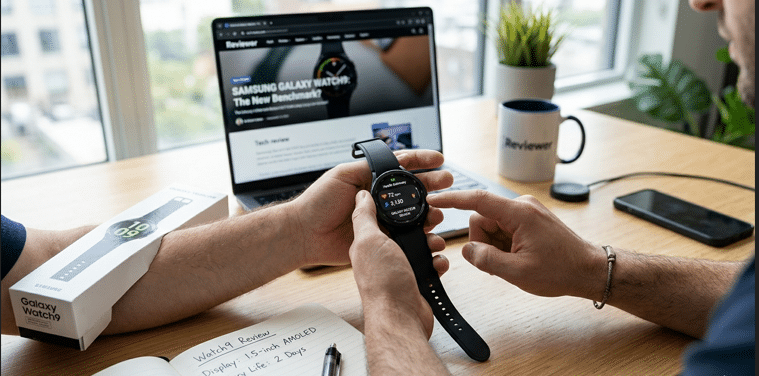
Samsung Galaxy Watch 9 Review:
![Samsung Galaxy Watch9, Graphite, 40mm Bluetooth Smartwatch | AI Assistant, Fitness Tracker, Sleep Coaching and Running Coaching with Heart Rate Tracking [US Version, 2 Yr Warranty]](https://m.media-amazon.com/images/I/31Q6G58gP9L._SL160_._SL160_.jpg)
- TRACK HEALTH PATTERNS¹ IN YOUR SLEEP WITH VITALS²: Stay aware of the subtle changes in your body with Vitals¹–it tracks health metrics while you sleep, catches shifts from your usual patterns, and provides tailored guidance based on the insights.²
- A PERSONALIZED COACH FOR YOUR FITNESS GOALS: Whether you're building endurance for a long trek or training to build muscle, Fitness Index³ delivers tailored guidance based on your fitness level goals. Finally, train smarter with your fitness watch.
- EVERYDAY AI ASSISTANCE, SIMPLIFIED: With the Galaxy Watch9, you can just raise your wrist, start talking naturally and get instant AI assistance⁴—no wake phrase needed. This smart watch won’t slow you down.
- ONE PERSONALIZED SCORE TO KNOW YOUR HEART BETTER: Instead of checking multiple metrics separately, track the single Heart Health Score⁵ based on sleep time, BMI, activity and vascular load to stay aware of your wellness.
- TRACK YOUR NIGHTS. OWN YOUR DAYS: Galaxy Watch9 gives you personalized recommendations and habit-building guidance with Advanced Sleep Coaching.⁶ Plus, Bedtime Guidance⁷ helps you find your optimal bedtime so you can wake up feeling refreshed.

The Honest Verdict Before the Details
The Galaxy Watch 9 is not a dramatic redesign.
It uses the same case dimensions as its predecessor.
The sensor hardware is mostly the same.
Buyers upgrading specifically from the Galaxy Watch 8 will notice the difference primarily in software and in the processor’s responsiveness rather than in anything visible on the outside.
Buyers upgrading from the Galaxy Watch 7 or anything older will notice a much more complete health platform, a significantly faster chip, and a software experience that genuinely earns its description as the best version of Wear OS currently available.
The battery is the one area where the Watch 9 falls short of what its feature set deserves.
The 40mm model will require daily charging for most users who enable sleep tracking.
The 44mm adds a few hours but does not fundamentally change the picture.
Everything else earns its place.
What Is Actually New in the Galaxy Watch 9

The Galaxy Watch 9 launched on August 7, 2026.
Samsung’s approach for this generation was internal rather than external.
The processor changed. The software expanded. The sensor suite added new capabilities. The case did not.
Understanding what is genuinely new separates a useful review from a specification restatement, so each new feature deserves proper explanation rather than a list of marketing names.
Snapdragon Wear Elite: The Processor That Changes How the Watch Feels
The Galaxy Watch 8 used Samsung’s own Exynos W1000 processor.
The Galaxy Watch 9 moves to Qualcomm’s Snapdragon Wear Elite, a 3-nanometre chip with a penta-core configuration running at up to 2.1 GHz.
The practical difference is responsiveness.
Opening apps, navigating menus, loading health data summaries, and responding to Gemini voice queries all happen faster on the Watch 9 than on the Watch 8.
For a device you interact with dozens of times per day in brief glancing interactions, the speed of those interactions accumulates into a meaningfully different daily experience.
The 3nm process also runs more efficiently than the Exynos W1000, which contributes to the Watch 9 extracting more battery life from a physically larger battery cell than the Watch 8 managed with a smaller one.
Vitals: Your Overnight Health Baseline in One Place
Vitals is the new health summary feature and real-world testing described it as the standout addition.
The name is straightforward in a way that Samsung’s health features sometimes are not.
The watch tracks five measurements during sleep every night: heart rate, heart rate variability, respiratory rate, blood oxygen saturation, and skin temperature.
After seven consecutive nights of wearing the watch to bed, it builds a personal baseline for each of those metrics specific to you.
Real-world testing confirmed that Vitals requires seven nights of sleep data before the personalised alerts activate.
Samsung Health version 7.0 or above and Android 13 or above are required for the full Vitals feature set.
From the eighth night onwards, any significant deviation from that personal baseline triggers an alert.
Not a generic alarm comparing your data to population averages.
A specific notification that your respiratory rate was higher than your own normal, or that your HRV dropped below your own typical range, or that your skin temperature was elevated overnight.
The difference between comparing against your own baseline and comparing against a population average is clinically significant.
Population averages reflect other people. Your baseline reflects you.
An elevated resting heart rate that is six beats above your own normal means something different from being six beats above a population average that includes athletes and sedentary individuals simultaneously.
Daily Cardio Load: WHOOP’s Core Feature Without the Subscription
This is the feature that most directly challenges the recovery wearable subscription model.
WHOOP’s entire value proposition is built around monitoring cardiovascular training load and recovery.
You wear the band, it tracks your workout strain and overnight recovery, and it tells you each morning whether your body is ready for intensity or needs rest. WHOOP charges a monthly fee for this service.
The Galaxy Watch 9’s Daily Cardio Load does the same thing.
Independent testing specifically described Daily Cardio Load as Samsung’s answer to WHOOP and other recovery-focused wearables, which put comparable analysis behind a monthly fee.
The difference is that Samsung provides this without any subscription requirement.
It estimates the cardiovascular strain from your recent training by combining heart rate data, workout intensity, and duration.
It assesses overnight recovery from the same HRV and sleep data that Vitals tracks.
Each morning it produces a readiness signal that reflects whether your cardiovascular system has recovered sufficiently to handle training load that day.
For a serious recreational athlete who currently pays for a WHOOP or similar subscription and uses a Samsung phone, this represents a genuine platform consolidation that removes a recurring cost while adding the full smartwatch features that WHOOP cannot provide.
Antioxidant Index: The Feature Almost Nobody Is Explaining Properly
Every Galaxy Watch 9 review mentions the Antioxidant Index.
Almost none of them explain what it actually measures or why it matters.
The measurement takes five seconds. You rest your thumb on the sensor on the back of the watch.
The watch shines light at a specific wavelength into the skin of your finger and measures how much carotenoid is present.
Carotenoids are the pigments found in colourful fruits and vegetables.
Carrots, tomatoes, leafy greens, peppers. When you eat foods rich in carotenoids, your body absorbs them and they deposit in your skin tissue.
The concentration of carotenoids in your skin is a measurable proxy for how much of these antioxidant compounds are present in your system.
The Antioxidant Index uses this measurement to give you a score that reflects your dietary antioxidant intake and your body’s current oxidative stress level.
Oxidative stress rises during intense training, chronic stress, poor sleep, and inflammatory states. Antioxidant compounds from diet counteract it.
The practical application is tracking whether your diet is providing adequate antioxidant support during periods of training load.
If your Cardio Load is high and your Antioxidant Index is low, the data is telling you something specific about the relationship between your training stress and your dietary recovery support.
Hands-on testing confirmed the five-second thumb-scan measurement process and its relationship to dietary and lifestyle antioxidant status.
No other mainstream consumer smartwatch carries this measurement.
Fitness Index: Five Scores That Show Your Overall Physical Fitness
The Fitness Index provides five scores covering different dimensions of physical fitness: aerobic capacity, muscle strength, flexibility, body composition, and endurance.
Together they build a picture of overall fitness level rather than focusing on any single metric.
Real-world testing was honest about the Fitness Index’s current limitation: the scores are interesting but it is not always clear from the watch alone how to improve any specific score.
The data is there. The actionability needs refinement.
Samsung’s five-year software support commitment for the Watch 9 is the reason to be patient with this. Features that launch with limited actionability on day one tend to improve across software updates.
GPS and Workout Tracking:
The dual-band GPS on the Galaxy Watch 9 uses both the L1 and L5 frequency bands simultaneously.
This is the same approach that Garmin uses in their higher-end Forerunner models and that delivers meaningfully more accurate positioning in urban environments where satellite signals reflect from buildings.
Real-world testing described the Watch 9’s automatic workout detection as very good, specifically noting that Pilates sessions were detected and logged without any manual mode selection.
Hands-on testing described it as the best automatic workout detection tested after running it through multiple activity types.
Independent testing confirmed the dual-band GPS accuracy as strong, matching what you would expect from a watch specifically designed for GPS outdoor activities rather than from a smartwatch that has GPS added as a feature.
The Running Coach feature, currently in beta, provides a three to five week guided training programme.
It is a genuine addition rather than a rebranded step counter, though its beta status means it should be treated as a work in progress for the current generation.
Gemini AI: The Assistant That Answers From Your Wrist
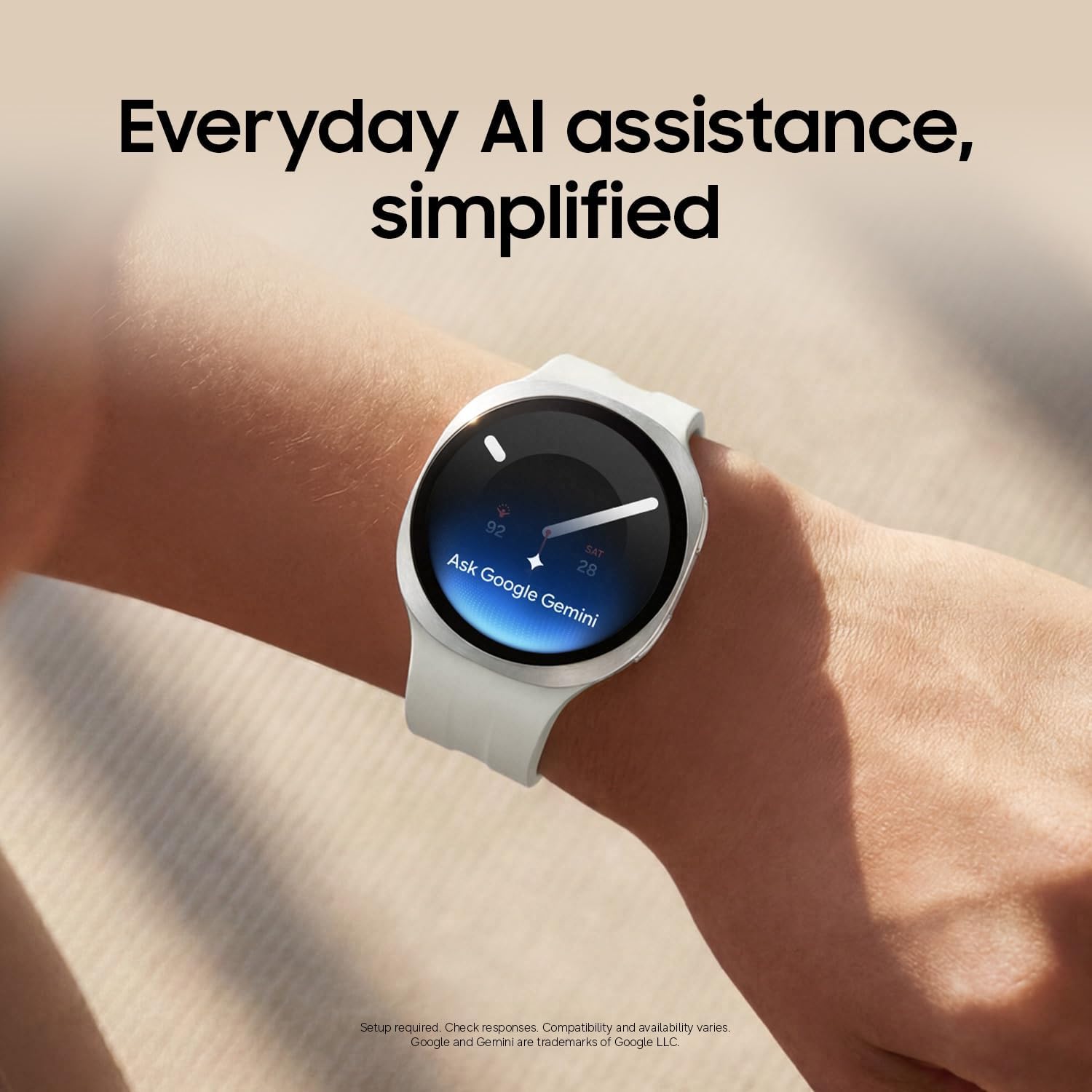
The Galaxy Watch 9 carries native Gemini AI with a raise-to-talk function.
Raising your wrist and speaking activates Gemini directly, without any button press or screen tap.
Ask how your sleep was last night. Ask what your Vitals showed. Ask Gemini to set a reminder. Get a weather update.
The watch responds from the speaker and the answer appears on the display simultaneously.
For a watch you are checking dozens of times per day in brief interactions, voice-first access to information removes the navigation steps that make small displays frustrating for data retrieval.
Rather than finding the right tile, swiping to the right summary, and reading it while squinting, you ask and you hear the answer.
Battery Life: The Honest Assessment
The Galaxy Watch 9’s battery is the one area where every review gives the same honest verdict.
The 40mm model carries a 390mAh battery.
Real-world testing described it as barely lasting through the day with sleep tracking enabled. Extended wear testing reported getting from 7am one morning to mid-afternoon the next before needing to charge.
Hands-on testing confirmed 40 hours with always-on display disabled and 30 hours with it enabled.
For a watch that asks you to wear it to bed for Vitals and sleep coaching data, daily charging during the day rather than nightly becomes the practical routine.
You put the watch on the charger during your morning shower.
You get off the charger with a full charge. You wear it all day and to bed. You charge again during your next morning routine.
This is a manageable routine. It is not a particularly impressive one for a watch launched in 2026, particularly when Amazfit and Garmin offer double-digit day battery life at comparable or lower investment.
The 44mm model with its 445mAh battery adds a few hours to these figures but does not fundamentally change the charging relationship.
Charging from zero takes approximately 90 minutes at 10W wireless.
This is slower than Apple’s fast charging and notably slower than the Pixel Watch 4’s 15-minute top-up capability.
For buyers who are particularly sensitive to charging speed, this is a real limitation.
Design, Build and One Important Limitation
The Galaxy Watch 9 uses the same case design as the Galaxy Watch 8. The dimensions are the same. The visual identity is the same. Buyers who found the Watch 8 design attractive will find the Watch 9 equally so.
Buyers who were hoping for a visual refresh will not find one here.
The 40mm model is specifically proportioned for smaller wrists.
Independent testing noted it is clearly tailored toward women in terms of case dimensions.
The 44mm model suits the average male wrist more proportionally.
The Dynamic Lug system is worth noting honestly. It provides a convenient quick-release mechanism for strap changes. It also means only Samsung-compatible straps with the Dynamic Lug connector are compatible.
Standard 20mm straps from any manufacturer, which fit dozens of other smartwatches at this size, do not attach to the Watch 9.
If you enjoy changing straps regularly or want access to the widest possible range of strap options, this is a meaningful limitation compared to watches with standard lug widths.
The watch is MIL-STD-810H tested, IP68 rated, and 5ATM water resistant. It handles daily wearing in all conditions including swimming without concern.
The Dynamic Lug system is worth noting honestly. It provides a convenient quick-release mechanism for strap changes.
It also means only Samsung-compatible straps with the Dynamic Lug connector are compatible. Standard 20mm straps from any manufacturer, which fit dozens of other smartwatches at this size, do not attach to the Watch 9.
If you enjoy changing straps regularly or want access to the widest possible range of strap options, this is a meaningful limitation compared to watches with standard lug widths.
The watch is MIL-STD-810H tested, IP68 rated, and 5ATM water resistant. It handles daily wearing in all conditions including swimming without concern.
Galaxy Watch 9 vs Galaxy Watch 8: Should You Upgrade?
| Feature | Galaxy Watch 8 | Galaxy Watch 9 |
|---|---|---|
| Processor | Exynos W1000 | Snapdragon Wear Elite 3nm |
| Battery 40mm | 325mAh | 390mAh |
| Battery 44mm | 425mAh | 445mAh |
| Vitals | No | Yes |
| Daily Cardio Load | No | Yes |
| Antioxidant Index | No | Yes |
| Fitness Index | No | Yes |
| Running Coach | No | Yes (beta) |
| Bluetooth | 5.3 | 6.0 |
| OS | Wear OS 6 | Wear OS 7 |
| Software support | 4 years | 5 years |
| Display | Same | Same |
| Design | Same | Same |
| GPS | Dual-band | Dual-band |
Independent analysis was direct: the Galaxy Watch 9 is hard to recommend over its predecessor specifically for existing Watch 8 owners because the processor and new health features do not justify the upgrade cost for someone who already has the Watch 8 platform.
For buyers upgrading from the Watch 7, Watch 6, or any older Galaxy Watch, the Watch 9 is the right destination.
For buyers choosing between the Watch 8 and Watch 9 as a first Samsung smartwatch or a fresh purchase, the Watch 9 is the correct choice because it carries the current platform and will receive software updates for five years.
For a closer look at how the full Samsung Galaxy Watch lineup compares across all current models including the Galaxy Watch FE and Galaxy Watch Ultra 2, the full guide at best-samsung-wearables covers the Samsung wearable ecosystem in detail.
Who Should Buy the Galaxy Watch 9
You use a Samsung Galaxy phone and want the deepest Samsung Health integration. You track your training seriously and want WHOOP-equivalent recovery analysis without a subscription. You want the best Wear OS experience currently available with five years of guaranteed software updates. You specifically value the Antioxidant Index as a dietary monitoring tool. You are upgrading from any Samsung Galaxy Watch older than the Watch 8.
Who Should Not Buy the Galaxy Watch 9
You own a Galaxy Watch 8 already — the upgrade case is weak and the new features do not justify it. You want multi-day battery life — the Garmin Vivoactive 6 or Amazfit Active 2 deliver that where the Watch 9 cannot. You use an iPhone — Apple Watch SE 3 is the right choice for iOS households. You want unrestricted strap compatibility — the Dynamic Lug system limits you to Samsung-compatible straps.
For a broader look at how the Galaxy Watch 9 compares against the Google Pixel Watch 5 and Apple Watch Series 11 across health monitoring, safety features, and everyday usability, the full guide at best-smartwatches-under-300 covers the full Android and iOS smartwatch category in detail.
Specifications
| Feature | Galaxy Watch 9 (40mm) | Galaxy Watch 9 (44mm) |
|---|---|---|
| ASIN Bluetooth | B0H9BPZXZC (Graphite), B0H1DG7XRW (Cream) | B0H9B66J2R (Silver LTE) |
| Display | 1.34″ AMOLED, 3000 nits | 1.47″ AMOLED, 3000 nits |
| Processor | Snapdragon Wear Elite, 3nm | Same |
| RAM/Storage | 2GB RAM, 32GB | Same |
| Battery | 390mAh, 40hrs (AOD off) | 445mAh, ~45hrs (AOD off) |
| Charging | 10W wireless, 90 minutes | Same |
| OS | Wear OS 7, One UI Watch 9 | Same |
| Software support | 5 years | Same |
| GPS | Dual-band L1+L5 | Same |
| Bluetooth | 6.0 | Same |
| Health | Vitals, Cardio Load, Antioxidant Index, Fitness Index, ECG, BP, Sleep Apnea | Same |
| AI | Gemini, raise-to-talk | Same |
| Water | 5ATM, IP68 | Same |
| Military | MIL-STD-810H | Same |
| Straps | Dynamic Lug, proprietary | Same |
| Launched | August 7, 2026 | Same |
FAQs
Does the Samsung Galaxy Watch 9 work with non-Samsung Android phones?
Yes, the Galaxy Watch 9 pairs with any Android phone running Android 13 or above through the Galaxy Wearable app. Basic functions including notifications, workout tracking, GPS, and most Samsung Health features work across all compatible Android phones. The features that require a Samsung Galaxy phone specifically are ECG, blood pressure monitoring, sleep apnea detection, and some advanced health alerts. Confirmed testing showed that Samsung lists these features as requiring Samsung phone pairing specifically. For non-Samsung Android users who want the full feature set without restriction, the Google Pixel Watch 5 or the Garmin Vivoactive 6 provide platforms that do not restrict features based on phone manufacturer. For iPhone users, the Apple Watch SE 3 is the appropriate choice as no Galaxy Watch provides meaningful iPhone integration.
What is the Antioxidant Index on the Galaxy Watch 9 and how does it work?
The Antioxidant Index measures the concentration of carotenoids in your skin. Carotenoids are pigment compounds found naturally in colourful fruits and vegetables including carrots, tomatoes, spinach, and peppers. When you consume these foods, your body absorbs and deposits carotenoids into skin tissue. The Galaxy Watch 9 shines a specific wavelength of light from its BioActive sensor into your thumb skin for five seconds during the measurement. The sensor reads how much light is reflected or absorbed based on the carotenoid concentration present. A higher score indicates more carotenoids and therefore better dietary antioxidant intake. A lower score suggests the opposite. The practical application is using the measurement alongside your Daily Cardio Load to understand whether your diet is providing adequate antioxidant support relative to your training intensity. Hands-on testing confirmed the five-second thumb-scan measurement process and its relationship to dietary and lifestyle antioxidant status.
Is the Samsung Galaxy Watch 9 worth buying in 2026 if you already own a Galaxy Watch 8?
Based on multiple independent hands-on reviews, the Galaxy Watch 9 is not a compelling upgrade specifically for Galaxy Watch 8 owners. Independent testing described it as hard to recommend over its predecessor for existing Watch 8 owners given the similar design, similar sensors, and price increase. The new features — Vitals, Daily Cardio Load, Antioxidant Index, Fitness Index — are meaningful additions but do not represent a sufficiently dramatic platform change to justify upgrading from a Watch 8 that is functioning well. Samsung may extend some of the new health software features to the Watch 8 through updates, as Samsung Health updates have previously brought new capabilities to older hardware. The Galaxy Watch 9 makes a strong case for new buyers, buyers upgrading from Watch 7 or older, and buyers switching from non-Samsung Android smartwatches. It makes a weaker case for Watch 8 owners specifically. The American Heart Association provides consumer guidance on wearable health technology at heart.org.
Luis Cooper

Hi, I'm Luis, the guy behind this site. I love wearing watches, especially ones that look great on small wrists (mine are about 6.3" around). The Watches Geek is dedicated to helping you learn about and buy watches that you will love wearing. I want this website to be the last destination for people to pick the best watches to fit their needs. You can find our unbiased reviews here on Thewatchesgeek.