
Last Updated on October 12, 2026 by Luis Cooper
I have owned both.
I owned a Garmin Forerunner for three years, then an Apple Watch for eighteen months, then went back to Garmin.
The question I get asked most often by people looking for their first serious smartwatch is not which specific model to buy — it is which brand makes sense for them at all.
This article answers that question.
Before comparing anything else, there is one decision that most comparison articles bury at the end when it should be stated at the beginning.
If you use an iPhone, both brands work.
If you use an Android phone, only Garmin works.
Apple Watch pairs exclusively with iPhone. Garmin watches pair with both iOS and Android.
This single fact eliminates the Apple Watch as an option for every Android user before any other consideration matters.
If you use a Samsung Galaxy, a Google Pixel, or any other Android phone, Garmin is your brand, and you can skip directly to the Garmin section below.
If you use an iPhone, the comparison is genuinely interesting and worth reading in full.
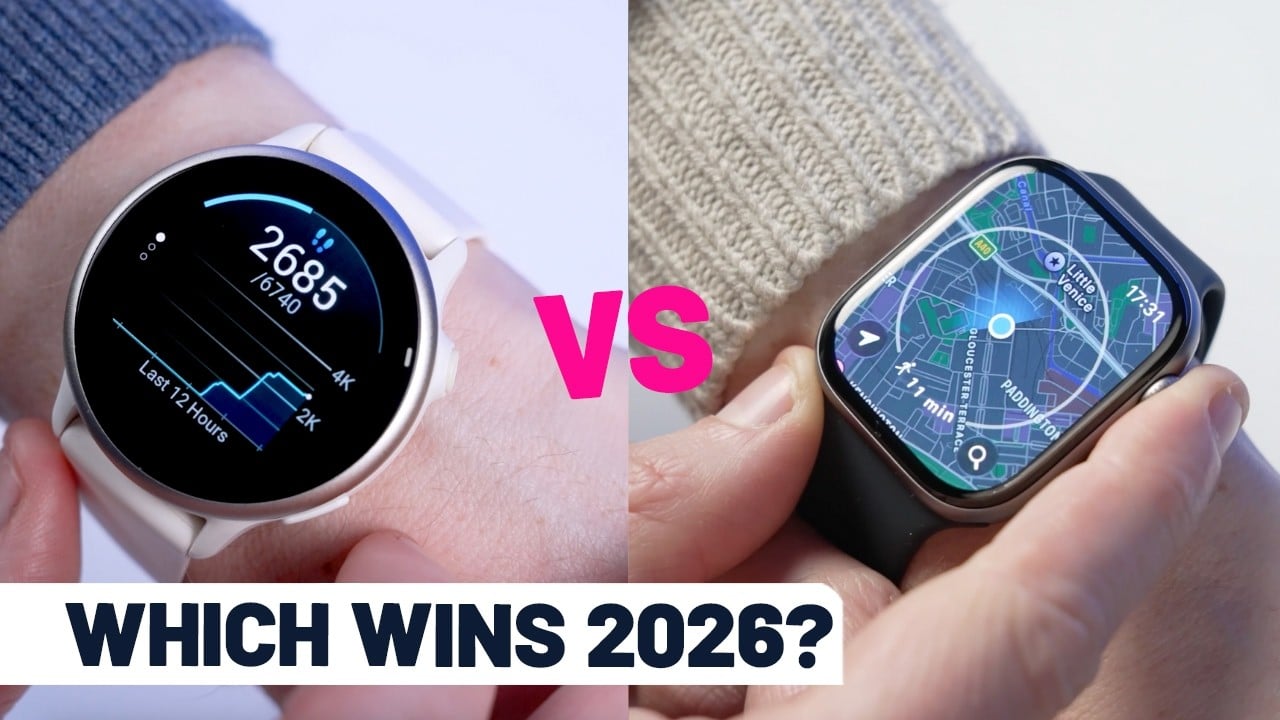
Garmin vs Apple Watch in 2026:
The Brands and What They Stand For:
These two companies built fundamentally different products for fundamentally different people, and understanding that difference prevents the most common smartwatch buying mistake—choosing a watch built for someone else’s life.
Apple built the Apple Watch as an extension of the iPhone.
Everything about it assumes you have an iPhone in your pocket.
Notifications, health data storage, app installation, payment, Siri, emergency features — all of it flows through the iPhone.
At its best, the Apple Watch is the most elegant and capable iPhone accessory ever made.
It is not trying to be an independent athletic computer on your wrist.
It is trying to make your iPhone experience richer and more accessible from your wrist.
Garmin built its watches as standalone athletic instruments.
The watches sync data and receive notifications from smartphones, but they don’t depend on proximity to a phone for their core functions.
A Garmin on a mountain trail, even without your phone nearby, continues to track GPS, log the hike, measure your heart rate, and forecast the weather using barometric pressure.
It does this for days on a single charge.
That independence is deliberate.
Pete Matheson, who wore both an Apple Watch and a Garmin for a full year and documented the comparison, described it this way: one watch acts like a tiny phone, and the other acts like a tough coach. Both descriptions are accurate.
Garmin’s Watch Lineup — Which Model for Which Person
Garmin makes more watch models than Apple does, which can feel overwhelming at first but makes sense once you understand its approach.
Different athletes have different needs, and Garmin built specific watches for them.
1. Garmin Venu 4:
- Smaller-sized smartwatch with a bright, colorful display, stainless steel design, and built-in flashlight; up to 10 days of battery life gives a more complete picture of your health
- Make improvements to promote a healthier lifestyle and know your body better with extensive health monitoring features, including wrist-based heart rate, Body Battery energy monitoring, fitness age, stress tracking, meditation and more (device data presented is intended to be a close estimation of metrics tracked)
- Get a sleep score and personalized sleep coaching, including recommendations for how much sleep you need, tips on how to improve, alignment on your inner sleep cycle by using circadian rhythm and more; breathing variations feature uses Pulse Ox to check your level of variations while sleeping (this is not a medical device, and device data presented is intended to be a close estimation of metrics tracked; Pulse Ox is required and not available in all countries)
- The health status feature looks for changes in your health data that could indicate added stress to your body for key metrics such as heart rate, HRV, skin temperature and more, which could be related to factors such as physical activity, potential illness or other health changes (device data presented is intended to be a close estimation of metrics tracked)
- Log custom or preset daily behaviors — such as caffeine and alcohol intake — and view reports in the Garmin Connect smartphone app on how lifestyle choices may impact your sleep, stress and HRV to help you make more health-conscious decisions (device data presented is intended to be a close estimation of metrics tracked)

Garmin’s lifestyle smartwatch.
41mm AMOLED case, 10-day battery, LED flashlight, Garmin Pay, and offline music.
This Garmin most directly competes with the Apple Watch Series 11 for daily wear by active, health-conscious users.
Tom’s Guide tested the Garmin Venu 4 head-to-head against the Apple Watch Ultra 3 across a 7,500-step walk and found both watches within 100 steps of the actual count, with the Venu 4 marginally closer.
2. Garmin Forerunner 570:

- Our brightest AMOLED touchscreen display with button controls and an aluminum bezel in 42 mm size to fit smaller wrists
- Up to 10 days of battery life in smartwatch mode and up to 18 hours in GPS mode for a more complete picture of your training and recovery
- Train for an event, achieve a milestone, or improve your fitness with Garmin Coach training plans; these running and triathlon plans are personalized to you and adapt based on your performance and recovery
- Training readiness score is based on sleep quality, recovery, training load and HRV status to determine if you’re primed to go hard and get the most out of your workout (data presented is intended to be a close estimation of metrics tracked)
- Built-in microphone and speaker let you make and take phone calls from your wrist when your watch is paired to your smartphone — and you can even use your smartphone’s voice assistant to respond to text messages and more
Dedicated running watches with AMOLED displays. Training Readiness, Daily Suggested Workouts, VO2 max, race prediction.
For runners who want data-driven coaching without the expense of the Fenix 8.
3. Garmin Instinct 3:

- Make a bold statement with this rugged GPS smartwatch, featuring a vibrant 1.2” AMOLED display and up to 18 days of battery life
- Engineered with a supertough 45 mm fiber-reinforced polymer case and metal-reinforced bezel
- Built-in LED flashlight with variable intensities and strobe modes gives you greater visibility in the outdoors and provides convenient illumination when you need it
- Know your body better with health monitoring features, including wrist-based heart rate, advanced sleep monitoring, Pulse Ox and more (this is not a medical device, and data presented is intended to be a close estimation of metrics tracked; Pulse Ox not available in all countries)
- Navigate confidently with a 3-axis compass, barometric altimeter and multi-band GPS with SatIQ technology, which delivers superior positioning while also optimizing battery life
Rugged outdoor watch with up to 18 days of battery on solar charging.
MIL-STD-810 rated. For hikers, hunters, and outdoor professionals who need a watch that survives the environment.
4. Garmin Fenix 8:

- Advanced multisport GPS smartwatch for athletes/adventurers features a bright 1.3” AMOLED display, stainless steel bezel, enhanced graphical interface and a built-in LED flashlight for after- dark visibility
- Power up your body’s performance, endurance and resistance to injury with targeted strength training plans, real-time stamina tracking, sport-specific workouts and a full range of built-in sports apps
- Battery performance: up to 10 days in smartwatch mode; up to 28 hours in GPS mode
- Your training readiness score is based on sleep quality, recovery, training load and HRV status to determine if you’re primed to go hard and reap the rewards (data presented is intended to be a close estimation of metrics tracked)
- For your active lifestyle, a built-in speaker and mic let you make and take phone calls from your wrist when your watch is paired to your smartphone — and you can even use your smartphone’s voice assistant to respond to text messages and more
Garmin’s premium flagship.
Preloaded topo maps, built-in LED flashlight, speaker and microphone, multi-band dual-frequency GPS, 18+ days of battery life.
For serious outdoor athletes and professionals who want everything in one device.
Apple Watch Lineup — Which Model for Which Person
Apple currently offers three Apple Watch lines, each with a clear position.
1. Apple Watch SE 3:
![Apple Watch SE 3 [GPS 44mm] Smartwatch with Midnight Aluminum Case with Midnight Sport Band - M/L. Fitness and Sleep Trackers, Heart Rate Monitor, Always-On Display, Water Resistant](https://m.media-amazon.com/images/I/41IZwhp9VXL._SL160_._SL160_.jpg)
- GET SMARTER HEALTH INSIGHTS—Apple Watch SE 3 is an advanced health tracker that helps you better understand your body. The smartwatch sends alerts for an irregular heart rhythm, or an unusually high or low heart rate.* You can view your overnight health tracking metrics with the Vitals app,* track your sleep score, and get sleep apnea notifications.*
- A GREAT FITNESS TRACKER—SE 3 can track your workouts in a healthy number of ways—from running and strength training to simply achieving your 10K steps a day. With real-time metrics and Workout Buddy powered by Apple Intelligence from your nearby iPhone,* you’ll hit your goals like never before.
- KEEP HELP CLOSE AT HAND—SE 3 is a smartwatch that can detect a hard fall or severe car crash and automatically help connect you to emergency services and notify your emergency contacts.* Check In can automatically notify a loved one when you’ve arrived at your destination.
- WOMEN’S HEALTH INSIGHTS—SE 3 has advanced sensors that track your wrist temperature while you sleep. With this smartwatch, you can log your periods and symptoms, get period predictions, and get notified of cycle deviations.*
- GREAT BATTERY LIFE AND FASTER CHARGING—Enjoy a smartwatch with all-day, 18-hour battery life* from sunup to sundown. Then charge up to twice as fast as SE 2* and get up to 8 hours of battery in just 15 minutes.*
Apple’s entry-level watch.
Full watchOS, activity tracking, heart rate monitoring, fall detection, crash detection, and emergency SOS.
No ECG, no always-on display, no ultra-brightness.
For iPhone users who want the Apple Watch experience without the premium price.
2. Apple Watch Series 11:
![Apple Watch Series 11 [GPS 46mm] Smartwatch with Jet Black Aluminum Case with Black Sport Band - M/L. Sleep Score, Fitness Tracker, Health Monitoring, Always-On Display, Water Resistant](https://m.media-amazon.com/images/I/416RQ0rtsUL._SL160_._SL160_.jpg)
- A FULL-FEATURED HEALTH TRACKER—Apple Watch Series 11 gives you invaluable insights about your body, right from your wrist. Take an ECG anytime* and get alerts for a high and low heart rate or an irregular rhythm*—so you can stay closer to your heart. You can also view your overnight health tracking metrics with the Vitals app* and be notified of possible sleep apnea.*
- KNOW YOUR SLEEP SCORE—With advanced sleep tracking, Series 11 gives you a daily sleep score. It’s an easy way to help measure and understand the quality of your sleep, so you can make it more restorative.
- GET HYPERTENSION NOTIFICATIONS—Did you know that Series 11 can spot signs of chronic high blood pressure? By analyzing how your blood vessels respond to beats of the heart, it can notify you of possible hypertension.*
- SAFETY FEATURES—A smartwatch that puts your safety first. Series 11 can detect a hard fall or severe car crash, automatically help connect you with emergency services, and notify your emergency contacts.* Check In can automatically notify a loved one when you’ve arrived at your destination.
- A POWERFUL FITNESS TRACKER—With advanced metrics and motivating features like Pacer, Heart Rate Zones, training load, and Workout Buddy powered by Apple Intelligence from your nearby iPhone*—Series 11 is made to help everyone stay active, from runners and hikers to strength-training enthusiasts.
The mainstream flagship.
ECG, always-on OLED at 2000 nits, hypertension detection, crash and fall detection, dual-frequency GPS.
For most iPhone users, this is the right answer.
3. Apple Watch Ultra 3:
![Apple Watch Ultra 3 [GPS + Cellular 49mm] Running & Multisport Smartwatch w/Rugged Titanium Case w/Black Ocean Band. Satellite Communications, Advanced Health & Fitness Tracking](https://m.media-amazon.com/images/I/41H6S7vjc+L._SL160_.jpg)
- RUGGED AND READY TO GO—The ultimate sports and adventure smartwatch is built to last with an extremely tough titanium case and a strong sapphire crystal display. Water resistant up to 100m—it’s great for swimmers, divers, and fans of high-speed water sports.*
- A FULL-FEATURED HEALTH TRACKER—Ultra 3 can take an ECG* and check your heart rhythm for signs of AFib—right from your wrist. The smartwatch sends alerts for possible hypertension,* an irregular heart rhythm,* or an unusually high or low heart rate. You can view your overnight health tracking metrics with the Vitals app,* track your sleep score, and take readings of your blood oxygen.*
- ULTIMATE RUNNING AND WORKOUT COMPANION—A superior fitness tracker for marathoners, triathletes, mountain bikers, backcountry hikers, and mountain climbers, Ultra 3 provides precision dual-frequency GPS, Pacer, Heart Rate Zones, Custom Workouts, running power, Workout Buddy powered by Apple Intelligence from your nearby iPhone,* training load, and more.
- KEEP HELP CLOSE AT HAND—Ultra 3 is a smartwatch that can detect a hard fall or severe car crash* and automatically help connect you to emergency services and notify your emergency contacts. Check In can automatically notify a loved one when you’ve arrived at your destination.
- MULTIDAY BATTERY LIFE—Ultra 3 is a smartwatch that’s engineered to give you even longer battery life. It’s perfect for trail runners—with up to 42 hours of normal use and up to 72 hours in Low Power Mode.* Track a workout with full GPS and heart rate monitoring for up to 20 hours in Low Power Mode.*
Apple’s outdoor and athletic flagship.
49mm titanium case, 60-meter water resistance, satellite emergency SOS, 3000-nit display, dual-frequency GPS, 36-hour battery, LED siren.
For iPhone users who work outdoors, train in remote areas, or want Apple’s most capable watch, regardless of price.
Head-to-Head: 7 Categories Compared
1. Design and Daily Wearing Comfort:
Apple Watch design divides people cleanly.
The rectangular case with rounded corners is instantly recognizable and has been refined over eleven generations to a finish most watch reviewers consistently describe as premium.
It reads correctly in professional environments, formal settings, and everyday casual wear without adjustment.
Tom’s Guide awarded Apple the design category in their direct 2025 comparison.
Garmin’s design range is wider and more varied.
The round cases of the Instinct, Venu, and Forerunner lines read like traditional watches and sit proportionally on most wrists.
The Fenix 8 and Tactix read as serious outdoor equipment — clearly appropriate for field use, less so for formal professional settings.
The Venu 4 is the Garmin that most commonly crosses into professional daily wear without comment.
Weight is comparable across both brands. Both offer silicone, textile, and metal strap options.
Thanks to the QuickFit system, you can also swap out straps without tools, allowing more interchangeability.
Winner: Apple for aesthetics in professional and social contexts. Garmin for functional design across athletic and outdoor use.
2. Display Quality:
Tom’s Guide tested the Garmin Venu 4 and multiple Apple Watch models and gave Apple the display category overall.
The Apple Watch Series 11’s 1.8-inch OLED is larger than any Garmin display in the same price bracket, and the Apple Watch Ultra 3’s 3000-nit display is the brightest of any Apple Watch.
The Garmin Fenix 8 and Venu 4 both use AMOLED panels that are excellent in their own right.
Garmin’s transflective MIP displays on the Instinct and some Forerunner models are designed for outdoor readability in direct sunlight—different technology, but genuinely superior to AMOLED in that specific condition.
In dense mountain sunlight, a Garmin Instinct’s MIP display requires no wrist adjustment, whereas an AMOLED watch requires deliberate viewing-angle management.
Winner: Apple on AMOLED display quality at comparable prices. Garmin’s MIP displays well specifically in direct outdoor sunlight.
3. Battery Life — Garmin Wins Clearly:
This is where the gap is the largest and most practically meaningful.
Apple Watch Series 11: 18 to 24 hours in the real world. Daily charging is required for most users.
Apple Watch Ultra 3: 36-60 hours. Every one to two days.
Garmin Venu 4: 10 days smartwatch mode.
Garmin Forerunner 265: 11 days in smartwatch mode.
Garmin Instinct 3: 18 days in smartwatch mode; unlimited with solar in direct outdoor use.
Garmin Fenix 8: 18 days in smartwatch mode, up to 149 hours of GPS with solar.
Tom’s Guide’s Dan Bracaglia, who has been testing smartwatches for over fifteen years and reviews them professionally for Tom’s Guide, noted in the Venu 4 vs Apple Watch Ultra 3 test that the Apple Watch Ultra 3 used only 1 percent of its GPS battery on a 7,500-step walk compared to 5 percent for the Venu 4 — meaning in this specific test,
Apple was actually more battery efficient.
But this reflects a short walk.
Over days and weeks, Garmin’s longer battery life means charging every 10 days rather than every day for Apple users.
Over a year of wearing, Apple Watch users charge their watch approximately 365 times. Garmin Forerunner 265 users charge approximately 33 times.
This compounds into a meaningfully different daily experience.
Winner: Garmin by a significant margin at every price point.
4. Fitness and Training Analytics — Garmin Wins for Athletes
Tom’s Guide awarded Garmin the fitness category in their direct brand comparison, describing Garmin’s toolkit as more extensive and precise than Apple’s for athletic performance.
Garmin’s athletic features unavailable on Apple Watch:
Body Battery:
Synthesizes overnight HRV, sleep quality, stress, and daily activity into a real-time energy level from 0 to 100, updating throughout the day.
Training Readiness:
Each morning, a score reflecting whether the body is ready for hard training or needs recovery, based on sleep quality, recent training load, and HRV trends.
Training Load:
Tracks cumulative training stress across the week, distinguishing between aerobic base building and high-intensity load.
Daily Suggested Workouts:
Adapts each day’s recommended session based on current fitness and fatigue.
Over weeks, this builds a personalized training plan that responds to how your body is actually recovering.
Running Power:
Wrist-based power measurement during runs without additional sensors.
80 plus activity profiles
Compared to Apple Watch’s 25 basic modes, Garmin distinguishes between backcountry and resort snowboarding, multiple swimming stroke types, and triathlon transitions.
GPS accuracy for runners:
Tom’s Guide’s Nick Harris-Fry ran a half marathon with the Apple Watch Ultra 3 and Garmin Forerunner 970. Garmin recorded 13.15 miles, and Apple recorded 13.22 miles against the official 13.1-mile distance, making Garmin marginally more accurate.
The5krunner, an independent endurance sports publication that has tested GPS watches for twenty years, described the Garmin Forerunner 970’s GPS track as the best they’ve seen in ten years on their standard testing course.
Winner: Garmin is clearly for any runner, cyclist, triathlete, or outdoor athlete training with purpose. The Apple Watch covers basic fitness and general activity tracking well but doesn’t match Garmin’s athletic depth.
5. Health Monitoring — Apple Wins for Specific Features
Tom’s Guide awarded Apple the health-monitoring category, specifically citing crash detection, fall detection, and hypertension detection as features that set it apart from Garmin.
Apple Watch advantages:
Hypertension detection monitors heart patterns over 30 days and alerts the wearer if patterns suggest possible hypertension — a proactive cardiovascular screening feature not available on Garmin watches.
Crash detection automatically contacts emergency services if the wearer is incapacitated in a vehicle collision without any user interaction.
Fall detection does the same for hard falls. Both features run passively at all times.
ECG on Apple Watch has been through more regulatory scrutiny across more product generations than Garmin’s equivalent, and Sportskeeda Tech found Apple Watch delivers slightly more accurate heart rate tracking at rest and during intense exercise.
Garmin advantages:
Garmin offers more detailed sleep staging, including Nightly Recharge overnight HRV analysis.
The Garmin Fenix 8 and some Forerunner models include an Orthostatic Test that measures HRV in both supine and standing positions for clinical-level autonomic nervous system assessment.
Winner: Apple for safety-oriented passive monitoring. Garmin for deep sleep and recovery analytics.
6. Smart Features and Daily Usability — Apple Wins
Apple Watch is the better daily smartwatch for iPhone users, and Tom’s Guide awarded Apple this category without reservation.
The integration between Apple Watch and iPhone is the deepest of any smartwatch-phone pairing available.
Notifications arrive instantly and reliably.
Siri responds from the wrist for most practical tasks.
Apple Pay works consistently.
Every iOS app that has a companion Apple Watch app connects seamlessly.
The App Store provides thousands of watch apps.
The interface requires almost no learning for anyone who already uses an iPhone.
Garmin’s smart features are intentionally more limited.
Notifications arrive from the phone but are read-only on most Garmin models.
Replies are limited to preset options.
There is no app store equivalent to the Apple Watch’s ecosystem. Garmin Pay is available on some models but covers fewer retailers.
The interface rewards the time invested in learning it, but it has a steeper learning curve than the Apple Watch.
Winner: Apple for daily smartwatch use and iPhone integration.
&. Durability and Outdoor Reliability — Garmin Wins
Garmin’s MIL-STD-810 military-standard certification across the Instinct, Fenix, and Tactix lines covers temperature extremes, shock, vibration, and humidity under tested conditions.
The Fenix 8 handles 10 ATM water pressure.
The Instinct 3 Solar maintains GPS tracking indefinitely in direct outdoor sunlight.
Apple Watch Ultra 3 is Apple’s most durable model with Grade 5 titanium and 60-meter water resistance.
It is genuinely rugged for a consumer smartwatch.
The standard Series 11 is 50-meter swimproof and built to withstand daily active use, but it lacks military standard certification.
For outdoor professionals, construction workers, search-and-rescue personnel, and extreme-sport athletes, Garmin’s long-term durability credentials are more extensive.
Winner: Garmin across the range. Apple Watch Ultra 3 competes at the top end.
Pros and Cons
Garmin
Pros
- A multi-day to multi-week battery removes daily charging entirely from the equation.
- Training Readiness, Body Battery, and Daily Suggested Workouts provide athletic coaching depth Apple hasn’t matched.
- Compatible with both iOS and Android — works regardless of which phone is in your pocket.
- MIL-STD-810 durability on outdoor models withstands conditions that consumer smartwatches typically can’t.
- GPS accuracy on running and cycling is marginally more precise than Apple in independent testing by Tom’s Guide and The5krunner.
- No ecosystem lock-in — switching phones does not require switching watches.
Cons
- Smart features are limited compared to Apple Watch — notification management is basic, no app store equivalent.
- Interface has a steeper learning curve, especially on Fenix and Instinct models.
- No crash detection or fall detection — passive emergency alerting is absent across the range.
- No hypertension detection available on any current Garmin model.
- Garmin Pay is available on fewer models and retailers than Apple Pay.
- Apple Watch iOS integration is not replicable through Garmin on iPhone
Apple Watch
Pros
- Crash detection and fall detection provide automatic emergency alerting that no Garmin currently offers.
- Hypertension detection after 30 days of continuous monitoring provides proactive cardiovascular screening unique in the mainstream smartwatch market.
- iPhone integration is the deepest of any watch-phone combination available, covering notifications, payments, calls, Siri, and the App Store.
- Slightly more accurate heart rate at rest and during exercise per Sportskeeda Tech’s independent testing.
- Fast charging goes from 0% to 80% in about 45 minutes.
- Regular watchOS updates confirmed across current models — Series 11 confirmed for watchOS 27.
Cons
- 18- to 24-hour real-world battery life requires daily charging for most users, interrupting overnight sleep tracking.
- iPhone only — Android users cannot use any Apple Watch.
- No Training Readiness, Body Battery, or Garmin’s athletic coaching platform.
- No standalone operation — most features require iPhone proximity.
- Apple’s update support history is unpredictable — Series 8, Ultra 1, and SE 2 all dropped from watchOS 27 in June 2026 after two major update cycles.
Who Should Buy Garmin:
Buy any Garmin watch if you use an Android phone.
This is non-negotiable — Apple Watch does not work with Android.
Buy Garmin if you are a runner, cyclist, swimmer, or triathlete training toward performance goals.
The training analytics platform is the most developed available from a consumer wearable at any price.
Buy Garmin if daily charging genuinely creates friction in your life and you want a watch that is reliably charged when you put it on every morning.
Buy Garmin if you work outdoors, participate in outdoor sports, or need a watch that survives demanding physical environments across years of wearing.
Buy Garmin if you want a watch that works correctly whether you use an iPhone today or an Android phone in two years, with no transition cost.
For a detailed look at how Garmin’s top models compare in outdoor GPS navigation, the full comparison at best-gps-watches-for-hunting covers Garmin’s outdoor GPS platform in demanding field use.
Who Should Buy an Apple Watch:
Buy the Apple Watch Series 11 if you use an iPhone and want the best daily smartwatch experience available.
The integration, safety features, and ecosystem depth are unmatched on iPhone.
Buy it if passive safety monitoring is a specific priority.
Crash detection and fall detection run continuously for solo drivers, lone workers, and solo outdoor users, without any user action.
Buy it if hypertension detection matters — thirty days of continuous monitoring catches patterns that infrequent manual BP checks miss entirely.
Buy the Apple Watch Ultra 3 if you use an iPhone and work in genuinely remote outdoor environments where satellite emergency communication could matter. It is the only consumer smartwatch with satellite SOS.
Buy the Apple Watch SE 3 if you want the Apple Watch platform and core health monitoring at the lowest entry price.
For a more detailed comparison of how the Apple Watch Series 11 stacks up against Samsung’s best Android watch across health features, display, and battery, the full head-to-head review at samsung-galaxy-watch-8-vs-apple-watch-series-11 covers both platforms in depth.
Head-to-Head Summary
| Category | Winner |
|---|---|
| Price and value | Garmin |
| Design and aesthetics | Apple |
| Display quality | Apple |
| Battery life | Garmin clearly |
| Fitness and training | Garmin clearly |
| Health monitoring | Apple |
| Smart features | Apple |
| Durability | Garmin |
| Android compatibility | Garmin only |
| iPhone integration | Apple only |
FAQs:
Is Garmin better than Apple Watch for running?
For serious runners training toward specific performance goals, Garmin is better. Tom’s Guide’s Nick Harris-Fry ran a half marathon with the Garmin Forerunner 970 and Apple Watch Ultra 3 simultaneously. The Garmin recorded 13.15 miles versus the Apple Watch’s 13.22 miles against the official 13.1-mile distance, making Garmin marginally more accurate. The5krunner, an independent GPS testing publication with twenty years of testing experience, described the Forerunner 970’s GPS track in that same test as the best they had seen in a decade on their standard course. Beyond GPS accuracy, Garmin’s Training Readiness, Body Battery, Daily Suggested Workouts, and running power analysis are specifically designed for runners managing training load and recovery across weeks and months of preparation. Apple Watch provides solid GPS and heart rate tracking for recreational runners who run by feel, but it lacks the coaching analytics depth Garmin offers for structured training.
Can I use a Garmin watch with my iPhone?
Yes. All Garmin watches are compatible with iPhone through the Garmin Connect app, available on the App Store. Pairing a Garmin to an iPhone works the same way as pairing to an Android phone — download Garmin Connect, follow the pairing instructions, and the watch syncs health data, receives notifications, and accesses all Garmin Connect features. Some functions that depend on the phone’s operating system, such as sending replies to messages, may have slightly different behaviour on iOS versus Android, but core fitness tracking, GPS, health monitoring, and Garmin Connect data sync all work correctly on iPhone. This means Garmin is the only brand on this list that genuinely works regardless of which phone is in your pocket.
Should I switch from Apple Watch to Garmin for better fitness tracking?
If you run, cycle, swim, or train seriously toward athletic goals, it’s worth considering the switch. Garmin’s training analytics platform that Garmin provides —Training Readiness, Body Battery, Daily Suggested Workouts, and multi-sport depth—isn’t available on Apple Watch at any price. Pete Matheson, who documented a full year wearing both and published his conclusions, found that Garmin provided better fitness-coaching data, longer battery life, and better athletic GPS performance, while Apple Watch offered better smart features and iOS integration. He concluded that if fitness and health tracking are your primary reasons for owning a smartwatch, a Garmin will likely suit you better than an Apple Watch. If smart features, iPhone integration, and daily smartwatch utility are the priority, Apple Watch is the better choice. The American College of Sports Medicine provides research-based guidance on using wearable technology for fitness monitoring at acsm.org.
Related Articles:
Apple Watch Series 12 vs Samsung Galaxy Watch 9
Luis Cooper

Hi, I'm Luis, the guy behind this site. I love wearing watches, especially ones that look great on small wrists (mine are about 6.3" around). The Watches Geek is dedicated to helping you learn about and buy watches that you will love wearing. I want this website to be the last destination for people to pick the best watches to fit their needs. You can find our unbiased reviews here on Thewatchesgeek.