
Last Updated on August 3, 2026 by Luis Cooper
Some watches are designed by committee.
You can tell because they have a feature for everything and do nothing particularly well.
The Amazfit Balance 3 is the opposite.
Amazfit made a deliberate choice about who this watch is for and built everything around that person.
The result is a watch that does what a specific kind of buyer needs better than almost anything else at its price, and that combination of clarity and execution is why it deserves a serious look in 2026.
That buyer is someone who trains with a mix of strength work and endurance, who wants their watch to understand both disciplines rather than being built for one and tolerating the other, who is frustrated by daily charging on their current Apple Watch or Samsung Galaxy Watch, and who wants the analytical depth of a Garmin platform without paying Garmin flagship prices.
If that description fits you, read every section of this review before buying.
If it does not fit you, this review will save you time by telling you that early.
Before getting into the detail, a note on how this review was put together.
The Amazfit Balance 3 launched on June 2, 2026. This review draws on four independent hands-on tests published after launch: Gadgets and Wearables’ three-week review by Marko Maslakovic (fifteen-plus years testing wearables), NSF Technology’s month-long daily use report including a head-to-head GPS comparison against a Garmin Forerunner, Yahoo Tech’s real-world battery testing, and the Orkio aggregated review summary covering multiple independent video testers.
Amazfit Balance 3 Review 2026

- DUAL-BAND GPS & OFFLINE MAPS: Navigate confidently with dual-band positioning and six satellite systems. Use offline maps, turn-by-turn navigation, and automatic rerouting to stay on track without your phone.
- 21-DAY BATTERY: Get up to 21 days of battery life on a single charge, and never worry about forgetting your charger on trips. Enjoy long battery life performance from work, to workouts, to weekend trips.
- AMOLED SCREEN & BUILT-IN FLASHLIGHT: A large 1.5" AMOLED screen protected by sapphire glass is easy to read in bright daylight or night. Stay safe and visible in low-light conditions with the built-in white or tactical red flashlight.
- NO SUBSCRIPTION APP: Health, recovery, and workout data is free to access in the included Zepp App. Track calories and protein goals.
- APP CONNECTIONS & HYROX TRAINING: Use fitness apps like Strava, TrainingPeaks, Intervals.ICU to share workouts. Improve HYROX training with built-in HYROX training plans and Virtual Pace simulations.

Before You Buy: The Two Questions That Matter Most
Question one: Do you have smaller wrists?
The Balance 3 comes in a 48mm case. That sounds manageable but the actual wearing diameter is closer to 51.4mm measured across the widest point. At 14.6mm thick including the heart rate sensor bump on the back, this is a genuinely large watch. NSF Technology’s reviewer, who described having smaller wrists, specifically flagged this as something to check before buying rather than assuming size from a specification sheet. If you are currently wearing a 40mm or 42mm watch comfortably, trying the Balance 3 on before purchasing is worth the effort. If you are regularly wearing 45mm and above without issue, the Balance 3 will feel proportional.
Question two: Do you primarily want a smartwatch or a sports watch?
Gadgets and Wearables’ review put this most plainly after three weeks of daily use: the main limitation is app depth. The Balance 3 does not provide an Apple Watch or Wear OS experience. It handles the useful smartwatch functions adequately — notifications, Bluetooth calling, music playback — but you will not be installing third-party apps from a full app store. The real reason to buy the Balance 3 is the fitness package, the battery life, and the large screen. If those three things align with your priorities, the Balance 3 is one of the strongest options in its price range right now.
Design and Build: Premium Materials, Four Buttons, and a Flashlight
The Balance 3 comes in two material options that look similar from a distance but wear differently on the wrist.
The stainless steel version at 62 grams provides the premium feel and visual weight of metal.
The titanium version at 55 grams drops seven grams from that weight, which is not enormous in isolation but is noticeable across a full day of wearing, particularly during workouts where the watch is moving with your arm.
The Orkio review summary specifically noted the titanium bezel and sapphire glass combination as providing a “premium, resilient design” that surprised reviewers given the watch’s positioning against mainstream competitors.
The sapphire crystal glass protecting the 1.5-inch AMOLED display is the same material that Apple uses on the Apple Watch Ultra 3 and that Garmin uses on its premium Fenix and MARQ lines.
Most competing watches in this price range use mineral glass or Gorilla Glass.
Sapphire is harder than either and accumulates micro-scratches at a significantly slower rate across daily wearing, equipment contact, and desk work.
Over six months or a year of daily wearing, a sapphire crystal display stays optically clearer than mineral glass alternatives.
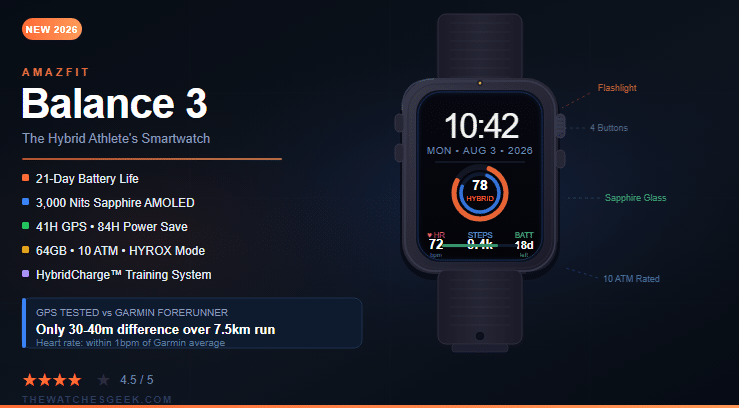
The four-button layout is the design change that looks most interesting in photographs and feels most significant in actual use.
Two buttons on the right — a rotating crown on top and a flat button below — handle navigation and back functions.
Two new buttons on the left handle workout-specific shortcuts.
Gadgets and Wearables, after testing this during actual workouts, described the four-button layout as making sense specifically in exercise context.
The reason is straightforward: during an outdoor run when your hands are sweaty, when it is raining, or when you need to pause a session quickly, four physical buttons provide reliable control that touchscreens cannot guarantee under the same conditions.
Touchscreens are excellent until you need them urgently and your fingers are not dry.
The built-in LED flashlight on the Balance 3 is a practical addition that the Balance 2 lacked entirely.
It covers the pre-dawn run starts, post-sunset finishes, and dark-environment navigation that active people encounter regularly without needing to carry a separate light.
The 1.5-inch AMOLED display at 480 by 480 pixel resolution reaches 3,000 nits peak brightness — 50 percent brighter than the Balance 2’s screen.
The number matters specifically for outdoor training use.
A display that reads clearly on a summer afternoon trail run or a bright urban cycling route is genuinely more useful as a training tool than one you have to shade with your free hand to confirm your current pace.
Reviewers across multiple tests described the display as one of the Balance 3’s clearest strengths, with the Gadgets and Wearables review specifically noting that the screen has enough real estate to keep maps readable during navigation.
The screen size also matters practically for the 64GB offline map storage the Balance 3 carries.
Downloading maps for upcoming routes is only useful if the map displays at a resolution where you can actually make navigation decisions from a moving wrist.
The Balance 3’s combination of physical screen size, brightness, and resolution makes it specifically better as a navigation device than smaller watches with comparable storage.
HybridCharge: The New Feature That Explains the Watch’s Name

Every Amazfit watch for the past several years has tracked recovery and readiness.
What the Balance 3 introduces differently is HybridCharge — an energy monitoring system that specifically accounts for strength training load alongside endurance training load in a way that previous Amazfit tracking did not.
The reason this matters is how strength and endurance training interact physiologically.
A hard leg day in the gym creates muscle damage and metabolic stress that affects your cardiovascular training capacity for forty-eight hours or more, even if your resting heart rate has recovered.
A simple readiness score built entirely from overnight HRV and sleep data misses this load because it is looking at cardiovascular recovery rather than neuromuscular recovery.
HybridCharge attempts to bridge this by incorporating strength session data into the recovery calculation alongside endurance load and sleep quality.
The Lim Reviews assessment, aggregated by Orkio, described HybridCharge as functioning similarly to Garmin’s Body Battery but with a specific additional dimension for hybrid training.
Gadgets and Wearables described it as one of the two features Amazfit is leaning on hardest to differentiate the Balance 3 from competitors and from previous generations of Amazfit watches.
The PAI (Personal Activity Intelligence) score runs alongside HybridCharge, providing a weekly activity target that adapts to the individual wearer’s cardiovascular response data rather than applying generic step or calorie targets.
In practical terms, a hybrid athlete coming off a heavy strength session should see this reflected in their HybridCharge readiness score even if their overnight heart rate data looked clean — which represents a more honest picture of actual recovery status than a score built only from sleep and HRV would provide.
GPS and Sports Tracking: The Garmin Comparison That Actually Tells You Something

The most useful GPS accuracy test in any Amazfit review is a head-to-head comparison against Garmin, because Garmin is the reference that most buyers considering the Balance 3 are using to calibrate whether to spend more.
NSF Technology ran that comparison during a 7.5-kilometre outdoor run in hot conditions.
The Balance 3 tracked the route within approximately 30 metres of the Garmin Forerunner’s total distance.
Gadgets and Wearables ran the same head-to-head test and reported a 40-metre difference across their session.
Neither reviewer described the difference as meaningful for practical training use — a 30-to-40-metre gap over 7.5 kilometres represents an error rate of roughly 0.4 to 0.5 per cent, which does not materially affect pace calculation, training load assessment, or route recording quality.
Heart rate accuracy in the same Gadgets and Wearables test showed: Garmin clocked an average of 133 beats per minute with a session maximum of 147.
The Amazfit Balance 3 recorded 132 beats per minute average and 147 maximum.
One beat per minute difference in average, identical maximum.
That is a result close enough that the difference is practically invisible in any training context, including high-intensity interval sessions where optical heart rate sensors are most challenged.
The GPS endurance figures deserve specific attention.
The Balance 3 provides 41 hours in accuracy GPS mode — the mode that uses dual-band GPS from six satellite systems and provides the route accuracy confirmed in the head-to-head tests above. In power-saving GPS mode, this extends to 84 hours.
That 84-hour figure means a watch that can track continuous outdoor activities across three and a half days without charging.
For ultra-endurance athletes — trail runners completing multi-day events, cyclists on long-distance challenges, or hikers covering extended routes — 84 hours of GPS recording on a single charge is a practically significant capability that most competing smartwatches cannot match.
The 180-plus sports modes include the official HYROX training and competition integration that Amazfit maintains through its partnership with the sport’s governing body.
The HYROX modes cover structured training plans, race simulations, and pace guidance specific to the hybrid functional fitness competition format.
For the growing community of HYROX athletes, finding this depth of integration on a watch under four hundred dollars rather than on Garmin’s flagship tier is the specific purchase reason that many buyers cite.
The 25 auto-recognised strength exercises handle gym sessions without manual mode selection.
The watch identifies the movement, counts reps, tracks sets, and logs rest periods.
For buyers who currently manually log every gym exercise either in an app or on the watch itself, this automation removes the most friction-generating part of gym tracking.
Health Monitoring: Sleep, Stress, and the Sensors Behind the Data
The BioTracker sensor platform inside the Balance 3 monitors heart rate continuously twenty-four hours a day, blood oxygen saturation, skin temperature, stress levels from HRV patterns during waking hours, breathing rate during sleep, and the aggregate sleep staging — time in light, deep, and REM sleep — that the Balance series has refined across three generations.
Lim Reviews confirmed sleep accuracy as consistent across multiple nights of testing, describing the detailed sleep analysis as matching their subjective experience of sleep quality reliably.
The Balance 3’s sleep tracking adds specific focus on recovery quality rather than simply time in bed — the distinction between eight hours of poor-quality fragmented sleep and seven hours of consolidated deep sleep is something the platform attempts to surface in its morning readiness assessment alongside the HybridCharge score.
Stress monitoring uses HRV measurement during the day, flagging periods of elevated stress response and providing breathing exercises directly from the watch interface when stress levels are sustained.
For buyers who use their watch primarily during work hours alongside training, the continuous stress monitoring provides the context that explains the relationship between working day stress load and training readiness — a connection that most athletes who have trained seriously and experienced the effect of a high-pressure work week on subsequent workout quality will recognise immediately when they see it represented in data.
Battery Life: The 21-Day Claim Put to Real Use

Amazfit rates the Balance 3 at 21 days under typical use. Yahoo Tech’s real-world testing translated this to not thinking about the charger for well over a week at a time under active daily use, including regular GPS tracking, workout sessions, and constant notification handling.
NSF Technology described the battery as “comfortably lasting over a week” under heavier use that included workouts, GPS, and notifications running constantly.
The distinction between the specification and these real-world results is worth understanding clearly.
Twenty-one days is the figure under typical use, which Amazfit defines as specific usage parameters that most active users exceed through more frequent GPS sessions and always-on display preferences.
The honest expectation for a buyer who runs several times per week with GPS active, trains daily with heart rate tracking, and keeps notifications running throughout the day is somewhere between ten days and two weeks between charges.
That range still represents a fundamentally different charging relationship from Apple Watch and Samsung Galaxy Watch alternatives that require charging every one to two days.
The 658mAh battery inside the Balance 3 is a physically larger cell than the Balance 2 carried, and the GPS efficiency improvement — 41 hours accuracy mode versus the Balance 2’s 33 hours — reflects both the larger battery and improved GPS chipset efficiency in the Balance 3 generation.
Smart Features: What the Balance 3 Does Beyond Training

Bluetooth calling through the dual speakers works correctly for brief practical communication.
Gadgets and Wearables noted that the touchscreen struggles during sweaty or wet conditions — which is the specific context where the four physical buttons earn their presence as the reliable backup input method during calls received mid-workout.
The 64GB of onboard storage handles music for extended workout sessions without phone connectivity, offline maps for routes covering far more terrain than users are likely to encounter in a single session, and watch face and application data without the storage management that 32GB and smaller alternatives require.
Music plays through connected Bluetooth earbuds, and the Balance 3 controls playback from the wrist.
Offline maps with turn-by-turn navigation and automatic rerouting when the user diverges from a planned route provide the navigation independence from a phone that trail runners and cyclists specifically want.
The Lim Reviews assessment confirmed that the watch serves as a phone-free GPS navigation device during outdoor activities, with the six-satellite dual-band positioning providing fast acquisition and reliable tracking.
NFC contactless payment is supported in regions where Amazfit has established bank partnerships, covering the tap-to-pay functionality at supported retailers without requiring the phone.
Balance 3 vs Balance 2: Is the Upgrade Worth It?
| Feature | Balance 2 | Balance 3 |
|---|---|---|
| Case | 47mm, 35g | 48mm, 62g (SS) / 55g (Ti) |
| Display brightness | AMOLED | AMOLED, 3,000 nits (50% brighter) |
| GPS accuracy mode | 33 hours | 41 hours |
| GPS power saving mode | 67 hours | 84 hours |
| Storage | 32GB | 64GB |
| Sports modes | 170 plus | 180 plus |
| Buttons | 2 | 4 (2 new left) |
| Flashlight | No | Yes |
| Training system | Standard readiness | HybridCharge Energy Intelligence |
| Golf courses | 40,000 maps | Improved routing |
For current Balance 2 owners: the meaningful upgrades are GPS endurance (41 versus 33 hours, and 84 versus 67 in power-saving mode), double the storage, the four-button layout that specifically helps during active use, the flashlight, and HybridCharge’s hybrid training load integration.
If GPS endurance during longer events and the HybridCharge system are relevant to your training, the Balance 3 is a meaningful upgrade.
If you primarily track standard workouts and the Balance 2’s battery life is already more than sufficient for your routine, the upgrade is less urgent.
For new buyers choosing between them: buy the Balance 3.
It is the current generation with the current platform, and the specific improvements — GPS endurance, storage, button layout, and training intelligence — are in the categories that matter most for the kind of buyer this watch targets.
Balance 3 vs Garmin Venu 4: Who Should Buy Which
Buyers who are comparing these two specifically deserve a direct answer rather than a comparison that hedges the conclusion.
Choose the Balance 3 if GPS battery endurance is a priority — 41 hours versus the Venu 4’s standard GPS endurance gives the Balance 3 a meaningful advantage for longer activities.
Choose the Balance 3 if you train for HYROX events or compete in functional fitness formats where the Balance 3’s official partnership provides training plan and race simulation integration the Venu 4 does not have.
Choose the Balance 3 if storing more offline music and maps without management is important — 64GB versus the Venu 4’s smaller storage.
Choose the Garmin Venu 4 if the Garmin Connect ecosystem and training analytics platform — Training Readiness, Training Load, Body Battery, and the accumulated community of Garmin users sharing routes and workout data — is something you specifically want access to.
Choose the Garmin Venu 4 if you are already in the Garmin ecosystem with a Garmin Forerunner or Fenix and want platform continuity.
The Garmin platform’s depth in training analytics has been developed over years and represents a genuine advantage for buyers who will engage with it thoroughly.
For a deeper look at how the Garmin Venu 4 and Garmin’s training analytics platform perform across specific training goals, the full guide at best-garmin-watches-for-interval-training covers the Garmin platform in detail.
Full Specifications
| Feature | Details |
|---|---|
| ASIN Stainless Steel | B0H383F5QN |
| ASIN Titanium | B0H388XWPW |
| Case | 48mm (51.4mm diameter) |
| Case material | Stainless steel (62g) or titanium (55g) |
| Thickness | 14.6mm including HR sensor |
| Display | 1.5-inch AMOLED, 480×480, 3,000 nits peak |
| Glass | Sapphire crystal |
| Battery | 658mAh, rated 21 days typical |
| GPS accuracy mode | 41 hours |
| GPS power saving mode | 84 hours |
| Charging | Proprietary magnetic cradle |
| Sensor | BioTracker (heart rate, SpO2, stress, skin temperature) |
| GPS | Dual-band, 6 satellite systems |
| Storage | 64GB |
| Water resistance | 10 ATM, 45m dive certified |
| Sports modes | 180 plus |
| Special modes | HYROX Race and Training, Scuba, Golf |
| Buttons | 4 total: rotating crown, back (right), 2 new (left) |
| Flashlight | Built-in LED |
| Audio | Bluetooth calling, music playback |
| Payments | NFC in supported regions |
| Maps | Offline with turn-by-turn, automatic rerouting |
| Compatibility | iOS and Android |
| Launch | June 2, 2026 |
Final Verdict
The Amazfit Balance 3 is the clearest expression of what Amazfit has been building toward across the Balance series. The original Balance established the platform and the 14-day battery as the headline specification. The Balance 2 upgraded the sensor, the display, and the water resistance. The Balance 3 takes those foundations and adds the features that specifically serve the hybrid athlete who the entire platform was designed for: the four-button layout that works during actual exercise rather than just menu navigation, HybridCharge that accounts for strength training in recovery scoring, 84 hours of power-saving GPS for multi-day events, a flashlight for low-light training, and 64GB for all the maps and music that training across multiple disciplines requires.
What makes the verdict straightforward is how well the real-world test results align with the specifications. Two independent GPS comparisons against Garmin showed accuracy within 30 to 40 metres over 7.5 kilometres and heart rate tracking within one beat per minute. These are not specification sheet claims. They are measured results from testers who ran with both watches simultaneously and compared the outputs. The Balance 3 is not almost as good as Garmin GPS. It is within measurement noise of Garmin GPS at a price that is consistently lower.
The specific buyer who should not consider the Balance 3 is anyone who needs the Garmin Connect ecosystem specifically, wants third-party app installation, needs LTE cellular independence, or has wrists below 6.5 inches. For everyone else fitting the hybrid athlete profile — people training across strength and endurance, frustrated by daily charging, wanting GPS accuracy without Garmin pricing, and needing a watch that works as well with sweaty hands as it does in a meeting — the Balance 3 is the most focused and well-executed option at its price in 2026.
For a broader look at how Amazfit’s health tracking platform compares across the full category of recovery-focused smartwatches including dedicated fitness trackers, the full comparison at best-smartwatches-for-monitoring-stress covers the recovery monitoring category in depth.
FAQs
Is the Amazfit Balance 3 worth buying over the Amazfit Balance 2 in 2026?
For anyone buying new, the Balance 3 is the correct choice. The improvements are across the specific areas that matter most for the target buyer: GPS endurance increased from 33 to 41 hours in accuracy mode and from 67 to 84 hours in power-saving mode, storage doubled from 32GB to 64GB, the button layout expanded from two to four specifically improving workout usability when touchscreen reliability drops during sweaty or wet conditions, the display brightness increased by 50 percent to 3,000 nits for better outdoor readability, and HybridCharge replaces the previous readiness system with one that specifically accounts for strength training load alongside endurance and sleep data. The Balance 3 Stainless Steel is available on Amazon. For existing Balance 2 owners, the upgrade decision depends on whether GPS endurance during longer events and HybridCharge’s hybrid training integration are active priorities for their current training. If they are not, the Balance 2 continues to perform correctly and the upgrade is less urgent.
How does the Amazfit Balance 3 compare to the Apple Watch Series 11 for fitness tracking?
They serve the same user in genuinely different ways and choosing between them depends on which priorities matter more. The Balance 3 provides significantly longer battery life — a week or more of heavy use versus the Apple Watch’s 18-hour standard battery requiring daily charging. The Balance 3’s GPS accuracy tested within 30 to 40 metres of a Garmin Forerunner in independent tests, while Apple Watch GPS provides strong accuracy within the Apple ecosystem but without the equivalent endurance for multi-hour outdoor sessions. The Balance 3’s HYROX integration, 180-plus sports modes including scuba, and 84-hour power-saving GPS are specifically relevant for outdoor and hybrid athletic use that the Apple Watch’s platform does not match in depth. The Apple Watch Series 11 wins clearly in smartwatch breadth — the full app ecosystem, cellular calling independent of the phone, Apple Health integration with iOS health records, and fall detection and crash detection safety features that the Balance 3 does not carry. For iPhone users whose primary need is a smartwatch that also handles fitness tracking, the Apple Watch Series 11 is the better choice. For users whose primary need is a serious fitness tracking and training platform with multi-week battery life, and who are comfortable with a more limited smartwatch feature set, the Balance 3 delivers that combination more completely. The Federal Trade Commission provides consumer guidance on evaluating smartwatch features and fitness claims at ftc.gov.
What is HybridCharge and is it actually useful or just marketing?
HybridCharge is Amazfit’s energy monitoring system that tracks your physical capacity across both strength training and endurance training simultaneously, then produces a readiness score and daily energy guidance based on the combined load. The distinction from a standard recovery score — which most smartwatches calculate from overnight HRV and sleep data alone — is that HybridCharge accounts for the muscle damage and neuromuscular fatigue that a heavy gym session creates, even when your cardiovascular data shows clean overnight recovery. A person who did heavy squats and deadlifts on Monday may have perfect HRV and sleep data on Tuesday morning but still have compromised performance capacity because the muscles used in those exercises have not fully recovered. HybridCharge attempts to reflect this in the readiness score rather than ignoring the strength training load entirely. Independent reviewers including the Orkio-aggregated Lim Reviews assessment described HybridCharge as accurately assessing readiness to train by integrating sleep, stress, and activity data. Whether it is useful depends entirely on how you train: if your routine combines regular strength sessions with endurance training and you find that standard readiness scores regularly overestimate your actual recovery capacity on the day after heavy gym work, HybridCharge addresses that specific gap. If you primarily run or cycle without regular strength training, a standard readiness score would produce equally accurate guidance for your routine.
Luis Cooper

Hi, I'm Luis, the guy behind this site. I love wearing watches, especially ones that look great on small wrists (mine are about 6.3" around). The Watches Geek is dedicated to helping you learn about and buy watches that you will love wearing. I want this website to be the last destination for people to pick the best watches to fit their needs. You can find our unbiased reviews here on Thewatchesgeek.