
Last Updated on June 22, 2026 by Luis Cooper
For six years, Whoop owned the screenless fitness tracker category alone.
If you wanted a distraction-free band that tracked your health around the clock without interrupting you with a glowing display, your only real option was Whoop and its annual subscription commitment.
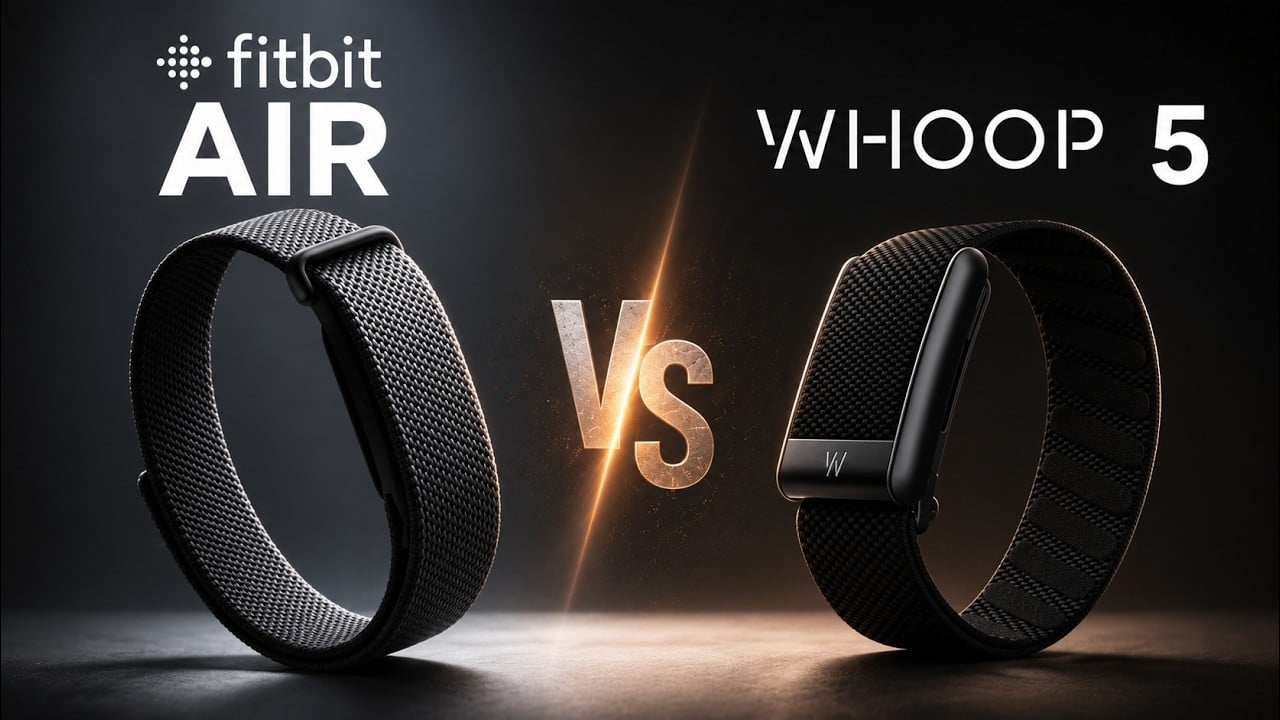
Then in May 2026, Google launched the Fitbit Air and changed the conversation entirely.
Two wrist-worn bands with no screens.
Both continuously track heart rate, sleep, and recovery.
Both connect to your phone for all the data.
Both are available on Amazon right now.
But they are built on completely different philosophies about who should be tracking this closely, what data actually matters, and how much it should cost.
Before looking at either watch in detail, one reassuring thing is worth knowing. Both the Fitbit Air and Whoop 5.0 are compatible with both iOS and Android.
This comparison does not come down to the phone platform.
It comes down to how seriously you train, how deep into your health data you want to go, and which cost model works for how you actually use devices.
Here is what I found.
The One Sentence Summary:
Tom’s Guide, after testing both simultaneously, described the difference in a single sentence: the Fitbit Air is built to help you stay well over time, while Whoop is built to help you train at your peak.
That sentence is the entire article compressed to its essential point.
If you are a recreational exerciser, a parent, or someone who wants to understand their sleep and stress patterns without becoming an amateur performance analyst, the Fitbit Air covers your requirements.
If you are a competitive athlete, a serious endurance runner, or someone who already tracks training load and wants deeper recovery data to guide daily decisions, Whoop provides that platform in a way the Fitbit Air does not.
Fitbit Air vs Whoop 5.0:
1. Fitbit Air: Full Review

- Google Fitbit Air is the unbelievably comfortable, exceptionally smart way to transform your health[1]; and Google Health brings together effortless tracking and adaptive coaching to help make the most of your everyday[2]
- Unlock more with Google Health Premium: With a premium membership, get personalized coaching that’s built with Gemini and adapts to your life[2]; get a 3-month trial at no cost to you[5] (Google Health Premium subscription sold separately)
- Comfortable fit - One Size Tracker (130-210 mm): The lightweight, micro-adjustable fit sits comfortably and quietly, so you can wear Google Fitbit Air through work, play, and sleep; advanced sensors and new algorithms power more accurate, precise health tracking, 24/7[1]
- Designed for every occasion: With no screen to distract you or disrupt your style, your tracker moves seamlessly from bracelet to workout band to sleep band, and you can change looks in seconds – just press the pebble in, click, and go
- Long battery life: Google Fitbit Air’s battery lasts up to a week, and fast charging gets you one day of battery life in just five minutes[6,7]

The Problem Google Solved:
A secondary school teacher who described her relationship with her phone as already too all-consuming took a Fitbit Inspire 3 off her wrist and replaced it with the Fitbit Air the day it arrived.
She had worn fitness trackers for years but found the notification vibrations and display glances pulling her attention during lessons and family time in ways she was trying specifically to reduce.
The Fitbit Air on her wrist collected data without interrupting anything.
She checked her sleep score in the morning when she wanted to.
She checked her stress chart in the evening when she had a moment.
The rest of the time, the tracker was invisible.
She described it as the first wearable she had owned where the technology served her schedule rather than competing with it.
Design:
The Fitbit Air is genuinely small.
The sensor module weighs 5.2 grams — the total with the band is 12 grams.
To put that in context, a standard house key weighs approximately 25 grams. The Fitbit Air on the wrist is lighter than most jewellery.
Tom’s Guide’s Dan Bracaglia, who reviewed it in depth, noted it weighs roughly five times less than the Whoop 5.0 band.
The pebble-shaped sensor sits in a soft band available in an Active Band silicone version for workouts and an Elevated Modern Band fabric version for daily wear and sleep.
The Performance Loop Band uses recycled materials for its hook-and-loop fastening. Available colours include Berry, Porcelain, and Obsidian.
The design was teased through a Stephen Curry partnership before launch — the marketing angle was deliberate, positioning the Fitbit Air as a screenless tracker that ordinary people could access without the Whoop commitment.
Platform:
The Fitbit Air launched alongside a significant platform change. Google rebranded the Fitbit app as Google Health on May 19, 2026 — the same week the Fitbit Air launched.
The Google Health app on both iOS and Android receives all the tracker’s data.
The Gemini-powered Health Coach, which had been in public beta with approximately 500,000 participants since October 2025, left beta with the Fitbit Air launch and is now available to every Fitbit Air user.
The free tier provides access to your health data — sleep summary, activity totals, heart rate trends, Daily Readiness score, and Cardio Load — in the Google Health app.
An optional Google Health Premium subscription unlocks personalized AI-backed insights, deeper trend analysis, and Health Coach guidance.
Health Features:
The Fitbit Air continuously tracks heart rate every 2 seconds.
Sleep stages are analyzed each night and presented as a Sleep Score, with a breakdown of time spent in light, deep, and REM sleep, along with consistency and restoration metrics.
Daily Readiness score synthesizes overnight heart rate variability and sleep quality into a morning number indicating how hard you can push that day.
Cardio Load reflects cumulative cardiovascular stress from recent activity.
Stress is scored on a 0-100 scale based on heart rate, sleep quality, and activity patterns.
What the Fitbit Air lacks is the EDA (electro-dermal activity) sensor that the Fitbit Sense 2 and Charge 6 include.
kygo.app’s comparison noted this specifically — neither the Fitbit Air nor the Whoop 5.0 uses EDA for stress detection, which is notable given that more expensive Fitbit models do.
Battery and Charging:
Tom’s Guide confirmed up to seven days of battery life in real-world testing.
The charge process requires removing the tracker from the wrist and placing it on a magnetic charging cable.
The5krunner flagged this as a real limitation for a device whose primary appeal is uninterrupted 24/7 data collection — removing it to charge creates a gap in the overnight dataset if charging coincides with sleep.
In practice, seven days of battery means most users can charge during a morning shower or weekend morning without interrupting overnight data collection.
Who Should Not Buy the Fitbit Air:
If you are a competitive athlete or do seriously structured training — running specific race times, managing training load across a season — the Fitbit Air’s platform is not built for that level of depth.
The Whoop 5.0’s Strain and Recovery scoring, with its proprietary training load analytics, is a more developed platform for that use case.
If you want to wear the tracker on your bicep, calf, or inside athletic clothing rather than the wrist, the Fitbit Air is wrist-only.
If you do intense cold-weather workouts with gloves on and want maximum HR accuracy, Whoop’s on-body flexibility gives you better sensor placement options.
Fitbit Air Specifications:
| Feature | Details |
|---|---|
| Sensor Weight | 5.2g |
| Total Weight | 12g with band |
| Battery | Up to 7 days |
| HR Sampling | Every 2 seconds |
| Water Resistance | 164 feet (50m) |
| Charging | Remove from wrist, magnetic cable |
| Wear Position | Wrist only |
| Health Features | Heart rate, sleep stages, Daily Readiness, Cardio Load, stress score |
| AI Platform | Google Health + Gemini Health Coach |
| Compatibility | iOS and Android |
| Colors | Berry, Porcelain, Obsidian |
2. Whoop 5.0: Full Review

- What’s Included: You only pay for your 12-month WHOOP Peak membership. Your WHOOP 5.0 device is included at no additional cost, along with a SuperKnit band and Waterproof Wireless PowerPack.
- HSA/FSA Eligible: All 12-month WHOOP memberships and battery packs are HSA and FSA eligible and qualify for HSA/FSA reimbursement. Use your HSA or FSA funds by submitting your receipt for reimbursement as a pre-tax qualified purchase.
- AI Coach & Personalized Coaching: In the WHOOP app, WHOOP AI acts as your personal coach, turning 140+ health and fitness metrics into insights on what to do next. Track 160+ daily behaviors in the WHOOP Journal to see how your habits impact your sleep, recovery, and health, and get personalized AI coaching that adapts to you.
- Track Your Age with Healthspan: See how your daily habits impact your long-term health and how your body is aging. WHOOP Healthspan analyzes 9 key health metrics to calculate your WHOOP Age and Pace of Aging, showing whether your body is aging faster or slower than your chronological age. Get science-backed insights to understand healthy aging, improve longevity, and extend your performance for years to come.
- Sleep Tracker for Better Sleep: WHOOP's lightweight, comfortable and screenless design allows for all night sleep tracking, including REM sleep, deep sleep, light sleep, awake time, sleep need, sleep debt, sleep consistency, and sleep efficiency. See how daily habits like training, alcohol, and travel affect your sleep and how your sleep impacts your Recovery, with personalized recommendations to help you build better sleep habits. Daily WHOOP wear is linked to 2.3 more hours of sleep per week.
Who Whoop Is For:
A marathon runner who has competed at club level for four years described switching from a Garmin watch to Whoop 5.0 as the most significant change in his training approach since hiring a running coach.
He had been managing training load by feel and by schedule.
The Whoop Strain score — a number from zero to twenty-one reflecting the cardiovascular stress his body had absorbed across the previous twenty-four hours — gave him a daily measurement that replaced the guesswork.
He described specific training weeks where the Strain score told him to reduce intensity on days he felt fine and push harder on days he felt tired, and found his performance consistently better when he followed the data rather than his instinct.
He described it as having a coach’s perspective on his own physiology without having a coach present.
What Whoop Does Differently:
The Whoop 5.0 is built around a concept that the Fitbit Air’s platform approximates but does not match in depth: the training-recovery loop.
Every day produces two scores.
The Strain score reflects how hard the previous day was on your cardiovascular system, accounting for all activity, including walking, stress, and poor sleep, alongside intentional workouts.
The Recovery score synthesizes overnight heart rate variability, resting heart rate, sleep performance, and respiratory rate into a percentage from 0 to 100 that indicates whether today is a green, yellow, or red training day.
The platform behind these scores is built on data from serious athletes across a decade of development.
Tom’s Guide noted that Whoop members who dig into the data consistently find the platform’s ceiling is significantly higher than the Fitbit Air’s — Advanced Labs, ECG for higher-tier subscribers, and the proprietary algorithm that connects behaviour patterns to recovery outcomes represent a depth of athletic health analytics that Google Health has not yet matched.
Design and Sensor:
The Whoop 5.0 tracking module measures 1.37 by 0.94 by 0.42 inches.
The SuperKnit band is designed for extended continuous wearing.
Whoop’s testing has shown that users can wear it for weeks without skin irritation, and the material holds up to sweat, gym use, and daily life.
Yahoo Tech described the band as comfortable for weeks of wear but noted it detracted from a dressed-up appearance in social settings.
The sensor can be worn on the wrist, the bicep, the calf, or inside compatible clothing.
This flexibility matters for specific sports where wrist placement creates accuracy problems — cycling with aero bars, gymnastics, climbing, contact sports, and any activity where the wrist sensor is displaced by equipment.
Whoop’s bicep placement specifically is described by multiple users as providing more accurate heart rate data during high-intensity training than wrist placement.
Heart Rate Sampling:
kygo.app’s sensor comparison confirmed that Whoop samples heart rate every one second — twice the frequency of the Fitbit Air’s two-second interval.
Over the course of a sleep period, a workout, or a day of continuous monitoring, this difference produces a finer-grained picture of cardiac response to activity and rest.
For athletes trying to understand rapid heart rate changes during interval training or overnight HRV patterns down to the beat, the higher sampling frequency produces data that the Fitbit Air’s intervals cannot capture with the same resolution.
Battery and Charging:
Whoop 5.0 is rated at approximately fourteen days of battery life — twice that of the Fitbit Air.
The charging method is significantly different in design philosophy.
A small battery pack slides over the tracker while it remains on the wrist. The battery pack charges the Whoop from an external power source while the tracker continues recording.
Charging, therefore, creates no gap in the health data — the Whoop never needs to be removed, even during charging.
The 5krunner flagged this as the single most meaningful design difference between the two products for someone whose primary motivation for a screenless tracker is uninterrupted 24/7 data.
Journal Feature:
Whoop includes a Journal feature that no other mainstream tracker currently provides at this level.
Users log daily behaviors — caffeine intake timing, alcohol, supplements, screen time before bed, stress events — and Whoop’s algorithm correlates those behaviors with Recovery and Strain scores over time.
The result is personalized insights into which specific habits are affecting your recovery, with statistical confidence that builds as the dataset grows across weeks and months of use.
Healnourishgrow, who wore Whoop alongside the Fitbit Air for a week with the Oura Ring 4 as a reference, described the Journal as the feature that most directly changed their behavior rather than just informing them.
Who Should Not Buy the Whoop 5.0:
If subscription costs over time are a specific concern and the core health features available without a subscription from the Fitbit Air cover your requirements, Whoop’s model requires ongoing commitment that represents a high long-term cost.
If you are new to health tracking and do not already have a training routine to optimize, the depth of the Whoop platform may produce more data than a newcomer can meaningfully apply.
Tom’s Guide described Whoop as “serious-athletes-only” in their Fitbit Air recommendation and suggested that 80 percent of users would be better served by the Fitbit Air.
For a broader look at how Whoop 5.0 compares across the full category of screenless health trackers, including smart rings, the full guide at best-fitness-trackers-without-a-screen covers the screenless tracking category in detail.
Whoop 5.0 Specifications:
| Feature | Details |
|---|---|
| Battery | Up to 14 days |
| HR Sampling | Every 1 second |
| Water Resistance | IP68, 32 feet |
| Charging | On-wrist via battery pack — no tracking gap |
| Wear Positions | Wrist, bicep, calf, inside clothing |
| Health Features | Strain, Recovery, Sleep, HRV, SpO2, skin temperature, respiratory rate |
| Journal | Behaviour logging correlated with recovery outcomes |
| AI Coach | Available in higher subscription tiers |
| Compatibility | iOS and Android |
Head-to-Head: 7 Categories Compared
1. Design and Daily Wearability — Fitbit Air
At 12 grams versus Whoop’s heavier module, the Fitbit Air has a genuinely lower wrist presence during all-day wear, including sleep.
For users whose primary frustration with previous trackers was awareness of something on their wrist during rest or social situations, the Fitbit Air’s weight and profile is the more invisible choice.
Tom’s Guide confirmed the weight difference is approximately five times in Fitbit Air’s favour.
2. Battery Life — Whoop 5.0
Fourteen days versus seven days. Whoop’s battery advantage means charging once every two weeks rather than once a week.
The more significant distinction is the charging method — Whoop’s on-wrist battery pack means the tracker never comes off, while the Fitbit Air must be removed and placed on a cable.
For the specific goal of continuous, uninterrupted data, Whoop’s charging design yields a more complete dataset over the full ownership period.
Winner: Whoop clearly.
3. Heart Rate Accuracy — Whoop 5.0 (slight edge)
Sampling every one second versus every two seconds means Whoop captures more data points per minute of heart rate monitoring.
healnourishgrow.com’s week of simultaneous wearing found both devices producing broadly similar sleep and recovery summaries, with Whoop’s data showing slightly more granular overnight HRV fluctuation patterns.
For recreational health tracking, the difference is small.
For serious athletes managing training intensity in short intervals, the higher frequency matters.
Winner: Whoop (slight).
4. Platform and AI Coaching — Draw, Context-Dependent
Google Health with Gemini coaching is a more accessible and broadly familiar platform for most users.
The Fitbit app rebrand brought cross-platform AI insights that a non-athlete user can act on from day one.
Whoop’s platform requires more investment in learning the metrics but provides a higher ceiling of athletic insight for users who reach that ceiling.
Neither platform is objectively better — each is better for its target user.
Winner: Draw.
5. Wear Flexibility — Whoop 5.0
Wrist, bicep, calf, inside clothing versus wrist only.
For competitive athletes in sports where wrist placement creates movement artifacts or compression issues — cycling, climbing, contact sports, gymnastics — Whoop’s placement flexibility is a genuine practical advantage.
For general fitness users who wear their tracker on the wrist at all times, this difference is irrelevant.
Winner: Whoop for athletes, Draw for general users.
6. Water Resistance — Fitbit Air
164 feet versus 32 feet.
Fitbit Air handles recreational swimming, open-water swimming, and surfing.
Whoop’s IP68 covers standard submersion but is rated to a lower depth.
For swimmers, surfers, or anyone who trains in the water regularly, the Fitbit Air offers a more confident water-resistance story.
Winner: Fitbit Air.
7. Cost Over Time — Context-Dependent
This category cannot declare a single winner because the correct answer depends on how long you keep the device and which Whoop subscription tier you use.
The fact is that the Fitbit Air’s core health features require no subscription to access, whereas Whoop requires an active membership for the hardware to function at all.
The longer you keep a fitness tracker, the more the subscription model affects total spending.
For buyers who try trackers for a year and replace them, the equation looks different from buyers who keep devices for three or four years.
Neither is universally cheaper — your usage pattern determines the better value.
Who Should Buy the Fitbit Air
Buy the Fitbit Air if you want screenless health tracking without committing to a subscription.
The Google Health platform with Gemini AI coaching is accessible from day one, the device is genuinely light and unobtrusive, and the core features — sleep, daily readiness, stress, cardio load — cover what most people actually use from a fitness tracker.
Buy it if you are new to this category and want to understand what screenless tracking offers before committing to a more intensive platform.
Buy it if you swim, surf, or train in water regularly — the 164-foot water resistance covers those activities with more confidence than Whoop’s rating.
Buy it if you are coming from a Fitbit or already use Google Health, since the platform transition is seamless.
Who Should Buy the Whoop 5.0
Buy the Whoop 5.0 if you train competitively or seriously and want the most detailed training-recovery data currently available from a consumer wearable.
The Strain and Recovery platform, built on a decade of athlete data, is genuinely different from what Google Health provides and produces actionable daily training decisions rather than general wellness awareness.
Buy it if you train in sports where wrist placement is impractical, and you want the flexibility of bicep, calf, or in-clothing wear positions.
Buy it if uninterrupted continuous data is the priority — on-wrist charging means the Whoop never comes off and never creates a gap in your health dataset.
Buy it if you want the Journal feature’s behaviour-correlation insights, which have no equivalent on the Fitbit Air platform.
For a broader comparison of how Whoop 5.0 and Fitbit Air fit within the full-screenless recovery tracker category alongside the Oura Ring 4, the Samsung Galaxy Ring, and other no-screen options, the full guide at best-smartwatches-for-monitoring-stress covers recovery-focused health tracking in detail.
Quick Comparison Summary
| Category | Winner |
|---|---|
| Design and wearability | Fitbit Air |
| Battery life | Whoop 5.0 |
| Heart rate accuracy | Whoop 5.0 (slight) |
| AI coaching platform | Draw |
| Wear position flexibility | Whoop 5.0 |
| Water resistance | Fitbit Air |
| Cost model | Context-dependent |
| Beginners and casual users | Fitbit Air |
| Serious and competitive athletes | Whoop 5.0 |
FAQs:
Does the Fitbit Air require a subscription?
No. Core health features including sleep tracking, heart rate monitoring, Daily Readiness score, Cardio Load, and stress tracking are all accessible through the Google Health app without any subscription. An optional Google Health Premium subscription adds personalised AI-backed insights from the Gemini Health Coach, deeper trend analysis, and holistic health summaries. The distinction is that you can own the Fitbit Air and use it meaningfully for years without ever paying beyond the initial purchase. The Whoop 5.0 works differently — the hardware is provided through the subscription rather than purchased outright, which means an active subscription is required for the device to function. This cost model difference is the single most defining practical difference between the two products for the majority of buyers who are weighing them against each other.
Which tracker is better for sleep tracking?
Both track sleep stages and produce a sleep quality score. healnourishgrow.com wore both simultaneously alongside an Oura Ring 4 as a reference for one week and found both devices producing broadly matching big-picture sleep summaries — bedtime, wake time, and total sleep duration tracked within five minutes of each other across the majority of nights. Where Whoop provides more detail is in its Sleep Performance score, which evaluates not just what your sleep produced but how it compares to what your body needed based on your recent activity and recovery debt. Fitbit Air’s Sleep Score is comprehensive for general wellness tracking. For athletes specifically managing sleep debt across training camp weeks and competition periods, Whoop’s framework provides more contextualised analysis. For most users, both platforms produce sleep data that is equally actionable.
Can I use the Fitbit Air or Whoop 5.0 with an iPhone?
Yes, both trackers are fully compatible with iPhone through their respective apps. The Google Health app is available on the iOS App Store and provides the full Fitbit Air experience on iPhone. The Whoop app is available on iOS and provides the complete Strain, Recovery, and Sleep platform on iPhone. Neither tracker is Android-exclusive or iPhone-exclusive. This is one of the few categories in wearable technology where the phone in your pocket genuinely does not influence which device is better suited to your needs. The American College of Sports Medicine publishes research on wearable technology for health monitoring and recovery tracking at acsm.org.
Luis Cooper

Hi, I'm Luis, the guy behind this site. I love wearing watches, especially ones that look great on small wrists (mine are about 6.3" around). The Watches Geek is dedicated to helping you learn about and buy watches that you will love wearing. I want this website to be the last destination for people to pick the best watches to fit their needs. You can find our unbiased reviews here on Thewatchesgeek.