

Last Updated on October 9, 2026 by Luis Cooper
Some watches are built to look good in a boardroom.
These are not those watches.
A rugged watch is built to keep working when everything else has given up.
Rain, mud, heat, cold, rocks, sweat — none of that should stop it.
Whether you are hiking a mountain trail, doing construction work, serving in the military, or just someone who puts hard wear on everything they own, a rugged watch needs to take it without complaining.
The problem is that the word “rugged” gets used a lot. Some watches earn it.
Others just look the part.
This guide covers ten watches that genuinely hold up.
We looked at water resistance ratings, shock protection, GPS accuracy, battery life, and what real users report after months of daily wear.
No filler picks. No outdated models.
Every watch on this list is available right now and worth your time.
Here is what made it onto the list.
What Makes a Watch Actually Rugged?
Before you look at the list, it helps to know what to look for so you can choose the right watch for your situation.
Water resistance is measured in ATM or meters. A watch rated 10 ATM or 100 metres can handle swimming, showering, and most outdoor conditions without issue. Anything below 5 ATM is splash-resistant at best.
MIL-STD-810 is a set of US military standards for durability. A watch certified to this standard has been tested against extreme temperature, shock, humidity, altitude, and vibration. It is a meaningful certification, not just marketing.
IP ratings like IP68 or IP69K tell you how well a watch resists dust and water ingress. IP68 is fully dust-tight and can be submerged. IP69K adds resistance to high-pressure water jets.
Build material matters too. Titanium and fibre-reinforced polymer are lighter and more impact-resistant than regular plastic. Sapphire crystal glass resists scratches far better than mineral glass.
If a watch does not mention these things specifically, be skeptical of any “rugged” claims.
Which are the Best Rugged Watches?
Here are my recommended top 8 Best Rugged Watches:-
![Apple Watch Ultra 3 [GPS + Cellular 49mm] Running & Multisport Smartwatch w/Rugged Titanium Case w/Black Titanium Milanese Loop - L. Satellite Communications, Advanced Health & Fitness Tracking](https://m.media-amazon.com/images/I/51x8F3QDUWL._SL160_.jpg)

![Samsung Galaxy Watch Ultra2, Titanium Gray, 47mm LTE Smartwatch | Rugged Design, AI Assistant, Advanced Sleep and Running Coach, Dive-Rated, Heart Rate Tracking [US Version, 2 Yr Warranty]](https://m.media-amazon.com/images/I/41poqoqkViL._SL160_._SL160_.jpg)


1. Garmin Instinct 3 AMOLED: (Best Rugged Smartwatch Overall)

The Garmin Instinct 3 AMOLED launched at CES 2025, and it is the most capable rugged smartwatch you can buy without spending a fortune on a Fenix or Tactix.
It combines a proper AMOLED display with a genuinely durable build, and its battery life on an AMOLED screen is unlike anything else in this category.
Garmin made the Instinct 3 with a reinforced housing that meets MIL-STD-810 military durability standards.
It has a 10 ATM water resistance rating, so it handles swimming, heavy rain, and whatever else you throw at it outdoors.
The operating temperature range is -20 to 60 degrees Celsius, so it works in conditions where most electronics would fail.
The display is a 1.2-inch AMOLED panel with a 390 by 390 pixel resolution.
It is bright, clear, and easy to read in direct sunlight.
The Instinct line has always used a distinctive layered case design with a sub-dial window showing battery percentage or time, and that design is back here with the larger 50mm option, giving you even more screen real estate.
Battery life is where this watch pulls away from the competition.
Garmin claims up to 18 days in smartwatch mode.
In real-world testing, users consistently report about 14 to 15 days with regular GPS use.
Switching on the always-on display mode drops that to around 7 days, which is still strong for an AMOLED watch.
GPS tracking lasts up to 32 hours on a single charge.
The watch comes loaded with over 90 sports activity profiles, multi-band GPS with Garmin’s SatIQ technology for accuracy in challenging terrain, a barometric altimeter, a compass, a built-in LED flashlight, and a full suite of health sensors including heart rate, pulse oxygen, HRV, and stress tracking.
Garmin Connect IQ is included, so you can add apps, watch faces, and data fields without a subscription.
No subscription is required for any of this.
Buy the watch, get everything.
Navigation is handled through five physical buttons rather than a touchscreen, which is the right call for a rugged watch.
Gloves, wet hands, rain — none of it stops you from using the watch properly.
The one area where the Instinct 3 AMOLED is not the leader is maps.
It doesn’t have full downloadable topographic maps like the Fenix 8.
You get GPS breadcrumb navigation, which is enough for most outdoor activities, but not a full mapping platform.
Jake is 38 and works as a forestry surveyor. He spends most of his working week outdoors in all weather.
He switched to the Garmin Instinct 3 AMOLED after a budget GPS watch gave out on him mid-survey.
Six months later, the Instinct 3 has been through mud, heavy rain, and temperatures below zero.
He uses the GPS daily and still charges it less than once a week.
Who Should NOT Buy This:
If you need full offline maps with turn-by-turn navigation on your wrist, the Garmin Instinct 3 AMOLED is not the right watch. Look at the Garmin Fenix 9 instead. If you want a traditional watch face without smartwatch features, the Casio G-Shock on this list is a better match.
Check Amazon for current price
2. Amazfit T-Rex 3: (Best Rugged Watch for the Price)
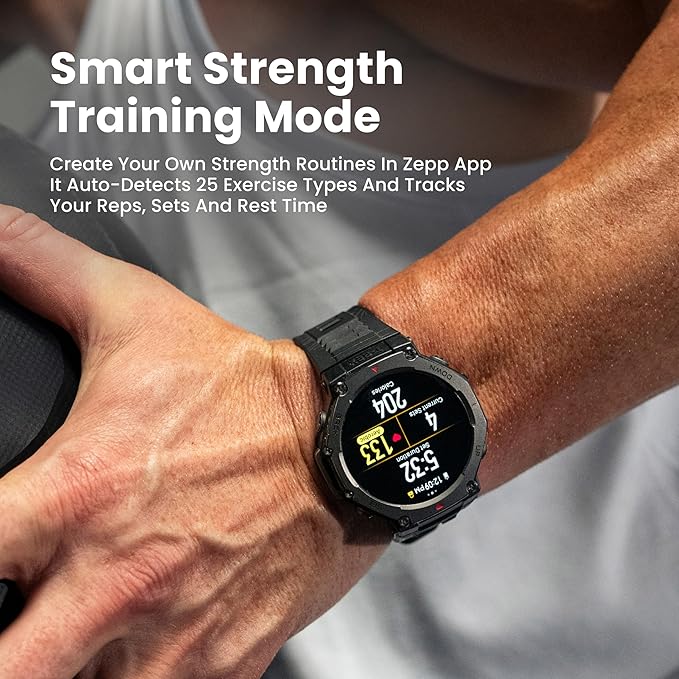
If you want a rugged, feature-packed smartwatch and you do not want to spend Garmin Fenix money, the Amazfit T-Rex 3 deserves a serious look.
It has a 1.5-inch AMOLED display, dual-band GPS across six satellite systems, a 10 ATM water rating, MIL-STD-810H certification, and a battery that can last nearly a month in basic use.
At its price, no other watch in this category comes close to matching it.
The T-Rex 3 was built on the idea that a rugged watch shouldn’t feel like a compromise.
The case is polymer with a stainless steel bezel, metal buttons, and a metal bridge structure.
It feels solid and dense in the hand.
The Corning Gorilla Glass on the screen resists scratches well in daily use.
It meets nine MIL-STD-810H standards, covering shock, temperature extremes, humidity, low pressure, and more.
That screen is worth talking about.
At 480 by 480 pixels on a 1.5-inch panel, it is one of the sharper displays in this price range.
It can reach nearly 2,000 nits, so you can read it easily in full sunlight.
Text is crisp, colours pop, and the always-on display option is actually usable outdoors rather than just a dim smear on the wrist.
Water resistance goes beyond the standard 10 ATM rating.
The T-Rex 3 is also certified for freediving to 45 metres under EN13319 and ISO standards.
That is a proper dive rating, not just swimming clearance. If you swim in open water or dive recreationally, this watch handles it.
GPS uses dual-band positioning with a circularly polarised antenna, which Amazfit introduced for the first time in this series.
That antenna design reduces signal bounce off buildings and terrain, improving accuracy when you are surrounded by obstacles.
The watch supports GPX, TCX, and KML route imports so you can load a planned route before you head out.
Real-world battery life lands around 12 days with continuous heart rate tracking, sleep monitoring, notifications, and a workout per week.
If you turn off the always-on display and keep smart features lighter, you can push toward 20 days.
GPS drains it faster — expect around 42 hours of continuous GPS tracking before needing a charge.
That is well above average for a watch at this level.
Sport mode coverage is impressive. The T-Rex 3 includes over 160 sport profiles, including freediving and, unusually, Hyrox races — it was among the first smartwatches to offer a dedicated Hyrox mode.
Automatic strength exercise recognition is also included, which detects exercises like squats and push-ups without you having to start a manual session.
The T-Rex 3 has no speaker.
You cannot take phone calls on the watch or use voice navigation with audio directions.
The offline voice assistant handles basic commands, but it is not Alexa or Google Assistant.
These are real limitations if those features matter to your daily use.
Charging is also slower than competitors — expect around three hours for a full charge.
When the battery lasts 27 days in light use, charging for three hours every three or four weeks isn’t a major burden.
But if you forget to charge and need a quick top-up before heading out, it is slower than ideal.
Ryan is 26, trail runs on weekends and works in landscaping during the week.
He needed a watch that could survive both and track his weekend mileage without draining flat mid-run.
He’s worn the T-Rex 3 through soil, rain, and sweat five days a week for four months.
The screen still looks new, and the GPS accuracy on trail routes has been consistently reliable.
Who Should NOT Buy This:
If you rely on audio turn-by-turn navigation or need to take calls on your watch, the T-Rex 3 is not the right fit. It has no speaker. If you are a serious runner or triathlete who needs the most accurate heart rate data possible during intense training, the Garmin Instinct 3 or Fenix 9 use more proven sensor hardware. The T-Rex 3 is best suited to outdoor workers, hikers, and active people who want a durable, capable watch at a sensible price.
Check Amazon for current price
3. Apple Watch Ultra 3: (Best Rugged Smartwatch for iPhone Users)
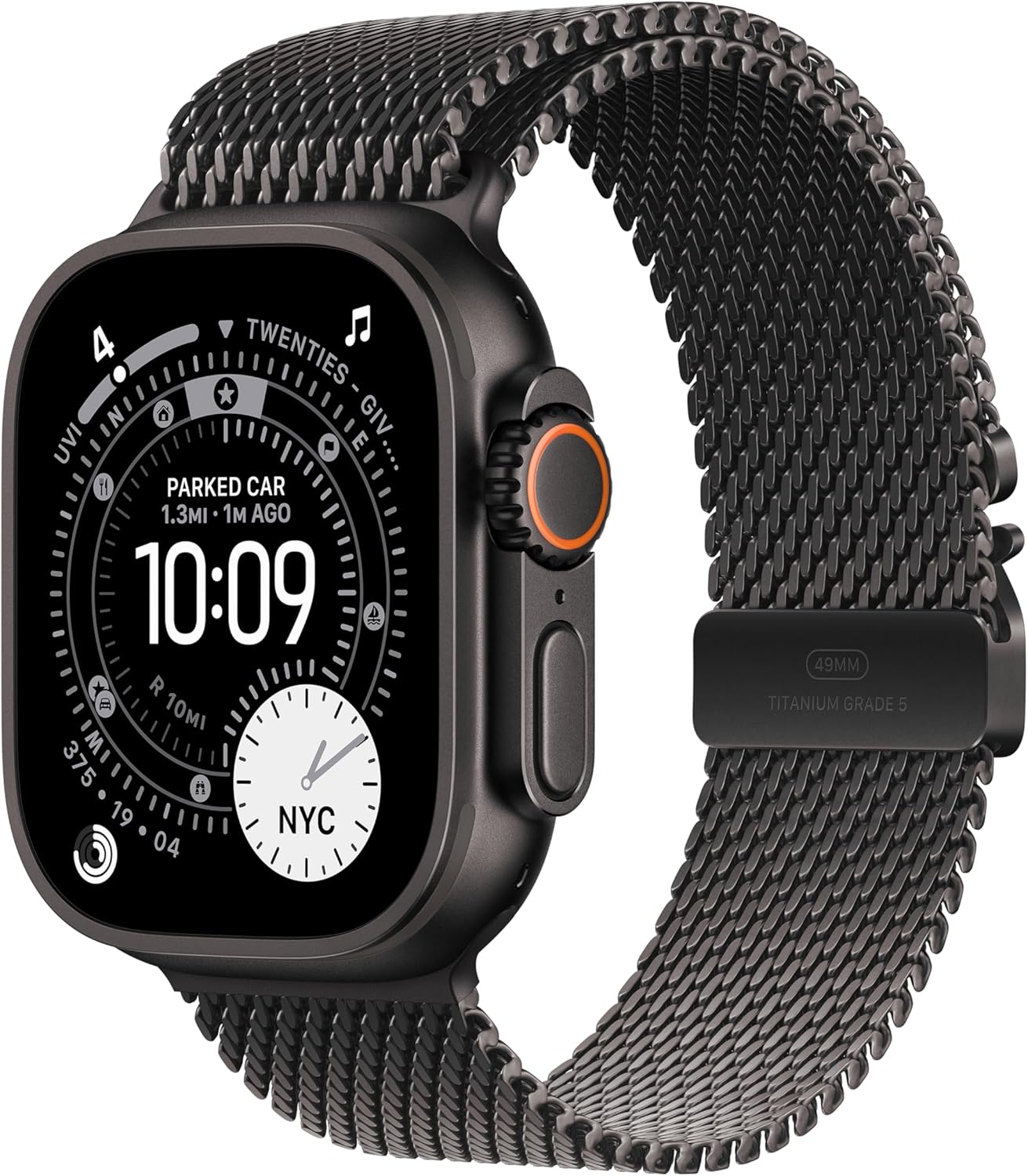
The Apple Watch Ultra 3 is what happens when a company that normally makes sleek, minimal products decides to build something that can take a beating.
Released in September 2025, it is the toughest Apple Watch ever made, and it genuinely competes with purpose-built outdoor watches from Garmin and Suunto on features that matter in the field.
Start with the build.
The Ultra 3 has a 49mm titanium case with a ceramic back and a flat sapphire crystal display.
Titanium is lighter than steel and more resistant to impact.
Sapphire glass is one of the hardest materials available for watch displays — it resists scratches from almost everything you will encounter in daily outdoor use.
The raised titanium crown guard protects the digital crown from side impacts. This is not cosmetic toughness. It is practical engineering that holds up.
The watch meets MIL-STD-810 standards and is rated to 100 metres of water resistance.
That covers everything from ocean swimming to white-water kayaking, without concern.
The display reaches up to 3,000 nits of brightness, among the highest of any smartwatch.
On a bright day at altitude, you can read it without squinting.
Battery life is the strongest the Ultra line has ever delivered. Apple rates it at 42 hours in standard use and 72 hours in Low Power Mode.
If you are doing a multi-day hike or a long triathlon, switching to Low Power Mode gives you three full days on a charge while still tracking GPS and heart rate. Very few smartwatches can match that.
GPS coverage is thorough. The Ultra 3 uses multi-system positioning including GPS, GLONASS, Galileo, BeiDou, and QZSS. Dual-frequency GPS improves accuracy near buildings, in forests, and in valleys where signals bounce.
The Compass app includes a Backtrack feature that records your path and can guide you back to your starting point if you lose your way, even without a mobile signal.
The health sensor package is the most complete of any watch on this list.
You get ECG with atrial fibrillation detection, blood oxygen monitoring, skin temperature sensing, a barometric altimeter, and continuous heart rate tracking.
Crash detection and emergency SOS work even without your phone nearby because the Ultra 3 has built-in LTE with an eSIM.
In a genuine emergency in a remote area, that connectivity can matter.
The Action Button on the side lets you set a custom shortcut for your most-used workout, torch, dive computer, or any other function you reach for most.
It is a small feature that becomes very useful once you get used to it.
The watch runs watchOS, so you have access to the full Apple Watch app library.
That includes detailed dive computer apps, navigation tools, weather services, music playback, contactless payments, and more.
The speaker and microphone let you take calls and use Siri directly from your wrist.
The main limitation is that the Ultra 3 only works with iPhone. Android users cannot use it.
If you don’t use an iPhone, you can’t use this watch, no matter how good it is.
It is also the largest watch on this list at 49mm. People with smaller wrists find it genuinely big.
It is designed to be a wrist-filling tool rather than an everyday elegant piece.
If size is a concern, the standard Apple Watch Series 11 is more compact, but it sacrifices the rugged build and battery life.
Sarah is 31 and competes in open water swimming events and takes two or three hiking trips a year.
She wanted one watch that could handle both and still look reasonable at work.
The Ultra 3 handles her swim sessions with no issue and tracked her GPS route accurately over a two-day trail in Scotland.
She uses the ECG feature once a month as a personal health check and has found the battery comfortably lasts a full weekend trip without needing a top-up.
Who Should NOT Buy This:
If you use an Android phone, stop here — the Apple Watch Ultra 3 is not compatible. If you want deep offline mapping with topographic detail, the Garmin Fenix 9 is a better fit. If budget is a priority, the Amazfit T-Rex 3 or Garmin Instinct 3 deliver rugged performance at a much lower cost. The Ultra 3 is the right choice for iPhone users who want the most capable, feature-complete rugged smartwatch available.
Check Amazon for current price
4. Casio G-Shock: (Best Traditional Rugged Watch)

Not every rugged watch needs to be a smartwatch.
The Casio G-Shock Mudmaster GG-B100 is proof of that.
It has no touchscreen, heart rate monitor, sleep tracking, or app ecosystem.
Instead, it’s a watch that can take punishment that would destroy most electronics and keep running for two years without a charge.
The Mudmaster was built specifically for muddy, dusty, dirty conditions.
The Carbon Core Guard structure uses a carbon and resin compound to form the inner case and outer bezel.
This material combination absorbs impact differently from standard resin — it is stiffer under compression and lighter than metal.
The case is fully mud-resistant, meaning dust and thick mud cannot work their way into the movement the way they can in watches that only meet standard shock-resistance ratings.
Water resistance is rated to 200 metres.
That is more than twice the depth certification of most smartwatches on this list and well beyond anything you will encounter in outdoor work or recreational diving.
The Quad Sensor setup is where the GG-B100 earns its outdoor credentials beyond just being tough.
It includes a compass, altimeter, barometer, thermometer, and step counter — all in the watch itself, with no phone needed to access any of them.
You can check your altitude on a climb, read your compass heading without opening an app, and monitor the barometric pressure drop that signals incoming weather.
These are the sensors serious outdoor workers and hikers actually use in the field.
For location tracking, the GG-B100 uses your phone’s GPS via Bluetooth and the G-Shock Connected app.
It doesn’t have a built-in standalone GPS chip.
If you want to log a trail route, you will need your phone with you.
If that is a dealbreaker, the Garmin Instinct 3 or another watch on this list handles GPS without the phone.
If you are mostly in environments where you use your phone anyway and just want a watch that can take a beating, the lack of standalone GPS isn’t a problem in practice.
The display is a negative LCD — white characters on a dark background.
It is highly readable at night and in low light without being backlit.
In direct bright sunlight, it can be harder to read than an AMOLED screen.
The Super Illuminator backlight solves this when you need it.
The watch face covers 38 time zones, five daily alarms, and an hourly time signal, plus all the sensor data.
It packs a lot of functionality, even without any smartphone features.
Battery life is the real headline for people who are tired of charging watches.
The GG-B100 runs on a single CR2025 coin cell battery that lasts approximately two years under normal use.
When it runs out, you replace it yourself at any watch shop for a small amount. No cable, no magnetic charger, and no worrying about whether you remembered to charge before a long trip.
The watch is large and heavy at 92 grams, which is noticeable compared to lighter smartwatches.
The 55.4mm case size is substantial. People with smaller wrists may find it too bulky for comfortable daily wear.
It is designed to be a working tool on the wrist, not a minimal everyday piece.
If you do a lot of outdoor work and want a rugged GPS tracker, our guide to the best GPS watches for hunting covers options built specifically for field use.
Daniel is 44 and works as a site manager on large construction projects.
He has gone through three smartwatches in four years — screens cracked, charging ports filled with dust, one fell off scaffolding.
He picked up the Mudmaster eighteen months ago. It has been dropped twice, submerged in a flooded site inspection, and sat in direct sun all day throughout a summer.
He checks his compass and altitude readings daily.
He has not thought about charging it once.
Who Should NOT Buy This:
If you need standalone GPS for route tracking without your phone, this watch is not the right choice — look at the Garmin Instinct 3 or the Amazfit T-Rex 3 instead. If you want smartwatch features like heart rate monitoring, sleep tracking, or app notifications, the Mudmaster does not offer any of those. It is the right watch for people who work in genuinely harsh environments and want a tool that lasts for years without maintenance.
Check Amazon for current price
5. Samsung Watch Ultra 2: (Best Rugged Smartwatch for Android Users)

The Samsung Galaxy Watch Ultra 2 launched in July 2026, and it is the most serious outdoor smartwatch Samsung has ever built.
It takes the cushion-shaped titanium design of the original Galaxy Watch Ultra and improves almost everything that matters—a much larger battery, a brighter display, a faster chip, and a new dive certification the first model lacked.
The 47mm titanium case has a cushion shape that sits a little differently on the wrist than a round or square watch.
The titanium frame is lighter than steel while still offering strong impact resistance.
The display uses sapphire crystal protection over a 1.52-inch Super AMOLED panel that peaks at 5,000 nits.
That is one of the brightest watch displays available, and it makes a meaningful difference when you are checking navigation data in full sunlight outdoors.
Durability credentials are thorough.
The Galaxy Watch Ultra 2 carries MIL-STD-810H certification, a 10 ATM water resistance rating, IP69K dust and high-pressure water resistance, and EN13319 recreational dive certification to 40 metres.
The IP69K rating is notable because it means the watch can handle high-pressure water jets—useful in industrial and outdoor settings where you deal with hoses, heavy rain, or cleaning equipment.
The original Galaxy Watch Ultra only had an IP68 rating.
This is a genuine upgrade.
Battery life was the first Ultra model’s biggest weakness.
Samsung addressed it with an 800mAh silicon-carbon cell, which is 35 percent larger than its predecessor.
In real-world testing with the always-on display running, reviewers consistently got close to three full days.
For a smartwatch with a 5,000-nit AMOLED screen and full-time health monitoring running, three days is a strong result.
It charges to around 40 percent in thirty minutes if you need a quick top-up before heading out.
The chipset is a Qualcomm Snapdragon Wear Elite built on a 3nm process.
This delivers noticeably fast, fluid performance across menus, apps, and health data—significantly quicker than previous Samsung watch chips.
The watch runs Wear OS 7 with One UI 9 Watch on top, giving you access to Google Play apps alongside Samsung’s health and fitness platform.
Health tracking covers the full range.
You get optical heart rate, ECG, blood oxygen, bioimpedance body composition analysis, skin temperature, and barometric altitude.
Samsung’s AI-powered health engine runs on the watch itself and can provide personalised insights without sending your data to the cloud.
Independent tests have consistently shown heart rate accuracy close to the Apple Watch Ultra 3 and dedicated health trackers.
GPS uses dual-frequency L1 and L5 positioning for better accuracy in challenging environments.
Built-in LTE and eSIM let you leave your phone behind and still take calls, send messages, and reach emergency contacts.
One clear limitation: the Galaxy Watch Ultra 2 is Android-only.
It requires an Android phone running version 13 or later.
iPhone users cannot pair it, no matter how capable it is.
The Apple Watch Ultra 3 is the equivalent choice for iPhone users.
Like the Casio and the Apple Watch Ultra 3, the Galaxy Watch Ultra 2 is large and heavy.
People with smaller wrists find it prominent. It is designed to be a capable tool rather than a discreet everyday piece.
Emma is 29 and competes in obstacle course races and open water swims.
She uses a Samsung phone and wanted an Android watch that could keep up with her training and handle the mud and water her races involve.
The Ultra 2 has been through two race days, including one with a full water submersion section.
The GPS tracking held steady throughout both events, and the battery lasted a full race weekend without needing a mid-trip charge.
Who Should NOT Buy This:
iPhone users cannot use the Galaxy Watch Ultra 2 — the Apple Watch Ultra 3 is the right alternative. If you want multi-week battery life for long expeditions without access to charging, the Garmin Instinct 3 Solar or Fenix 9 is a better fit. If you want a simple rugged watch without smartwatch features, the Casio G-Shock Mudmaster handles that at a lower cost.
Check Amazon for current price
6. Fenix 9 Pro Solar: (Best Rugged Watch for Serious Outdoor Athletes)

The Garmin Fenix 9 Pro Solar launched in August 2026, and it sits at the top of the outdoor GPS watch category.
If the other Garmin on this list — the Instinct 3 AMOLED — is built for capable everyday outdoor use, the Fenix 9 Pro Solar is built for people who take outdoor activity seriously enough that their watch is a critical piece of kit.
Full offline topographic maps, extraordinary battery life extended by solar charging, and a sensor suite that covers everything from mountain climbing to open water diving make it the most complete outdoor watch available.
The case is full titanium, with a Power Sapphire lens—a hardened sapphire crystal that resists scratches from rocks, branches, and rough surfaces.
It comes in 47mm and 51mm sizes.
The 47mm version weighs 84 grams total, which is heavier than a smartwatch but typical for a full outdoor GPS unit at this level of capability.
Battery life is the Solar model’s standout specification.
In standard smartwatch mode, the 47mm version runs up to 34 days with solar input — and up to 57 days on the larger 51mm. In GPS activity mode with solar, the 47mm lasts up to 81 hours.
Switch to Max Battery GPS mode with the solar panel active, and it goes up to 740 hours of GPS tracking.
That number is not a typo.
Under the right conditions — outdoor use with reasonable sun exposure — the Fenix 9 Pro Solar can go months between charges.
For multi-day expeditions, long hikes, or extended outdoor work, this changes the calculation entirely.
The display is a MIP screen rather than AMOLED.
MIP technology is always-on, readable in bright sunlight without a backlight, and extremely power-efficient—which is part of why the solar battery figures are so high.
It isn’t as vivid as an AMOLED screen in dim light, but outdoors, where this watch is designed to be used, it is clear and easy to read from any angle.
The Fenix 9 Pro Solar has no real competition on this list for navigation.
It comes preloaded with TopoActive topographic maps covering the world.
You can see your route, the terrain around you, elevation contours, and points of interest directly on the watch without needing your phone or a data connection.
The onboard storage is 64GB, enough for maps across multiple regions alongside your music.
ClimbPro gives you a live readout of upcoming ascents during a hike or mountain run — how much climbing is left, your pace, your current grade. It is genuinely useful on long routes.
GPS uses multi-band dual-frequency GNSS across all five major systems.
Garmin’s SatIQ technology switches between single-band and multi-band GPS automatically to balance accuracy with battery efficiency.
Health sensors include Garmin Elevate Gen 5 heart rate, ECG for atrial fibrillation detection, pulse oxygen, barometric altimeter, three-axis compass, gyroscope, thermometer, and a depth sensor rated to 40 metres for diving.
A built-in LED flashlight, speaker, microphone, and Garmin Pay complete the feature set.
Training Readiness, Body Battery, HRV Status, and Sleep Coach are included at no subscription cost.
The Fenix 9 Pro Solar is the only watch on this list with an inReach variant.
The Fenix 9 Pro inReach Solar adds two-way satellite messaging and SOS capability through the Iridium satellite network — no mobile signal needed, anywhere on Earth.
If you travel to genuinely remote areas, that is a safety feature worth knowing about.
James is 36 and runs ultra-marathons and does two or three multi-day mountain routes each year.
He needs a watch that can navigate offline in areas with no signal, last the full duration of a 100-mile race, and track his training load accurately enough to guide his preparation.
He’s used the Fenix line for years, and the 9 Pro Solar is the version he’s been waiting for — the offline maps and 740-hour max battery life in GPS mode mean he charges it far less than any previous watch he’s owned.
Who Should NOT Buy This:
If you are an occasional hiker or casual fitness tracker, the Fenix 9 Pro Solar is far more watch than you need—the Garmin Instinct 3 AMOLED or the Amazfit T-Rex 3 offer strong outdoor performance at a much lower cost. If you want an AMOLED screen, the Fenix 9 Pro AMOLED version is available separately. If you use an iPhone and want a smartwatch rather than a dedicated outdoor GPS unit, the Apple Watch Ultra 3 is a better fit for daily use.
Check Amazon for current price
7. Coros Nomad: (Best Rugged Watch for Budget-Conscious Adventurers)

It packs offline color topographic maps, dual-frequency GNSS, and on-device music storage into a lightweight watch that costs significantly less than most of its competitors.
It is the pick for hikers, trail runners, and outdoor workers who want proper GPS navigation features without paying flagship prices.
The case is 47.8mm in diameter, built from fiber-reinforced polymer with an aluminum subframe.
It weighs 61 grams with the silicone band, or 49 grams with the optional nylon strap—lighter than most rugged watches at this size.
It’s rated to 5 ATM, which covers swimming, rain, and sweat.
One important note: 5 ATM is 50 metres, which is half the depth rating of most other watches on this list.
It is adequate for surface water activities but not intended for diving.
The display is a 1.3-inch MIP panel with a 260 by 260 pixel resolution.
Like other MIP screens, it is always-on and very readable in direct sunlight.
The glass is hardened mineral rather than sapphire, so it is more scratch-prone than watches with sapphire crystal protection.
That is a reasonable trade-off at this price point, but worth knowing if you work in rocky terrain.
Battery life is where Coros consistently outperforms the market. Rated at 22 days of daily use and 50 hours in GPS mode, independent tests have shown real-world mixed use delivering close to 18 days before needing a charge.
That is exceptional for a GPS watch with dual-frequency positioning and always-on display.
The Nomad has no solar charging, but the base battery lasts long enough that you rarely need it.
GPS uses dual-frequency L1 and L5 GNSS across five satellite systems — the same positioning approach as much more expensive watches.
It includes offline color topographic maps with trail markings, terrain shading, and points of interest visible directly on the watch.
The 32GB of storage holds maps for multiple regions and also supports offline MP3 music playback over Bluetooth headphones.
That is a combination — maps and music in the same budget watch — that very few competitors offer at this price.
There is no training plan integration with platforms like TrainingPeaks.
The Coros app handles training analysis, but its watch ecosystem is smaller than Garmin’s or Polar’s.
It also doesn’t automatically reroute when you drift off a planned route, and VO2 Max estimates run conservatively compared to independent lab testing.
Neither of these things matters much for casual trail use, but athletes using the watch for serious training tracking should note them.
Tom is 27 and spends most weekends hiking and doing trail runs in the Peak District.
He doesn’t want to spend a lot on a watch, but he does want offline maps, reliable GPS, and enough battery to cover a full weekend trip without charging.
The Nomad does all of that, and its music storage means he can leave his phone behind on solo runs.
He’s taken it through muddy trails, river crossings, and a heavy downpour with no issues.
Who Should NOT Buy This:
If you need 10 ATM or deeper water resistance for diving or surface water sports, this watch is not rated for that — look at the Amazfit T-Rex 3 or the Suunto Vertical instead. If you follow structured training plans on TrainingPeaks or require precise VO2 Max tracking, the Garmin or Polar options on this list are better suited. If you need ANT+ accessories like a chest strap to pair with the watch, confirm compatibility before buying. The Coros Nomad is the right choice for people who want proper GPS navigation and long battery life and do not want to pay more than they have to.
Check Amazon for current price
8. Polar Grit X2 Pro: (Best Rugged Watch for Serious Training Athletes)

The Polar Grit X2 Pro is aimed at a specific type of person: someone who wants a rugged outdoor watch and also takes their training data seriously.
It is the first Polar watch to carry MIL-STD-810H certification; it has a vivid AMOLED display under sapphire crystal and uses Polar’s reputation for precise heart rate monitoring in a case built to handle real outdoor conditions.
It isn’t the most feature-rich watch on this list for navigation, but it stands out for training load management and health data.
The case uses a stainless steel front frame with a plastic back panel—an unusual combination Polar chose to balance durability with weight.
The Titan edition swaps the steel front for titanium, reducing weight while maintaining impact resistance.
Water resistance is rated to 100 metres, which covers swimming, surfing, and most outdoor water activities with no concern.
The operating temperature range is -20 to +50 degrees Celsius.
The display is a 1.39-inch AMOLED touchscreen at 326 pixels per inch, protected by sapphire crystal.
At 1,050 nits, it is readable in direct sunlight.
The watch also has five physical buttons alongside the touchscreen, which is useful when wearing gloves or doing activities where touchscreen accuracy is reduced.
Battery life is 43 hours in GPS training mode. In real-world hiking and navigation testing, reviewers consistently recorded 20 to 25 hours per charge with active GPS and maps running. With the always-on display, expect 3 to 5 days of daily use depending on activity.
That is shorter than many watches on this list, and worth planning around on multi-day trips.
Offline maps are preloaded for North America and Europe at basic detail, with additional regions available for free download over USB.
Komoot turn-by-turn navigation is supported when you sync a route from the app.
It is worth noting that navigation here is breadcrumb-trail rather than fully routable maps — the watch shows your track and position on the map but will not recalculate a new route automatically if you leave the planned path.
Health sensors are a genuine strength.
The fourth-generation optical heart rate sensor has been independently tested as one of the more accurate wrist sensors across activity types.
ECG recording is available. Nightly skin temperature, HRV tracking, and sleep analysis complete the health picture.
The ECG detects no AFib, which is a limitation compared to Garmin and Apple equivalents.
One notable gap: no NFC payments, no music storage, and no WiFi.
At this price point, those are meaningful omissions that competitors include.
There is also no ANT+ support confirmed — Bluetooth Smart accessories are supported.
Alex is 34 and is a long-distance road cyclist who also does mountain hiking in summer.
He uses the Grit X2 Pro to track training load carefully across a season and to navigate on trail days without his phone.
The AMOLED screen is clear enough for a quick glance at power zone data on the bike, and the 100m water resistance covers the occasional off-season swim session.
He knows the battery needs charging every two to three days, and he’s built that into his routine.
Who Should NOT Buy This:
If you need multi-day GPS battery life for expeditions or ultra-marathons, the Suunto Vertical, Coros Nomad, or Garmin Fenix 9 Pro Solar are better choices. If you want NFC payments, offline music, or WiFi sync, this watch does not offer any of those. If you want a smartwatch for day-to-day notifications and app access rather than a dedicated training tool, consider the Apple Watch Ultra 3 or Samsung Galaxy Watch Ultra 2. The Polar Grit X2 Pro is the right pick for serious athletes who want precise training data and a durable build in the same watch.
Check Amazon for current price
Quick Comparison: All 8 Rugged Watches Side by Side
| Watch | Water Resistance | Durability | Display | GPS Battery | GPS | Best For |
|---|---|---|---|---|---|---|
| Garmin Instinct 3 AMOLED | 10 ATM | MIL-STD-810 | 1.2″ AMOLED | 40 hrs | Dual-freq | Best overall |
| Amazfit T-Rex 3 | 10 ATM + 45m dive | MIL-STD-810H (9x) | 1.5″ AMOLED | 42 hrs | Dual-freq | Best value |
| Apple Watch Ultra 3 | 100m | MIL-STD-810 | 2.1″ OLED | 72 hrs (low power) | Dual-freq | iPhone users |
| Casio G-Shock Mudmaster | 200m | Shock/mud resistant | Negative LCD | No standalone GPS | Via phone | Traditional field watch |
| Samsung Galaxy Watch Ultra 2 | 10 ATM + 40m dive | MIL-STD-810H + IP69K | 1.52″ AMOLED | ~3 days | Dual-freq | Android users |
| Garmin Fenix 9 Pro Solar | 10 ATM + 40m depth | MIL-STD-810 | 1.4″ MIP | 740 hrs max | Multi-band | Serious outdoors |
| Coros Nomad | 5 ATM | Fiber-reinforced polymer | 1.3″ MIP | 50 hrs | Dual-freq | Budget outdoor |
| Polar Grit X2 Pro | 100m | MIL-STD-810H | 1.39″ AMOLED | ~22 hrs | Dual-freq | Training athletes |
How to Choose the Right Rugged Watch for You
If you use an iPhone, the Apple Watch Ultra 3 is the only serious smartwatch option on this list. It integrates perfectly with iOS and offers features like Crash Detection that only work within the Apple ecosystem.
If you use an Android phone and want full smartwatch functionality, the Samsung Galaxy Watch Ultra 2 is the equivalent choice. It runs Wear OS and supports Google Play apps.
If you want the longest GPS battery possible, the Garmin Fenix 9 Pro Solar is in a different category to everything else. The 740-hour Max GPS mode is not matched by any other watch.
If you are on a tighter budget and still want real dual-frequency GPS with offline maps, the Coros Nomad gives you most of what you need at a significantly lower cost.
If you spend time in the mountains specifically, the Suunto Vertical is built for that — long GPS battery, free lifetime topo maps, and reliable positioning at altitude.
If you want a serious training watch that also handles outdoor adventures, the Polar Grit X2 Pro has the most precise training analytics of any watch here alongside its MIL-STD-810H certification.
If you want something that needs zero maintenance and works in total darkness, the Luminox Navy SEAL is in a category of its own.
Frequently Asked Questions
What does MIL-STD-810 mean on a watch? MIL-STD-810 is a US military durability standard. Watches certified to this standard have been tested against shock, temperature extremes, humidity, altitude, vibration, and other stress factors. It means the watch has gone through standardized tests that simulate real-world harsh conditions — not just that the manufacturer claims it is durable.
Is 10 ATM water resistance enough for swimming? Yes. A 10 ATM rating (100 metres) is more than sufficient for lap swimming, snorkeling, showering, and general outdoor water exposure. For recreational diving below 40 metres, you would want a watch with a specific dive certification like EN13319, which the Samsung Galaxy Watch Ultra 2 and Amazfit T-Rex 3 both carry.
Do rugged watches work without a phone?
The majority of GPS watches on this list are able to navigate, track activity and tell time without a phone at all. Except for the Casio G-Shock Mudmaster, which requires your phone for GPS positioning. Most features on the smartwatch, such as the Apple Watch Ultra 3 and Samsung Galaxy Watch Ultra 2, are stand-alone, but pairing adds more features.
What is the difference between ATM and IP ratings? ATM measures how deep a watch can go in water without leaking — 10 ATM equals 100 metres. IP ratings (like IP68 or IP69K) measure dust and water ingress resistance in a different way. IP68 means fully dust-tight and can be submerged continuously. IP69K adds resistance to high-pressure water jets. A watch can carry both ratings, like the Samsung Galaxy Watch Ultra 2 with 10 ATM and IP69K.
How long does a rugged watch last? The analog watches on this list — the Casio Mudmaster and Luminox Navy SEAL — can last decades with standard battery replacements. GPS smartwatches typically see a lifespan of five to eight years before battery degradation becomes a noticeable issue. Garmin and Suunto both offer battery replacement services.
Can I wear a rugged watch every day? Yes, and that is what most of them are designed for. Many people on this list wear their watch 24 hours a day for sleep tracking, health monitoring, and always having the time. The lighter options like the Coros Nomad and Amazfit T-Rex 3 are comfortable enough for all-day wear despite their rugged build.
For a deeper look at GPS accuracy across watch types, our guide to GPS watch accuracy compares multi-band positioning with standard GPS in real conditions. For a full breakdown of how smartwatch health sensors work, the team at Wareable regularly tests heart rate and GPS accuracy against lab equipment.
Related Articles:
- Fitbit Air Review
- Best Garmin Watches Under $500
- Best Smartwatches Compatible with Dexcom G6/G7
- Best Women’s Watches with Military Time
Luis Cooper

Hi, I'm Luis, the guy behind this site. I love wearing watches, especially ones that look great on small wrists (mine are about 6.3" around). The Watches Geek is dedicated to helping you learn about and buy watches that you will love wearing. I want this website to be the last destination for people to pick the best watches to fit their needs. You can find our unbiased reviews here on Thewatchesgeek.