
Last Updated on October 9, 2026 by Luis Cooper
Most fitness trackers want your attention.
They buzz, they glow, they show you notifications from people you were already ignoring on your phone.
You end up glancing at your wrist fifty times a day for reasons that have nothing to do with your health.
The Fitbit Air goes in the opposite direction completely.
There is no screen. No buzzing for messages. No notifications at all.
It sits on your wrist, quietly records everything, and at the end of the day you open the app to see what actually happened to your body.
For many people, that is exactly what they have been looking for.
This review covers everything you need to know before buying the Fitbit Air.
What it does well, what it does not do at all, who it makes sense for, and who will walk away frustrated.
No hype, no filler, just the honest picture.
Fitbit Air Review


What Is the Fitbit Air
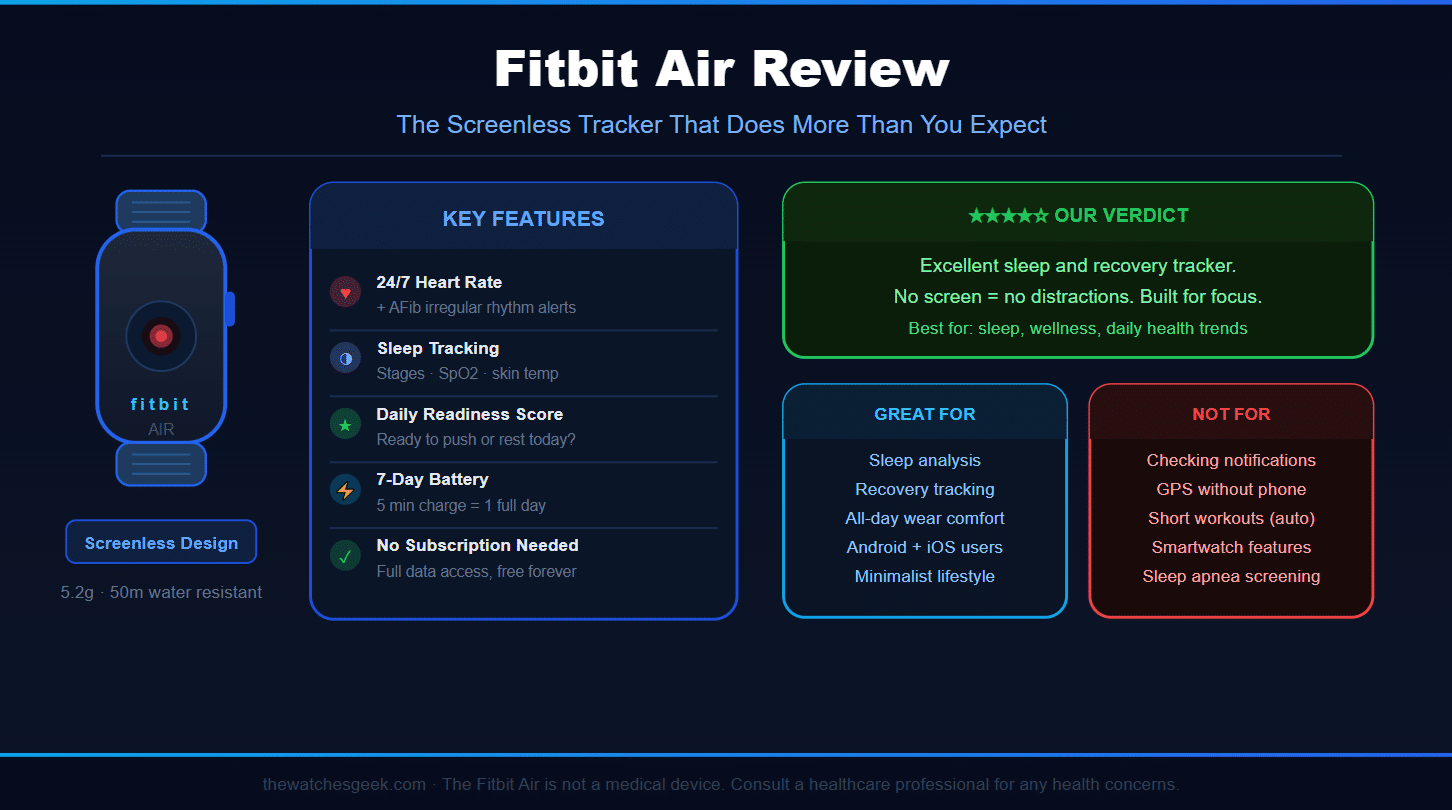
The Fitbit Air is Google’s answer to what a fitness tracker should be when you strip away everything a smartwatch does. No screen.
No buttons, except for one small one you press to start a workout. No map display. No replies to texts.
Just sensors that measure your body and an app that makes sense of what they find.
Google launched it in May 2026 as its smallest and most affordable tracker. The idea is simple: wear it all day and all night, check the app when you want to, and let the rest of your day happen without your wrist interrupting it.
That sounds like a downgrade. For many people, it feels like a relief.
Design and Build Quality
The Fitbit Air is genuinely small.
The tracker pebble itself is 35 millimetres long, 17 millimetres wide, and 8 millimetres thick.
It weighs 5.2 grams on its own, which is lighter than a standard pencil.
With the strap attached, most people forget it is on their wrist within a day or two.
The band that comes in the box is the Performance Loop, made from recycled materials.
It feels slightly knitted, and a few people notice it on day one.
By day three, most reviewers stop noticing it entirely.
If you prefer something softer against the skin, Google sells a silicone Active Band separately, which is also sweat-resistant and better for people with sensitive skin.
There is also a more fashion-forward option called the Elevated Modern Band, and a Stephen Curry Special Edition for anyone who wants more visibility on the wrist.
The tracker snaps onto and off the band with a small clip.
This is useful because you charge the tracker separately from the band, and swapping bands takes about five seconds.
The tracker is IP68 rated and water-resistant to 50 metres, which is better than most competitors in this category and means showering, swimming, and sweaty workouts are all fine.
Available colours include Obsidian Black, Lavender, Berry, and the Stephen Curry edition. All of them are understated.
You can wear any of them to a formal event or the gym, and they’ll look fine in both places.
What the Fitbit Air Tracks
Heart Rate
The Fitbit Air monitors your heart rate continuously throughout the day and night.
It measures beats per minute in real time, calculates your 24-hour resting heart rate, and tracks heart rate variability.
HRV is the variation in time between individual heartbeats and is one of the better signals for how well your body has recovered from stress and exercise.
It also has irregular heart rhythm notifications. If the sensor detects a pattern consistent with atrial fibrillation during a rest reading, it alerts you through the app.
This is the same category of feature used by FDA-cleared devices.
Google is careful to say the Fitbit Air is not a medical device and that these notifications are for awareness, not diagnosis.
If you get one, take it to a doctor.
But having the alert at all, at this price point, is genuinely notable.

- Google Fitbit Air is the unbelievably comfortable, exceptionally smart way to transform your health[1]; and Google Health brings together effortless tracking and adaptive coaching to help make the most of your everyday[2]
- Unlock more with Google Health Premium: With a premium membership, get personalized coaching that’s built with Gemini and adapts to your life[2]; get a 3-month trial at no cost to you[5] (Google Health Premium subscription sold separately)
- Comfortable fit - One Size Tracker (130-210 mm): The lightweight, micro-adjustable fit sits comfortably and quietly, so you can wear Google Fitbit Air through work, play, and sleep; advanced sensors and new algorithms power more accurate, precise health tracking, 24/7[1]
- Designed for every occasion: With no screen to distract you or disrupt your style, your tracker moves seamlessly from bracelet to workout band to sleep band, and you can change looks in seconds – just press the pebble in, click, and go
- Long battery life: Google Fitbit Air’s battery lasts up to a week, and fast charging gets you one day of battery life in just five minutes[6,7]
Sleep Tracking
Sleep is where the Fitbit Air earns the most attention.
Put it on before bed and the next morning you get a sleep score out of 100, a breakdown of how much time you spent in light sleep, deep sleep, and REM, your breathing rate during the night, your blood oxygen levels, and your skin temperature variation compared to your personal baseline.
In tests by multiple reviewers comparing the Fitbit Air to Garmin devices, sleep data were close on most nights. The biggest real-world complaint is that the device occasionally logs time as sleep when you are still awake on your phone.
A handful of forum users reported that the tracker added steps during nighttime wrist movements or didn’t properly register the first 30 to 60 minutes of the night.
These are not dealbreakers for most people, but they are worth knowing.
If you are tracking sleep because you have a specific health concern and need precise data, a dedicated sleep study or a clinically validated device is a better fit.
For general patterns and trends over weeks and months, the Fitbit Air gives you a genuinely useful picture.
Daily Activity
Steps, distance, active zone minutes, calories burned, and hourly activity reminders all work automatically.
You do not need to tell the device you are going for a walk. It detects it and logs it.
Automatic workout detection kicks in after 15 consecutive minutes of activity.
This covers walking, running, outdoor cycling, and a handful of other common activities.
It also covers swimming automatically. For shorter workouts or more specific activities, like a 10-minute HIIT session or pickleball, you need to start tracking manually in the app.
The Fitbit Air doesn’t have built-in GPS.
To track a route, you need to bring your phone. The tracker borrows your phone’s GPS for distance and map data during outdoor workouts.
For anyone who exercises without their phone, the distance tracking will be based on your step count and stride estimate instead, which is less precise.
Cardio Load and Daily Readiness
Two of the more useful ongoing features are Cardio Load and Daily Readiness Score.
Cardio Load tracks how much your workouts are stressing your cardiovascular system over time.
This is not just counting steps. It looks at how hard your heart was working and for how long, and tells you whether you are building fitness at a sustainable pace or overdoing it.
Daily Readiness gives you a score from 0 to 100 each morning based on your sleep, HRV, and recent activity.
A high score means your body is ready for a hard effort.
A low score means it’s worth taking an easy day.
This signal takes most people years of experience to develop by feel, and the Fitbit Air surfaces it as one number every morning.
Skin Temperature and SpO2
The Fitbit measures your skin temperature baseline over several nights, then tracks variation.
A meaningful increase can signal early illness or hormonal change, and the data appears as a graph in the Health app.
Blood oxygen is also tracked overnight, which gives you a picture of how well your breathing is during sleep.
The Google Health App
The Fitbit Air requires the Google Health app, which replaced the old Fitbit app.
It works on both Android and iOS.
The app is well designed for people new to tracking.
The dashboard clearly shows your key metrics and lets you tap into each one for more detail without burying you in numbers.
You can set goals, log water intake, track your menstrual cycle, and read your overnight summaries all in one place.
The free version of the app gives you full access to your tracking data and most of the core features.
This is a meaningful point.
Whoop requires a subscription just to use the device.
Oura Ring requires a subscription to access most of its insights.
The Fitbit Air lets you see everything the sensors record without paying anything beyond the hardware.
Google Health Premium
Google Health Premium costs $9.99 per month or $99.99 per year.
The Fitbit Air includes a three-month trial.
Premium adds an AI health coach powered by Gemini, adaptive weekly workout plans, personalised recovery guidance, and expanded sleep analysis powered by AI models that Google says are 15 per cent more precise at identifying sleep stages.
The honest verdict on Premium is mixed.
The AI coach summaries are useful at first, and some users find them genuinely helpful over time.
But they take up a lot of space in the app interface, and you can’t see your data without also seeing the AI commentary.
Some people find this annoying. Android Authority published a piece in 2026 concluding that Premium is not worth the ongoing cost for most users, largely because the summaries cannot be turned off without losing the features you are paying for.
The practical answer: use the three-month trial, see whether the coaching helps you personally, and then decide.
The tracker is fully functional without it.
If you are a Google One AI Pro or Ultra subscriber, Google Health Premium is included in your subscription at no extra cost.
Battery Life
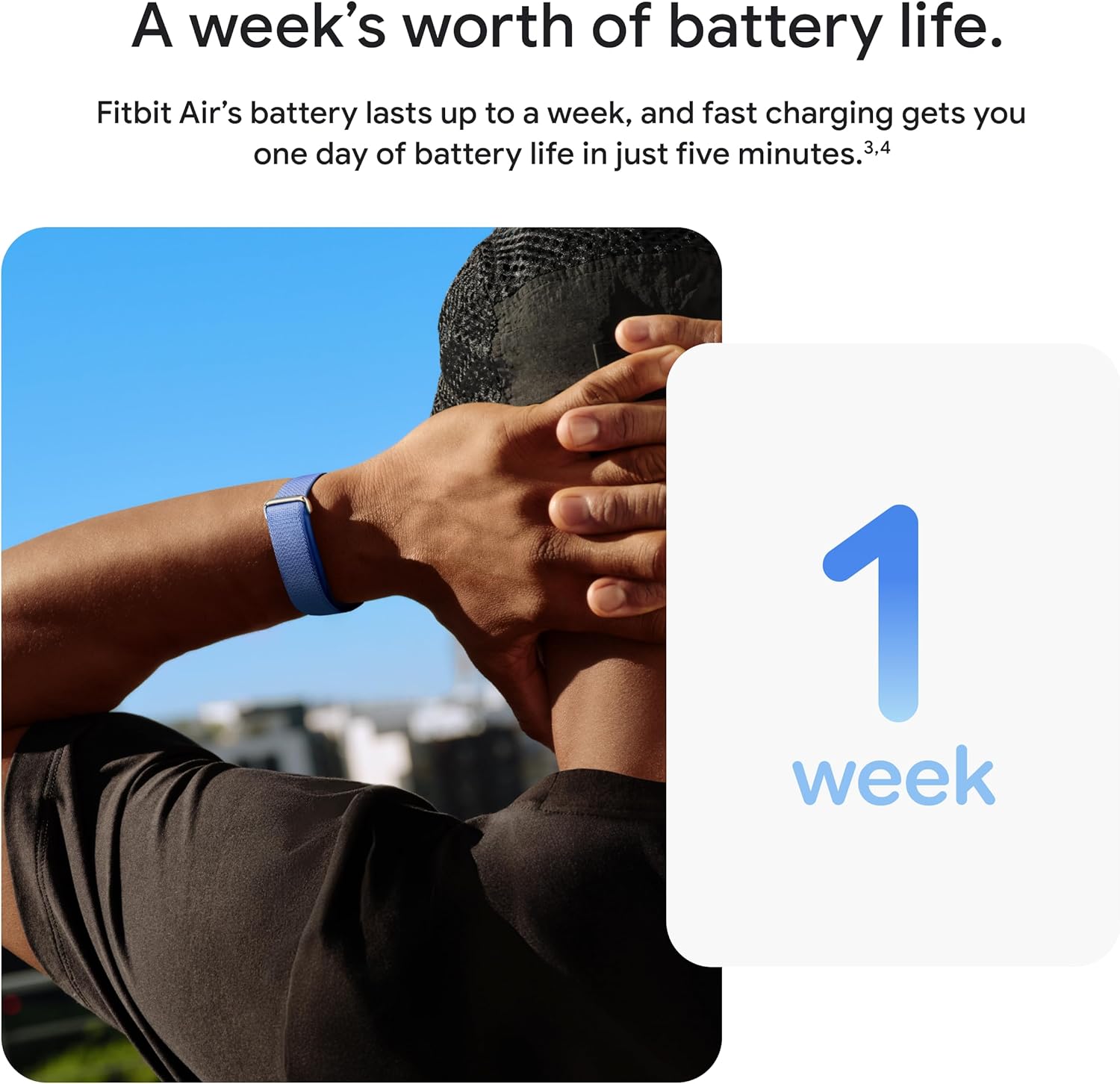
Google rates the Fitbit Air at seven days of battery life. In real-world testing with daily workouts and continuous tracking, most reviewers land at around six to seven days before needing a charge.
That aligns with the official rating and is better than most devices’ claims.
The charging cable is proprietary. It attaches magnetically to the back of the tracker.
A full charge from zero takes about 90 minutes. Fast charging is also available: five minutes on the charger gives you roughly a full day of use.
The battery life is one of the genuine advantages here.
Seven days means you can wear it all week, charge it on Sunday morning while you make breakfast, and never think about it again. Compared to smartwatches that need charging every one to two days, this is a meaningful difference for anyone who wants to track sleep without planning around charging.
What the Fitbit Air Does Not Do
This section matters as much as everything above.
The Fitbit Air has no screen.
You cannot see the time on your wrist. You cannot see your heart rate mid-run without taking out your phone. Y
ou cannot read a message or see who is calling. There are no apps. No Apple Pay or Google Pay.
There is no music control. There is no navigation.
If any of those things sound like dealbreakers, they are.
The device does not detect sleep apnea.
It tracks blood oxygen and breathing patterns overnight, but it is not FDA-cleared for sleep apnea screening.
If you specifically need that, the Apple Watch Series 11 and later or the Samsung Galaxy Watch have FDA-cleared sleep apnea screening features.
The auto workout detection has a 15-minute minimum.
Short exercise sessions are not automatically logged. The workout type list also doesn’t include every activity.
If you do specific sports, you’ll tap to start workouts manually more often than not.
Who Should Buy the Fitbit Air
You will get the most from the Fitbit Air if:
You want to understand your sleep, recovery, and health trends over time without a distracting screen.
You care more about how your body is doing than about wrist notifications.
You do not want a subscription just to use a tracker. You exercise regularly but do not need GPS on the device itself because you carry your phone.
You prefer something light and discreet that does not look like a piece of technology.
Priya is 34, works a demanding job, and has been trying to understand why she wakes up tired despite getting seven or eight hours.
The Fitbit Air gives her a nightly breakdown of her sleep stages and a readiness score each morning.
After four weeks, she sees the pattern: her deep sleep drops sharply on nights when she has a glass of wine. She did not need a screen for that. She needed data.
Who Should NOT Buy the Fitbit Air
Don’t buy the Fitbit Air if you want notifications, messages, or calls on your wrist.
It does not do any of that.
Do not buy it if you run or cycle without your phone and want accurate GPS distance and route maps directly on the device. It has no onboard GPS.
Do not buy it if you do very short workouts of under 15 minutes and want them logged automatically.
You will need to start tracking manually.
Do not buy it if you need a clinical-grade health monitor for a specific medical condition.
No consumer wearable replaces a doctor, and the Fitbit Air is not a medical device.
Do not buy it if you want a smartwatch. This is a health tracker.
It does one thing very well and leaves everything else entirely to your phone.
Fitbit Air vs the Competition
vs Whoop 5.0: Whoop has a longer battery life (up to 14 days) and is the only screenless tracker you can charge without removing it.
But Whoop requires a subscription to use the device at all, and that adds up quickly over time.
The Fitbit Air is lighter, cheaper upfront and functional without a subscription.
vs Oura Ring 5: The Oura Ring 5 tracks the same core data in a ring form factor instead of a band.
The ring is more discreet, and some people find it more comfortable for sleep.
But the ring cannot act as an external heart rate monitor during workouts the way the Fitbit Air can; it requires a subscription, and it costs considerably more.
If you want a ring, the Oura Ring 5 is excellent. If you are fine with a band, the Fitbit Air gives you more for less.
vs Garmin Cirqa: The Garmin Cirqa is a newer, screenless tracker that offers almost all its data for free.
It has a physical button for starting workouts, slightly better durability, and a longer track record from Garmin in fitness accuracy.
It also weighs nearly three times as much as the Fitbit Air.
If you are a serious athlete who values Garmin’s fitness metrics, the Cirqa may suit you better. If you prioritise comfort and simplicity, the Fitbit Air is easier to wear daily.
For a deeper look at the Oura Ring 5, see our full Oura Ring 5 review.
Final Verdict
The Fitbit Air is a well-made tracker that does what it sets out to do and does not pretend to be anything else.
If your goal is to understand your body better over time, the Fitbit Air gives you a serious amount of data without requiring a monthly commitment.
The sleep tracking is good. The readiness score is genuinely useful.
The battery lasts long enough that you stop thinking about it. And the lack of a screen becomes a genuine feature once you have worn it for a week.
People who need GPS, want notifications, or expect something close to a smartwatch experience should look elsewhere. This is not that device.
But for someone who wants a tracker that stays out of the way and quietly gives you a clearer picture of your health, the Fitbit Air is one of the best options right now.

Check Amazon for the current price
Frequently Asked Questions
Does the Fitbit Air have a screen? No. The Fitbit Air is completely screenless. All of your data is displayed in the Google Health app on your phone. The only output on the device itself is a small haptic vibration for the silent alarm feature.
Does the Fitbit Air need a subscription? No. The core features, including heart rate, sleep tracking, readiness score, and activity tracking, are all available without a subscription. Google Health Premium adds AI coaching and expanded analysis for $9.99 per month, with a three-month trial. The tracker works fully without paying for Premium.
Can you shower and swim with the Fitbit Air? Yes. The Fitbit Air is water resistant to 50 metres, which covers showering, lap swimming, and ocean swimming. Rinse it with fresh water after use in a pool or salt water.
Does the Fitbit Air detect sleep apnea? No. The Fitbit Air tracks overnight blood oxygen and breathing rate but it does not have FDA clearance for sleep apnea screening. If you need sleep apnea screening from a wearable, Apple Watch Series 9 and later have that specific clearance.
Does the Fitbit Air work with iPhone? Yes. The Fitbit Air works with both Android 11 or later and iOS 16.4 or later. It requires the Google Health app and a Google account.
How accurate is the Fitbit Air’s heart rate tracking? In independent testing, the Fitbit Air’s continuous heart rate monitoring was comparable to entry-level Garmin sports watches during steady-state activity. Like all optical wrist-based sensors, it is less reliable during high-intensity interval training and strength training where wrist movement is unpredictable.
What is the battery life on the Fitbit Air? Google rates it at seven days. Real-world testing by multiple reviewers confirmed six to seven days with regular workouts and continuous tracking. A five-minute charge gives approximately one day of power.
External reference: Google Fitbit Air official announcement
Luis Cooper

Hi, I'm Luis, the guy behind this site. I love wearing watches, especially ones that look great on small wrists (mine are about 6.3" around). The Watches Geek is dedicated to helping you learn about and buy watches that you will love wearing. I want this website to be the last destination for people to pick the best watches to fit their needs. You can find our unbiased reviews here on Thewatchesgeek.