
Last Updated on November 2, 2026 by Luis Cooper
Emma had a simple question. She wanted a fitness tracker that would help her track daily steps, sleep, and heart rate without spending a lot of money.
She looked at the Xiaomi Smart Band 10 and then saw there was a Pro version too. Same name, slightly different design, a bit more features.
Which one made sense for her?
That question is more common than you think.
Xiaomi released both the Smart Band 10 and the Smart Band 10 Pro around the same time, and on the surface, they look similar.
Both have bright AMOLED screens. Both track your heart rate and sleep.
Both work with Android and iPhone.
But they are built for different kinds of people, and if you pick the wrong one, you will either spend more than you need to or end up missing features you actually wanted.
This comparison breaks down every meaningful difference between the two.
Xiaomi Smart Band 10 vs Band 10 Pro


Quick Summary: The Single Biggest Difference
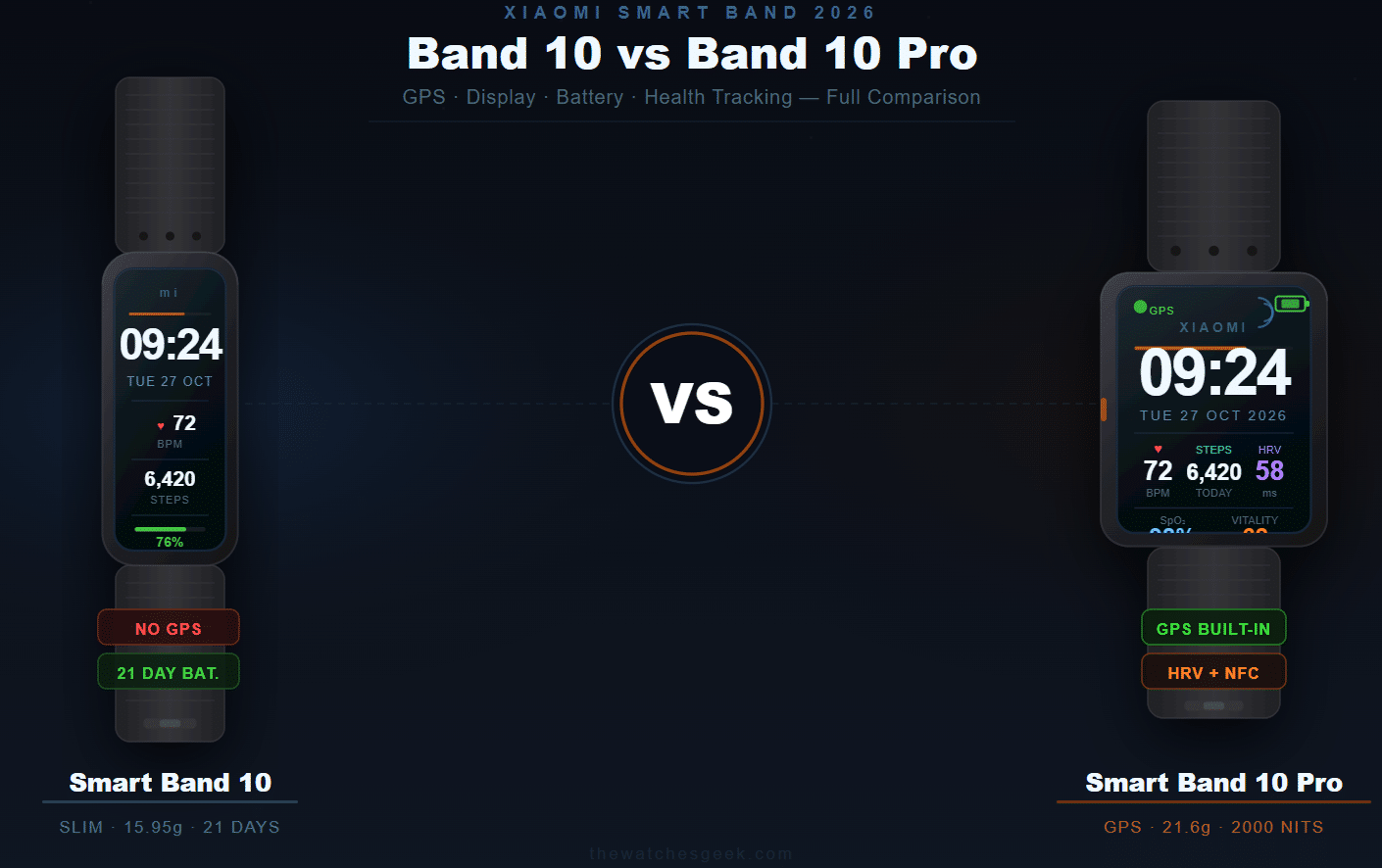
The standard Smart Band 10 is a slim, ultralight fitness band that relies on your smartphone for GPS.
The Smart Band 10 Pro is a wider, slightly heavier device with built-in GPS, meaning it can track your outdoor runs, walks, and bike rides completely on its own, even if you leave your phone at home.
Everything else — the sharper display, the advanced sleep HRV tracking, the AI running pacer, the 400-meter track correction mode — flows from that core difference.
The Pro is for people who train outdoors.
The standard Band 10 is for people who want a clean, lightweight tracker for everyday wellness.
If that one sentence settled it for you, great.
If you want to understand every detail before you decide, keep reading.
Design and Build Quality
Xiaomi Smart Band 10

The Smart Band 10 keeps the same classic pebble shape that the Xiaomi Band series has used for years.
It is a small, oval-shaped module that sits flat on your wrist and barely feels like it is there.
At just 15.95 grams without the strap, it is one of the lightest fitness trackers available anywhere.
You can sleep with it, shower with it, and wear it all day without ever being aware of it.
The frame is aluminum alloy with a sandblasted finish that looks more premium than the budget price suggests.
There is also a Ceramic Edition for buyers who want something that feels extra refined on the wrist, though it is slightly heavier.
The screen sits behind 2.5D glass, which curves gently at the edges.
One thing to know upfront: there are no physical buttons.
The whole interface runs through taps and swipes on the touchscreen. In dry conditions, this works fine.
During a sweaty workout or when your hands are wet, it can become frustrating.
The band also cannot be powered on without placing it on the magnetic charger first, which is an unusual quirk.
The default strap has a clasp mechanism that some users find unreliable.
It has been known to come undone during intense movement. If this bothers you, Xiaomi sells a range of aftermarket straps that use a more secure system.
Dimensions: 46.57 x 22.54 x 10.95 mm Weight: 15.95g without strap (aluminum version) Water resistance: 5ATM (up to 50 meters, suitable for swimming)
Xiaomi Smart Band 10 Pro
The Smart Band 10 Pro looks and feels noticeably different the moment you hold it.
Instead of the slim band shape, it has a wider, more square-ish case that resembles a compact smartwatch.
It is still slim at just 9.7mm in thickness, but the wider 32mm face gives it a more substantial presence on the wrist.
The weight increase over the standard model is real but modest.
At 21.6 grams without the strap (52.5 grams with), it is not heavy by any standard, but those who have worn slim fitness bands for years may notice the change for the first few days.
The frame is high-strength aluminum alloy, available in Glacier Silver, Midnight Black, and Lavender Pink.
There is also a Pearl White Ceramic Edition that uses a ceramic top layer with a fluororubber strap.
The ceramic version has a luxurious, cool-to-the-touch feel and is genuinely one of the nicest-looking budget fitness devices available today.
Just like the standard model, there are no physical buttons. Everything is controlled through the touchscreen.
A microphone is built in for certain voice input functions, but there is no speaker, which means you cannot take calls through the band.
Dimensions: 42.83 x 32.16 x 9.7 mm Weight: 21.6g without strap Water resistance: 5ATM (up to 50 meters)
Design Verdict
For wrist comfort and everyday wearability, the standard Band 10 wins.
It disappears on the wrist.
For looks and a more premium feel, the Band 10 Pro, especially the Ceramic Edition, is in a different league.
Both are well-built for the money.
Display Comparison
Both devices use AMOLED panels, and both look excellent for the budget they sit in.
But there are meaningful differences once you put them side by side.
The Smart Band 10 has a 1.72-inch AMOLED display with a 212 x 520 pixel resolution.
The tall, narrow aspect ratio makes it look like a traditional fitness band.
The peak brightness reaches 1,500 nits, which is genuinely readable in direct sunlight.
The always-on display option is available and typically manages around 9 days of battery life when enabled.
The Smart Band 10 Pro has a 1.74-inch AMOLED display with a 480 x 336 pixel resolution.
That resolution number matters more than it might look at first glance.
The wider 32mm case means the screen is physically broader, giving you more real estate for displaying workout data, maps, and health stats at a glance.
The Pro pushes peak brightness to 2,000 nits, which is noticeably better in harsh outdoor conditions.
You will not need to squint or shade the screen with your hand at the beach.
Both panels use 2.5D curved glass, both support auto-brightness, and both have an always-on display mode.
The Pro has the edge on raw brightness and data density.
The standard Band 10 has the edge on that clean, minimal look that some people prefer.
Health and Fitness Tracking
Both the Smart Band 10 and the Smart Band 10 Pro cover the essentials and then some. Heart rate monitoring runs continuously throughout the day, and both use Xiaomi’s updated PPG optical sensor technology.
In independent testing, the Smart Band 10’s heart rate readings closely matched chest-strap reference devices during workouts, with average deviations under 2 beats per minute. The Pro uses a second-generation PPG module with dual light sources and dual photodetectors, which Xiaomi claims delivers 98.2 percent accuracy. Real-world reviews have confirmed that steady-state exercise readings are very reliable on both devices.
Blood oxygen (SpO2) monitoring is available on both, working either continuously in the background or on demand. Stress tracking, sleep staging with smart alarm, step counting, calorie burn, and over 150 sport modes are standard on both.
The Mi Fitness app connects both to Android and iPhone and syncs with Apple Health, Google Fit, Strava, and Suunto.

Where the Smart Band 10 Pro Goes Further
The Pro adds features that go beyond what the standard Band 10 can do.
Heart Rate Variability (HRV) overnight monitoring is the most significant health upgrade. HRV is a measure of how much variation exists between your heartbeats, and it is one of the best indicators of recovery quality. A low HRV after a hard training week tells you your body has not fully recovered. The standard Band 10 does not track HRV at all, which puts it behind several competitors in this space. The Pro addresses that gap directly.
Vitality Score is a daily wellness score based on your resting heart rate, maximum heart rate, age, and your last seven days of training load. It gives you a number out of 80 each day, making it easier to understand how fit and recovered you are in practical terms.
Sleep HRV Analysis is a step beyond what the standard model offers. The Pro tracks HRV through the night and combines it with sleep stage data to give a more complete picture of sleep quality. The standard Band 10’s sleep tracking is functional but occasionally inaccurate on wake times and REM periods.
Advanced running tools on the Pro include an AI pacer that adjusts your target pace based on your current fitness level, and a 400-meter track correction mode that improves distance accuracy when training on a standard athletics track. These are niche features for casual users but genuinely useful for runners who train seriously.
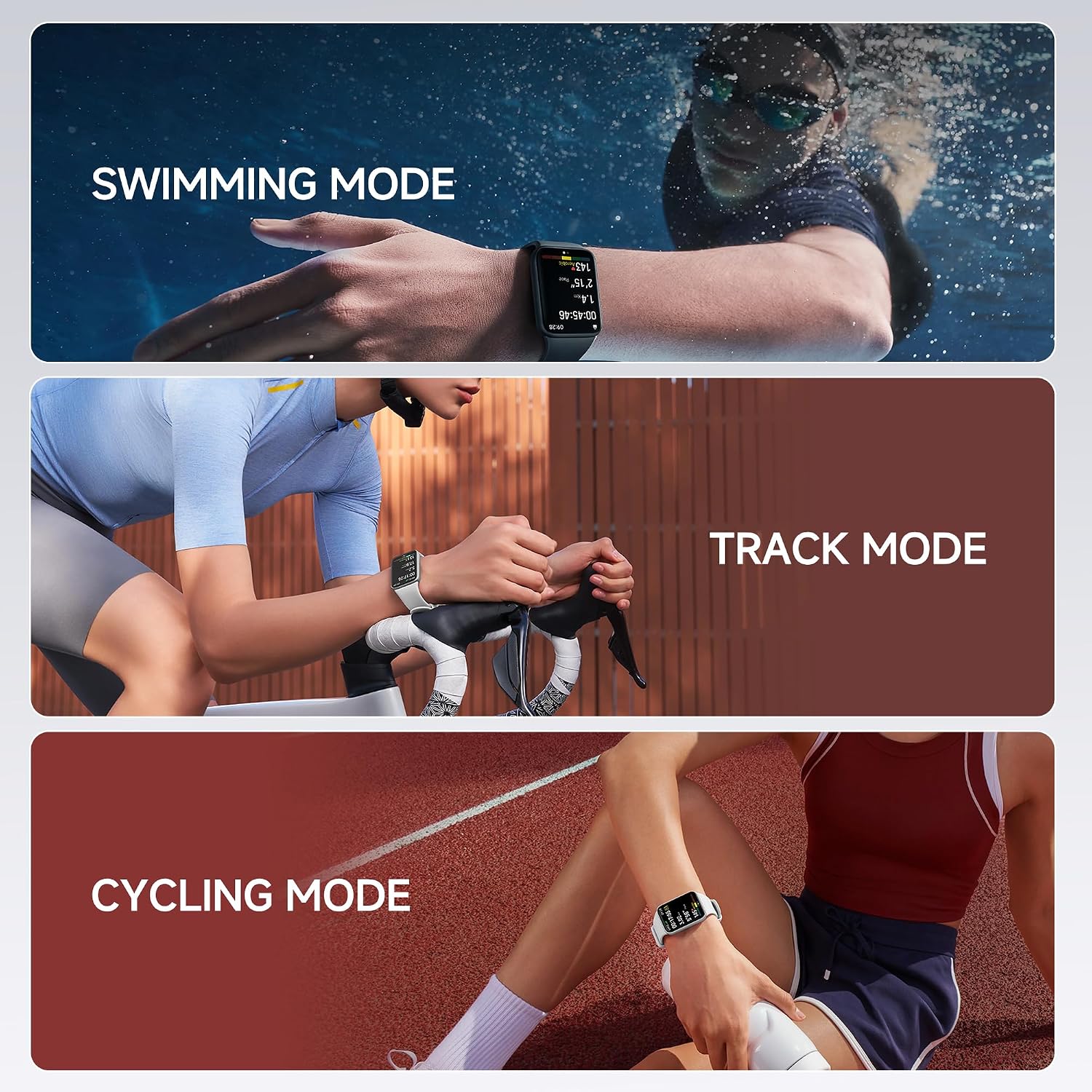
Open-water swimming mode is available on the Pro. Both devices track pool swimming, but only the Pro adds the open-water mode with GPS route recording in water.
GPS Tracking: The Decision-Maker
If you run, cycle, or hike outdoors, this section matters more than any other.
Smart Band 10: Connected GPS
The standard Band 10 does not have a GPS chip.
When you start a run or bike ride, it uses your smartphone’s GPS to track distance and route.
This works adequately in most situations.
The phone needs to be with you, which means either carrying it in your hand, wearing an armband, or using a waist pack.
In testing by multiple reviewers, the connected GPS on the Band 10 showed slight distance underestimates compared to a dedicated running watch, typically in the range of two to three percent.
For casual runs and daily tracking, this is not a problem.
If you are training for a race and want precise pacing data, the variance matters.
The bigger practical issue is the requirement to bring your phone.
Many runners specifically want a fitness band so they can leave the phone behind.
Smart Band 10 Pro: Built-In Multi-GNSS

The Pro carries a five-system GNSS chip supporting GPS, GLONASS, BeiDou, Galileo, and QZSS.
This covers all major satellite navigation systems and gives you strong signal acquisition in most conditions, including urban areas with tall buildings.
In real-world testing, the Pro’s GPS distance and pace matched a dedicated running watch well on familiar routes.
Reviewers noted it is not dual-band GPS, which means it cannot provide the same centimeter-level accuracy as premium devices like the Garmin Forerunner 965.
But for the price, the GPS performance is genuinely impressive.
The Pro records GPS tracks that can be exported as GPX, KML, or TCX files, making it compatible with most fitness analysis platforms.
You can leave your phone at home, track your run, and upload the data when you return.
If outdoor training matters to you and you want the freedom to run without your phone, the Band 10 Pro is the only sensible choice between these two.
Battery Life

Battery life is one of the clearest advantages of the standard Band 10.
The Smart Band 10 packs a 233mAh battery and Xiaomi rates it at 21 days of typical use.
Real-world testing bears this out fairly well.
With heart rate monitoring, sleep tracking, frequent notifications, and regular workouts, most users report 14 to 19 days between charges.
With the always-on display enabled, that drops to around 9 days, which is still excellent.
The Smart Band 10 Pro has a larger 350mAh battery and is also rated at 21 days in its light-use mode.
That mode, however, disables many features.
In normal usage mode with all health tracking active, Xiaomi rates it at 15 days.
With AOD on, it drops to 8 days.
Reviewers who tested it with GPS-tracked workouts and all health features active saw roughly 7 to 10 days in practice.
The trade-off is direct: the Pro does more, which costs more battery.
If you use GPS for an hour-long run every day, you will be charging more often.
Charging times differ too. The standard Band 10 reaches full charge in about one hour.
The Pro takes roughly 1.5 hours due to its larger battery. Both use magnetic charging cables.

Smart Features: NFC and Notifications
NFC Payments
The standard Smart Band 10 does not include NFC in the global version.
Buyers in China may have access to an NFC variant, but this does not carry over to the units sold internationally.
The Smart Band 10 Pro includes NFC on its Ceramic Edition.
This enables contactless payments through Xiaomi Pay on supported Mastercard and Visa terminals. Coverage depends on your bank and region.
At the time of this review, NFC payments on the Band 10 Pro worked with a limited number of partner banks in Europe, and availability varies widely by country.
If NFC payments are a priority, check Xiaomi’s current list of supported banks in your region before buying.
Notifications and Calls
Both devices display incoming notifications from your phone, including messages, app alerts, and incoming call alerts.
The standard Band 10 and the Pro both show text content from notifications clearly, though neither supports emoji display well.
Neither device has a speaker, which means you cannot answer calls through the band.
The Pro has a microphone for certain input functions, but audio output simply does not exist on either model.
If you want to take calls from your wrist, you will need a smartwatch like the Apple Watch or Samsung Galaxy Watch.
Neither device supports quick replies to messages.
Music Control
Both devices include music playback controls that let you pause, play, skip tracks, and adjust volume from your wrist.
These work with your phone’s music app and most streaming services.
Neither device has onboard music storage.
Software and App Experience
Both devices run on Xiaomi’s Mi Fitness app available on Android and iOS.
The app works for logging workouts, reviewing health trends, setting alarms and customizing watch faces, but it’s not as polished as the Garmin Connect, Fitbit or Samsung Health app.
The app tracks detailed data for up to one month and syncs with Apple Health, Google Fit, Strava and Suunto, so it covers most popular third-party fitness platforms.
You can customize your watch face to a great extent and there is a huge library of watch faces that you can download.
Common criticisms include a slightly cluttered layout in some menus, limited social features, and the health insight recommendations being basic rather than personalized.
For someone who wants clean data logging without needing deep analysis tools, the app does the job. For data enthusiasts, it may feel thin.
The Smart Band 10 runs on HyperOS 2.0. The Smart Band 10 Pro runs on HyperOS 3.2.
The Pro’s firmware is newer and has some improvements in interface responsiveness and notification handling.
Full Specification Comparison Table
| Feature | Smart Band 10 | Smart Band 10 Pro |
|---|---|---|
| Display size | 1.72 inches | 1.74 inches |
| Resolution | 212 x 520 px | 480 x 336 px |
| Peak brightness | 1,500 nits | 2,000 nits |
| Case width | 22.54 mm | 32.16 mm |
| Thickness | 10.95 mm | 9.7 mm |
| Weight (no strap) | 15.95g | 21.6g |
| Battery capacity | 233 mAh | 350 mAh |
| Battery life (typical) | 21 days | 15 days (normal mode) |
| Battery life (AOD) | 9 days | 8 days |
| Full charge time | ~1 hour | ~1.5 hours |
| Built-in GPS | No (connected phone GPS) | Yes (5-system GNSS) |
| NFC | No (global version) | Yes (Ceramic Edition) |
| HRV monitoring | No | Yes (overnight) |
| AI running pacer | No | Yes |
| 400m track mode | No | Yes |
| Open-water swimming | No | Yes |
| Vitality Score | No | Yes |
| Barometer | No | Yes |
| Microphone | No | Yes |
| Speaker | No | No |
| Bluetooth | 5.4 | 5.4 |
| Water resistance | 5ATM | 5ATM |
| OS | HyperOS 2.0 | HyperOS 3.2 |
| App | Mi Fitness | Mi Fitness |
| Phone support | Android 8.0+, iOS 12+ | Android 8.0+, iOS 14+ |
Xiaomi Smart Band 10:
Who Should Buy the Xiaomi Smart Band 10
The Smart Band 10 is the right choice for the casual fitness tracker user who wants clean, reliable health monitoring without paying for features they will never use.
Buy it if you primarily track steps, sleep, and heart rate throughout the day.
Buy it if you work out at the gym or follow indoor training programs and do not need GPS route tracking.
Buy it if you prefer the lightest possible device on your wrist and do not want anything that feels like a watch.
Buy it if battery life is a priority and you want to charge once every two weeks or less.
It is also a strong choice for older users or teenagers picking up their first fitness tracker, because the interface is clean, the health features are easy to understand, and the small size means it never gets in the way.
Who Should NOT Buy the Xiaomi Smart Band 10
Do not buy it if outdoor running, cycling, or hiking is a core part of your routine and you want GPS data without carrying your phone.
Do not buy it if you train seriously and want recovery tools like HRV monitoring to guide your rest days and training load.
Do not buy it if you need NFC contactless payments built into your tracker.
Do not buy it if you already own the Xiaomi Smart Band 9, since the hardware improvements between the two generations are minor and the display upgrade alone does not justify a full repurchase.
Xiaomi Smart Band 10 Pro:
Who Should Buy the Xiaomi Smart Band 10 Pro
Buy the Smart Band 10 Pro if you run, cycle, or hike outdoors and want accurate GPS tracking without carrying your phone.
This is the primary reason to choose the Pro, and it justifies the step up on its own.
Buy it if you take your recovery seriously and want overnight HRV data to understand how well your body is adapting to training load.
Buy it if you want the wider, brighter screen and do not mind the slightly larger form factor.
Buy it if you want the Ceramic Edition specifically and need NFC payment capability in your tracker.
It is also worth considering for competitive runners who want track correction mode and AI pacing tools, or open-water swimmers who want accurate distance tracking in the pool and beyond.
Who Should NOT Buy the Xiaomi Smart Band 10 Pro
Do not buy it if you primarily use your tracker indoors and never do outdoor runs, rides, or hikes.
You would be paying for a GPS chip you will never use.
Do not buy it if maximizing battery life is your top priority.
The standard Band 10 simply lasts longer between charges with regular use.
Do not buy it expecting full smartwatch functionality.
There is no speaker for calls, no voice assistant, no app store, and no navigation turn-by-turn on the device.
It is still a fitness tracker, not a smartwatch.
Do not buy it if budget is the primary concern.
The Pro costs more, and if the features that justify that premium do not apply to your lifestyle, the standard Band 10 is the smarter choice.
Final Verdict
Both the Xiaomi Smart Band 10 and the Smart Band 10 Pro are genuinely impressive fitness trackers for the money.
Xiaomi has been refining this product line for years, and both devices reflect that experience.
The Smart Band 10 is for the everyday wellness user.
If you want something lightweight, long-lasting, and straightforward that tracks your health without getting in the way, the Band 10 does that job better than almost anything at its price point. It is the smarter buy for the majority of people.
The Smart Band 10 Pro is for the active person who trains outdoors. The built-in GPS alone separates it from the standard model in a way that matters the moment you step outside for a run.
Add in overnight HRV, the AI running pacer, the brighter screen, and the ceramic design option, and the Pro becomes one of the most capable budget fitness trackers available in 2026.
If any of those features apply to your life, the Pro is worth every extra rupee.
If you want to explore the world of serious fitness tracking further, our guide on the best military tactical watches covers watches built for demanding outdoor environments.
For wearables with eye-catching luminous dials, the best luminous watches list has excellent options at every budget.
Frequently Asked Questions
Does the Xiaomi Smart Band 10 have GPS? No. The standard Smart Band 10 does not have a built-in GPS chip. It uses your connected smartphone’s GPS to record outdoor routes and distances. You need to carry your phone during outdoor workouts to get accurate GPS data.
Does the Xiaomi Smart Band 10 Pro have GPS? Yes. The Smart Band 10 Pro has built-in five-system GNSS supporting GPS, GLONASS, BeiDou, Galileo, and QZSS. It can record outdoor runs, rides, and hikes completely independently without your phone.
What is the difference between the Band 10 and Band 10 Pro? The key differences are built-in GPS (Pro only), overnight HRV monitoring (Pro only), a wider 32mm display with 2000-nit brightness (Pro), advanced running tools including AI pacing and 400m track mode (Pro), and NFC payments on the Ceramic Edition (Pro). The standard Band 10 is lighter, cheaper, and has longer real-world battery life.
Can you take calls on the Xiaomi Smart Band 10 Pro? No. Neither the Smart Band 10 nor the Smart Band 10 Pro has a speaker. The Pro has a microphone but no audio output, so you cannot take calls through either device.
Is the Xiaomi Smart Band 10 waterproof? Both the Smart Band 10 and the Smart Band 10 Pro are rated at 5ATM, meaning they can be submerged up to 50 meters. Both are safe for pool swimming, showering, and rain. Xiaomi advises against using either in hot showers, saunas, or during scuba diving.
What app does the Xiaomi Smart Band 10 use? Both devices use the Mi Fitness app, available for free on Android and iOS. The app syncs with Apple Health, Google Fit, Strava, and Suunto.
Which Xiaomi Smart Band 10 should I buy if I am a beginner? The standard Smart Band 10 is the better starting point for most people. It is more affordable, lighter, has better battery life, and covers every essential health tracking feature a beginner needs. The Pro’s extra features only matter once you are regularly doing outdoor workouts without your phone or want deeper recovery data.
Luis Cooper

Hi, I'm Luis, the guy behind this site. I love wearing watches, especially ones that look great on small wrists (mine are about 6.3" around). The Watches Geek is dedicated to helping you learn about and buy watches that you will love wearing. I want this website to be the last destination for people to pick the best watches to fit their needs. You can find our unbiased reviews here on Thewatchesgeek.