

Last Updated on April 3, 2026 by Luis Cooper
Are you guys looking for smartwatches with the best battery life?
Here, I’m going to list some smartwatches for you.
Finding a smartwatch with good battery life could be challenging, but not impossible.
The battery is an essential part of every technology.
You must first check the battery life if you’re planning to get an expensive smartwatch or smartphone.
Let’s dive into the article to learn more about smartwatches with the best battery life.
Which Smartwatches have the best battery life?
Here are my recommended top 8 Smartwatches with the best battery life:-


![Samsung Galaxy Watch Ultra (2025) 47mm LTE Smartwatch, Titanium Casing, Advanced Sleep Coaching, Running Coach, Energy Score, Heart Rate Tracking, GPS, Titanium Silver [US Version, 2 Yr Warranty]](https://m.media-amazon.com/images/I/51tqxcqQXyL._SL160_.jpg)


Garmin Enduro 3 (51mm, Solar): (Best Smartwatch for Extreme Battery Life)

There are smartwatches with good battery life, and then there is the Garmin Enduro 3.
These are two very different categories.
When a reviewer crashes motorcycles, tomahawks on a snowboard, hikes in temperatures from 0 to 110 degrees Fahrenheit, and the watch comes out looking exactly as it did on day one, you start to understand what Garmin actually built here.
This is not a smartwatch that happens to have outdoor features.
It is an expedition tool that happens to sit on your wrist.
The Battery Life That Changes Everything:
Up to 36 days in smartwatch mode.
Up to 120 hours with GPS running continuously.
Push that further with solar charging, and you are looking at 90 days in smartwatch mode and 320 hours of GPS tracking under good sunlight conditions.
Real-world thru-hikers consistently report 30 to 45 days of life in mixed conditions without touching a charger.
What this actually means, day to day, is that you genuinely stop thinking about your watch’s battery.
For multi-day expeditions, long ultras, or thru-hikes where power access is unreliable or nonexistent, no other GPS watch on the market comes close.
The solar charging works through a redesigned ring that wraps around the 1.4-inch MIP display.
Compared to the Enduro 2, which used the entire screen as a solar panel, this approach produces twice the energy harvest while also making the display noticeably clearer.
An hour or two in strong sunlight makes a visible dent in the battery percentage.
Built to Outlast Almost Everything:
The 51mm case features a fibre-reinforced polymer body, a titanium bezel, and sapphire crystal glass.
At 63 grams, including the nylon strap, it is over 34% lighter than the Garmin Fenix 8, which is remarkable given the size.
The nylon UltraFit strap is genuinely one of the best watch straps available on any GPS watch at any price.
Flexible, breathable, and secure without pressure points, it is the reason most reviewers forget they are wearing a large watch within a few days.
Navigation That Keeps Up:
Full-color TopoActive maps come preloaded. No phone needed, no connection required.
ClimbPro shows you the upcoming elevation gain in real time on a dedicated screen.
TracBack creates a route back to your starting point.
Multi-band GPS with five satellite systems ensures positioning remains accurate even in dense forests and deep canyons, where single-band watches drift.
In real-world testing of 6-mile runs with a COROS watch, route distances matched exactly from the first session.
The LED flashlight mounted at 12 o’clock sounds like a gimmick until you actually need it at 4 AM in a tent or at a remote aid station.
It is brighter and more useful than most reviewers expect going in.
The Sensors Worth Knowing About:
The Elevate Gen 5 heart rate sensor adds ECG capability and skin temperature tracking to the already solid suite of heart rate, SpO2, stress, HRV, and sleep monitoring.
Accuracy holds up well across casual to moderate exercise. Where it struggles, as with most wrist-based sensors, is during strength training movements that require a tight grip. A chest strap paired via ANT+ solves this completely.
What You Give Up:
No microphone or speaker means no phone calls from the wrist and no voice assistant.
No AMOLED display means colours are flat compared to Garmin’s Fenix 8 AMOLED, though in direct sunlight, the MIP screen actually wins for readability.
The watch comes in one size only, and 51mm will genuinely be too large for people with smaller wrists.
These are the trade-offs Garmin made to achieve the battery life, and they are deliberate, not oversights.
Who Should Buy This:
Ultrarunners, thru-hikers, backcountry skiers, and endurance athletes who treat battery life as a non-negotiable rather than a nice-to-have.
If you have ever cut a route short because of a dying GPS watch or spent a rest day anxiously looking for a power source, this watch solves that problem completely.
Who Should Skip This:
Anyone who wants Bluetooth calling, voice controls, an AMOLED display, or a compact watch that disappears on a small wrist.
Also not the right fit for casual gym users who primarily track indoor workouts.
Specifications:
| Feature | Details |
|---|---|
| Display | 1.4″ MIP transflective, 280x280px |
| Glass | Sapphire crystal |
| Case Size | 51mm (one size only) |
| Case Material | Fibre-reinforced polymer with titanium bezel |
| Weight | 63g with strap |
| Thickness | 15.7mm |
| Battery Life | 36 days smartwatch / 120 hours GPS / 320 hours GPS with solar |
| Solar Charging | Yes, redesigned Power Glass solar ring |
| Water Resistance | 10ATM (100m) |
| GPS | Multi-band, 5 satellite systems |
| Heart Rate Sensor | Elevate Gen 5 with ECG and skin temperature |
| Health Features | Heart rate, SpO2, sleep, stress, HRV, ECG, skin temperature |
| Navigation | TopoActive full-color offline maps, ClimbPro, TracBack |
| Sports Modes | 150 plus activity profiles |
| Flashlight | Built-in LED at 12 o’clock position |
| Smart Features | Garmin Pay, offline music, Garmin Messenger |
| Connectivity | Bluetooth, ANT Plus, Wi-Fi |
| Compatibility | Android and iPhone |
| Strap | 26mm UltraFit nylon |
OnePlus Watch 3: (Best Wear OS Smartwatch for Battery Life)

Most Wear OS watches share the same quiet defeat.
You start the morning with a full charge, use GPS for a workout, keep notifications on throughout the day, wear it to bed for sleep tracking, and by the second evening, you are already reaching for the charger.
OnePlus got tired of that pattern before most of its users did, and the Watch 3 is the result of actually fixing it rather than just talking about it.
The Emerald Titanium version is the one that turns heads.
Silver titanium bezel, green strap, and a 1.5-inch AMOLED screen that hits 2,000 nits of brightness in direct sunlight.
It looks more like a luxury dress watch than a fitness tracker.
The sapphire crystal glass on the display has the scratch resistance to match that premium appearance in real use, not just on paper.
The Dual Engine Setup That Actually Works:
Two chips sit inside this watch.
The Qualcomm Snapdragon W5 handles Wear OS when you need the full smartwatch experience.
An energy-efficient BES2800 co-processor quietly handles background tasks and powers the Power Saver mode when battery conservation matters most.
The switch between these two modes occurs entirely in the background, without interrupting what you are doing on the watch.
The result is up to 5 days in full Smart Mode with GPS workouts, sleep tracking, and notifications running continuously.
Turn on the always-on display, and real-world testers consistently hit 4-4.5 days.
Switch to Power Saver mode, and the watch stretches to 16 days.
For a watch that gives you the complete Wear OS experience, including the Play Store, Google Maps, Spotify, and contactless payments, those numbers are in a different category from anything else running Android on the wrist.
When it does need charging, the 10W fast charger takes it from flat to full in under an hour.
Wear OS With Everything That Means:
Because this runs full Wear OS 5, every app you would expect is available.
Strava, Spotify, AllTrails, Audible, Google Pay, and Google Maps on your wrist.
The rotating digital crown, new for this generation, makes scrolling through menus and app lists genuinely comfortable.
Its haptic feedback is one of the most satisfying physical interactions on any smartwatch currently available.
Health tracking covers heart rate using an 8-channel optical sensor, SpO2 with 16-channel accuracy, stress monitoring, sleep stages, wrist temperature, vascular health, and arterial stiffness readings.
The animated post-workout maps in the OHealth app, which overlay your route with multiple data points in satellite view, are genuinely more useful for training analysis than those offered by most competing apps.
Important to Know Before Buying:
This watch is Android only.
No iOS compatibility, no workarounds.
No LTE, so your phone needs to be nearby for calls and notifications.
ECG functionality is hardware-ready but only activated in certain regions outside North America.
At 81 grams including the strap and 46.6mm across the case, it is a substantial watch that sits clearly on the wrist.
People with smaller wrists will notice it.
Who Should Buy This:
Android users who want the full Wear OS app ecosystem, a premium build, and battery life that finally makes a Wear OS watch practical for extended daily use.
Who Should Skip This:
iPhone users, anyone seeking LTE independence, or those with smaller wrists who prefer a lighter, more compact watch.
Specifications:
| Feature | Details |
|---|---|
| Display | 1.5″ LTPO AMOLED, 2000 nits |
| Glass | 2D Sapphire crystal |
| Case Size | 46.6mm |
| Case Material | Stainless steel with titanium bezel |
| Weight | 81g with strap |
| Battery | 631mAh silicon-carbon |
| Battery Life | Up to 5 days Smart Mode / 16 days Power Saver |
| Charging | 10W fast charging, 0 to 100% under 60 minutes |
| Water Resistance | 5ATM and IP68 |
| GPS | Dual-band L1 and L5 |
| Chipsets | Snapdragon W5 plus BES2800 co-processor |
| Storage | 32GB |
| RAM | 2GB |
| Health Features | Heart rate, SpO2, sleep, stress, temperature, vascular health, arterial stiffness |
| Operating System | Wear OS 5 with RTOS Power Saver mode |
| Compatibility | Android only, no iOS support |
| Military Rating | MIL-STD-810H certified |
Garmin vivosmart® 5: (Best Fitness Tracker with Long-Lasting Battery)

WHAT DO WE GET FROM THESE?
COMFORT AND USE:
This smartwatch is easy to use and comfortable to wear.
You just have to set it up once with the Garmin Connect app.
It has a touch screen and a bright, larger display.
MODES AND BATTERY LIFE:
You’ll get an uninterrupted health profile with 7 days of battery life in its normal mode.
It’s safe for swimming and showering too.
MONITORING:
This smartwatch can detect respiration, pulse rate, body battery level, menstrual cycle, hydration, stress, and heartbeat.
It will also notify you regarding your progress.
SLEEP:
You’ll get notified if you need to improve your sleep.
Through the Garmin Connect app, you’ll get notified.
FITNESS:
You can achieve your fitness goals through age, stepping, calories burnt, and intense training.
PHYSICAL ACTIVITY:
It has a sports feature by which you can get your activity profile, such as walking, running, yoga, cardio, swimming pool, and much more.
GPS:
It will connect to your smartphone to track outdoor walks, runs, and rides.
NOTIFICATIONS:
It will keep you connected with your phone to get notified of calls, messages, calendar views, social media, and much more.
SAFETY:
If an emergency occurs, they’ll notify your emergency contacts about any injury.
DESIGNS:
It’s designed to be user-friendly and makes band replacements easy and convenient.
CONCLUSION:
The Garmin Vivosmart is easy to use and comfortable to wear.
It tracks your every physical activity, including yoga, cardio, walking, running, and more.
This wristwatch will inform you about your heart rate, stress level, and body battery.
Moreover, when it’s connected to your phone and a sudden injury occurs, it will notify your contacts of an emergency.
Samsung Galaxy Watch Ultra: (Best Samsung Smartwatch for Battery Life)

Samsung makes some excellent smartwatches, but most share one familiar weakness: you have to charge them every day or every other day.
The Galaxy Watch Ultra is the one exception in Samsung’s lineup.
With a 590mAh battery and the efficient Exynos W1000 chip, it gives you significantly more time between charges than any other Samsung watch currently available.
In real-world use with always-on display active, workouts tracked, and sleep monitoring running through the night, the Watch Ultra consistently delivers around 48 hours of continuous use.
Turn the always-on display off, and you get closer to 72 to 80 hours. Switch to Power Saving mode, and the watch can stretch to 100 hours, which is just over four days.
For a fully featured Wear OS smartwatch with GPS, ECG, and health tracking all running, those numbers stand out from the competition within the Wear OS category.
The charging is just as practical.
It supports 25W fast charging and reaches 50% in roughly 30 minutes, so a quick charge while getting ready in the morning keeps you covered for the next couple of days.
Built for People Who Push Hard:
The Grade 4 titanium case is not just a marketing term.
Multiple reviewers have noted the watch holds up without scratches or damage through genuinely rough activities.
The sapphire crystal glass, 10ATM water resistance to 100 meters, and MIL-STD-810H military durability certification make this a watch you can wear without worrying.
There is also a built-in emergency siren that emits 86 decibels and can be heard up to 180 meters away, which is the kind of feature that sounds unusual until you actually need it in the backcountry.
The 1.5-inch AMOLED display hits 3,000 nits of peak brightness, making it one of the most readable outdoor smartwatch displays from any brand.
Health and Coaching Features That Go Deeper:
Energy Score gives you a daily snapshot of how ready your body actually is before you train.
Running Coach builds personalized training plans based on your fitness data.
Advanced Sleep Coaching now includes sleep apnea detection.
Two genuinely new additions in 2025 are Vascular Load monitoring during sleep and an Antioxidant Index that tracks how your diet may be affecting your long-term health.
These are not features you find on most smartwatches at any price.
Google Gemini is built in and handles voice commands well enough that asking it to start a run and play a playlist simultaneously actually works without any extra steps.
The one limitation worth knowing before you buy: it’s Android-only.
No iOS compatibility.
No LTE option outside of pairing with your phone, either, which means your phone needs to be nearby for full functionality.
Who Should Buy This:
Android users who want Samsung’s best hardware, serious battery life within the Wear OS ecosystem, and features built for real outdoor use.
Who Should Skip This:
iPhone users, anyone wanting a compact everyday watch, or anyone seeking the longest battery life in any category, regardless of OS.
Specifications:
| Feature | Details |
|---|---|
| Display | 1.5″ AMOLED, 480x480px, 3000 nits |
| Glass | Sapphire crystal |
| Case Size | 47mm |
| Case Material | Grade 4 titanium |
| Weight | 60.1g |
| Battery | 590mAh |
| Battery Life | Up to 80 hours / 100 hours Power Saving |
| Charging | 25W fast charging, 50% in 30 minutes |
| Water Resistance | 10ATM (100m) |
| GPS | Dual-frequency |
| Chipset | Exynos W1000 (3nm) |
| Storage | 64GB |
| Health Features | ECG, heart rate, SpO2, sleep, blood pressure, Vascular Load, Antioxidant Index |
| Smart Features | Google Gemini, Google Pay, Running Coach, Energy Score, emergency siren |
| OS | Wear OS 6 with One UI Watch 8 |
| Compatibility | Android only |
| Military Rating | MIL-STD-810H |
Garmin Forerunner 35: (Best Garmin Smartwatch with Good Battery)
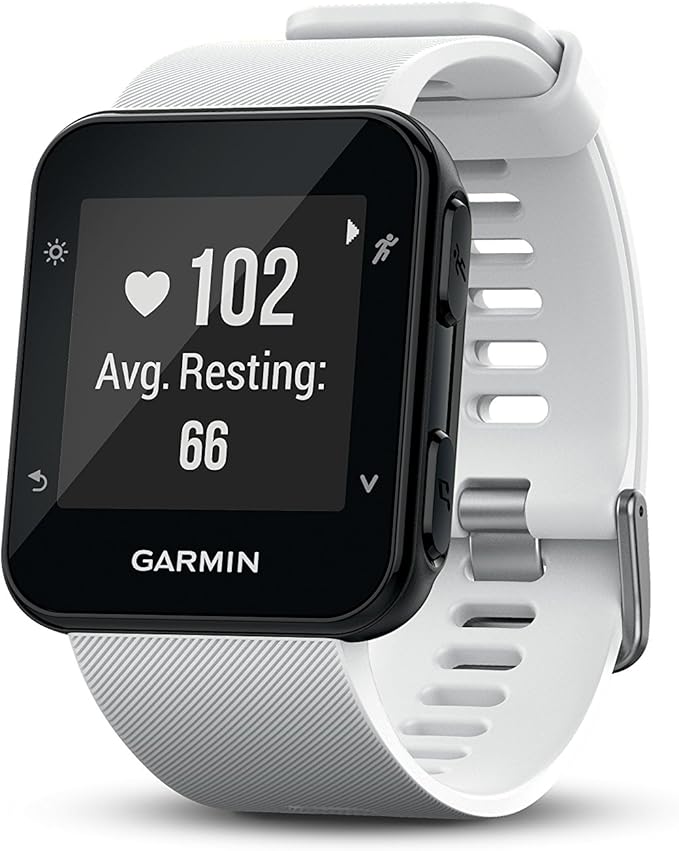
It’s easy to use and has a GPS to help you navigate.
It can also detect your heart profile.
It was very convenient to make our trip.
This smartwatch is a game-changer.
Grab this amazing smartwatch at such an affordable price.
WHAT DO WE GET IN THESE?
GPS:
It’s easy to use. While you connect your mobile phone’s GPS app, you’ll track how far, how fast, and where you run.
TECHNOLOGIES:
It has wrist-based heart rate technology that detects heart rate day and night.
FEATURES:
It provides smart notifications, automatic uploads, live tracking, and music controls.
FITNESS:
It has a day-tracking feature that detects your calories, steps, and intensity, and notifies you where to move.
CONCLUSION:
Garmin smartwatch is easy to use and can be connected to GPS, by which you’ll be able to track how fast, how far, and where you’ve to run.
This smartwatch will monitor your heart rate day and night.
It will provide you with smart notifications, uploads, tracking, and music controls.
It has a day-tracking feature that will detect your calories, steps, and intensity and notify you where you’ve to move.
COROS PACE Pro GPS Sport Watch: (Best AMOLED Running Watch for Battery Life)

Most AMOLED sports watches force you to choose between a bright screen and a long battery life.
The COROS PACE Pro is the first watch from COROS to say you don’t have to pick one or the other.
It brings a vivid, always-on AMOLED display while still delivering 20 days of daily use and 38 hours of continuous GPS tracking on a single charge.
For runners who want a good-looking screen without babysitting the battery every couple of days, that combination is genuinely hard to find at this price elsewhere.
How the Battery Actually Holds Up:
In real-world testing, reviewers consistently hit 5 to 6 days of battery life even with the always-on display active and GPS workouts running every day in the most accurate dual-frequency mode.
Turn the always-on display off and switch to raise-to-wake instead, and the watch pushes toward the full 20-day claim.
A runner who was injured and not doing workouts for a stretch reported the watch outlasting even the 7-day estimate, with the screen always on.
One hour of GPS activity typically drains about 1 to 3 per cent of the battery, which means daily training barely moves the needle.
Built Light, Built Fast:
At 37 grams with the nylon strap, the PACE Pro is the lightest AMOLED sports watch currently on the market.
That matters in a race.
The Ambiq Apollo510 processor delivers more than twice the processing power of the COROS PACE 3, making scrolling through maps and menus snappy in a way that cheaper GPS watches never feel.
Map zoom speed is three times faster than older COROS models, so pulling up your route mid-run doesn’t involve waiting around.
The 1.3-inch AMOLED screen hits 1,500 nits of brightness.
In direct sunlight, the display stays readable without needing to shade it with your hand.
The auto-adjusting brightness sensor handles transitions from shade to sunlight automatically.
Navigation That Works Without a Phone:
Global offline maps are stored directly on the watch using its 32GB of built-in storage.
Download topographic and landscape maps through the COROS app before you head out, then follow turn-by-turn directions from your wrist with no phone needed.
Dual-frequency GPS with support for all major satellite systems keeps positioning accurate in urban canyons and remote trails alike.
Sleep tracking and nap detection run alongside the training tools, with recovery time estimates helping you decide when to push and when to back off.
Who Should Buy This:
Runners and triathletes who want an AMOLED display, serious GPS accuracy, offline maps, and 20 days of battery life without carrying the bulk of a premium outdoor watch.
Who Should Skip This:
Anyone who needs smart features like Google Pay or a full app ecosystem.
Also worth knowing is that heart rate tracking accuracy during cycling has shown some inconsistencies in independent testing.
Specifications:
| Feature | Details |
|---|---|
| Display | 1.3″ AMOLED, Always-On, 1500 nits |
| Glass | Mineral glass |
| Case Size | 46mm |
| Case Material | Fibre-reinforced polymer |
| Weight | 37g nylon strap / 49g silicone strap |
| Battery Life | 20 days daily use / 38 hours GPS / 31 hours dual-frequency GPS |
| Charging | USB-C keychain adapter |
| Water Resistance | Swim-proof |
| GPS | All-systems plus dual-frequency |
| Storage | 32GB |
| Processor | Ambiq Apollo510 |
| Health Features | Heart rate, SpO2, sleep, nap detection, recovery time, ECG |
| Navigation | Global offline maps, turn-by-turn, topographic maps |
| Strap Width | 22mm |
| Compatibility | Android and iPhone |
| Subscription | None required |
Polar Grit X :(Best GPS Smartwatch with Ultra Long Battery Life)

I’m a smartwatch lover.
I love to collect watches for myself.
This time I was looking for a unique watch with good battery life.
The smartwatches I had were good, but their batteries didn’t last long.
I discussed it with my friend, who told me about the Polar Grit X-Rugged Multisport GPS smartwatch.
This smartwatch was perfectly according to my requirements.
Its battery life is amazing and can last up to 40 hours nonstop.
If you’re also looking for a smartwatch with good battery life, get your hands on this.
WHAT DO WE GET FROM THESE?
BATTERY LIFE AND WEIGHT:
It is the lightest outdoor watch with up to 40 hours of battery life with full GPS and HR tracking.
It weighs 20-30% less than other watches.
DURABILITY:
It’s water resistant for up to 100mm-10ATM.
DETECTING:
It will automatically show your speed, distance, and altitude data for your route.
MEASUREMENTS:
It will safely improve your body further overnight.
CONCLUSION:
The Polar Grit is light in weight and can be used outdoors, and its battery can last for up to 40 hours.
It’s water resistant for up to 100-10ATM.
This watch will help you detect your speed, distance, and altitude for your route.
Moreover, this will keep you informed about your fitness.
You can also use it for adventures.
Amazfit Bip 6: (Best Budget Smartwatch With Long Battery Life)

Here is the thing about most budget smartwatches with AMOLED displays.
The screen looks great for about a day and a half, and then you spend the rest of the week looking for the charger.
The Amazfit Bip 6 breaks that pattern in a way that catches people off guard.
Reviewers who picked it up expecting it to last a week came back reporting 12 to 13 days of actual use under moderate conditions, with one user tracking exactly 47% battery remaining after a full seven days of continuous wear.
That number is backed up across multiple independent tests.
With continuous heart rate monitoring, nightly sleep tracking, and GPS sessions a few times a week, real-world results consistently fall between 10 and 14 days.
Disable the always-on display and cut back on GPS usage, and the watch stretches comfortably toward the full two-week claim.
Enable battery saver mode and the estimate climbs to 26 days, though most features shut down at that point.
The overnight battery drain is particularly impressive.
Multiple reviewers noted drops of only 1 to 3 per cent during overnight sleep tracking, meaning the watch barely draws on its battery while collecting sleep stage data.
For a watch that gives you two weeks of life, charging becomes something you do once at the start of the month and then mostly forget about.
The Screen That Makes the Battery Life More Impressive:
Most watches hit 14 days by using older, power-efficient MIP or LCD screens.
The Bip 6 does it with a 1.97-inch AMOLED display that peaks at 2,000 nits.
That is the same brightness figure Garmin quotes for the Forerunner 970, a watch that costs considerably more.
Colors are vivid, text is sharp, and it stays readable in direct sunlight without needing to shade it with your hand.
The fact that Amazfit managed this battery life with an AMOLED panel is the actual engineering achievement here, not just the headline number.
What You Get Day-to-Day:
The BioTracker sensor continuously monitors heart rate, SpO2, stress, and sleep.
Built-in GPS with five satellite system support handles outdoor tracking without needing your phone.
More than 140 workout modes include a dedicated HYROX race mode.
Bluetooth calls and text notifications work with both Android and iPhone.
Zepp Flow voice control lets you start workouts, check health stats, and reply to messages without touching the screen at all, which multiple reviewers found genuinely useful after a few days of using it.
Honest Limitations:
GPS drains the battery faster than daily wear, dropping roughly 6 percent per 30-minute session.
Sleep tracking occasionally misses brief wake-up periods, logging them as naps rather than part of the main sleep session.
No sapphire glass, just tempered glass, so careful handling helps over time.
Who Should Buy This:
Anyone who wants two weeks of battery life, a bright AMOLED screen, and solid everyday health tracking without paying a premium.
Who Should Skip This:
Anyone who needs precise GPS accuracy for competitive racing, or who wants premium glass protection and ECG monitoring.
Specifications:
| Feature | Details |
|---|---|
| Display | 1.97″ AMOLED, 2000 nits |
| Glass | Tempered glass |
| Case Size | 46mm (square) |
| Case Material | Aluminium alloy with polymer case |
| Weight | Under 30g without strap |
| Battery | 340mAh |
| Battery Life | Up to 14 days typical / 26 days power saver / 6 days heavy use |
| GPS Battery | 32 hours continuous |
| Water Resistance | 5ATM (50m) |
| GPS | Single-band, 5 satellite systems |
| Heart Rate Sensor | BioTracker 6.0 |
| Health Features | Heart rate, SpO2, sleep, stress, PAI score, readiness score |
| Sports Modes | 140 plus including HYROX |
| Smart Features | Bluetooth calls, Zepp Flow AI voice, offline maps, Apple Health sync |
| Charging | 1.5 to 2.5 hours full charge |
| Strap Width | 22mm, standard compatible |
| Colors | Black, Red, Blush, Stone, Charcoal |
| Compatibility | Android and iPhone |
| Subscription | None required |
Ending paragraph:
We have finalised our discussion about smartwatches with the best battery life.
Do you guys have any experience with smartwatches with the best battery life?
What are your thoughts on them?
Is there any smartwatch you love to give that I didn’t mention in this article?
Would you please leave your comments below?
Related Posts:
Garmin Fenix 8 Pro vs Enduro 2: Full Review
Best Potential Rolex Investments
Best Fitness Trackers for Sensitive Skin
How Do Watches Work Without Batteries?
Best Smartwatches with Music Storage
Luis Cooper

Hi, I'm Luis, the guy behind this site. I love wearing watches, especially ones that look great on small wrists (mine are about 6.3" around). The Watches Geek is dedicated to helping you learn about and buy watches that you will love wearing. I want this website to be the last destination for people to pick the best watches to fit their needs. You can find our unbiased reviews here on Thewatchesgeek.