
Last Updated on August 2, 2026 by Luis Cooper
Most people assume every watch needs a battery.
It makes sense — phones need charging, laptops need power, earbuds die after a few hours.
The idea that a watch on your wrist is running on nothing but a coiled piece of metal, or the motion of your arm, or the light coming through a window, feels almost too simple to be real.
But that is exactly how it works, and the engineering behind it is genuinely fascinating once you understand it.
This guide explains every type of battery-free watch clearly and accurately.
No jargon, no confusing tech speak, just a simple explanation of what’s going on inside the watch when you look at your wrist.
How Do Watches Work Without Batteries
The Key Idea Behind Every Battery-Free Watch:
Before getting into the specific types, one concept makes everything easier to understand.
Every watch needs a power source. A quartz watch gets that power from a battery.
A battery-free watch gets it from somewhere else — a wound spring, the movement of your wrist, sunlight, or kinetic energy from your body.
The challenge is not just generating that power. It is controlling how it gets released.
If a spring unwound completely in one second, the watch hands would spin out of control and stop. In mechanical horology, the genius is the system of parts that stores the energy and releases it at perfectly controlled, equal intervals that add up to measurable time.
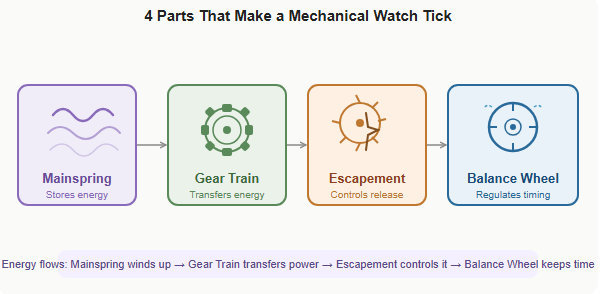
The system consists of four main parts: the mainspring, the gear train, the escapement, and the balance wheel.
When you know what each one does, the whole picture is clear.
Part 1: The Mainspring:
The mainspring is a strip of metal that is wound up tightly inside a small cylinder called the barrel.
The mainspring is about twenty to thirty centimetres long when fully uncoiled.
If you wind a watch, either by turning the crown or just by wearing it, this spring gets tighter.
The more tightly it is wound, the more energy it holds.
Think of it like a compressed rubber band.
Hold it stretched and it contains potential energy.
Let it go and that energy releases.
The mainspring works on the same principle, but it does not release all at once; it unwinds slowly, releasing energy gradually over hours or days.
How many hours depends on the specific movement.
Most mechanical watches provide between 38 and 80 hours of power reserve.
Some specialized movements extend to several days.
When the mainspring runs completely out of energy, the watch stops.
Part 2: The Gear Train:
The energy stored in the mainspring needs to travel to the watch hands.
A series of precisely sized gears that carry it there is a gear train.
Each gear in the train reduces the energy and reduces the rotation rate, transforming the raw power of the unwinding mainspring into the controlled rotation speeds needed to move the second hand once per minute, the minute hand once per hour, and the hour hand once every twelve hours.
The gear train was described in the June 2026 Mechanical Watch Mechanics Guide by Chronostreet as “carefully sequenced,” with each gear having a particular function in “stepping down the energy and translating it towards the regulating organ of the movement.”
But without the next component, all the energy of the spring would still be released too quickly. Hands would be out of control in seconds.
Part 3: The Escapement:
The escapement is the braking system of a mechanical watch.
It controls how quickly the mainspring’s energy gets released through the gear train, and it is the source of the ticking sound every mechanical watch makes.
At its centre is the escape wheel — a gear with specially angled teeth.
Next to it is the pallet fork, a small rocking lever with two tiny rubies on its arms.
The pallet fork rocks back and forth, alternately catching and releasing the teeth of the escape wheel.
Each catch stops the wheel completely for a fraction of a second.
Each release allows it to advance by exactly one tooth. This stop-start rhythm is the tick.
The escapement transforms the continuous unwinding of the mainspring into a series of discrete, equal steps.
Those steps are what a mechanical watch counts to measure time.
Part 4: The Balance Wheel:
The pallet fork rocks because something is making it rock at a precise, regular rhythm.
That something is the balance wheel.
The balance wheel is a small wheel with a weight on its rim.
It is connected to a thin spiral spring called the hairspring.
The hairspring gives the balance wheel its natural frequency of oscillation.
It swings one way; the hairspring pulls it back; it swings the other way; the hairspring pulls it back again.
This back-and-forth oscillation occurs at a constant rate, usually between six and ten oscillations per second, depending on the movement.
Each swing of the balance wheel rocks the pallet fork once.
Each rock of the pallet fork releases the escape wheel by one tooth.
That sequence, repeated thousands of times per hour, is how a mechanical watch divides time into equal, countable intervals without any electronic component or battery involved.
Precisionwatches.com’s March 2026 guide to mechanical watch mechanics described the balance wheel as “oscillating back and forth, regulated by a thin hairspring, with this oscillation determining the watch’s accuracy by dividing time into consistent intervals.”
The Two Types of Mechanical Watch: Manual and Automatic
Now that the internal mechanism is clear, the difference between manual-wind and automatic watches is straightforward.
Manual Wind Watches:
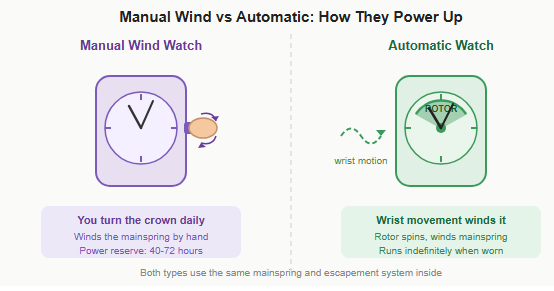
A manual wind watch requires the wearer to turn the crown regularly to wind the mainspring.
How often depends on the power reserve.
A watch with a 40-hour reserve needs winding every day or every second day.
One with a 70-hour reserve covers the working week and a weekend without attention.
The crown connects to the mainspring through a series of gears.
Turning it clockwise tightens the mainspring coil.
You feel resistance increasing as the mainspring approaches full wind, which tells you when to stop.
Overwinding is not usually possible on modern movements because a slip mechanism disengages when the spring reaches capacity.
Manual wind watches tend to be thinner than automatics because they do not need the rotor mechanism described below.
This makes them particularly suited to dress watches where a slim profile under shirt cuffs is valued.
The Orient Bambino, Hamilton Khaki Field Mechanical, and Tissot Le Locle are popular examples of manual wind watches available today with strong Amazon availability and ratings.
Automatic Watches:
An automatic watch winds itself using a semicircular weighted disc called the rotor.
The rotor is mounted on a central pivot inside the watch case and swings freely in either direction with the natural motion of the wearer’s wrist.
As it swings, it turns a series of gears that wind the mainspring.
Jeekwatch.com’s August 2025 guide to automatic watches confirmed that “even subtle arm movements — typing, walking — add power” to the mainspring, meaning the watch “keeps running indefinitely if worn daily.”
The rotor connects to the winding mechanism through a ratchet or ball-bearing system that converts both clockwise and anticlockwise rotor movement into one-directional winding of the mainspring.
A slip mechanism prevents overwinding in the same way manual watches do.
When you stop wearing an automatic watch, the mainspring continues unwinding from whatever state it was in.
If the power reserve is 48 hours and you last wore the watch 24 hours ago, it has approximately 24 hours of running time remaining.
If you leave it unworn for longer than the power reserve allows, it stops and needs to be either shaken gently to restart the rotor, wound manually using the crown, or placed on a watch winder.
See-through case backs, which many automatic watches feature, let you watch the rotor spinning as you move your arm.
This visible mechanism is one of the reasons many buyers find automatic watches more engaging than their quartz counterparts.
The Seiko 5 Sports and Orient Bambino open-heart edition both let you see the movement working through the dial itself.
Kinetic Watches: Where Mechanical Meets Electronic
Seiko introduced Kinetic technology in 1988 as a bridge between mechanical self-winding and quartz accuracy.
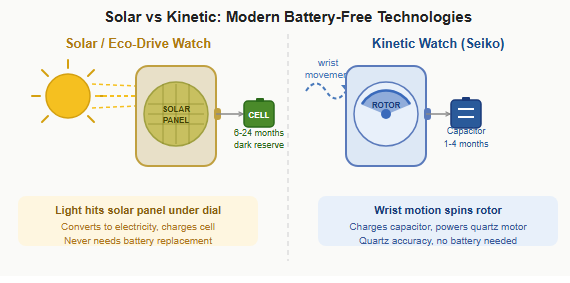
A kinetic watch uses the same rotor mechanism as an automatic watch, but instead of winding a mainspring, the rotor charges a capacitor — a small rechargeable power cell.
That capacitor then powers a quartz motor, which drives the watch hands with the same accuracy as a battery-powered quartz watch rather than the slightly variable accuracy of a mechanical movement.
Kinetic watches are technically battery-free in the sense that they require no battery replacement.
However, they do contain a capacitor that stores electrical charge, which is a distinction worth knowing when comparing them to purely mechanical alternatives.
Seiko’s Kinetic watches generally maintain a charge for one to four months without wearing, depending on the specific model and its power reserve.
For buyers who want the self-winding convenience of an automatic without the servicing requirements of a mechanical movement, and who specifically want quartz-level accuracy, kinetic technology covers that combination.
Solar and Eco-Drive Watches: Powered by Light
Citizen introduced Eco-Drive technology in 1976, making it the earliest commercial solar watch.
The current Eco-Drive platform converts any light source — sunlight, indoor fluorescent lighting, LED lighting — into electrical energy through solar cells mounted beneath the watch dial. That energy charges a secondary lithium-ion cell inside the watch.
The solar cells are invisible to the wearer because they sit behind the semi-transparent dial.
The dial appears normal while the solar panel beneath it collects energy from whatever light reaches the watch face.
The stored energy in a fully charged Eco-Drive powers the watch for a minimum of six months in complete darkness.
Some models, including the Citizen Garrison Field Watch in Super Titanium, provide up to 240 days of dark reserve.
This means a watch left in a drawer or worn only occasionally still runs reliably because it was charged during the periods it was exposed to light.
Eco-Drive watches are quartz movements — they use the same oscillating crystal technology as battery-powered quartz watches.
The difference is exclusively in the power source.
Replacing the battery is never required because the solar cell charges the secondary lithium-ion cell indefinitely across the watch’s lifespan.
For buyers who want a watch that never requires any maintenance related to power — no winding, no charging, no battery replacement — Eco-Drive is the most maintenance-free option available from any watch brand.
The Spring Drive: Seiko’s Unique Hybrid
The Spring Drive deserves a separate mention because it exists in a category that no other watchmaker has replicated.
It is a Seiko-exclusive movement that combines a mechanical mainspring with electromagnetic regulation.
A standard mechanical watch uses the physical escapement and balance wheel to regulate energy release.
The Spring Drive replaces this mechanical regulator with a Tri-synchro Regulator — a glide wheel that generates a tiny electromagnetic brake.
The mainspring powers the watch entirely, requiring no battery.
The electromagnetic regulator controls the release of that power with a precision that approaches quartz accuracy, achieving approximately one second per day rather than the two to ten seconds of a standard mechanical movement.
The result is a sweeping seconds hand that moves in a true continuous glide, with no tick at all — not even the smooth sweeping sound of a high-frequency mechanical.
The seconds hand flows.
This is the specific characteristic that distinguishes a Spring Drive from any other watch movement in the world.
Grand Seiko produces the finest Spring Drive watches currently available.
The movements are hand-finished to the highest standards of Japanese watchmaking and are available on Amazon through Grand Seiko’s authorized listings for buyers who want the most technically distinctive battery-free watch available from any manufacturer.
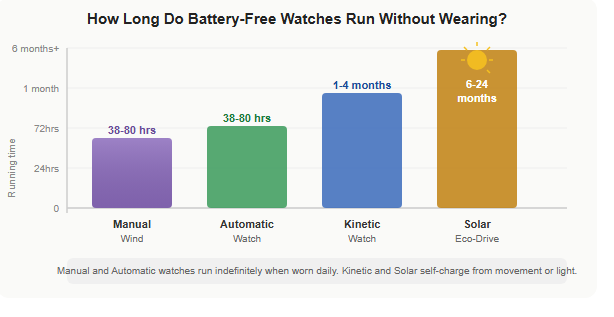
How Long Do Battery-Free Watches Run Without Wearing?
This is the practical question most buyers want answered before choosing a battery-free watch.
| Watch Type | Runs Without Wearing For |
|---|---|
| Manual wind (fully wound) | 26 to 80 hours depending on movement |
| Automatic (fully wound) | 38 to 80 hours depending on movement |
| Kinetic | 1 to 4 months on full charge |
| Eco-Drive solar | 6 to 24 months on full charge |
| Spring Drive | 72 hours on full wind |
For buyers who wear one watch daily, the power reserve of a mechanical watch is practically irrelevant.
The watch is winding or being wound during every wearing day, and the reserve is always sufficient for overnight.
For buyers who rotate between multiple watches, the power reserve matters more. Leaving an automatic in a drawer for three days means resetting the time when you return to it.
Which Battery-Free Watch Is Right for You?
The right choice depends on how you want to interact with the watch.
Manual wind suits buyers who enjoy the daily ritual of winding, who want the thinnest possible case, and who are drawn to the heritage of the oldest form of mechanical watchmaking.
A two-minute winding routine each morning is a small deliberate interaction with the watch that many buyers describe as a meaningful part of daily life.
Automatic suits buyers who want mechanical watchmaking without any routine maintenance.
Wear it and it winds itself.
The only attention it needs is an occasional service every three to five years, which any qualified watchmaker can provide.
Kinetic suits buyers who want the self-winding convenience of an automatic with the accuracy and low maintenance of quartz.
The capacitor means no battery replacement, and the quartz accuracy means no time drift.
Eco-Drive suits buyers who want complete independence from power management of any kind.
Solar charging from ambient light means the watch runs indefinitely without winding, without a watch winder, without battery replacement, and without any conscious power management at all.
For a closer look at how Citizen’s Eco-Drive technology performs across different watch categories and case styles, the full guide at best-titanium-watches covers the Citizen Super Titanium range, which combines Eco-Drive with Citizen’s advanced titanium construction.
FAQs:
Do automatic watches ever need a battery?
No. A genuine automatic mechanical watch contains no battery and requires none. It runs entirely from the kinetic energy of wrist movement, stored as tension in the mainspring. The only components inside an automatic watch are mechanical — springs, gears, levers, jewels, and screws. There is no electronic component of any kind. When the watch stops after being left unworn for longer than its power reserve allows, it is not a battery issue. The mainspring has simply run out of stored tension. Shaking the watch gently, wearing it for a few hours, or winding it manually through the crown restores the power reserve. If an automatic watch stops while being worn daily, the issue is a mechanical fault requiring servicing, not a power source failure.
How accurate is a mechanical watch compared to a quartz watch?
Quartz watches, both battery-powered and solar-charged, are significantly more accurate than mechanical watches. A standard quartz movement is accurate to within approximately fifteen seconds per month. A battery-free Eco-Drive watch provides the same quartz accuracy without any battery. A certified chronometer mechanical movement — the highest accuracy standard in mechanical watchmaking, set by COSC in Switzerland — is accurate to within four seconds per day, which accumulates to roughly two minutes per year. Most automatic watches from reputable brands like Seiko, Orient, and Tissot keep time within five to ten seconds per day without certification. For buyers who wear a watch for its craftsmanship and appreciate the mechanical achievement it represents, this level of accuracy is entirely acceptable for daily life. For buyers who need precise timekeeping above all else, a quartz movement of any power type provides it more reliably. For a closer look at how mechanical accuracy compares across specific watch brands and price points, the full guide at best-japanese-watch-brands covers Seiko and Orient movement quality across different tiers.
How often does a mechanical watch need servicing?
A mechanical watch should be serviced approximately every three to five years, though many watches run reliably for longer between services if the movement was well-made and the watch has been worn in clean conditions. Servicing involves a watchmaker disassembling the movement, cleaning every component in an ultrasonic bath, replacing worn parts such as gaskets and specific springs, lubricating the movement with watchmaker’s oils, and reassembling and timing it. The cost and complexity of the service depend on the specific movement and the watchmaker’s rates. Quartz watches, both battery-powered and solar-charged, require significantly less frequent servicing because they have fewer moving parts. The American Watchmakers-Clockmakers Institute provides a directory of qualified watchmakers for buyers seeking servicing for mechanical watches at awci.com.
Luis Cooper

Hi, I'm Luis, the guy behind this site. I love wearing watches, especially ones that look great on small wrists (mine are about 6.3" around). The Watches Geek is dedicated to helping you learn about and buy watches that you will love wearing. I want this website to be the last destination for people to pick the best watches to fit their needs. You can find our unbiased reviews here on Thewatchesgeek.