
Last Updated on October 5, 2026 by Luis Cooper
Battery anxiety is the specific feeling that shapes every smartwatch decision you make.
You check the percentage before leaving the house. You debate whether to track the morning run or save the charge for the afternoon meeting.
You carry a charging cable in your bag because missing a day risks showing up to an important moment with a dead watch.
On bad weeks, the watch charges more often than it provides useful data.
The OnePlus Watch 4 was built specifically to end this pattern for Android users.
A software architect who runs an outdoor hiking club described his previous experience with Wear OS watches as two days of excellent smartwatch features followed by two days of battery management followed by an afternoon of charging.
He had tried two watches from other brands before switching to the OnePlus Watch 4.
The difference he describes is not technical — it is psychological. He stopped thinking about the watch’s battery entirely.
OnePlus Watch 4 Review

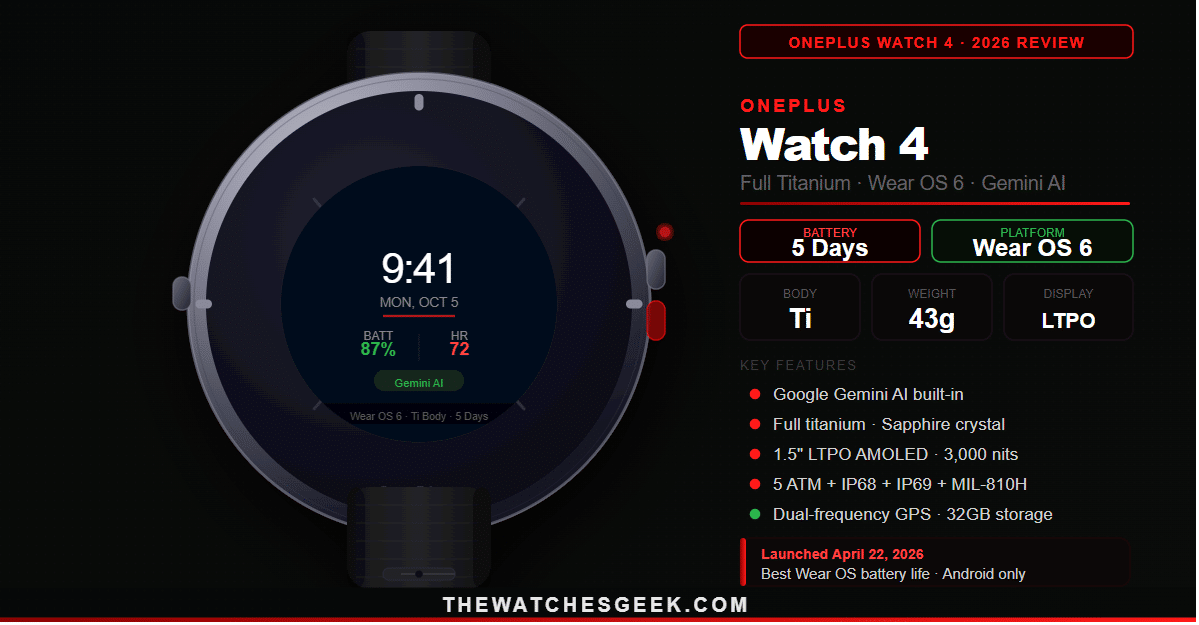
- Lightweight Comfort: Weighing just 43g and measuring 11mm thin, the titanium alloy case is 13% lighter and 6% thinner than its predecessor. Designed for all‑day and all‑night wear, you may barely feel it on your wrist even during sleep tracking or long workouts.
- Long Battery Life: Up to 16 days of battery life in power saving mode, and 5 days of use on a single charge in smart mode. Charge once and track your health, receive notifications, and sleep with it for days without battery anxiety.
- 60s Health Check: The 60s Wellness Overview measures up to 9 health indicators including heart rate, blood oxygen, stress level, sleep quality and mental wellbeing. A quick minute gives you a full snapshot of your current health status.
- Professional Fitness Tracking: Over 100 sports modes and 6 types of automatic activity recognition for walking, running, swimming and more. Professional metrics include aerobic training effect, cardiopulmonary capacity, recovery time and heart rate recovery rate to help you train smarter.
- Core Specs with Gemini Integration: Powered by the dual‑engine Snapdragon W5 and BES2800 chipset, with 5ATM, IP68 and MIL‑STD‑810H durability. The built-in Gemini lets you send messages, complete tasks, or get answers directly from your wrist.
Quick Verdict
The OnePlus Watch 4 earns a genuine recommendation for Android users who want the best battery life available on a Wear OS watch, a full titanium build with sapphire glass, and the latest Wear OS 6 with Google Gemini built in.
It earns that recommendation with honest caveats.
The processor inside is the same Snapdragon W5 Gen 1 used in the OnePlus Watch 3 and Watch 2 — there is no chip upgrade in this generation.
Health tracking covers the essential metrics thoroughly but doesn’t include ECG in the US market or sleep apnea detection, which competing platforms at the same tier offer.
And Android Central raised a reasonable question about OnePlus’s global business stability that buyers considering a multi-year ownership should factor into their decision.
The watch scores 8.2 out of 10 across multiple independent reviews, with “best Wear OS battery life” and “little progress from Watch 3” appearing as consistent verdicts.
Both descriptions are accurate simultaneously.
The OnePlus Watch 4 is the most capable version of a formula OnePlus has refined across three generations, and it remains the most compelling battery-first Wear OS proposition currently available.
Design and Build — Full Titanium at 43 Grams

The OnePlus Watch 4 is built from full titanium.
Not a titanium bezel with a stainless steel back, not a titanium alloy blend, but a full titanium case.
At 43 grams it is one of the lightest smartwatches available at 47mm, because titanium’s strength-to-weight ratio allows a robust case to weigh significantly less than steel of equivalent structural integrity.
The 11-millimetre thickness means the watch sits flat against the wrist rather than extending above it, which makes the difference between a watch that disappears under a sleeve and one that catches on doorframes and bag straps.
The sapphire crystal over the display provides the scratch resistance daily wear demands — sapphire, at Mohs hardness 9, resists keys, countertop edges, and casual contact that can mark mineral glass within weeks of continuous wear.
Water resistance is rated to three separate standards simultaneously.
Five ATM covers swimming and sustained submersion. IP68 covers dust and prolonged water exposure.
IP69 is the addition that differentiates the Watch 4 from its predecessor — it certifies the watch against high-pressure, high-temperature water jets, the specific standard used for industrial cleaning equipment.
Most wearers will never test this feature, but it confirms the watch’s sealing is genuinely robust rather than consumer-grade.
MIL-STD-810H military certification covers testing against shock, vibration, altitude, temperature extremes, humidity, and sand. Combined, these three water and durability ratings make the Watch 4 one of the most comprehensively protected consumer smartwatches currently available in its category.
The Display — 3,000 Nits in Sports Mode
The 1.5-inch LTPO AMOLED display is one of the largest and brightest currently available on a Wear OS watch.
LTPO stands for Low-Temperature Polycrystalline Oxide, the display technology that lets the screen automatically vary its refresh rate between 1Hz and 60Hz.
At 1Hz when the screen is showing a static watch face, the display draws minimal power.
At 60Hz during active scrolling and app interaction, it delivers smooth animation. This variable refresh rate is one of the mechanisms that contributes to the Watch 4’s battery endurance — the display does not run at peak power continuously.
The peak brightness of 3,000 nits is available in sports mode — the mode the watch activates automatically during outdoor workouts when solar conditions require maximum visibility.
Typical daytime brightness sits at 600 nits, which is comfortable for most indoor environments, while high-brightness mode reaches 1,600 nits for bright outdoor general use.
For context, most mid-range smartwatches at this price tier operate in the 500- to 1,000-nit range.
The Watch 4’s peak brightness means workout stats, route data, and health metrics remain readable in direct midday sunlight without shading the screen or pressing it toward the eye.
The Dual Engine System — Why the Battery Lasts
Understanding the battery performance of the OnePlus Watch 4 requires understanding the two processors inside it rather than looking only at the battery capacity number.
The Snapdragon W5 Gen 1 is the primary processor.
It handles everything computationally demanding — running Wear OS applications, processing AI queries through Gemini, managing GPS tracking, loading watch faces, and handling notifications.
It is also power-hungry for simple tasks.
The BES2800 is a low-power coprocessor.
It handles everything simple — displaying the time, measuring heart rate, counting steps, managing Bluetooth connection to the phone, and monitoring sleep.
The BES2800 consumes a fraction of the power the Snapdragon W5 uses for the same basic tasks.
The Watch 4 switches intelligently between these two processors based on what the watch is doing at any given moment.
When the wrist is still, and the watch is displaying the time between glances, the BES2800 handles everything and the Snapdragon sleeps.
When a notification arrives, or Gemini is activated, the Snapdragon wakes, handles the task, and returns to sleep.
This is the mechanism behind the 5-day smart mode figure—the watch isn’t running its full processor continuously.
It runs its low-power processor for most of the day, bringing the Snapdragon in only when needed.
The 16-day power saver figure extends this further by limiting what the Snapdragon handles, keeping the BES2800 active throughout without the Snapdragon waking for non-essential tasks.
For a buyer comparing these figures to a Galaxy Watch 9’s 30-40 hours or a Pixel Watch 5’s 30-40 hours, the arithmetic is clear.
Five days is about 120 hours — three to four times the Galaxy Watch 9’s normal-use figure. This difference eliminates the daily charging routine most Wear OS watches demand.
Wear OS 6 and Google Gemini — What Actually Changed

The OnePlus Watch 4 was among the first wearables in the world to launch with Wear OS 6 pre-installed from the factory, rather than receiving it as a later software update.
Wear OS 6 brings several practical changes over Wear OS 5. Application loading is faster. Transitions between screens and menus are smoother.
The Google integration — specifically Gemini — runs more efficiently on Wear OS 6 than earlier Gemini implementations on Wear OS 5 devices.
Gemini replaces Google Assistant as the voice interface on the Watch 4.
The practical difference between the two is meaningful for natural language queries.
Asking Google Assistant a contextual question—one that requires understanding what you meant based on what you asked previously—typically required you to reformulate the question more explicitly. Gemini understands conversational context, so you can ask a follow-up question without restating the full context, as you would in a human conversation.
On the watch specifically, Gemini can be activated by voice, answer questions using information from Google services, set reminders with contextual timing, and compose and send short messages by dictation.
The queries that work best on the watch are ones where a brief voice exchange provides a useful answer without requiring the wearer to look at a screen for the response.
The OxygenOS Watch 8 interface sits over Wear OS 6 and provides the visual organisation and customisation options that OnePlus has developed across four watch generations.
Watch face customisation, health dashboard organisation, and notification management all happen through OxygenOS Watch 8 rather than bare Wear OS, giving the watch a consistent visual identity while retaining access to the full Wear OS app ecosystem, including all Google and third-party Wear OS apps available through the Play Store.
Health and Fitness Features
The 60-Second Wellness Overview
The OnePlus Watch 4’s most distinctive health feature is the 60-Second Wellness Overview.
Pressing the shortcut button on the side of the watch starts a 60-second scan that measures nine metrics at once: heart rate, blood oxygen, stress level, wrist temperature, and additional cardiovascular and wellness indicators.
The practical value of the 60-Second Overview is context.
Instead of opening individual health apps and taking separate readings at different times, the Watch 4 delivers a snapshot of multiple metrics in under a minute.
For a wearer who wants to check in on their overall wellbeing before a workout, at the end of a stressful workday, or first thing in the morning, the single-button overview is faster and more informative than navigating to individual readings.
Continuous Health Monitoring
The Watch 4 monitors heart rate, blood oxygen, and wrist temperature continuously throughout the day.
Heart rate data appears in the OxygenOS health app as a historical timeline showing how the rate varied across the wearing day.
Wrist temperature provides context for recovery — elevated overnight temperature can indicate that the body is fighting illness or that training load has produced significant physiological stress.
Stress monitoring uses heart rate variability patterns to generate a stress score throughout the day.
The score reflects the physiological state of the autonomic nervous system rather than psychological stress directly — periods of high stress produce characteristic HRV patterns that the watch identifies and logs.
For a fuller understanding of how heart rate variability relates to stress and recovery, the American College of Sports Medicine provides guidance on interpreting these metrics in the context of training and wellness at acsm.org.
Sleep Tracking
Sleep tracking on the Watch 4 monitors sleep stages, total duration, and overnight heart rate across the night.
The titanium case and 43-gram weight make continuous wearing practical for overnight use — the watch is light enough that most wearers do not notice it during sleep once the habit is established.
Sleep stage data appears in the health app as a timeline showing light sleep, deep sleep, and REM periods across the night alongside the heart rate pattern that corresponded to each stage.
Dual-Frequency GPS
The Watch 4 uses dual-frequency GNSS connecting to five satellite systems: GPS, GLONASS, Galileo, BeiDou, and QZSS.
Dual-frequency positioning differentiates the Watch 4 from budget single-frequency GPS watches by improving accuracy in real outdoor conditions.
Single-frequency GPS calculates position from direct satellite signals, which works well in open environments.
In urban environments with tall buildings or under dense tree canopy, satellite signals reflect off surfaces and arrive at the receiver from incorrect angles, producing positioning errors.
Dual-frequency receivers can identify and compensate for these reflected signals because they arrive on the secondary frequency at measurable time offsets from the direct signals.
The result is more consistent positioning accuracy in exactly the environments where outdoor tracking watches are most regularly used.
100-Plus Sports Modes
The Watch 4 offers more than 100 sport modes, including running, cycling, swimming, hiking, strength training, yoga, and dozens of other activities. Each mode optimises the data collection and display for that specific activity type. During running, the watch tracks pace, distance, heart rate, and cadence in real time.
During swimming, it counts strokes, tracks laps, and calculates SWOLF efficiency.
GPS is active during outdoor activities and disabled during indoor training by default to preserve battery.
Indoor workout tracking uses the accelerometer for movement and the optical sensor for heart rate without the battery impact of continuous satellite positioning.
What the Watch 4 Does Not Include
Understanding the Watch 4’s limitations is as important as understanding its strengths, and those limitations deserve specific treatment rather than a brief mention in a cons list.
No ECG in the US. The Watch 4 carries ECG hardware in some markets, but in the US market, several health certifications are pending or unavailable. Buyers who specifically need ECG monitoring for atrial fibrillation detection should look at the Samsung Galaxy Watch 9 or Google Pixel Watch 5, both of which carry FDA-cleared ECG in the US. For a closer look at how the Google Pixel Watch 5’s health platform — including Loss of Pulse Detection and insulin resistance trends — compares to the standard health tracking package, the full review at google-pixel-watch-5-review covers every feature in detail.
No sleep apnea detection. The Watch 4 does not screen for sleep apnea patterns during overnight monitoring. The Samsung Galaxy Watch 9 carries sleep apnea detection, and the RingConn Gen 3 smart ring also offers overnight apnea pattern screening. Buyers who specifically want this feature should choose a platform that carries it.
No LTE. The Watch 4 requires a phone within Bluetooth range for calls, messages, and data queries. It cannot operate independently on a cellular network.
The processor is unchanged from Watch 3. The Snapdragon W5 Gen 1 that powers the Watch 4 is the same chip that powered the Watch 3 in 2025 and the Watch 2 before it. The battery and software improvements are meaningful and genuine, but buyers expecting a hardware performance leap will not find one here. The watch performs well by Wear OS standards — application loading is fast, navigation is smooth — but the chip architecture has not advanced.
OnePlus’s business position. Android Central noted in its Watch 4 coverage that OnePlus has not provided clear communication about its long-term support commitment for the watch, alongside questions about the company’s global business direction. This is a reasonable consideration for buyers who expect multi-year software updates and after-sale support. Buyers who prioritise long-term manufacturer support may prefer Google’s Pixel Watch 5 or Samsung’s Galaxy Watch 9, both of which come with published software support commitments.
OnePlus Watch 4 vs Google Pixel Watch 5 — Two Different Approaches
The OnePlus Watch 4 and Google Pixel Watch 5 are the two most relevant Wear OS alternatives for Android users in 2026, and they represent genuinely different design philosophies rather than competing on the same priorities.
| Feature | OnePlus Watch 4 | Google Pixel Watch 5 |
|---|---|---|
| Battery smart mode | 5 days | 30-40 hours |
| Body | Full titanium | Recycled stainless steel |
| Weight | 43g | Around 36g |
| ECG in US | Not available | FDA-cleared |
| Sleep apnea | Not included | Included |
| Loss of Pulse Detection | Not included | Included |
| Gemini | Built-in | Built-in |
| GPS | Dual-frequency | Dual-frequency |
| Storage | 32GB | 32GB |
| Water | 5 ATM + IP68 + IP69 | 5 ATM + IP68 |
The Watch 4 leads on battery life by a significant margin and matches the Pixel Watch 5 on build material quality and GPS capability. The Pixel Watch 5 leads on health monitoring depth — specifically ECG, sleep apnea detection, and Loss of Pulse Detection — and on the transparency of Google’s software support commitment.
The right choice depends on whether battery endurance or health monitoring completeness matters more to the buyer.
Buy the OnePlus Watch 4 if: Battery life across multiple days without daily charging is the primary requirement, you do not need US ECG or sleep apnea detection, and you want full titanium build quality with Wear OS 6 and Gemini.
Buy the Google Pixel Watch 5 if: ECG monitoring, Loss of Pulse Detection, and the most complete health monitoring platform on Wear OS matter more than battery duration, and you prefer Google’s established update track record.
Specifications
| Feature | Details |
|---|---|
| ASIN | B0GSZNLMSZ |
| Launch | April 22, 2026 |
| Display | 1.5-inch LTPO AMOLED, 466×466, 3,000 nits peak |
| Crystal | Sapphire |
| Case | 47mm, full titanium |
| Weight | 43 grams |
| Thickness | 11mm |
| Processor | Snapdragon W5 Gen 1 + BES2800 coprocessor |
| RAM | 2GB |
| Storage | 32GB |
| Battery | 646mAh |
| Smart mode | 5 days |
| Power saver | 16 days |
| Heavy use | 3 days |
| Charging | 7.5W, 100% in 75 minutes |
| GPS | Dual-frequency, 5 satellite systems |
| Water | 5 ATM, IP68, IP69 |
| Military | MIL-STD-810H |
| OS | Wear OS 6, OxygenOS Watch 8 |
| AI | Google Gemini |
| Sports modes | 100-plus |
| Health | Heart rate, SpO2, stress, sleep, temperature |
| Compatibility | Android |
FAQs
Does the OnePlus Watch 4 work with iPhone?
The OnePlus Watch 4 runs Wear OS 6, which requires an Android phone. It does not work with iPhone. Wear OS is Google’s watch platform and requires an Android device running Android 9 or later for pairing, notifications, health data sync, and access to the Play Store for third-party apps. iPhone users who want a comparable feature set should look at the Apple Watch Series 12 or Apple Watch SE 3 instead.
How does the OnePlus Watch 4 battery life hold up during GPS workouts?
The five-day smart mode figure applies to normal daily use with notifications, health monitoring, and typical smartwatch interaction without continuous GPS active. During outdoor GPS workouts, the Snapdragon W5 processor and the GPS receiver run simultaneously, which increases power consumption significantly. Independent reviewers consistently report real-world battery performance of approximately three days when daily GPS sessions are included. For buyers who run or cycle outdoors with GPS tracking active daily, the three-day figure is the more relevant planning number. The battery charges from zero to full in 75 minutes, which means an evening charge from low covers the following two to three days of use including GPS training.
Is the OnePlus Watch 4 a meaningful upgrade over the OnePlus Watch 3?
The Watch 4 upgrades Wear OS from version 5 to version 6, replaces Google Assistant with Google Gemini, adds IP69 high-pressure water resistance to the existing 5 ATM and IP68 ratings, and marginally increases battery capacity from 632mAh to 646mAh. The Snapdragon W5 Gen 1 processor, the 2GB of RAM, and the 32GB of storage are unchanged from the Watch 3. Independent reviews consistently describe the Watch 4 as a refinement rather than a generational leap — “strong Wear OS smartwatch, but little progress” describes the consensus. Buyers who own the Watch 3 and are satisfied with it are unlikely to notice a transformative difference in daily use. Buyers coming from the Watch 2 or from a different brand will find the Watch 4 a more substantial improvement relative to their previous experience.
Related Articles:
Garmin Quatix 8 vs Garmin Fenix 8
Luis Cooper

Hi, I'm Luis, the guy behind this site. I love wearing watches, especially ones that look great on small wrists (mine are about 6.3" around). The Watches Geek is dedicated to helping you learn about and buy watches that you will love wearing. I want this website to be the last destination for people to pick the best watches to fit their needs. You can find our unbiased reviews here on Thewatchesgeek.