
Last Updated on October 7, 2026 by Luis Cooper
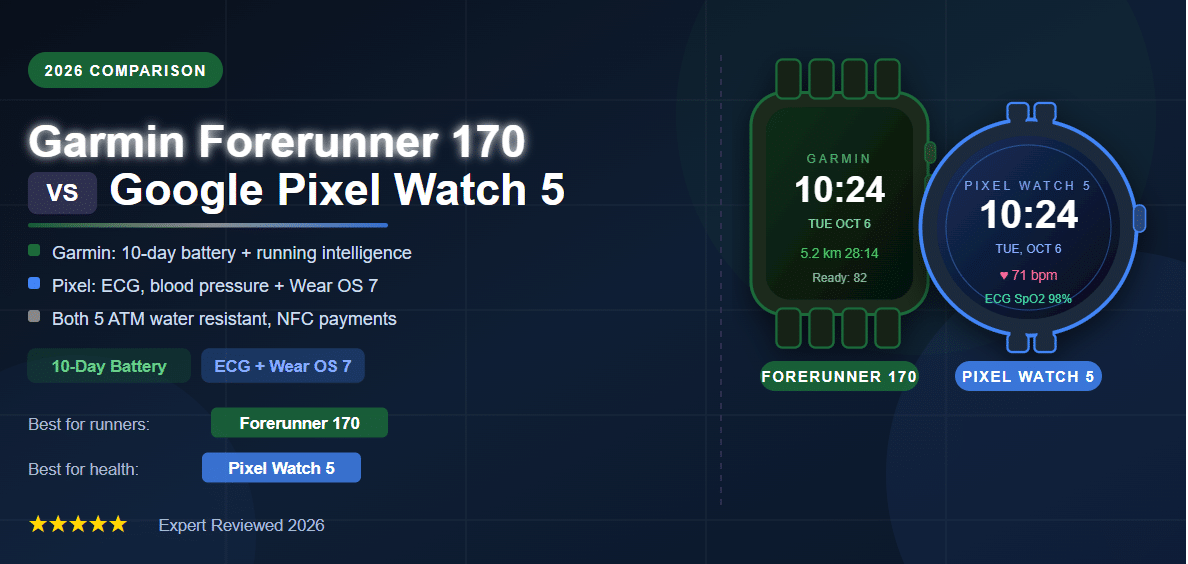
You have two solid watches in front of you. One is built for runners.
The other is built for everything. That single difference explains almost every choice you will face when comparing the Garmin Forerunner 170 and the Google Pixel Watch 5.
Both look good on your wrist.
But they serve completely different people, and you could easily buy the wrong one if you rely on spec sheets alone.
This guide breaks down every meaningful difference between the two so you can make the right call.
Garmin Forerunner 170 vs Google Pixel Watch 5: Which One Is Worth Your Money?


Quick Verdict: Which Watch Wins Overall?
Neither watch is better in every way.
The Garmin Forerunner 170 is the stronger pick for runners and fitness-focused users who want precise training data and long battery life.
The Google Pixel Watch 5 is the better daily smartwatch, offering ECG, blood pressure trends, Wear OS 7, Gemini AI, and Google Maps on your wrist.
If you run four or more times a week and care about training load and recovery data, get the Forerunner 170.
If you want one watch that handles workouts, messages, payments, and health monitoring without swapping apps, get the Pixel Watch 5.
Side-by-Side Specs Comparison
| Feature | Garmin Forerunner 170 | Google Pixel Watch 5 (45mm) |
|---|---|---|
| Display | 1.2″ AMOLED, 390×390 | 1.4″ Actua AMOLED, 3,000 nits |
| Case Size | 43mm | 41mm / 45mm |
| Weight | 41g | 36.7g (45mm) |
| Battery (smartwatch mode) | Up to 10 days | Up to 40 hrs (AOD on) |
| Battery (GPS mode) | Up to 20 hours | Up to 24 hrs |
| Battery saver mode | Not specified | Up to 72 hrs (45mm) |
| GPS | Multi-GNSS (no multi-band) | Dual-frequency GPS |
| Heart Rate Sensor | Elevate Gen 4 | Multi-path optical + cEDA |
| ECG | No | Yes |
| Blood Pressure | No | Trends monitoring |
| SpO2 | Yes | Yes |
| Skin Temperature | Yes | Yes |
| Sleep Tracking | Yes | Yes + Sleep Breathing Quality |
| OS | Garmin OS | Wear OS 7 |
| App Store | Connect IQ | Google Play Store |
| NFC Payments | Yes (Garmin Pay) | Yes (Google Wallet) |
| Music Storage | 4GB (Music model only) | 64GB internal |
| Water Resistance | 5 ATM | IP68 + 5 ATM |
| Sports Modes | 80+ | 40+ |
| Compatibility | Android + iOS | Android only |
Design and Build Quality
Garmin Forerunner 170
The Forerunner 170 is a classic sports watch. At 43mm and 41 grams, it sits light on the wrist — light enough that you stop noticing it after a few minutes of running.
The case uses fiber-reinforced polymer, which sounds basic but holds up well to daily wear and outdoor use.
The 1.2-inch AMOLED display is smaller than what you get on the Pixel Watch 5, but it is bright and readable in direct sunlight.
The band design is straightforward with a standard 20mm quick-release strap, so replacing it is simple and affordable.
Garmin offers the watch in two colorways: Black/Amp Yellow for the runner who wants something visible, and Whitestone/Cloud Blue for a cleaner, more versatile look.
Daniel, who runs four mornings a week before work, chose the Forerunner 170 because it doesn’t look like a tracker on his wrist during meetings.
It reads as a watch first and a fitness tool second.
Google Pixel Watch 5
The Pixel Watch 5 has the same circular design as its predecessors.
The build quality is excellent: Gorilla Glass 5 over an aluminum case, polished finish, and a premium feel that holds up in daily office and gym rotation.
At 36.7 grams for the 45mm model, it is actually lighter than the Forerunner 170 despite the larger display.
The 1.4-inch Actua 360 AMOLED screen is a genuine advantage here.
At 3,000 nits peak brightness, it is one of the brightest watch displays available in 2026.
Colors are rich, text is sharp, and it stays legible outdoors without raising your wrist awkwardly.
Which wins on design:
The Pixel Watch 5 has the better display and premium feel.
The Forerunner 170 is lighter and more comfortable for long runs.
Battery Life
Battery life is one of the clearest differences between these two watches, and it matters more than most people realize before they buy.
Garmin Forerunner 170

Garmin rates the Forerunner 170 at 10 days in smartwatch mode with the screen in raise-to-wake mode.
Real-world testing from The Run Testers confirms this holds up well: with daily health tracking active and three to four GPS runs per week, expect six to seven days before you need to charge.
Turn on the always-on display, and that drops to around three to four days.
GPS mode delivers up to 20 hours, which covers any marathon or ultra training session without anxiety.
All-Systems GNSS mode (using every satellite network simultaneously) runs for up to 14 hours, which is the more accurate setting for trail running.
Google Pixel Watch 5
The Pixel Watch 5 is rated at 40 hours with always-on display active on the 45mm model. In practice, that means charging every one to two days.
Battery Saver mode stretches this to 72 hours, but it disables most health-tracking features.
For someone wearing it as a daily smartwatch through a full workday and evening, you will charge it most nights.
That is a genuine trade-off compared to the Forerunner 170.
Aisha, a nurse who wears her Pixel Watch 5 through 12-hour shifts, charges it each morning before her shift starts.
It rarely dips below 20% by the time she gets home. For her schedule, the daily charging habit became normal within a week.
Which wins on battery:
Garmin Forerunner 170, by a wide margin.
GPS and Running Performance
Garmin Forerunner 170

The Forerunner 170 earns its price on GPS.
Garmin’s Multi-GNSS system (GPS, GLONASS, Galileo, BeiDou) is reliable and consistent in open conditions.
In testing against the Forerunner 970 and Coros Pace 4, the 170’s track matched within a few meters on standard road routes.
One honest limitation: it does not have multi-band GPS, which some competitors at a similar price offer.
Multi-band GPS performs better in dense urban environments, where tall buildings block satellite signals.
On open trails and roads, the difference is minimal.
Running-specific data includes pace, distance, cadence, stride length, ground contact time, and vertical oscillation — the full Running Dynamics suite.
Training Readiness tells you whether your body is ready for a hard session based on sleep quality, HRV, and recent training load.
Training Status tracks whether you are building fitness, maintaining it, or overreaching.
The Quick Workout feature is genuinely useful: it generates a session based on how much time you have and your current fitness state, so you are not standing at the door wondering what to do.
Google Pixel Watch 5

The Pixel Watch 5 uses dual-frequency GPS (L1 + L5), which is technically more capable than the Forerunner 170’s single-frequency system.
In urban environments and dense tree cover, the Pixel Watch 5 will generally track more accurately.
For casual runners, the Pixel Watch 5 handles pace, distance, heart rate, and workout summaries cleanly through Fitbit integration.
You get clear charts, readable data, and decent post-run analysis.
Where it falls behind the Forerunner 170 is in the depth of training analysis.
There is no Training Readiness score, no Training Status, no Running Dynamics.
If you want to know whether your body is ready to push hard today, the Pixel Watch 5 cannot tell you.
It records the run; it does not analyze whether the run was smart.
If running performance is the main reason you are buying a watch, our full guide to the best smartwatches for runners covers every top option across budgets and training levels.
The winner for running: Garmin Forerunner 170, clearly. The training intelligence gap is significant for anyone following a training plan.
Health Tracking
Garmin Forerunner 170
Health tracking on the Forerunner 170 covers the essentials well.
It offers continuous heart rate via Elevate Gen 4, SpO2 throughout the day and during sleep, skin temperature, stress tracking, Body Battery (Garmin’s energy score), and detailed sleep-stage analysis.
It includes women’s health tracking for cycle and symptom logging.
The one area where it trails the Pixel Watch 5 directly: no ECG, no blood pressure monitoring, and no galvanic skin response sensor.
These are health tools, not sports tools, and Garmin deliberately left them out of the Forerunner line to keep the price accessible.
Google Pixel Watch 5
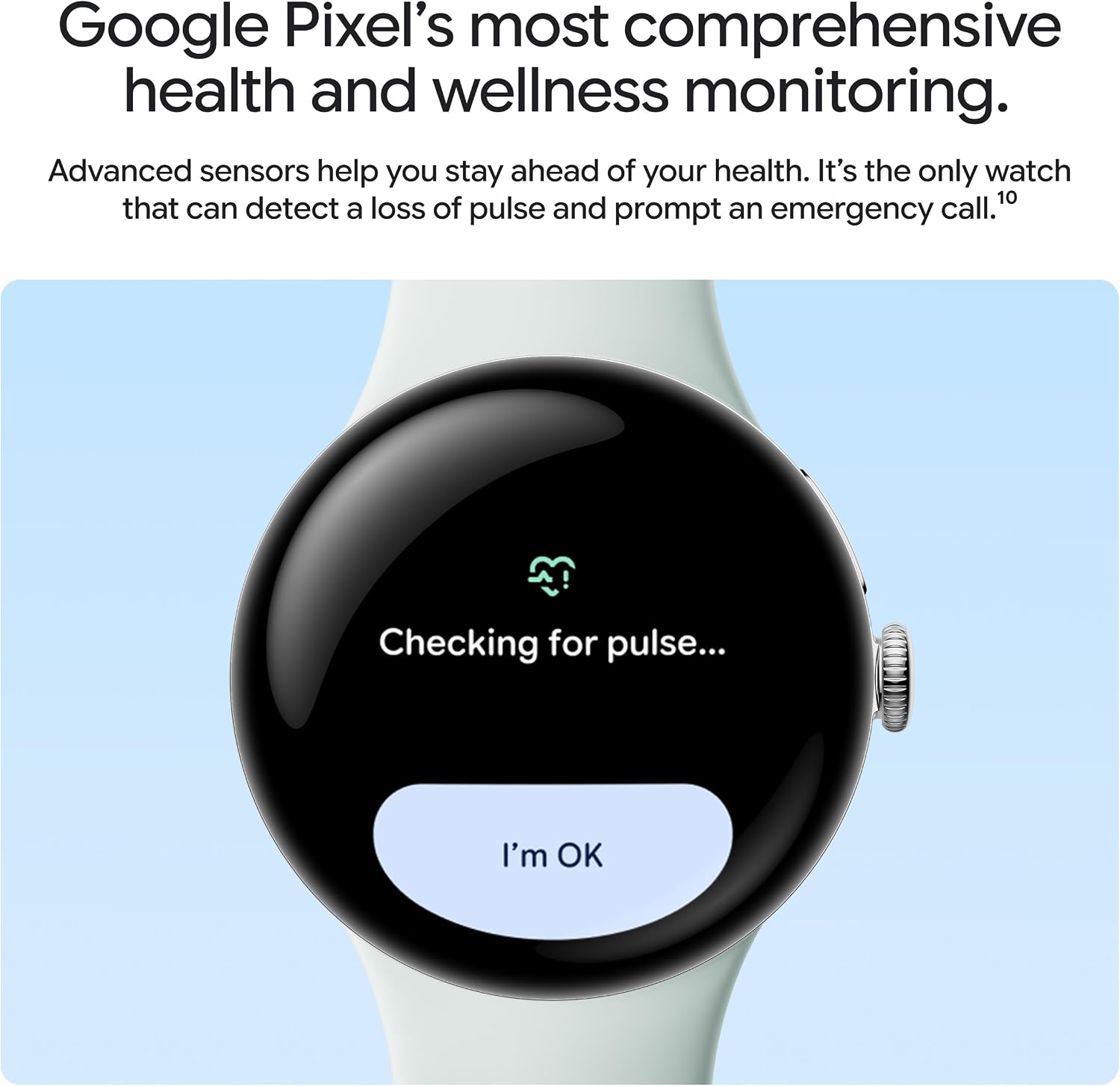
The Pixel Watch 5 takes health tracking more seriously than any previous Pixel Watch.
The sensor suite includes a multi-path optical heart rate sensor plus cEDA (continuous Electrodermal Activity), ECG for irregular heart rhythm detection, SpO2, far-field skin temperature, and a barometer.
New in 2026: blood pressure trends monitoring, insulin resistance tracking, and Sleep Breathing Quality assessment.
These are not gimmicks. Blood pressure trends can flag gradual changes that warrant a doctor visit.
According to the American Heart Association, high blood pressure often has no symptoms until serious damage has occurred — consistent trend monitoring is one way to catch changes early.
Insulin resistance tracking gives early signals relevant to metabolic health.
Sleep breathing quality catches disruptions that standard sleep tracking misses.
For anyone over 40, managing chronic health conditions, or simply wanting comprehensive wellness data beyond fitness, the Pixel Watch 5 offers meaningfully more than the Forerunner 170.
Which wins on health tracking: Google Pixel Watch 5.
Smart Features and App Ecosystem
Garmin Forerunner 170
The Forerunner 170’s smart features are functional but not exciting.
You get notification mirroring from your phone, Garmin Pay for contactless payments, and music controls.
The Music variant adds 4GB of internal storage for offline playback from Spotify, Amazon Music, and Deezer.
The Connect IQ app store exists but is limited compared to Google Play.
Third-party watch faces and basic apps are available, but do not expect the same selection you get on a Wear OS device.
One genuine advantage: the Forerunner 170 works with both Android and iOS. If you carry an iPhone, this watch is compatible. The Pixel Watch 5 is Android-only.
Google Pixel Watch 5
Wear OS 7 on the Pixel Watch 5 gives you access to the full Google Play Store — apps, watch faces, tools, fitness apps, and more.
Google Wallet works with NFC for payments at any contactless terminal. Google Maps delivers turn-by-turn navigation directly on your wrist, which is useful on unfamiliar running routes.
Gemini AI is built into the Pixel Watch 5, letting you ask questions, set reminders, and get responses without pulling out your phone.
The 64GB of internal storage comfortably holds music, apps, and offline maps.
The Pixel Watch 5 also supports optional LTE, so it can work independently of your phone for calls, messages, and navigation during runs.
Which wins on smart features: Google Pixel Watch 5, clearly.
Who Should Buy the Garmin Forerunner 170

The Forerunner 170 makes sense for:
- Runners training for a 5K, 10K, half marathon, or full marathon who want structured training data
- People who hate daily charging and want a watch that lasts a full week between charges
- Athletes who track multiple sports (cycling, swimming, strength) and want 80+ sport profiles
- iPhone users who want a capable sports watch (Pixel Watch 5 does not support iOS)
- Anyone who wants Garmin’s training intelligence — Training Readiness, Training Status, Quick Workout — without paying for the Forerunner 265 or higher
Who Should NOT Buy the Garmin Forerunner 170
Skip the Forerunner 170 if:
- You want ECG or blood pressure monitoring — this watch does not have either
- You need rich third-party apps on your watch
- You primarily use your watch as a daily fashion piece rather than a fitness tool
- You want multi-band GPS for urban running accuracy
- You need on-wrist navigation with maps
Who Should Buy the Google Pixel Watch 5

The Pixel Watch 5 makes sense for:
- Android users who want a single watch that handles fitness, health monitoring, smart notifications, and payments without switching apps
- Anyone who wants ECG, blood pressure trends, or insulin resistance tracking
- People who run Google services daily — Maps, Wallet, Gemini, Calendar — and want them on their wrist
- Casual runners who want decent workout tracking without dedicated running hardware
- Those who want a premium-looking watch that transitions from gym to office without standing out
Who Should NOT Buy the Google Pixel Watch 5
Skip the Pixel Watch 5 if:
- You follow a structured training plan and need Training Readiness or Running Dynamics
- Battery life is a priority — daily charging is mandatory with this watch
- You use an iPhone
- You want more than 40 sports profiles
- You want multi-day battery life for hiking, camping, or multi-day events
Real-World Scenarios: Which Watch Fits Your Life?
Scenario 1:
Marcus trains for his second half marathon. He runs five days a week, follows a 16-week plan, and tracks whether he is overtraining.
He needs Training Readiness, Running Dynamics, and a 10-day battery so he is not charging mid-training week.
He should get the Forerunner 170.
Scenario 2:
Priya is a 44-year-old marketing manager who walks 8,000 steps daily, does yoga three times a week, and wants to monitor her heart health after her doctor mentioned a risk of irregular rhythm.
She needs an ECG, blood pressure trends, and a watch she can wear to client meetings. She should get the Pixel Watch 5.
Scenario 3:
James wants one watch for everything — gym in the morning, office by day, restaurant at night.
He uses Google Maps for cycling to work, pays with his wrist at coffee shops, and asks Gemini questions throughout the day.
He should get the Pixel Watch 5.
Scenario 4:
Someone who swims three times a week, cycles on weekends, and runs twice.
They want everything tracked, every sport logged, and seven-plus days of battery.
They should get the Forerunner 170.
FAQs:
Can you use the Garmin Forerunner 170 as a daily watch?
Yes, it does handle notifications, Garmin Pay payments and music controls. But the app ecosystem is tiny compared to Wear OS. That’s fine for a daily watch for people who care more about fitness tracking than having lots of apps.
Does the Google Pixel Watch 5 work with Samsung phones?
Yes. The Pixel Watch 5 runs Wear OS 7 and works with any Android phone running Android 9 or later, including all Samsung Galaxy models. You will not get Samsung Health deep integration, but all core features work normally.
Which has better GPS accuracy?
The Google Pixel Watch 5 uses dual-frequency GPS (L1 + L5), which is technically more accurate in cities and under tree cover. The Forerunner 170 uses multi-system single-frequency GPS, which performs well on roads and open trails but can drift slightly in urban canyons.
Can I swim with both watches?
Yes. Both the Forerunner 170 and the Pixel Watch 5 are rated 5 ATM, meaning they handle lap swimming comfortably. The Forerunner 170 includes dedicated swim tracking profiles. The Pixel Watch 5 also handles pool swims.
Is the Garmin Forerunner 170 worth it over the Forerunner 165?
The Forerunner 170 adds Training Readiness, wrist-based Running Power, Running Dynamics, Garmin Cycling Coach, and expanded sports modes over the Forerunner 165. If you are a serious runner who wants those tools, the upgrade is worthwhile. Casual runners may be fine staying on the 165.
Which watch has better sleep tracking?
Both track sleep stages, but the Pixel Watch 5 adds a Sleep Breathing Quality assessment that can detect disrupted breathing patterns during sleep. For health-focused users, that extra layer of data is meaningful.
Final Verdict
The Garmin Forerunner 170 and Google Pixel Watch 5 excel at different things, and the right choice depends on what you actually do.
Get the Garmin Forerunner 170 if running is the main reason you are buying a watch. At this price, no Wear OS device matches its training intelligence, battery life, and sport-specific depth.
Get the Google Pixel Watch 5 if you want a watch that monitors your health, connects your Google life, and looks good doing it — even if battery life requires a daily charging habit.
Neither watch is the wrong choice. They are just built for different versions of your day.
Check Amazon for current price – Garmin Forerunner 170
Check Amazon for the current price – Google Pixel Watch 5
Related Articles:
Best Smartwatches Compatible with iPhone
Luis Cooper

Hi, I'm Luis, the guy behind this site. I love wearing watches, especially ones that look great on small wrists (mine are about 6.3" around). The Watches Geek is dedicated to helping you learn about and buy watches that you will love wearing. I want this website to be the last destination for people to pick the best watches to fit their needs. You can find our unbiased reviews here on Thewatchesgeek.