
Last Updated on April 3, 2026 by Luis Cooper
Firefighters run into danger when everyone else is running away.
They face heat, smoke, and stress to save people and homes.
A smartwatch might sound like a fancy toy, but out on a call, it can tell you the time, show your heart rate, and send alerts when you can’t pull out your phone.
I tried many watches while dragging hoses, searching dark rooms, and hiking up training towers with my crew.
These tests weren’t done in a lab – they happened during real calls and drills.
I’ll never forget climbing six flights of stairs with my air pack while my Garmin Fēnix 8 buzzed to warn me I was pushing too hard, or tapping its built‑in flashlight to look for a dropped tool in the dark.
Those moments taught me which watches survive the job and which ones don’t.
The watches below are tough and reliable.
Each one can handle knocks and water, track your fitness, and still buzz your wrist when your phone is buried in your coat.
Whether you’re a career firefighter, a volunteer, or just getting ready for a physical test, you’ll find a good match here.
Keep reading to see my picks and a few stories from my own time on the fireground.
Which are the Best Smartwatches for Firefighters?
Here are my recommended top 7 Best Smartwatches for Firefighters:-




![Apple Watch Ultra 2 [GPS + Cellular, 49mm] - Titanium Case with Blue Ocean Band, One Size (Renewed)](https://m.media-amazon.com/images/I/41HEae62LxL._SL160_.jpg)
![Samsung Galaxy Watch 8 40mm Bluetooth Smartwatch, Cushion Design, Quick Button, Sleep Coaching, Now Bar, Running Coach, Energy Score, Graphite [US Version, Amazon Exclusive 2Yr Warranty]](https://m.media-amazon.com/images/I/41pVUmtVzHL._SL160_.jpg)
Garmin Instinct 3 Tactical Edition: (Built for the Job, Not Just the Gym)

Firefighting does not forgive weak gear.
A watch that dies mid-shift, fogs up in smoke, or breaks under the first hard impact is worse than wearing nothing at all.
The problem is that most smartwatches are designed for people who run marathons on weekends and sit at desks during the week.
The Garmin Instinct 3 Tactical Edition was not designed for those people.
This watch was built with one idea in mind — keep working no matter what you throw at it.
For firefighters, first responders, and anyone whose daily environment involves heat, shock, water, and zero tolerance for equipment failure, the Instinct 3 Tactical Edition sits in a category almost entirely on its own.
Why This Watch Belongs on a Firefighter’s Wrist:
The first thing any firefighter needs to know about a smartwatch is whether it will survive the environment.
The Instinct 3 Tactical meets 20 U.S. military standard 810 tests, covering thermal shock, extreme heat, extreme cold, humidity, vibration, and physical impact.
The metal-reinforced bezel is not cosmetic — it is a bolted construction designed to absorb impacts that would crack or warp lesser watch casings.
The fibre-reinforced polymer body keeps it lightweight at 53 grams while maintaining structural integrity under conditions that would destroy a conventional smartwatch in minutes.
Water resistance at 10 ATM means it can withstand high-pressure water exposure.
That rating is not a gentle splash test — it is engineered for real submersion, which matters when you are working around hose lines and water mains at a scene.
The Solar Battery Is a Real Advantage on Long Shifts:
The 45mm Solar edition pulls in energy from sunlight through Garmin’s Power Glass lens, and the result is genuinely impressive.
In smartwatch mode with regular daily light exposure, the battery does not have a deadline.
For a firefighter working rotating shifts, spending time outdoors, or going weeks between days off, the idea of never hunting for a charger mid-rotation is more than just convenient — it removes a real operational headache.
Even in GPS mode, the solar charging significantly extends runtime, with up to 130 hours logged before the battery runs out.
That covers multi-day wildland fire deployments without breaking a sweat.
Five Physical Buttons, No Touchscreen, That Is the Right Call:
Firefighters wear heavy gloves.
Hands get wet.
Smoke changes visibility conditions.
A touchscreen becomes unreliable or completely unresponsive in every one of these scenarios.
Five physical buttons mean the watch is fully operable in full gear, in the dark, in the rain, with thick gloves on.
That is a design choice that shows Garmin understood exactly who this watch is for.
Tactical Features That Actually Matter on the Job:
The Stealth Mode shuts down all wireless communications instantly, which is useful during sensitive operations or when radio silence is required.
The green LED flashlight beam is specifically designed to protect natural night vision, allowing users to see without disrupting their eyes’ adjustment to darkness.
The white beam and strobe mode cover general illumination and emergency signaling.
The Kill Switch wipes all user data instantly if the watch changes hands or a situation demands it.
The barometric altimeter tracks pressure changes that can signal shifting weather patterns during wildland operations, and the 3-axis compass stays accurate regardless of how the watch is tilted, which matters when navigation cannot wait for ideal conditions.
TracBack routing records the path taken and can reverse it on demand, which is genuinely useful for search-and-rescue scenarios, wildland operations, or any situation where finding the way back to a safe point matters.
Health Tracking Through Long Shifts:
The watch continuously monitors heart rate, tracks blood oxygen levels via the Pulse Ox sensor, and measures heart rate variability throughout the night.
For firefighters facing the physical demands of the job and the cumulative fatigue of irregular shifts, the sleep coaching feature provides personalised rest recommendations based on individual patterns rather than generic guidelines.
HRV data gives a window into real recovery status before a demanding day begins.
Stress tracking runs throughout the day, and the barometric altimeter provides altitude readings relevant to wildland operations at elevation.
Specifications:
| Feature | Details |
|---|---|
| Display | Solar MIP (Memory-in-Pixel) with Power Glass solar lens |
| Case Size | 45mm |
| Case Material | Fiber-reinforced polymer with metal-reinforced bezel |
| Durability Standard | MIL-STD-810 (thermal, shock, vibration, humidity) |
| Water Resistance | 10 ATM (100 meters) |
| Battery Life | Unlimited in smartwatch mode with sufficient solar exposure |
| GPS Battery | Up to 130 hours (45mm solar, GPS mode) |
| GPS System | Multi-band GNSS with SatIQ technology |
| Sensors | 3-axis compass, barometric altimeter, Pulse Ox |
| Heart Rate | Garmin Elevate Gen 4 optical sensor |
| Flashlight | Built-in LED, white and green beams, strobe mode |
| Tactical Features | Stealth Mode, Kill Switch, Night Vision Goggle mode, Jumpmaster |
| Navigation | TracBack routing, waypoint projection, dual-position GPS format |
| Health Tracking | Heart rate, SpO2, HRV, sleep coaching, nap detection, stress |
| Smart Features | Garmin Pay, smart notifications, Garmin Connect app |
| Buttons | Five physical buttons, no touchscreen |
| Weight | 53g |
| Operating Temperature | Tested to MIL-STD-810 extremes |
| Compatible With | iOS and Android |
Garmin Fenix 8: (Best rugged smartwatch for firefighters)

The Garmin Fenix 8 is one of the strongest watches I’ve worn.
It can handle tough jobs and has tools useful to firefighters.
Key features:
Strong glass and metal case:
The 1.4‑inch screen uses tough sapphire glass and a titanium ring. It resists scratches and bumps.
Four‑mode flashlight:
A small LED light built into the watch can light up dark rooms or flash to get someone’s attention.
Solar charging:
A solar panel on the watch helps top up the battery.
You can get about 29 hours of GPS use or up to 31 days on low‑power mode.
Over 100 sports & voice control:
You can track more than 100 activities and even talk to the watch to control it.
Tested to military standards:
It has been tested against shocks, heat and water.
What it was like in the field:
I wore the Fēnix 8 during a 24‑hour shift that included two house fires and a call to help another department with a small forest fire.
The little flashlight on the watch was really useful when crawling through a basement full of smoke; instead of searching for my hand‑held torch, I just tapped the watch twice and had enough light to check my crew’s air gauges.
You can feel the watch’s weight, but I liked how strong it felt when swinging tools or climbing ladders.
Even after a full day on duty, the battery never dropped below 60 per cent because the solar panel topped it up in the afternoon.
This watch is now my top choice for long shifts and tricky rescues.
Polar Grit X2 Pro: (Best for ultra‑endurance training)

If your firefighting duties involve long shifts and heavy workouts, the Polar Grit X2 Pro is a great choice for long hours.
Even though it’s slim, it has a long‑lasting battery and lots of sport modes.
Key features:
Tracks over 150 workouts:
It has a mode for nearly any exercise, from climbing stairs to high‑intensity circuits.
Slim metal body:
It’s tough enough for the field, yet lighter and more comfortable than many rugged watches.
Long battery life:
The watch can run GPS for about 43 hours or act as a regular watch for up to 10 days.
Maps and directions:
Built‑in maps and route guidance help you find your way back after a long hike or training run.
What it was like in the field:
During a recent overnight wildland deployment, I strapped on the Grit X2 Pro for its long GPS runtime.
After 14 hours of hiking steep trails and cutting line, the battery still showed 50 percent.
I could glance at my wrist to get turn‑by‑turn directions back to basecamp without pulling out a phone.
The slim case slid comfortably under fire gloves, and the nylon strap never chafed.
My only gripe was that the glowing green LEDs occasionally lit up the inside of my tent when I shifted positions at night – a minor annoyance easily fixed by enabling night mode.
CARBINOX Edge: (The Affordable Rugged Smartwatch)

Most rugged smartwatches come with a price tag that makes you feel like the durability rating is doing half the convincing.
The CARBINOX Edge takes a different approach.
It is aimed directly at the people who actually need a tough watch on their wrist at work every day — construction workers, mechanics, welders, EMTs, firefighters — not at the outdoor enthusiast who takes one serious hike per year.
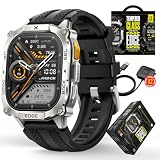
The Edge is the newest and most refined model in the Carbinox lineup, and it brings a 1.96-inch AMOLED screen, stainless steel construction, and dual-band GPS to a price point where most brands are still offering plastic and single-band tracking.
Built for the Job Site:
The stainless steel frame on the Edge is the real story here.
Most watches in this price range use aluminum or reinforced polymer.
Stainless steel raises the floor on impact resistance, scratch resistance, and overall longevity in a way that cheaper materials simply cannot match.
The Gorilla Glass screen protects against drops and debris without going milky or scratched after a few weeks of real use.
The IP69K rating warrants a specific mention because it differs from standard water resistance.
IP69K means the watch has been tested against high-pressure, high-temperature water jets, not just submersion.
For a firefighter dealing with hose lines or a mechanic hosing down a work area, this rating actually covers real-world water exposure rather than theoretical pool depth.
The AMOLED screen is a real surprise at this level:
A 1.96-inch AMOLED display is not what you expect at this price point.
The screen is large, color-accurate, and bright enough to read in direct sunlight without squinting.
Watch faces are fully customizable through the Carbinox Max app, and the display size means health data and notifications appear at a glance rather than requiring you to lean in and peer at a small readout.
For firefighters who need to check their heart rate, time a task, or glance at a notification while geared up, a large, legible screen genuinely reduces friction on the job.
Bluetooth Calling That Works With Gloves On:
The built-in mic and speaker mean calls come and go directly from the watch.
The AI voice texting feature lets you dictate messages hands-free, which matters enormously when your hands are full, covered in grease, or inside work gloves.
Real users consistently mention this feature specifically as one of the main reasons they chose the Edge over alternatives.
Getting a call on a job site and being able to answer without pulling out your phone or removing a glove is a practical win that adds up over time.
GPS and Health Tracking:
The dual-band GNSS across six satellite systems gives the Edge a level of positioning accuracy that used to be reserved for watches costing three times as much.
Dual-band GPS solves a problem that affects single-band GPS significantly, which is signal interference in urban canyons, dense forests, and around large structures.
For anyone navigating a large facility, tracking a training run through city streets, or logging a route on an incident scene, the accuracy improvement is real and noticeable.
Health tracking covers heart rate, blood oxygen, sleep, stress, mood, and steps.
The altimeter, barometer, and compass round out the sensor suite for anyone working in outdoor or elevation-variable environments.
One real user summed up battery performance well: ten days in and still sitting at fifty percent.
That kind of real-world battery longevity is exactly what shift workers need.
The lifetime warranty is not a marketing add-on.
If the watch fails for any reason, Carbinox replaces it with no questions asked.
For people working in environments where gear gets destroyed regularly, that kind of backing changes the conversation around value entirely.
Who Should Buy This:
The CARBINOX Edge is for the working person who needs a genuinely tough, genuinely capable smartwatch without paying flagship prices.
Firefighters, EMTs, tradespeople, and outdoor workers who want Bluetooth calling, dual-band GPS, health tracking, and a screen they can actually read on the job will find the Edge covers everything they realistically need from a wrist device.
The lifetime warranty removes the biggest risk of buying from a newer brand, and the stainless steel build backs up what the marketing claims.
For anyone who has destroyed two or three regular smartwatches in a year at work, this is the watch worth trying.
Specifications:
| Feature | Details |
|---|---|
| Display | 1.96″ AMOLED with Gorilla Glass |
| Case Material | Full stainless steel construction |
| Water Resistance | IP69K and 5 ATM dual-rated |
| Battery | 500mAh, up to 14 days typical use |
| GPS | Dual-band GNSS, 6 satellite systems |
| Bluetooth Calling | Built-in mic and speaker |
| Health Tracking | Heart rate, SpO2, sleep, stress, mood, steps, calories |
| Sensors | Altimeter, barometer, compass |
| AI Voice Feature | Voice texting, hands-free commands |
| Band | 22mm quick-release silicone, fits 150 to 240mm wrists |
| App | Carbinox Max (iOS and Android) |
| Sports Modes | Multiple preloaded activity profiles |
| Notifications | Calls, SMS, app alerts from paired phone |
| Warranty | Lifetime replacement warranty |
| Compatible With | Android and iOS |
Amazfit T‑Rex 3: (Best GPS watch for Volunteers)

Firefighting gear costs a lot, so you might not want to spend too much on a watch.
The Amazfit T‑Rex 3 proves you don’t need to go overboard to get a tough smartwatch.
Key features:
170+ Sports Modes:
Track cardio workouts, strength training, and even swimming thanks to 10 ATM water resistance.
42 hours GPS / 27 days standby:
The battery rivals more expensive models, lasting weeks between charges.
Military standard durability:
Built to 15 military certifications, it tolerates extreme temperatures and shocks.
Built‑in compass & barometer:
Helpful when you’re out in the woods or mountains and need to know your direction.
What it was like in the field:
I wore the T‑Rex 3 on several volunteer shifts where we used basic gear.
I was impressed that it kept working after bumping into door frames and getting sprayed with water from a hose.
The battery lasted about two weeks of on‑and‑off use with GPS turned on for training runs.
When I taught a group of new firefighters, they liked the watch’s bright screen and easy menus.
It was sometimes hard to read in direct sunlight, but overall, it’s a great starter watch for rookies.
Casio G‑Shock: (Toughest watch on the list)
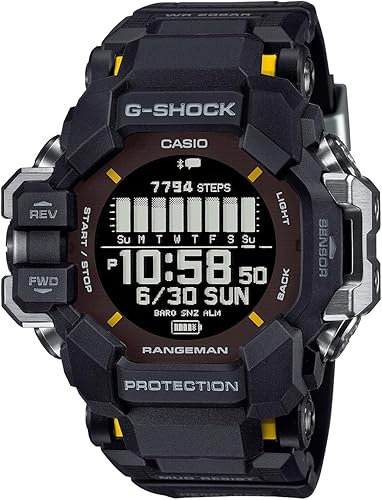
Casio’s G‑Shock watches are famous for being almost impossible to break, and the GPR‑H1000‑1 is the toughest one yet.
You want a watch you never have to worry about damaging, this is it.
Key features:
Shock‑absorbing construction:
The resin case and raised bezel protect the screen from drops and impacts.
Reviewers noted that even after intentionally damaging it, they couldn’t destroy the watch.
Water resistance to 200 meters:
More than enough for firefighting, rescue, swimming, or diving.
Solar‑powered battery:
In most conditions, the watch will trickle‑charge from sunlight and last for months without plugging in.
Sensors for everything:
Includes a compass, barometer, altimeter, temperature and heart‑rate sensor.
What it was like in the field:
I’ve been wearing G‑Shocks since training, and the GPR‑H1000‑1 lives up to that reputation.
During a practice rescue, I accidentally slammed it into the front pillar of a car.
The car took more damage than the watch.
It’s big and heavy, but the thick case protects it better than any other watch I’ve tried.
The solar charging kept the battery full for months while it sat on my gear.
It doesn’t have a color map or flashlight, but as a backup watch, this one is unbeatable.
Field notes:
One of my mentors has worn G‑Shocks for over a decade; he jokes that they’re harder to kill than cockroaches.
During a search drill, we used this model as an improvised hammer to knock out glass blocks when the Halligan wasn’t handy—and it didn’t even scratch the bezel.
The trade‑off is bulk; when crawling through tight spaces, the watch occasionally caught on gear, but that’s a small trade‑off for near‑indestructibility.
Apple Watch Ultra 2: (Best for iPhone users)

Apple’s second‑generation Ultra builds on the first model.
If you use an iPhone and want a watch that can act as a safety beacon and health monitor, this is a solid choice.
Key features:
Large metal case and strong glass:
The case is made of metal, and the screen is made of tough glass; the display is bright and easy to read through smoke.
Very accurate GPS:
Dual‑frequency GPS gives a precise location when other devices can’t.
Extra button and siren:
There’s a button you can press with gloves on to start workouts or drop a waypoint.
It also has a loud siren to help rescuers find you.
Advanced health & safety sensors:
It comes with fall detection, crash detection and blood‑oxygen monitoring as standard.
What it was like in the field:
I wore the Ultra 2 for a month to see if Apple’s system could handle firehouse life.
The bright screen was easy to see through the smoke, and the orange button was easy to press with gloved hands.
During a drill, I intentionally fell to trigger the watch’s fall detection; it immediately sounded a loud siren and showed an SOS screen.
When a call came in during a workout, I answered it on my wrist without taking off my helmet.
The battery barely made it through two shifts, so I kept a charger handy, but the safety and health features made it worthwhile.
Samsung Galaxy Watch 8: (Best for Android users)
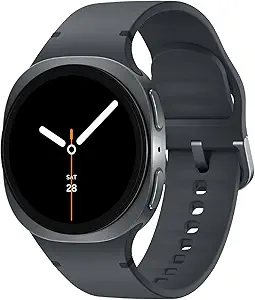
Samsung’s latest watch builds on the previous model and adds more health features.
For firefighters who use Android phones, the Galaxy Watch 8 strikes a good balance between strength and ease of use.
Key features:
Durable yet slim design:
It’s slimmer and lighter than the previous model, so it’s comfortable under gear.
Wear OS software:
Works seamlessly with Samsung phones and gives you access to Google apps.
Run‑coaching & health metrics:
Features like running power, advanced sleep tracking and an antioxidant index help you train smarter.
Improved heart‑rate sensor:
Offers better accuracy during high‑intensity workouts.
What it was like in the field
I paired the Galaxy Watch 8 with my personal Android phone and wore it while cleaning the station and going on daytime medical calls.
The slim design never caught on with gloves or gear, and the colourful screen was easy to use.
I liked how the watch automatically recognised when I switched from a run to a stair climb during training, logging separate workouts without me pressing a button.
The run‑coach feature gave me tips to run faster.
Like many Wear OS watches, it needed nightly charging; I got used to charging it while filling air bottles after each call.
Field notes:
I trained for our department’s Candidate Physical Ability Test (CPAT) with the Galaxy Watch 8.
The run‑coaching program built me a personalized plan and vibrated at each pace change, which helped me shave nearly two minutes off my previous time.
During shift work, the sleep insights encouraged me to take power naps and adjust my caffeine intake.
Though battery life is shorter than my Garmin’s, the watch charges quickly, and the slim profile never snags on my turnout coat.
How to choose a smartwatch for firefighting:
When your job involves running into burning buildings, the last thing you want is a delicate gadget on your wrist. After using dozens of models on countless calls, here are the factors I now consider when shopping for a firefighting smartwatch:
-
Durability: Look for devices with MIL‑STD‑810G certification, scratch‑resistant materials (sapphire or Gorilla glass), and water resistance of at least 50 meters. Extra features like raised bezels and shock‑absorbent cases add protection.
-
Battery life: Extended battery life or solar charging means you won’t need to plug in every night. Watches with 15‑plus hours of GPS time are ideal for long shifts or multi‑day deployments.
-
Navigation & sensors: Built‑in GPS, compass, and barometer help you navigate unfamiliar terrain during wildland fires or training hikes. A flashlight or siren is an added safety bonus.
-
Health & fitness tracking: Features like heart‑rate monitoring, VO2 max, recovery scores, and stress tracking can help you gauge performance and prevent overtraining.
-
Compatibility: Make sure the watch works with your smartphone’s operating system. Some functions (like Apple’s siren) may be exclusive to certain brands.
Beyond the specs, think about how the watch fits into your daily routine. On quiet nights at the firehouse, I mute notifications and dim the back‑light so I don’t wake my bunkmates. During long shifts, I turn down the brightness and vibration so the watch doesn’t light up the rig cab. In winter, I wear bigger watches over my coat sleeve; in summer, I tuck a slim watch under my glove to keep it out of harm’s way. After each call, I rinse off salt, sweat, and soot and wipe the charging contacts clean to prevent corrosion. A little care keeps your watch reliable when you need it most. My advice is to prioritise durability and battery life first, then look for training metrics that match your fitness goals. If you can, try on a few watches before you buy – comfort matters on a 14‑hour assignment.
Final Thoughts:
Smartwatches used to just count your steps. Today, these tough watches can handle heat, bumps, and water while still giving you health stats and directions. A good watch becomes part of your rhythm at a fire: it vibrates when command calls, tracks your air consumption, and reminds you to drink water during rehab.
After months of testing, I still grab the Garmin Fēnix 8 when I know it will be a hard day – its flashlight and battery life are too good to ignore. If you like something lighter, the Polar Grit X2 Pro and Coros Apex 2 Pro balance comfort and performance. If you’re on a budget, the Amazfit T‑Rex 3 offers lots of features while still being affordable, while the Casio G‑Shock GPR‑H1000‑1 is almost impossible to break. iPhone users may prefer the Apple Watch Ultra 2 for its siren and health features, and Android users can’t go wrong with the Samsung Galaxy Watch 8, especially if you own a Samsung phone.
Whichever watch you choose, remember that no piece of technology replaces proper training and situational awareness. Think of your smartwatch as a tool in your kit – one that helps you perform at your best and return home safely after every call. The stories I’ve shared throughout this guide are a testament to how these devices can assist, but they’re not a substitute for experience and teamwork. Stay safe out there.
Ending paragraph:
What are your thoughts on them?
Is there any smartwatch you love to give that I didn’t mention in this article?
Would you please leave your comments below?
Related Posts:
Best Watches for Law Enforcement & Police Officers
Google Pixel Watch 4 vs. Samsung Galaxy Watch 8 Classic
Best Women’s Watches with Military Time
Best Smartwatches To Monitor Blood Pressure
Best Kinetic Watches Under $500
Luis Cooper

Hi, I'm Luis, the guy behind this site. I love wearing watches, especially ones that look great on small wrists (mine are about 6.3" around). The Watches Geek is dedicated to helping you learn about and buy watches that you will love wearing. I want this website to be the last destination for people to pick the best watches to fit their needs. You can find our unbiased reviews here on Thewatchesgeek.