Last Updated on May 9, 2026 by Luis Cooper
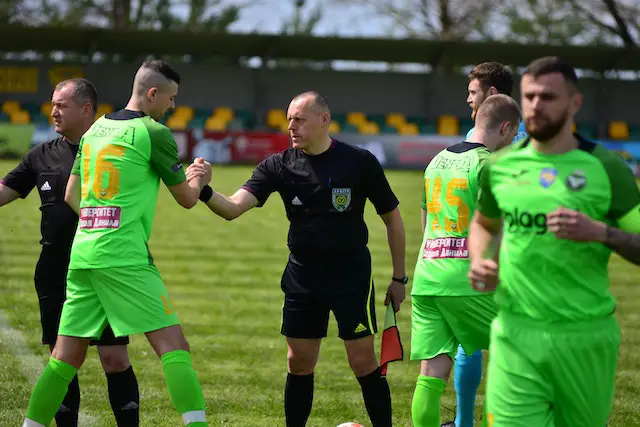
Football refereeing is one of the most physically demanding jobs in sport, and nobody talks about it.
An elite referee covers 10 to 13 kilometres per match, running at varying intensities across 90 minutes plus stoppage time and potential extra periods.
The physical demands during a match are comparable to those of an outfield player.
The mental demands are separate and additional.
A referee’s watch has to do several things that most consumers never consider when buying a smartwatch.
It has to start and stop a stopwatch reliably with a single button press while running.
It has to survive being struck by a football at close range.
It has to remain readable in full floodlight glare at 10 pm and in bright afternoon sun at 3 pm.
It has to track fitness data across multiple matches on a busy weekend.
And it absolutely cannot die mid-match.
Before getting into the recommendations, one important distinction.
The watches on this list divide into two categories.
Dedicated timing watches that referees have used for decades, built for the specific demands of the role.
And GPS smartwatches that provide fitness tracking and recovery data for referees who want to monitor the physical load of their officiating schedule.
A referee doing three matches a weekend who wants to understand their training load and recovery is using the watch differently from a referee who needs only a reliable stopwatch.
Both needs are covered here.
Which are the Best Smartwatch for Football Referees?
Here are my recommended top 6 Best Smartwatches for Football Referees:-


![Apple Watch Ultra [GPS + Cellular 49mm] Smart Watch w/Rugged Titanium Case & Orange Alpine Loop Large. Fitness Tracker, Precision GPS, Action Button, Extra-Long Battery Life, Brighter Retina Display](https://m.media-amazon.com/images/I/51XGrwhczrL._SL160_.jpg)
Casio: (Best Budget Referee Watch)

A Sunday league referee who had been officiating for eight years described the DW-5600UE as the watch he stopped thinking about from the first match.
He had gone through three different sports watches in four seasons. One died from rain exposure during a particularly heavy November afternoon.
One cracked when a player accidentally struck his wrist while celebrating a goal.
One simply stopped working mid-match without any warning or explanation.
He bought the DW-5600UE with low expectations and at a genuinely low cost.
It has been on his wrist through two complete seasons of officiating without any issue of any kind.
What the 5600 Series Has Always Done Right:
The DW-5600 design has existed since 1983 and has accumulated one of the most loyal user bases of any watch ever made.
The reason is straightforward.
The watch does exactly what it promises, every time, in any conditions, for years.
The stopwatch function starts, stops, and resets with single button presses.
The buttons are large and clearly differentiated, meaning a referee running alongside play can operate them by feel without looking at the watch.
The countdown timer can be preset to 45 minutes and quickly reset at halftime.
The LED backlight clearly illuminates the entire display during evening matches under floodlights.
The alarm function can be set to trigger at the end of the stoppage time as a secondary reminder.
The DW-5600UE improves on the older DW-5600E with an LED backlight replacing the electroluminescent panel, providing brighter illumination, and a five-year battery life that eliminates the risk of a battery dying mid-season.
At the weight of the watch, which registers as almost nothing on the wrist, there is no physical distraction during running.
The resin case and bezel handle impact without concern, whether from a ball strike, a collision with a post, or a dropped watch in the changing room.
200-metre water resistance is more than any outdoor weather condition requires.
Multiple referees across online officiating communities describe the watch as the most reliable piece of kit in their bag, which, for a role where reliability is the fundamental requirement, is the highest practical endorsement available.
The honest limitation is the display.
The negative LCD (light text on a dark background) requires a backlight in low ambient light.
The small text for secondary functions requires close reading under pressure.
The watch provides no fitness tracking, heart rate monitoring, or recovery data.
For a referee who wants only a reliable match timer, none of that matters.
Specifications:
| Feature | Details |
|---|---|
| Display | Digital, negative LCD |
| Case Size | 43.2mm |
| Water Resistance | 200m |
| Battery Life | 5 years |
| Backlight | LED |
| Stopwatch | 1/100 second, 24-hour capacity |
| Countdown Timer | Yes, presettable |
| Shock Resistance | G-Shock standard |
Casio: (Best Referee Watch with Atomic Timekeeping)

A county-level referee who officiates three to four matches per week described the specific problem the GW-M5610 solved.
He had been resetting his watch to the correct time manually before every match.
During a particularly busy weekend, with an early-morning kickoff, an afternoon match, and an evening match, he arrived at the third venue and noticed his watch was showing the incorrect time due to a previous manual adjustment that had introduced a one-minute error.
He reset it.
He bought the GW-M5610 the following week.
The watch has shown the correct time to the second on every subsequent match day without any intervention from him.
Multiband 6 Atomic Timekeeping for Match Officials:
The GW-M5610 receives radio signals from atomic clock transmitters and automatically corrects its time up to 6 times per day.
A referee who synchronises their watch before kickoff has a watch that shows the same time as the official match clock, without any manual adjustment.
This eliminates an error source that is small in normal daily use but meaningful for match officials, where precision timekeeping directly affects the officiating record.
Tough Solar charging converts any light source into stored energy.
The seven-month battery reserve without any light exposure means the watch never runs low during a normal officiating schedule.
For a referee who travels regularly for matches and cannot always guarantee charging access, the self-sustaining power system removes that logistical consideration entirely.
The square case design uses the same button layout as the DW-5600UE, so the stopwatch function feels identical while running a match.
The negative LCD display with the Super Illuminator backlight provides the clearest floodlit viewing available on any watch in this price range.
Multiple referees across officiating forums specifically mention that backlight quality is noticeably better than that of standard LED alternatives during evening matches.
The watch tracks time across 29 world time zones, which, for referees who officiate international competitions or travel across time zones for tournaments, provides immediate zone adjustment without manual calculation.
Five alarms and a countdown timer with auto-repeat cover the standard match timing requirements, including halftime duration and stoppage time management.
Who Should Not Buy This
If you want GPS tracking and heart rate monitoring alongside match timing, the Garmin Instinct 3, later in this list, offers them.
If the negative LCD display is difficult to read on digital watches, this watch uses the same display type as the DW-5600UE and has the same limitation.
Specifications:
| Feature | Details |
|---|---|
| Display | Digital, negative LCD |
| Case Size | 43.2mm |
| Timekeeping | Multiband 6 atomic, 29 time zones |
| Power | Tough Solar, 7-month reserve |
| Water Resistance | 200m |
| Backlight | Super Illuminator |
| Stopwatch | Yes, countdown timer with auto-repeat |
| Alarms | 5 |
Garmin Instinct 3 Solar: (Best GPS Smartwatch for Active Referees)

A semi-professional referee who officiates in a regional league described using the Instinct 3 Solar throughout a full season of twice-weekly matches and reviewing the data with his fitness trainer at the end of the season.
The total distance he had covered officiating over the season was comparable to a competitive amateur runner’s annual mileage.
His trainer described the data as revealing a training load that most people would not associate with an officiating schedule.
They restructured his conditioning work for the following season based on what the watch had shown about his actual physical output.
His fitness in the second half of the following season was noticeably better than in any previous campaign.
GPS Distance and Heart Rate for Referees:
The Instinct 3 Solar includes a Soccer and Football activity profile that tracks distance, speed zones, and heart rate during a match.
For referees who want to understand their physical output across a 90-minute match, this profile provides the same data that GPS vest trackers give outfield players, from a device worn on the wrist rather than a vest worn under the shirt.
After a season of matches, the accumulated data shows which types of matches are most physically demanding, how recovery between matches looks in terms of HRV trends, and whether conditioning work during the week is appropriate for the match load carried at the weekend.
This is information that was previously accessible only to professional referees working with sports science support.
Multiband GPS with SatIQ technology automatically selects the appropriate GPS mode based on conditions, balancing accuracy and battery life without any manual adjustment.
The GPS battery in all-systems mode runs to approximately 57 hours, covering any conceivable officiating commitment without concern.
The solar charging extends this further during outdoor matches in daylight.
MIL-STD-810 testing covers shock, thermal extremes, humidity, and vibration.
The case construction handles the physical demands of refereeing, including ball contact, weather exposure, and the general rough treatment that outdoor officiating produces over a season. 100-metre water resistance covers heavy rain during matches.
The built-in flashlight is a practical addition for referees who conduct changeovers in dark areas, need to check the match ball markings under floodlights, or officiate at poorly lit grassroots facilities.
Multiple Garmin Instinct users who refer to it describe the flashlight as one of the features they use most often and would not have predicted before purchase.
Who Should Not Buy This:
If you want a watch specifically for match timing reliability without the GPS features, the Casio options on this list are simpler and more focused.
If topographic maps for navigation are important, the Instinct 3 does not include preloaded maps.
For referees who want the GPS fitness data alongside colour mapping, the Garmin Fenix 8 covers both at a significant cost increase.
For a broader look at how the Instinct 3 Solar compares against other GPS watches for outdoor endurance activities, the full comparison at best-smartwatches-for-hiking covers the outdoor GPS watch category in detail.
Specifications:
| Feature | Details |
|---|---|
| Case Sizes | 45mm and 50mm |
| Display | MIP transflective, solar ring |
| Battery GPS | Up to 57 hours |
| Battery Smartwatch | Up to 29 days |
| GPS | Multi-band, SatIQ auto mode |
| Build | MIL-STD-810 |
| Flashlight | Yes, LED |
| Water Resistance | 100m |
| Activity Profile | Soccer and Football included |
Casio: (Best G-Shock for Referees Who Want Heart Rate Monitoring)

A referee and personal trainer who officiates weekend matches described the GBD-H2000 as the first G-Shock that actually measured something useful about his body during matches rather than just the time.
He had been wearing G-Shocks for officiating for years because of the durability and reliability.
The GBD-H2000 added heart rate monitoring to that foundation without compromising the build quality he had come to rely on.
He described reviewing his average heart rate across a match for the first time and understanding why certain matches left him more fatigued than others despite similar distances.
G-Shock Durability with Optical Heart Rate:
The GBD-H2000 sits in the G-Shock Move series, Casio’s fitness-focused G-Shock line that combines the brand’s established shock resistance and water resistance with an optical heart rate sensor.
The sensor monitors heart rate during activity and at rest, providing the cardiovascular data that standard G-Shocks cannot capture.
During matches, the optical heart rate shows zone distribution across the 90 minutes.
Understanding how much time a referee spends in moderate aerobic zones versus higher-intensity zones informs conditioning work during the week.
A referee who consistently spends a higher percentage of match time in zone 3 or above than expected may need to improve their aerobic base to officiate with less physical effort and better decision-making clarity in the final 20 minutes.
The GPS uses dual-antenna technology for reliable distance tracking during matches.
When reviewed in the companion app after a match, distance, pace distribution, and heart rate together build a picture of the physical demands of that specific match that accumulated over a season, providing genuine performance insight.
The G-Shock construction covers the durability requirements.
200-metre water resistance handles heavy rain without concern.
Shock resistance to the G-Shock standard handles ball contact and accidental impacts during matches.
The resin construction keeps the weight low and the case profile minimal on the wrist.
One genuine limitation is the GPS battery life in full-accuracy mode, which lasts approximately 22 hours.
For referees doing single matches, this is never a concern.
For referees doing multiple matches on consecutive days with limited charging access between them, planning a charge between days is necessary.
Specifications:
| Feature | Details |
|---|---|
| Case Size | 49.8mm |
| Water Resistance | 200m |
| Shock Resistance | G-Shock standard |
| GPS | Dual-antenna |
| Battery GPS | 22 hours |
| Heart Rate | Optical, continuous |
| Stopwatch | Yes |
| Fitness Features | Heart rate zones, distance, step count, sleep |
Amazfit T-Rex 3: (Best Budget GPS Smartwatch for Referees)
Rugged Build for the Budget Referee:
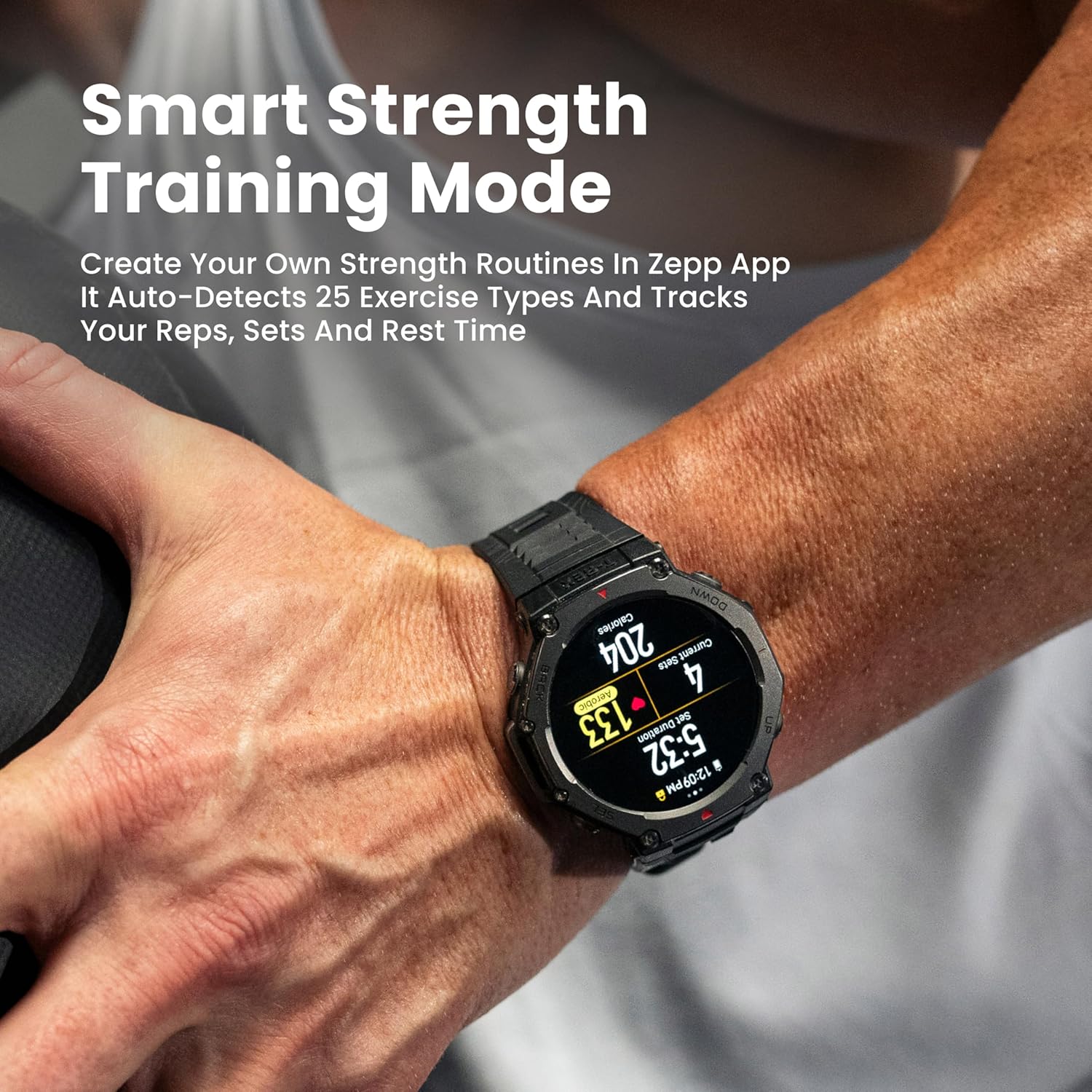
The T-Rex 3 meets 15 military testing standards covering shock, temperature extremes, salt mist, sand, and vibration.
For a watch worn throughout a full season of outdoor refereeing in all weather conditions, this durability certification covers the range of conditions the role encounters without requiring special handling by the wearer.
The dual-frequency GPS across five satellite systems tracks distance and route during matches with accuracy that reviews in multiple publications describe as comparable to watches at significantly higher prices.
After a match, reviewing distance, pace zones, and heart rate in the Zepp app provides the fitness data that informs conditioning decisions for the following week.
Battery runs to 42 hours in GPS mode, covering any realistic officiating commitment without mid-match or mid-weekend charging anxiety.
The 27-day smartwatch battery means the watch is always on the wrist, collecting the overnight HRV and sleep data that daily readiness scores depend on.
The 1.5-inch AMOLED display reads clearly during outdoor matches in all lighting conditions.
For evening matches under floodlights and afternoon matches in direct sun, the display remains readable without adjustments.
The daily readiness score synthesises overnight HRV and sleep quality into a morning number that tells a referee whether their body is prepared for high physical output.
For referees managing the load of multiple matches across a weekend, combined with conditioning training during the week, this daily score provides a basis for training intensity decisions that subjective self-assessment cannot reliably produce.
For a broader look at how the T-Rex 3 compares with other rugged GPS watches across outdoor sports and fitness-tracking contexts, the comparison at best-smartwatches-for-monitoring-stress covers the Zepp health platform in detail.
Who Should Not Buy This
If the Garmin Connect ecosystem is already part of your fitness setup through other Garmin devices, the T-Rex 3 operates on the separate Zepp platform and does not integrate with it. If atomic timekeeping for pre-match synchronisation matters, the Casio options provide that.
And if dedicated Football or Soccer activity profiles with speed-zone analysis are a specific requirement, the Garmin Instinct 3 includes them.
Specifications:
| Feature | Details |
|---|---|
| Case Size | 47mm |
| Display | 1.5 inch AMOLED |
| Battery GPS | 42 hours |
| Battery Smartwatch | 27 days |
| GPS | Dual-frequency, five satellite systems |
| Durability | 15 military standards, 10 ATM |
| Health Features | Daily readiness, sleep stages, HRV, VO2 max |
| Water Resistance | 10 ATM |
Apple: (Best GPS Watch for Referee Under $360)

WHAT DO WE GET FROM THESE?
Innovative Design:
This Apple Watch is exceptionally rugged, with a 49 mm corrosion-resistant case made from titanium.
It has a large Digital Crown and accessible buttons with resistance to the watch for underwater activities.
It also has a customizable button for instant physical control.
Moreover, the watch has a Retina display that’s convenient to use even in extreme daylight.
It has an additional room to DIY your watch face.
Advanced metrics are featured in workout applications, including heart rate modes and running forms.
GPS is used to calculate accuracy, pace, and speed.
This smartwatch is perfect for outdoor adventures and has unique functionality.
Your location is marked with waypoints.
You can also retrace your steps through GPS.
Most Advanced Features:
This Apple smartwatch is made for water sports.
It features an oceanic app that connects to a computer on your band.
The ocean band is weightless and adaptable, with a buckle made from titanium and a flexible loop for a safe fit even during speedy water sports.
The watch also features upgraded health sensors that give you deep information about your health.
Crash detection features can instantly connect you to emergency services in a severe accident.
You have to hold the action button to activate the siren.
Conclusion:
This Apple smartwatch is the best for football referees.
Its unique features and monitors help you maintain your health and running profiles.
For 24/7, you are monitored for your health, including your heart rate.
Plus, the bright display lets you see even in extreme sunlight.
Specs:
| Brand | Apple |
| Measurements of the item | 8.45 x 4.65 x 1.5 inches |
| Weight of the product | 2.16 ounces |
| ASIN | B0BDHHNCHP |
| The model number of the product | MNHC3LL/A |
| Batteries included the product | 1 Lithium Ion battery is required. (included) |
| The standing display size of the watch | is 1.43 inches |
| Manufacturer | Apple |
| Used for | unisex |
| Size of the watch | 49 millimeters |
| Special features of the watch | activity tracker, heart rate monitor |
| Date first available | September 7, 2022 |
FAQs:
What features does a football referee actually need in a watch?
The core requirements that differ from standard smartwatch use are reliable stopwatch operation by feel during running, clear display readability under both floodlights and direct afternoon sun, and water resistance sufficient for outdoor matches in heavy rain. Beyond those fundamentals, referees who officiate multiple matches per week benefit from fitness tracking features that show the cumulative physical load of their officiating schedule. Heart rate monitoring during matches reveals intensity levels that distance tracking alone does not capture. HRV-based recovery scores show how long the body needs to recover between matches. These fitness data features are less important for referees who officiate infrequently and more important for those managing the load of multiple matches across a demanding weekend schedule.
Should a football referee use a smartwatch or a dedicated referee timing watch?
Dedicated referee timing watches are simpler, cheaper, and extremely reliable for the specific timing tasks that officiating requires. A Casio G-Shock with a reliable stopwatch handles match timing with zero complexity. The limitation is that dedicated timing watches provide nothing beyond timing. Smartwatches add fitness tracking, recovery monitoring, and health data at higher cost and with more complexity. The right choice depends on what the referee wants from the watch. A grassroots referee doing one match per weekend who wants a reliable timer is better served by a dedicated timing watch. A semi-professional referee doing three matches across a weekend who wants to understand their physical output and plan their conditioning accordingly benefits from the additional data that a GPS smartwatch provides. Many experienced referees use a simple timing watch during matches and a separate fitness tracker for daily health monitoring, which avoids needing both functions from a single device.
How much running does a football referee do during a match?
Research published in sports science literature shows that elite referees cover between 10 and 13 kilometres per match, with approximately 1 to 2 kilometres of that at high-intensity running speeds. Top assistant referees cover between 6 and 9 kilometres per match. The physical demand varies significantly based on the level of the game, the style of play of the competing teams, and the pitch dimensions. High-pressing teams with fast transitions create more demand on the referee than defensive teams who play at slower tempo. Over a full season, an active referee who officials twice weekly accumulates physical mileage comparable to a competitive amateur runner’s annual total. The Professional Game Match Officials Limited, which oversees referee fitness standards in English football, publishes fitness requirements and monitoring protocols for referees at different levels of the game at pgmol.co.uk.
Related Articles:
Luis Cooper

Hi, I'm Luis, the guy behind this site. I love wearing watches, especially ones that look great on small wrists (mine are about 6.3" around). The Watches Geek is dedicated to helping you learn about and buy watches that you will love wearing. I want this website to be the last destination for people to pick the best watches to fit their needs. You can find our unbiased reviews here on Thewatchesgeek.