
Last Updated on October 10, 2026 by Luis Cooper
For three years, runners who wanted their first proper Garmin faced a specific frustration.
The Forerunner 55 — Garmin’s entry-level runner — was capable and affordable.
But its LCD display looked dated next to competing watches at the same price.
And it lacked the training tools that made paying for a Garmin worth it in the first place.
The Forerunner 70, launched on May 15, 2026, changes this completely.
It brings AMOLED display technology, comprehensive training analytics, wrist-based Running Power, and the full Garmin training ecosystem to the entry tier for the first time.
It is the watch the Forerunner 55 should have been when it launched.
A 33-year-old marketing manager who started the Couch to 5K program in January said buying a dedicated running watch turned running from an intention into a habit.
She had tracked her runs on her phone for two months, and looking at the data afterward told her what she had done, but not what she should do next.
The Forerunner 70’s Daily Suggested Workouts changed that.
Each morning it told her specifically what to run that day based on how recovered her body was and where she was in her fitness progression.
She stopped planning her runs herself.
She followed the watch.
Six months later, she ran her first 10K and is now training for a half marathon.
Garmin Forerunner 70 Review


Quick Verdict
The Garmin Forerunner 70 is the right watch for someone starting their running journey, upgrading from phone-based tracking, or buying their first Garmin.
It delivers AMOLED clarity, 13 days of battery, Garmin’s full training intelligence platform, and the best single-frequency GPS accuracy in its category — all at the entry price point.
It has clear limitations that deserve equal weight.
It lacks music storage, Garmin Pay, maps, and multi-band GPS.
For buyers who specifically need any of these features, those limitations matter more than the watch’s considerable strengths.
Whether the Forerunner 70 is the right choice comes down to a simple question: do you need music on the wrist while you run?
If yes, the Forerunner 165 Music is the right choice, but it costs more.
If no, the Forerunner 70 is the better watch in almost every other dimension.
Design — Lighter Than It Looks
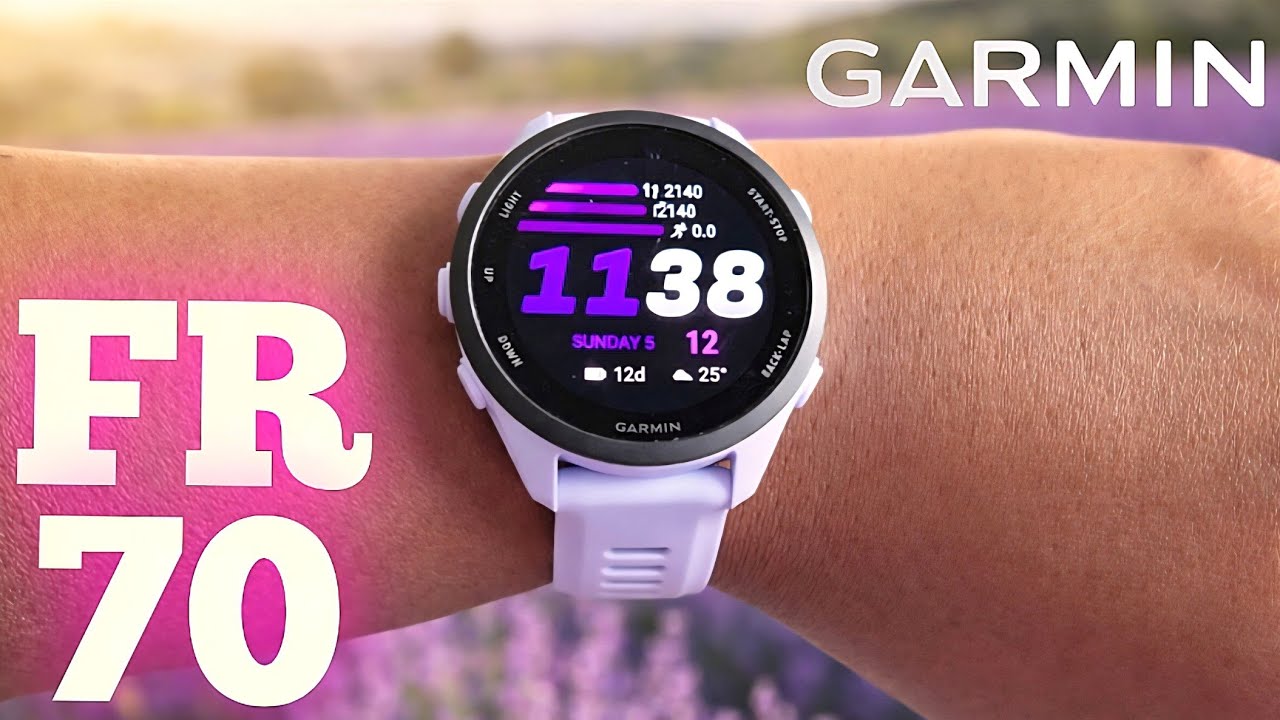
The Forerunner 70 has a 43mm case made from fiber-reinforced polymer, the composite material Garmin uses across its running watch lineup to cut weight without sacrificing durability.
The case measures 42.6 millimeters wide and 11.9 millimeters thick, and the complete watch with strap weighs 40 grams.
Forty grams is genuinely light for a watch with GPS hardware, optical sensors, a battery, and an AMOLED display inside.
Most wearers report forgetting the watch is on within the first run, which is the relevant standard for a device designed to be worn continuously through sleep, work, and activity.
The watch comes in six colors: Black, Tidal Blue, Citron, Soft Pink, Cool Lavender, and Whitestone.
The color range reflects the audience the Forerunner 70 is designed for — runners at the beginning of their journey, not performance athletes who only want black or grey.
The Tidal Blue and Citron colorways read as casual lifestyle watches as much as running watches, making the Forerunner 70 appropriate for daily wear beyond active use.
Five physical buttons sit on the side of the case alongside the touchscreen.
The combination of physical buttons and a touch display gives the Forerunner 70 two distinct ways to navigate menus and control workouts.
During a run with gloves on or with sweaty hands, the physical buttons work reliably.
For casual wear and browsing the health dashboard, the touchscreen is faster and more intuitive.
The crystal over the display is chemically strengthened glass rather than sapphire.
Chemically strengthened glass is scratch-resistant and durable against everyday contact but less resistant to hard-surface impacts than sapphire.
For a runner who wears the watch primarily during training and daily life, without technical outdoor use, this is an appropriate entry-tier material choice.
Water resistance is rated at 5 ATM, which covers swimming, showering, and all weather conditions without precaution.
The Display — AMOLED Changes Everything at This Price

The Forerunner 70’s biggest upgrade over the Forerunner 55 is the 1.2-inch AMOLED display.
The Forerunner 55 used an LCD/MIP display that looked washed out in bright sunlight and flat in low light.
Runners would need to manually adjust brightness or cup a hand over the screen to read pace data on a sunny afternoon.
The AMOLED panel on the Forerunner 70 generates its own light per pixel, producing vivid colours and true black backgrounds that remain readable in direct sun without any adjustment.
The 390 by 390 pixel resolution on the 1.2-inch display delivers sharp, clear text across all data fields.
Pace, heart rate, distance, and workout guidance all display clearly even in the peripheral vision glance that experienced runners use to check metrics without breaking stride.
The always-on display mode shows the watch face continuously without requiring a wrist raise.
With always-on enabled, data is immediately visible each time you glance down at your wrist.
Always-on mode reduces battery life from 13 days to about 5 days, which is still considerably longer than most competing watches at this tier offer, regardless of display settings.
GPS — The Most Accurate Single-Frequency Option at This Level

The Forerunner 70 uses multi-GNSS single-frequency positioning, connecting to five satellite systems simultaneously: GPS, GLONASS, Galileo, BeiDou, and QZSS.
In real-world testing, this GPS system outperformed what most reviews predicted for a single-frequency receiver.
Independent testing at Bushy Park parkrun — a precisely measured 5,000-metre course — produced excellent results.
Separate testing across a 10-mile road route showed the Forerunner 70 tracking within 0.03 miles of a Forerunner 965 reference watch used simultaneously, which is the Garmin flagship.
The5kRunner, who tests GPS watches against measured reference courses, described the Forerunner 70’s GPS accuracy as the best single-frequency performance he had measured in testing.
Road running in open and semi-open environments produces reliable, consistent distance and pace data.
The limitation applies specifically in challenging signal environments.
Single-frequency GPS is more susceptible to positioning error when satellite signals bounce off tall buildings in dense city centres or reflect off heavy tree canopy before reaching the receiver.
In these environments, the multi-band GPS on the Forerunner 570 and Forerunner 970—which receives two frequencies simultaneously and can identify and correct for bounced signals—produces more accurate results.
For runners who train in dense urban canyons or technical trail environments with thick overhead cover, multi-band is the better specification.
For the vast majority of entry-level runner use — parks, roads, suburban neighborhoods, tracks, and open trail — the Forerunner 70’s GPS performs with consistent accuracy across the sessions where it matters.
Heart Rate — Elevate Gen 4
The Forerunner 70 uses Garmin’s Elevate Gen 4.0 optical heart rate sensor.
This is one generation below the Elevate Gen 5 used in the Forerunner 570 and Forerunner 970.
Independent testing showed excellent heart rate accuracy in steady-state running at consistent effort levels. During zone 1 and zone 2 easy running, the Forerunner 70 tracked closely to chest strap reference data throughout.
During rapid effort changes — transitions between easy and hard paces during interval training — the sensor showed slightly wider limits of agreement than newer sensors, which is typical for optical wrist HR monitoring during rapid intensity changes.
For beginners and recreational runners whose training consists primarily of steady runs, progressive long runs, and structured easy-to-moderate sessions, Gen 4 accuracy is entirely adequate.
For experienced runners doing high-intensity intervals with frequent pace changes and who need the most precise heart rate response, pairing the watch with a chest strap for those specific sessions produces more accurate zone data.
Heart rate data feeds all the training analytics the watch provides—Training Readiness, Body Battery, HRV Status, Recovery Time, and Daily Suggested Workouts —and they all depend on accurate resting and active heart rate input.
Training Intelligence — Flagship Features at Entry Price

This section most clearly shows how much the Forerunner 70 punches above its tier. Until recently, its training analytics platform was associated with watches at two and three times the price.
Training Readiness
Training Readiness is the daily number that synthesises overnight HRV, sleep quality, and recent training load into a morning score.
The score tells the runner whether today is appropriate for a hard session, a recovery session, or rest — with specific context explaining which factor is limiting readiness on days when the score is low.
This feature particularly benefits beginner runners.
Beginners often do not yet have the experience to recognize when they are pushing too hard in consecutive days or when they are recovered enough to handle a harder effort.
Training Readiness provides that judgment from data rather than leaving it to intuition.
Daily Suggested Workouts

Each morning the Forerunner 70 generates a specific workout recommendation based on the runner’s current fitness level, recent training load, Training Readiness score, and any registered race or goal event.
The recommendation is not a generic plan from a chart — it is generated from the runner’s actual data and adjusts as fitness changes.
For a runner using Garmin Coach alongside Daily Suggested Workouts, the two systems integrate — the coaching plan sessions appear in the workout queue, and the adaptive suggestions account for both planned and completed training.
Quick Workout — The Feature No Other Forerunner Has
Quick Workout is exclusive to the Forerunner 70 and does not appear on any other model in the current Forerunner lineup.
It gives one-tap access to a pre-built structured session, no menu navigation or manual planning required.
For beginners who aren’t yet comfortable designing their own interval sessions or structured runs, Quick Workout delivers a ready-made session matched to their current fitness with a single button press.
The feature addresses the specific barrier that beginners face — knowing what to do today — in the most direct way possible.
Body Battery
Body Battery tracks the runner’s energy level from zero to one hundred throughout the day based on HRV, sleep quality, stress, and activity.
The number reflects how much physiological energy the body has available for physical and mental demands at any given moment.
For a runner managing training alongside work, family, and daily stress, Body Battery provides context for how the body responds to the combination of all of these things rather than running load alone.
A Body Battery of 38 at 6 am tells the watch that the hard track session planned for the morning may not produce the adaptation it would on a higher-energy day.
Running Power
Wrist-based Running Power estimates the runner’s power output per second using accelerometer data alongside heart rate and GPS.
Power-based running training is increasingly popular because it accounts for hills and headwinds in a way that pace cannot — the same power output on a climb produces a slower pace, but the effort is accurately represented in the power number.
Having Running Power available on a watch at the entry Forerunner tier is unusual.
It was previously associated with mid-range and premium models, and including it at the Forerunner 70 level gives beginning runners a training metric they can grow into over months of use rather than outgrowing the watch too quickly.
Garmin Coach
Garmin Coach provides free structured training plans for 5K, 10K, and half marathon distances.
The plans adapt to the runner’s pace and feedback as training progresses rather than following a fixed schedule regardless of how sessions went.
For a runner preparing for their first race, Garmin Coach provides coached structure without a coaching subscription or fee.
Battery — 13 Days Is the Right Number for Most People
The Forerunner 70 is rated at up to 13 days in smartwatch mode.
Independent reviews and user feedback broadly confirm this figure in normal daily use with sleep tracking, heart rate monitoring, notifications, and occasional daily GPS sessions.
The practical battery calculation for most runners works as follows.
A runner who trains four times per week with GPS sessions averaging one hour each uses approximately 40 percent of the battery per week on GPS tracking alone.
Adding continuous health monitoring, sleep tracking, and notification processing in the same week brings total consumption to 13 days for moderate use and about 7 to 9 days for more active runners.
With daily GPS sessions of one hour or more and always-on display enabled, real-world battery lands closer to 4 to 5 days — the figure that heavy Garmin users report consistently.
This is still meaningfully longer than the Apple Watch Series 12’s 24 hours or the Samsung Galaxy Watch 9’s 30 to 40 hours, which most users charge daily regardless of GPS use.
For training specifically, the GPS battery lasts up to 23 hours, enough for any realistic single training session or race.
A marathon, a half-iron-distance triathlon, and a full-day orienteering event all fall within the GPS battery ceiling without requiring any battery management.
Battery saver mode extends total life to about 28 days by reducing the watch to basic timekeeping, with occasional step and heart rate recording.
This mode is useful for travel when a charger isn’t available, rather than for active training.
What the Forerunner 70 Does Not Include
Understanding the omissions is essential to making the right purchase decision.
No music storage. The Forerunner 70 cannot store Spotify, Amazon Music, or any other music for phone-free listening during workouts. It can control music on a paired phone via Bluetooth, but the phone must stay nearby for this to work. Buyers who specifically want to leave their phone at home and run with music through wireless earbuds need the Forerunner 165 Music, which carries onboard music storage. For a complete guide to every Garmin watch that supports phone-free music listening, the full guide at best-garmin-watches-with-music covers the current music-capable lineup in detail.
No Garmin Pay. The Forerunner 70 doesn’t support contactless payment from the wrist. Post-run coffee, a sports drink purchase, or a race registration fee cannot be paid from the watch.
No multi-band GPS. As covered in the GPS section, single-frequency positioning is appropriate for most running environments but falls behind dual-band systems in challenging signal conditions. The Forerunner 570 and Forerunner 970 carry multi-band GPS for runners who specifically need it.
No maps. They don’t offer turn-by-turn navigation or topographic maps. The Forerunner 70 shows a basic breadcrumb trail of the current route but does not display a map. Runners who need on-wrist map navigation should choose models above the Forerunner 70 tier.
Pool swim only. The Forerunner 70 supports pool swimming with lane counting and SWOLF tracking. It doesn’t support open-water swim tracking with GPS route recording, which can limit triathletes training in open water.
Garmin Forerunner 70 vs Forerunner 165 — The Most Important Comparison
The most common buying decision for anyone considering the Forerunner 70 is whether to choose it or the Forerunner 165 Music.
| Feature | Forerunner 70 | Forerunner 165 Music |
|---|---|---|
| Music storage | No | Yes — Spotify, Amazon Music, Deezer |
| Battery smartwatch | 13 days | 11 days |
| Battery GPS | 20-23 hours | 19 hours |
| GPS systems | 5 — including BeiDou, QZSS | 3 — GPS, GLONASS, Galileo |
| Running Power | Yes | No |
| Quick Workout | Yes — exclusive | No |
| Garmin Pay | No | Some models |
| Touchscreen | Yes | Yes |
| HR sensor | Elevate Gen 4 | Elevate Gen 4 |
| Colors | 6 options | 4 options |
The decision comes down to one question: Is music storage during workouts essential for you?
If yes, the Forerunner 165 Music is the correct choice.
If not, the Forerunner 70 offers better battery life, GPS satellite coverage, and running-specific features, including Running Power and the exclusive Quick Workout feature.
For serious runners who want Garmin’s full analytical depth, multi-band GPS, and advanced running metrics, the full review at garmin-fenix-9-review covers what Garmin’s premium outdoor platform delivers for experienced athletes.
Who should not buy this: Runners who want phone-free music during training should look at the Forerunner 165 Music. Experienced runners who train in technical terrain, urban canyons, or need multi-band GPS precision should consider the Forerunner 570 or higher. Buyers who specifically need Garmin Pay or open-water swim GPS recording will find those features on models above the Forerunner 70 tier.
Specifications
| Feature | Details |
|---|---|
| ASIN | B0H1F6H8FN (Black) |
| Launch | May 15, 2026 |
| Display | 1.2-inch AMOLED, 390×390, touchscreen |
| Crystal | Chemically strengthened glass |
| Case | 43mm, fiber-reinforced polymer |
| Weight | 40 grams |
| Thickness | 11.9mm |
| Controls | 5 physical buttons + touchscreen |
| GPS | Multi-GNSS 5 systems, single-frequency |
| GPS road accuracy | Within 0.03 miles over 10-mile routes (independent testing) |
| Heart rate | Elevate Gen 4.0 |
| Battery smartwatch | Up to 13 days |
| Battery GPS | Up to 20-23 hours |
| Battery always-on | Approximately 5 days |
| Battery saver | Up to 28 days |
| GPS drain per hour | Approximately 10% |
| Water resistance | 5 ATM |
| Training | Training Readiness, Daily Suggested Workouts, Body Battery, Running Power, HRV, Recovery Time, VO2 Max |
| Exclusive feature | Quick Workout |
| Coaching | Garmin Coach — free structured plans |
| Sport profiles | 80-plus |
| Colors | Black, Tidal Blue, Citron, Soft Pink, Cool Lavender, Whitestone |
| Amazon rating | 4.4 stars from 110-plus reviews |
| Compatibility | iOS and Android |
FAQs
Is the Garmin Forerunner 70 good for beginners?
The Forerunner 70 is specifically designed for beginners and early-stage runners. The Daily Suggested Workouts feature generates a recommended session each morning based on the runner’s current fitness and recovery, so you don’t have to plan training independently. Garmin Coach provides free structured plans for 5K, 10K, and half marathon distances that adapt as fitness develops. The Quick Workout feature — exclusive to the Forerunner 70 — starts a pre-built structured session with a single tap for runners who want structured training without building sessions themselves. The training intelligence platform that guides experienced runners toward better performance does the same work in reverse for beginners—it identifies when the body is ready for a harder session and when it needs recovery, preventing the overtraining that causes most beginners to abandon their running programs in the first two months.
How does the Garmin Forerunner 70 battery compare to the Apple Watch?
The Forerunner 70’s 13-day smartwatch battery is significantly longer than the Apple Watch Series 12’s 24 hours. In practice, a runner wearing an Apple Watch charges it every night. A runner who wears the Forerunner 70 charges it approximately once every one to two weeks depending on how many GPS sessions occur during that period. The difference eliminates the daily charging routine that most Apple Watch owners describe as the most friction-producing aspect of the watch. The 20-23-hour GPS battery covers any single training session or race comfortably. For runners upgrading from an Apple Watch because of battery limitations, the Forerunner 70’s endurance figure is usually the main reason for the switch.
Does the Garmin Forerunner 70 work with iPhone?
Yes. The Forerunner 70 connects to both iPhone and Android devices through the Garmin Connect app. On iOS, the full feature set is available — training analytics, health data sync, Daily Suggested Workouts, notifications from the phone, and music control (the phone’s music, not stored on the watch). The Garmin Connect app for iOS provides the same dashboard and data view as the Android version. For more guidance on training load, VO2 Max, and how heart rate zones support fitness development, the American College of Sports Medicine provides evidence-based guidance for recreational runners at acsm.org.
Luis Cooper

Hi, I'm Luis, the guy behind this site. I love wearing watches, especially ones that look great on small wrists (mine are about 6.3" around). The Watches Geek is dedicated to helping you learn about and buy watches that you will love wearing. I want this website to be the last destination for people to pick the best watches to fit their needs. You can find our unbiased reviews here on Thewatchesgeek.