
Last Updated on September 29, 2026 by Luis Cooper
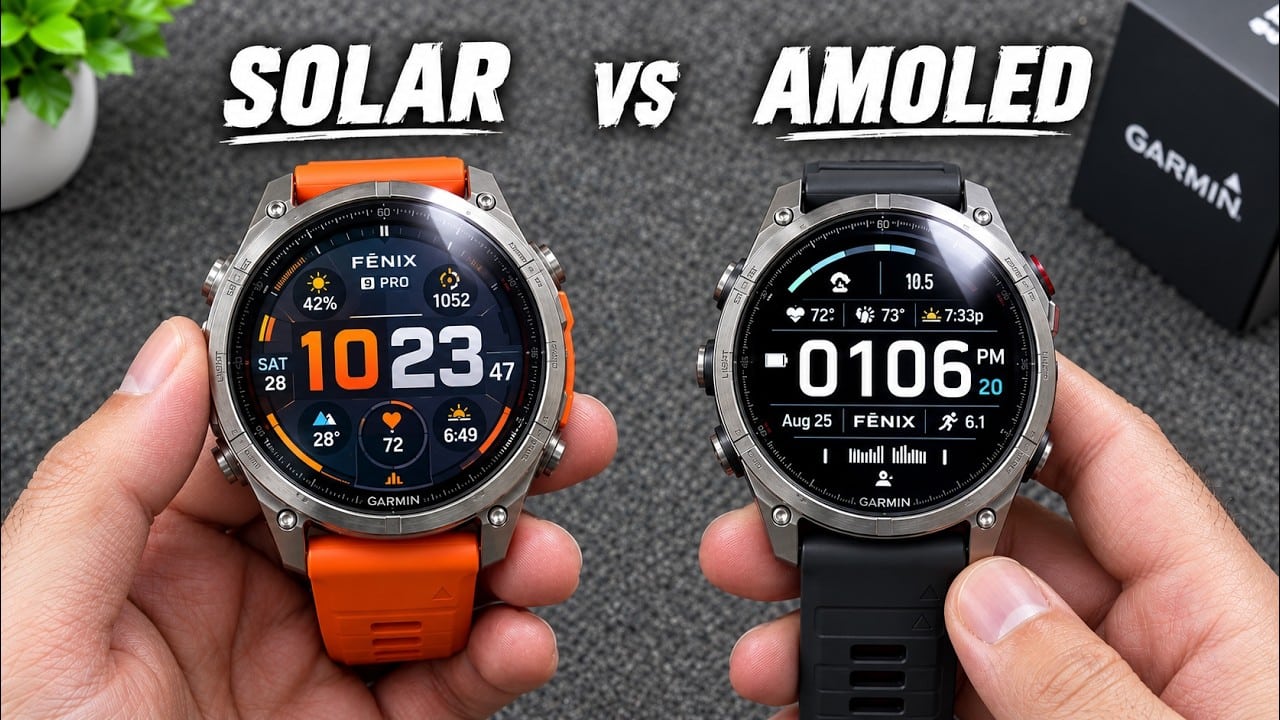
The Garmin Fenix 9 Pro comes in two versions that look almost identical on the outside but feel completely different day to day.
One has the brightest, most vivid screen Garmin has ever put on a Fenix.
The other can run for over a month without touching a charger.
The choice between them is not about which one is better in any absolute sense. It is about which one suits the specific way you actually train and live.
This guide explains what separates them, what real-world battery numbers look like beyond the spec sheet, and which type of athlete belongs with each model.
By the end of it, the right choice for your life will be clear.
Garmin Fenix 9 Pro Solar vs AMOLED


The Quick Answer — Before You Read Everything
Buy the Fenix 9 Pro AMOLED if:
You train primarily in evenings or indoors, you want the most vivid map and navigation experience available on a Garmin, you train regularly but not on multi-week expeditions, and you charge your watch every few days without complaint.
Buy the Fenix 9 Pro Solar if:
You do ultra-endurance events lasting multiple days, go on expeditions where charging isn’t possible for a week or more, train primarily outdoors in daylight, or cycle and mount your watch on handlebars where you need screen visibility in direct sunlight without a battery penalty.
Skip the Pro entirely if:
The standard Garmin Fenix 9 does everything you need. The Pro adds a brighter display, a full titanium case, and solar charging options — but the core GPS platform, sport modes, health monitoring, and training analytics are identical to the standard model.
Both the Fenix 9 Pro AMOLED and Pro Solar carry the same titanium case, the same six-button layout, the same multi-band GPS system, the same heart rate sensor, the same topographic maps with 30 percent faster panning over the Fenix 8, the same 64GB storage with Spotify and Amazon Music support, the same 100-metre water resistance, and the same full Garmin training platform including Training Readiness, Daily Suggested Workouts, and Race Predictor.
The difference is entirely the display and how that choice affects battery life. Every other specification is the same.
The Display — Understanding What You Are Actually Choosing

The AMOLED Display
AMOLED is the same display technology used in premium smartphones and the Apple Watch Ultra.
Each pixel generates its own light, so colours are vivid, blacks are true black, and the contrast makes map lines, data fields, and health metrics sharp and immediately readable, no matter how small the text is.
At 3,000 nits of peak brightness, the Fenix 9 Pro AMOLED is the brightest watch Garmin has ever produced.
Looking at the full-colour topographic map in direct midday sunlight is the specific test that demonstrates this most clearly — the map detail is readable without shading the screen with your hand or squinting at the data.
The AMOLED screen is also a touchscreen. Scrolling through data fields, panning across a map, and navigating menus mid-activity happens with a finger tap rather than button presses.
For riders who mount the watch on bike handlebars, water droplets can trigger touch sensitivity — something worth knowing before an event in wet conditions.
The MIP Solar Display
MIP stands for Memory-in-Pixel. It is a fundamentally different technology from AMOLED.
Where AMOLED pixels generate light, MIP pixels reflect ambient light — specifically sunlight — to become visible. The brighter the sun, the clearer the MIP screen.
This is the opposite of most screen technology, which gets harder to read in sunlight.
A MIP display gets clearer in direct sunlight, making it the superior option for anyone who trains outdoors in good conditions and wants maximum screen visibility without any battery cost.
The trade-off is visible immediately in dim or indoor conditions.
Without good ambient light, the MIP screen activates a backlight, and that backlight draws more power than the AMOLED panel does during normal use.
This distinction matters most for athletes who train at night — which is covered in the battery section.
The Solar ring around the edge of the MIP display converts sunlight into electrical energy that extends battery life.
This is not a gimmick — the real-world data confirms meaningful battery extension in the right conditions. But those conditions are specific, and the 57-day headline figure requires conditions that most buyers will not consistently meet.
The Battery — The Real Numbers Nobody Explains Clearly
This is the section that the specification sheets do not tell you and that most review articles do not explain in a way that changes how you actually make the decision.
The Official Numbers (47mm model)
| Mode | Pro AMOLED | Pro Solar |
|---|---|---|
| Smartwatch mode | 18 days | 21 days (34 with solar) |
| Low power mode | 24 days | 37 days (119 with solar) |
| GPS normal activity | 32 hours | 54 hours (81 with solar) |
| GPS + music | 13 hours | 15 hours (16 with solar) |
The GPS activity mode is where the difference matters for real athletic use. 32 hours versus 54 hours is the difference between a watch that covers an ironman with margin remaining and a watch that tracks a 50-hour ultra event in standard GPS mode without switching to battery-saving settings.
The Real-World Test That Changes Everything
Independent real-world testing during a gravel ride compared both 47mm models simultaneously.
Both were tested under the same conditions: the same ride and the same satellite settings.
In the daytime test with consistent sunlight, the Solar unit used 2.80 percent of battery per hour — giving approximately 35.5 hours of continuous GPS tracking.
The AMOLED used 3.75 percent per hour, giving approximately 26 hours. The Solar wins by nearly 37 percent in good daylight conditions.
Now here is the finding that almost no comparison article explains: testing the same models during night navigation with no sunlight, the AMOLED used 1.76 percent of battery per hour — approximately 56 hours of GPS tracking.
The Solar MIP unit, which must activate its backlight to be readable in darkness, used substantially more power than its daytime figure.
The solar advantage reverses completely at night. The AMOLED lasts significantly longer during dark training sessions because it generates its own light efficiently while the Solar MIP needs a backlight that costs more power than the AMOLED uses to operate the entire display.
This single fact matters more than any spec comparison.
The Physical Difference Nobody Mentions

The Fenix 9 Pro Solar is physically thicker than the Fenix 9 Pro AMOLED, and the screen is slightly smaller despite the larger case volume.
The Solar model needs extra space inside the case for the MIP panel and solar charging circuitry.
The result is a watch that is noticeably thicker when placed side by side with the AMOLED version.
For buyers who prioritise a slimmer profile — for professional daily wear, formal occasions, or simply physical comfort across extended wear — this thickness difference is worth factoring into the decision before purchase.
The Solar’s screen is smaller than the AMOLED’s at equivalent case sizes because the solar ring occupies the outer portion of the face.
The AMOLED uses that entire area for the display.
Who Should Buy Each — Practical Profiles
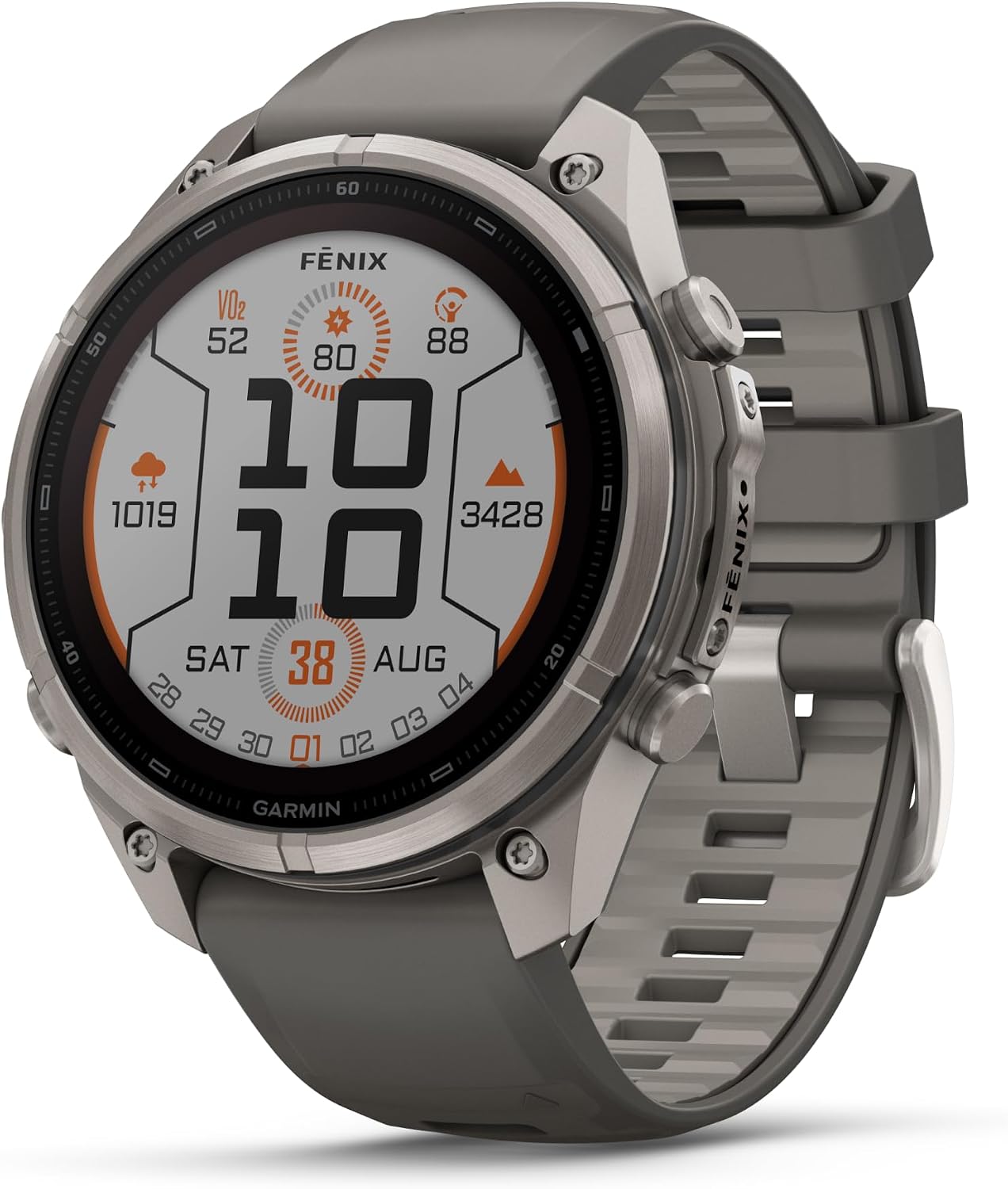
The Fenix 9 Pro Solar Suits These Buyers
The ultra-endurance athlete who runs or cycles events lasting 24 hours or more, trains across multiple consecutive days, or competes in events where access to charging equipment is not guaranteed. At 54 hours of GPS battery in standard mode — and up to 81 hours with solar contribution — the Solar covers the full duration of events that no other smartwatch in this guide approaches.
A 44-year-old mountain ultramarathon runner who competes in 100-mile races described making the Solar choice as removing the one anxiety he carried into every event — whether the watch would outlast the race. At 54 hours of GPS with music and solar contribution in the cloudless summer conditions of high-altitude trail events, the anxiety disappeared. He has not thought about his watch battery during a race since.
The expedition-style athlete who spends consecutive days hiking, bikepacking, or at sea where charging access may not occur for a week or more. Under real outdoor conditions in sunny climates, the Solar genuinely extends the time between charges in a way that changes expedition planning.
The outdoor cyclist who mounts the watch on handlebars. Mounted directly on handlebars, the watch faces the sky throughout the ride rather than tilting with the wrist, which maximises the solar charging panel’s exposure. The MIP screen stays readable in direct sunlight without any battery penalty, making it the natural choice for this mounting position.
The Fenix 9 Pro AMOLED Suits These Buyers

The daily athlete who trains in the evenings or mornings before sunrise. If training sessions consistently happen in limited natural light — before dawn, after sunset, under indoor track conditions, in gym environments — the solar advantage never materialises and the AMOLED’s longer battery in low-light GPS mode is the more relevant number.
A 38-year-old software engineer who runs at 6am before work every day described the AMOLED as the obvious choice the moment he understood how the solar charging actually works. He runs before sunrise most mornings. The solar panel generates nothing during those sessions. The AMOLED display gives him a vivid screen for navigation and data without the thickness compromise of the Solar version.
The map user who values detail. Topographic map navigation on the AMOLED is qualitatively different from the MIP experience. Elevation shading, trail colour coding, and contour line detail are all more distinct on the vivid AMOLED panel. For athletes who rely heavily on on-wrist navigation in technical terrain rather than primarily using the watch for pace and heart rate data, the AMOLED map experience is worth the battery trade-off.
The athlete who charges regularly and values the thinner profile. If charging every few days after longer sessions is already part of the routine, the battery difference between Solar and AMOLED is academic. The AMOLED is thinner, has a larger screen for the case size, and has a touchscreen that works consistently in the conditions most athletes train in.
Fenix 9 Pro Solar vs AMOLED — Full Comparison Table (47mm)
| Feature | Pro AMOLED | Pro Solar |
|---|---|---|
| Display type | AMOLED, 3,000 nits | MIP with solar ring |
| Touchscreen | Yes | No |
| Case thickness | Slimmer | Thicker |
| Screen size | Larger | Smaller (solar ring takes space) |
| Smartwatch battery | 18 days | 21 days (34 with solar) |
| GPS normal battery | 32 hours | 54 hours (81 with solar) |
| GPS + music | 13 hours | 15 hours (16 with solar) |
| Night GPS performance | Better — no backlight needed | Worse — backlight activates |
| Daytime GPS performance | Good | Better in direct sunlight |
| Best for | Daily athletes, evening training | Ultra events, expeditions, daytime outdoor |
| Map readability | Vivid, high contrast | Excellent in daylight, dim indoors |
| Price | Same tier | Same tier |
| Case material | Full titanium | Full titanium |
| GPS system | Multi-band GNSS | Multi-band GNSS |
| Storage | 64GB | 64GB |
| Water resistance | 100 metres | 100 metres |
| Green flashlight | Yes | Yes |
| ASIN | B0HGG2WM1D | Search “Garmin Fenix 9 Pro Solar” |
The 57-Day Battery — What That Number Actually Requires
The 57-day battery claim for the Fenix 9 Pro Solar 51mm appears in every specification table and in most headlines about the watch.
It is a genuine figure, but the conditions it requires deserve a clear explanation.
Garmin’s 57-day estimate assumes all-day wear with three hours per day outdoors in 50,000 Lux illumination.
To put that light level in context, direct midday summer sunlight in a clear sky at sea level produces approximately 100,000 Lux.
A lightly overcast day produces 10,000 to 25,000 Lux. An overcast day produces 1,000 to 10,000 Lux.
Three hours of 50,000 Lux per day is direct clear-sky sunlight during the brightest part of the day.
In most climates and most lifestyles, this is an optimistic condition rather than a typical one.
Real-world testing across twelve weeks of training produced a consistent 22-day battery cycle on the 47mm Solar with daily outdoor workouts.
In a warm-weather summer test, the same reviewer achieved 34 days. The difference reflects how consistently and directly the solar panel faced the sun across those weeks.
For buyers in consistently sunny climates who spend significant time outdoors daily, the solar contribution is real and meaningful.
For buyers in northern latitudes, those who train primarily indoors, or those whose outdoor time comes in the morning or evening rather than during peak sunlight, the Solar battery advantage over the AMOLED is more modest than the headline figure suggests.
For a closer look at every feature the Garmin Fenix 9 platform provides across both the standard and Pro models, including GPS accuracy, training platform depth, and the full specification comparison with the Fenix 8, the full review at garmin-fenix-9-review covers the complete platform in detail.
The Decision — Three Questions That Give You the Answer
Question 1: When do you train?
Primarily in daylight outdoors → Solar. Primarily in evenings, mornings before sunrise, or indoors → AMOLED.
Question 2: How long are your longest events or trips?
Under 30 hours, or you have access to charging → AMOLED. Over 40 hours, or expedition-style use without charging → Solar.
Question 3: Do you value map visual quality or maximum battery?
Map detail, colour navigation, vivid display → AMOLED. Maximum battery across any condition → Solar in daytime, AMOLED at night.
FAQs
Is the Fenix 9 Pro Solar worth buying over the standard Fenix 9?
The Pro adds three things the standard Fenix 9 does not have: a brighter display option on the AMOLED version, solar charging availability on the MIP version, and a green LED flashlight mode. The standard Fenix 9 already has a full titanium case and the same core GPS and training platform. For buyers whose primary interest is the Garmin training platform — Training Readiness, maps, sport tracking, health monitoring — the standard Fenix 9 delivers that without the Pro premium. The Pro earns its additional cost specifically for the buyers described in the Solar and AMOLED profiles above: ultra-endurance athletes, expedition users, or buyers who specifically want the 3,000-nit display or solar battery extension.
Does the solar charging on the Fenix 9 Pro Solar work indoors or on cloudy days?
Solar charging requires direct or near-direct sunlight to produce meaningful charging. Under fluorescent indoor lighting the solar panel generates negligible energy — insufficient to affect battery life in any practical way. On cloudy days the output is reduced proportionally to how much the cloud cover reduces the available light, from minimal on overcast days to moderate on lightly cloudy bright days. The solar benefit is consistent and meaningful for athletes who spend several hours per day outdoors in clear or partly cloudy conditions. For athletes whose outdoor time is limited, seasonal, or happens primarily in early morning and evening hours when the sun angle is low, the solar contribution will be smaller than the specification conditions suggest. Real-world testing confirms that the honest range for most buyers is 22 to 34 days rather than the maximum 57-day figure.
Can the Fenix 9 Pro AMOLED track a full ironman or 100-mile ultramarathon on one charge?
The 47mm Fenix 9 Pro AMOLED offers 32 hours of GPS battery in standard mode. A full ironman triathlon takes between 8 and 17 hours for most age-group participants — covered comfortably on one charge. A 100-mile ultramarathon takes most participants between 24 and 36 hours depending on terrain and pace. The AMOLED covers the faster end of that range at 32 hours, but buyers attempting 100-mile events in the 30-plus-hour range should consider the Pro Solar’s 54-hour GPS battery, which covers the full event duration in standard mode with meaningful margin. For athletes who want to cover 50-hour and longer events in max-accuracy multi-band GPS mode, the Solar in solar-assisted conditions extends to 81 hours — the specification that defines the Solar as the appropriate choice for ultra-endurance racing. For a closer look at which Garmin watches best support music alongside the training platform across both the standard and Pro tiers, the full guide at best-garmin-watches-with-music covers every current music-capable Garmin in detail.
Luis Cooper

Hi, I'm Luis, the guy behind this site. I love wearing watches, especially ones that look great on small wrists (mine are about 6.3" around). The Watches Geek is dedicated to helping you learn about and buy watches that you will love wearing. I want this website to be the last destination for people to pick the best watches to fit their needs. You can find our unbiased reviews here on Thewatchesgeek.