Last Updated on September 14, 2026 by Luis Cooper
The original Samsung Galaxy Watch Ultra arrived in 2024 and did something important. It proved that Samsung could build a genuinely rugged smartwatch. Not rugged in the way that marketing teams describe things as rugged. Actually rugged — titanium construction, 10 ATM water resistance, a Quick Button built with a protective shroud around it, and a build quality that made you feel like you could drop it from a meaningful height and check the time when you picked it up.
The Galaxy Watch Ultra 2 does not reinvent that. It refines it.
And two years of refinement, when applied to something that already had the right foundation, produces results worth paying attention to.
Samsung Galaxy Watch Ultra 2 Review:
![Samsung Galaxy Watch Ultra2, Titanium Gray, 47mm LTE Smartwatch | Rugged Design, AI Assistant, Advanced Sleep and Running Coach, Dive-Rated, Heart Rate Tracking [US Version, 2 Yr Warranty]](https://m.media-amazon.com/images/I/41poqoqkViL._SL160_._SL160_.jpg)
- YOUR TRAIL GUIDE ON YOUR WRIST: Navigate challenging trails on your run with path, elevation and pace guidance on your Galaxy Watch Ultra2¹. The smart watch gives you personalized hydration alerts² along the way so you can run and feel your best.
- ONE PERSONALIZED SCORE TO KNOW YOUR HEART BETTER: Get an easy-to-understand view of your overall heart health³ with a single personalized score⁴ and guidance, so you can avoid the guesswork.
- INSTANT AI ASSISTANCE. NO SLOWING DOWN: Every second can be crucial when you're outdoors. With Galaxy Watch Ultra2, you can just raise your wrist, start talking naturally and get instant AI assistance⁵—no wake phrase needed, no slowing down.
- GREAT DURABILITY FOR THE GREAT OUTDOORS: From rugged trails to under water, take this fitness watch anywhere as your dependable adventure partner. IP69K and 10ATM rated, it’s dust-tight⁶ and water resistant⁷ up to 100m so you can take on any challenge.
- YOUR BODY SPEAKS. LISTEN WITH VITALS: Understand your body better with Vitals⁹–it’s built to track 5 different health metrics while you sleep, catch shifts from your usual patterns, and also provide tailored guidance based on the insights.⁸

The Honest Verdict First
The Galaxy Watch Ultra 2 is meaningfully better than its predecessor in every area that matters for active outdoor use. The battery is 35% larger. The display is 67% brighter. The chassis is 12% slimmer. It has fast charging for the first time in Galaxy Watch history. It earned EN13319 dive instrument certification — something no Galaxy Watch has ever carried before. And it runs the Snapdragon Wear Elite chip that makes everything on the watch feel faster and more responsive.
What it does not do is dramatically separate itself from the Galaxy Watch 9 that launched alongside it. The health platform is largely the same. The GPS chip is the same. Wear OS 7 runs on both. The Watch 9 delivers most of the same health and fitness data. The Ultra 2 earns its premium through materials, certification, specific sport modes, and the kind of durability that buyers who genuinely push watches hard will recognise immediately.
If you are a serious trail runner, diver, hiker, or anyone whose watch needs to withstand conditions most consumer electronics were not designed for, the Galaxy Watch Ultra 2 is built specifically for you.
If you are a Samsung phone user who wants excellent daily health tracking in a premium-feeling watch, the Galaxy Watch 9 covers most of the same ground for less.
Both statements are true, and the right choice between them depends entirely on what your daily life asks of a watch.
Design: 12% Slimmer, Still Seriously Built
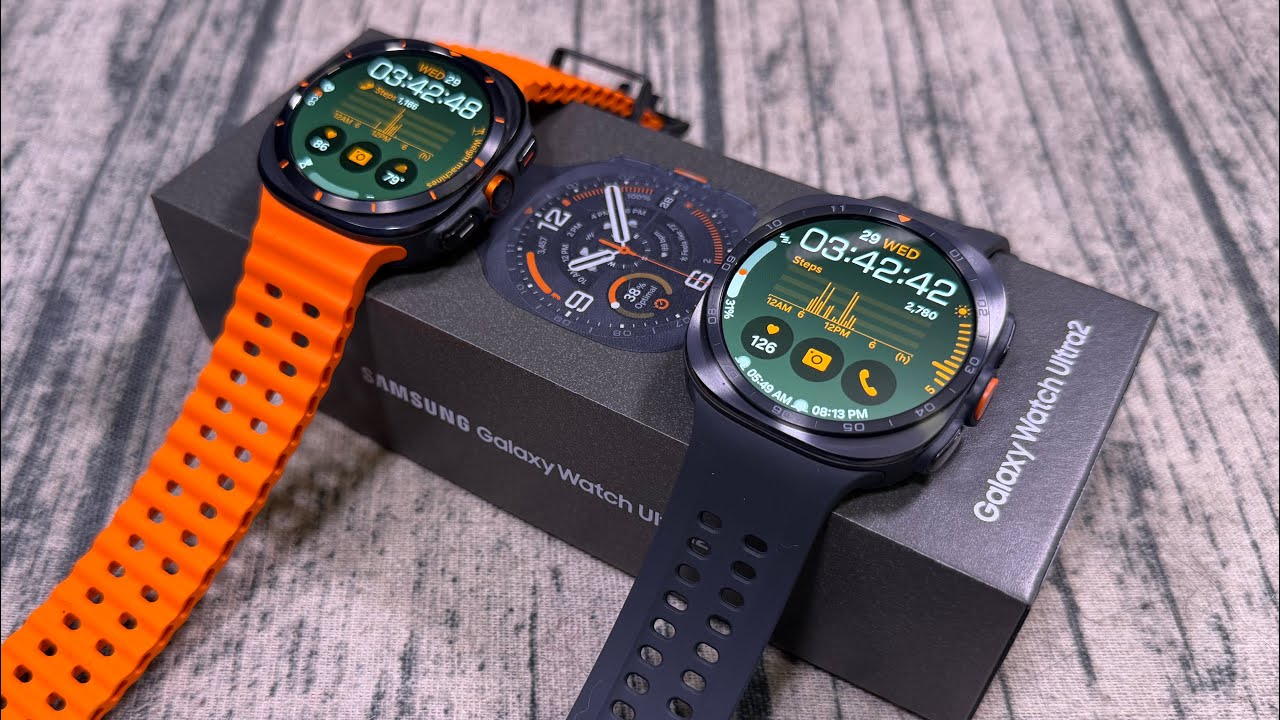
The squircle shape — the square with rounded corners that Samsung calls a cushion design — remains. The titanium frame remains. The three-button layout on the right side remains, with the Quick Button in the centre carrying its protective shroud. What changed is every measurement.
The case is now 10.7mm deep, down from 12.1mm. That 1.4mm reduction sounds small written down. On the wrist it is not small. The original Ultra had a profile that you were always aware of — it sat up noticeably from the wrist and the interaction with shirt cuffs and jacket sleeves was constant. The Ultra 2 sits lower, sits quieter, and carries its 61.5 grams without announcing itself the way the original did.
The strap is 25% lighter than the original Marine Band. The new Marine Band’s inner surface features a contoured Air Pocket design that channels water out during aquatic activity rather than trapping it against the skin. For swimmers and divers who wear a watch during water activities and notice water sitting between the band and their wrist, this is a practical design improvement rather than a visual one.
Two colours launched: Titanium Silver and Titanium Gray. The grade 4 titanium construction offers the same corrosion and scratch resistance, and the same weight-to-strength ratio that made the original Ultra’s build quality one of its most consistently praised aspects.
The protective shroud around the Quick Button is retained. The three-button layout — top button for navigation, Quick Button in centre, bottom button — remains the same. The Quick Button can be mapped to any application or function. During a run, a single press of a pre-mapped button starts the workout without navigating any menus.
Display: 5,000 Nits Changes What Outdoor Use Feels Like

The original Galaxy Watch Ultra had a 3,000-nit display.
That was brighter than almost everything else on the market at the time, and it read clearly in most outdoor conditions.
The Ultra 2 reaches 5,000 nits.
That is not a marginal improvement.
In direct summer sunlight at noon, the difference between 3,000 and 5,000 nits is the difference between a display that you squint at and one that you simply read.
The 1.52-inch Super AMOLED panel is also slightly larger than the original’s 1.47-inch screen, and the resolution improved from 480×480 to 498×498 pixels.
The combined effect is a display that independent extended testing described as one of the best screens currently available on any Android smartwatch.
The always-on display option draws the battery down from 60 hours to approximately 45 hours of claimed endurance, but the 5,000-nit brightness means the always-on mode remains readable in conditions where lower-brightness alternatives become invisible.
The Two New Certifications That Matter Most
IP69K: Beyond Waterproof
The original Galaxy Watch Ultra carried IP68 certification — protected against dust ingress and capable of water immersion to 1.5 metres for 30 minutes under standard test conditions. It also carried a 10-ATM rating, which is a separate, more practically meaningful test for pressure exposure during water activities.
The Ultra 2 adds IP69K alongside these. IP69K covers protection against high-pressure, high-temperature water jets from close range. This certification exists specifically for industrial equipment that needs to survive high-pressure cleaning. On a wristwatch, it means the Ultra 2 handles jet wash, high-pressure shower exposure, and pressure hosing — conditions that IP68 alone does not certify against.
For outdoor workers, motorcyclists, agricultural professionals, and anyone whose daily environment involves exposure to pressurised water, this is a meaningfully different certification from the one the original carried.

EN13319: The First Galaxy Watch Certified as a Dive Instrument
This is the certification that sets the Galaxy Watch Ultra 2 apart from every Galaxy Watch that came before it and from almost every mainstream consumer smartwatch currently available.
EN13319 is the European standard for dive instruments. It is not a marketing depth rating. It is a technical certification that specifies performance requirements for wrist computers used in recreational diving, including underwater display legibility, functional accuracy during diving operations, and verified depth-measurement capability to 40 metres.
No previous Galaxy Watch carried EN13319. The Ultra 2 carries it.
The practical consequence is Mares Dive app integration. Mares is one of the most established names in professional dive equipment. The Mares Dive app on the Galaxy Watch Ultra 2 provides a full scuba diving computer on the wrist — dive profile, depth tracking, ascent rate monitoring, no-decompression limits — the data set that recreational scuba divers typically read from a dedicated dive computer device.
For a buyer who currently dives with a separate dive computer and a smartwatch, the Ultra 2 eliminates one of those devices. For a buyer who has wanted Samsung Health’s health platform and a dive computer in a single device, the Ultra 2 is the first Samsung watch to make that combination possible.
What Is New in the Processor
The Snapdragon Wear Elite chip replaces the Exynos W1000 from the original. Extended testing confirmed 32% faster CPU performance and 19% faster GPU performance compared to the previous generation.
For daily use, the improvement manifests as smoother navigation, faster app loading, and quicker response to the raise-to-wake gesture. For GPS specifically, the Snapdragon Wear Elite’s improved processing capacity contributes to the dual-band L1+L5 GPS delivering what extended real-world GPS testing described as very impressive route accuracy during outdoor workouts.
The raise-to-talk Gemini function, which activates Google’s AI assistant by lifting the wrist and speaking, benefits directly from the processor improvement. The response time from gesture to active AI assistant is fast enough to be practical during activity rather than requiring the stationary interaction that slower processors needed.
Fast Charging: First Time on Galaxy Watch
Every previous Galaxy Watch charged slowly. There was no fast charging standard across the lineup.
The Ultra 2 changes this with the first fast charging capability in Galaxy Watch history, using the EP-OL715 wireless charger with a 5V/2A adapter. Forty per cent charge in approximately 30 minutes. A flat battery reaching functional daily use in the time it takes to get ready in the morning.
For Ultra buyers specifically, who are likely to push the battery harder through extended GPS sessions and demanding outdoor activities than standard Watch buyers, this fast-charging capability is particularly significant. An Ultra 2 that reaches flat on a long trail day can recover to a full charge in approximately 90 minutes, rather than requiring an overnight charge to be ready for the following morning.
What Is New in the Processor
The Snapdragon Wear Elite chip replaces the Exynos W1000 from the original. Extended testing confirmed 32% faster CPU performance and 19% faster GPU performance compared to the previous generation.
For daily use, the improvement manifests as smoother navigation, faster app loading, and quicker response to the raise-to-wake gesture. For GPS specifically, the Snapdragon Wear Elite’s improved processing capacity contributes to the dual-band L1+L5 GPS delivering what extended real-world GPS testing described as very impressive route accuracy during outdoor workouts.
The raise-to-talk Gemini function, which activates Google’s AI assistant by lifting the wrist and speaking, benefits directly from the processor improvement. The response time from gesture to active AI assistant is fast enough to be practical during activity rather than requiring the stationary interaction that slower processors needed.
Fast Charging: First Time on Galaxy Watch
Every previous Galaxy Watch charged slowly. There was no fast charging standard across the lineup.
The Ultra 2 changes this with the first fast charging capability in Galaxy Watch history, using the EP-OL715 wireless charger with a 5V/2A adapter. Forty percent charge in approximately 30 minutes. A flat battery reaching functional daily use in the time it takes to get ready in the morning.
For Ultra buyers specifically, who are likely to push the battery harder through extended GPS sessions and demanding outdoor activities than standard Watch buyers, this fast-charging capability is particularly significant. An Ultra 2 that reaches flat on a long trail day can recover to a full charge in approximately 90 minutes, rather than requiring an overnight charge to be ready for the following morning.
Trail Running Mode:

Trail running on standard GPS watches involves recording the route, pace, and heart rate. The Ultra 2 adds a dedicated Trail Running mode that tracks the specific metrics trail conditions create that road running does not.
Grade-adjusted pace accounts for elevation change when calculating effort. A pace that looks slow on a steep climb is not slow relative to the energy output. Grade-adjusted pace corrects for this. Vertical ascent and descent rates are tracked as separate metrics from overall pace. The complexity of trail running terrain is reflected in the data rather than in a route map that simply shows less flat ground than usual.
For buyers who run trails seriously and have previously used Garmin or Suunto watches specifically because Samsung’s platform lacked trail-specific metrics, the Ultra 2’s trail running mode narrows that gap meaningfully.
Health Platform: The Complete Picture
The Galaxy Watch Ultra 2 carries the full Samsung Health platform introduced with the Galaxy Watch 9. Every feature on the Watch 9 is present on the Ultra 2.
Vitals builds a personal health baseline from seven consecutive nights of sleep data, tracking heart rate, HRV, respiratory rate, blood oxygen, and skin temperature. From the eighth night onwards, deviations from your personal baseline trigger alerts rather than comparing against population averages.
Daily Cardio Load tracks cardiovascular training load and recovery, providing the recovery-focused analysis that subscription-based recovery trackers charge for monthly at no additional cost.
The Antioxidant Index measures carotenoid concentration in the skin via a 5-second thumb scan, reflecting dietary antioxidant intake and oxidative stress levels.
AGEs Index measures Advanced Glycation End-products — compounds that form when proteins or fats combine with sugar in the bloodstream. Elevated AGEs are associated with accelerated ageing and metabolic stress. The measurement reflects long-term dietary patterns rather than single-day data.
ECG, blood pressure monitoring, sleep apnea detection, and body composition measurement all require a Samsung Galaxy phone for full functionality. Non-Samsung Android users get workout tracking, GPS, and most health-monitoring features, but lose those specifically tied to Samsung Health’s phone-side processing.
For a closer look at how the full Samsung Health platform works across the Galaxy Watch lineup, the full guide at best-samsung-wearables covers the complete Samsung wearable ecosystem in detail.
Battery Life: The Real Picture

Samsung rates the Galaxy Watch Ultra 2 at up to 60 hours with always-on display active. That is the figure under Samsung’s specific test conditions.
Real-world extended wear testing covering daily use, including sleep tracking, regular GPS sessions, and the always-on display, produced a consistent result across multiple weeks of testing: a minimum of 3 days between charges, with heavier GPS use reducing that to 2 full days.
Two to three days is meaningfully better than the original Ultra’s real-world performance. It is not the four or five days that buyers sometimes expect from the 800mAh specification. The combination of a 5,000-nit display, continuous health monitoring, always-on GPS during activities, and Wear OS background processes draws more power than a watch doing less with the same cell.
The fast charging makes the practical charging routine more manageable. A nightly top-up during a morning routine rather than an overnight charge is viable with the Ultra 2 in a way it was not with the original.
Galaxy Watch Ultra 2 vs Galaxy Watch Ultra 1
| Feature | Galaxy Watch Ultra 1 | Galaxy Watch Ultra 2 |
|---|---|---|
| Battery | 590mAh | 800mAh, 35% more |
| Fast charging | No | Yes, 40% in 30 min |
| Display size | 1.47 inch | 1.52 inch |
| Display brightness | 3,000 nits | 5,000 nits |
| Thickness | 12.1mm | 10.7mm, 12% slimmer |
| Processor | Exynos W1000 | Snapdragon Wear Elite |
| Water rating | IP68, 10ATM | IP69K, 10ATM |
| Dive certification | No | EN13319, 40m |
| Trail Running mode | No | Yes |
| Mares Dive app | No | Yes |
| Bluetooth | 5.3 | 6.0 |
| Wi-Fi | 5 | 6 |
| Vitals | No | Yes |
| Daily Cardio Load | No | Yes |
| Antioxidant Index | No | Yes |
| Gemini raise-to-talk | No | Yes |
| Software support | 4 years | 5 years |
| Storage | 32GB | 64GB |
| Colors at launch | 4 | 2 |
Who Should Buy the Galaxy Watch Ultra 2
You trail run regularly and want grade-adjusted pace and vertical rate data in a rugged certified watch. You dive recreationally and want a single device that integrates the Samsung Health platform with a certified Mares Dive diving computer. You work or train in environments involving high-pressure water exposure where IP69K matters beyond IP68. You are upgrading from any Galaxy Watch older than the original Ultra. You want the most capable and most durable Samsung watch available in 2026, and you use a Samsung Galaxy phone.
Who Should Not Buy the Galaxy Watch Ultra 2
You own the original Galaxy Watch Ultra and primarily use it for daily health tracking and standard workouts — the upgrade case requires the dive certification, trail running mode, or fast charging to be compelling. You primarily want the Samsung Health platform in a premium watch and do not specifically need rugged outdoor certification — the Galaxy Watch 9 delivers most of the same health features for less. You use an iPhone — no Galaxy Watch provides meaningful iPhone integration. You have wrists below 6.5 inches — the 47mm squircle case is large and will appear oversized on smaller wrists.
For a closer look at how the Galaxy Watch Ultra 2 compares with the Google Pixel Watch 5 and Apple Watch Ultra 3 across safety features, outdoor capabilities, and health monitoring, the full guide at best-smartwatches-under-300 covers the premium smartwatch landscape in detail.
Specifications
| Feature | Samsung Galaxy Watch Ultra 2 |
|---|---|
| Amazon ASIN | B0H1D46MPG |
| Launched | August 7, 2026 |
| Case | 47.4 x 47.1 x 10.7mm, titanium grade 4 |
| Weight | 61.5g without strap |
| Display | 1.52 inch Super AMOLED, 5,000 nits |
| Resolution | 498 x 498 pixels, 327 PPI |
| Processor | Snapdragon Wear Elite, 3nm |
| RAM/Storage | 2GB RAM, 64GB |
| Battery | 800mAh, up to 60 hours |
| Fast Charging | Yes, 40% in 30 minutes |
| Water | IP69K, 10 ATM |
| Dive | EN13319 certified, 40m |
| GPS | Dual-band L1+L5 |
| Bluetooth | 6.0 |
| Wi-Fi | 6 |
| OS | Wear OS 7, One UI Watch 9 |
| Software Support | 5 years |
| Sport Modes | Trail Running, Diving, 100 plus |
| Health | Vitals, Cardio Load, Antioxidant Index, AGEs Index, ECG, BP, Sleep Apnea |
| AI | Gemini raise-to-talk |
| Colors | Titanium Silver, Titanium Gray |
FAQs
Is the Samsung Galaxy Watch Ultra 2 worth upgrading to from the original Ultra?
The answer depends on which new features align with your actual use. If you dive recreationally and want the EN13319-certified diving computer through Mares Dive, the original Ultra cannot do this and the Ultra 2 is the specific upgrade that enables it. If you trail run seriously and want grade-adjusted pace data, trail running mode provides metrics the original Ultra did not track. If fast charging matters — the original Ultra had no fast charging option and the Ultra 2’s 40% in 30 minutes changes the morning charging routine. If none of these specific capabilities apply to your use, the original Ultra’s health platform, GPS, and build quality remain capable and the upgrade case is limited. Extended real-world testing across multiple weeks confirmed that the differences are meaningful for the outdoor and active use cases the Ultra was built for, and incremental for primarily daily use buyers.
What is the difference between the Galaxy Watch Ultra 2 and Galaxy Watch 9?
Both watches run One UI Watch 9 on Wear OS 7 and carry the same Samsung Health platform including Vitals, Daily Cardio Load, Antioxidant Index, AGEs Index, ECG, blood pressure monitoring, and sleep apnea detection. The health data you get from both is largely the same. The differences are in construction, certification, and sport modes. The Ultra 2 has titanium construction where the Watch 9 uses aluminium. The Ultra 2 carries IP69K, 10 ATM, and EN13319 dive certification where the Watch 9 is IP68 and 5 ATM. The Ultra 2 has trail running mode and Mares Dive integration where the Watch 9 does not. The Ultra 2 has an 800mAh battery with fast charging where the Watch 9 has a smaller cell. And the Ultra 2 has a 5,000-nit display where the Watch 9 reaches 3,000 nits. For buyers who want Samsung Health in a standard daily wear context, the Watch 9 provides it. For buyers who want the rugged certification, dive computer, and trail running depth, the Ultra 2 is the specific choice.
Does the Samsung Galaxy Watch Ultra 2 work with iPhones?
No. The Galaxy Watch Ultra 2 requires Android and delivers its deepest integration with Samsung Galaxy Android phones specifically. iPhone users cannot pair the Ultra 2 or access any of its features through iOS. For iPhone users who want a rugged high-performance smartwatch with outdoor activity certification, the Apple Watch Ultra 3 is the appropriate alternative. Samsung Health’s ECG, blood pressure monitoring, and sleep apnea features additionally require a Samsung Galaxy phone even among Android users — non-Samsung Android phone users can access most health tracking, GPS, and workout features but lose the Samsung-phone-specific capabilities. The American Heart Association provides guidance on wearable technology for cardiovascular health monitoring at heart.org.
Related Articles:
Best Garmin Watches For Swimming and Running
Luis Cooper

Hi, I'm Luis, the guy behind this site. I love wearing watches, especially ones that look great on small wrists (mine are about 6.3" around). The Watches Geek is dedicated to helping you learn about and buy watches that you will love wearing. I want this website to be the last destination for people to pick the best watches to fit their needs. You can find our unbiased reviews here on Thewatchesgeek.
Thanks for putting in the time to give an honest review!