Last Updated on October 21, 2026 by Luis Cooper
Smart rings are having a moment. They sit on your finger, disappear into your day, and collect more health data than most people realize is even possible from something that small.
No screen to glance at, no band to adjust, no wrist bulk. Just a ring.
Two names come up in almost every conversation about smart rings right now.
The Oura Ring 5 has been setting the standard in this category for years.
The RingConn Gen 3 is the most credible challenger, and it asks whether you really need to keep paying a monthly fee for excellent health tracking.
Both rings track sleep, heart rate, HRV, blood oxygen, skin temperature, and daily readiness.
Both sit on your finger 24 hours a day.
Both are genuinely good at what they do.
The decision between them comes down to a few things: how important subscription-free ownership is to you, which app experience you prefer, and whether the extra polish in the Oura ecosystem is worth what it costs over time.
This comparison covers both rings honestly, side by side.
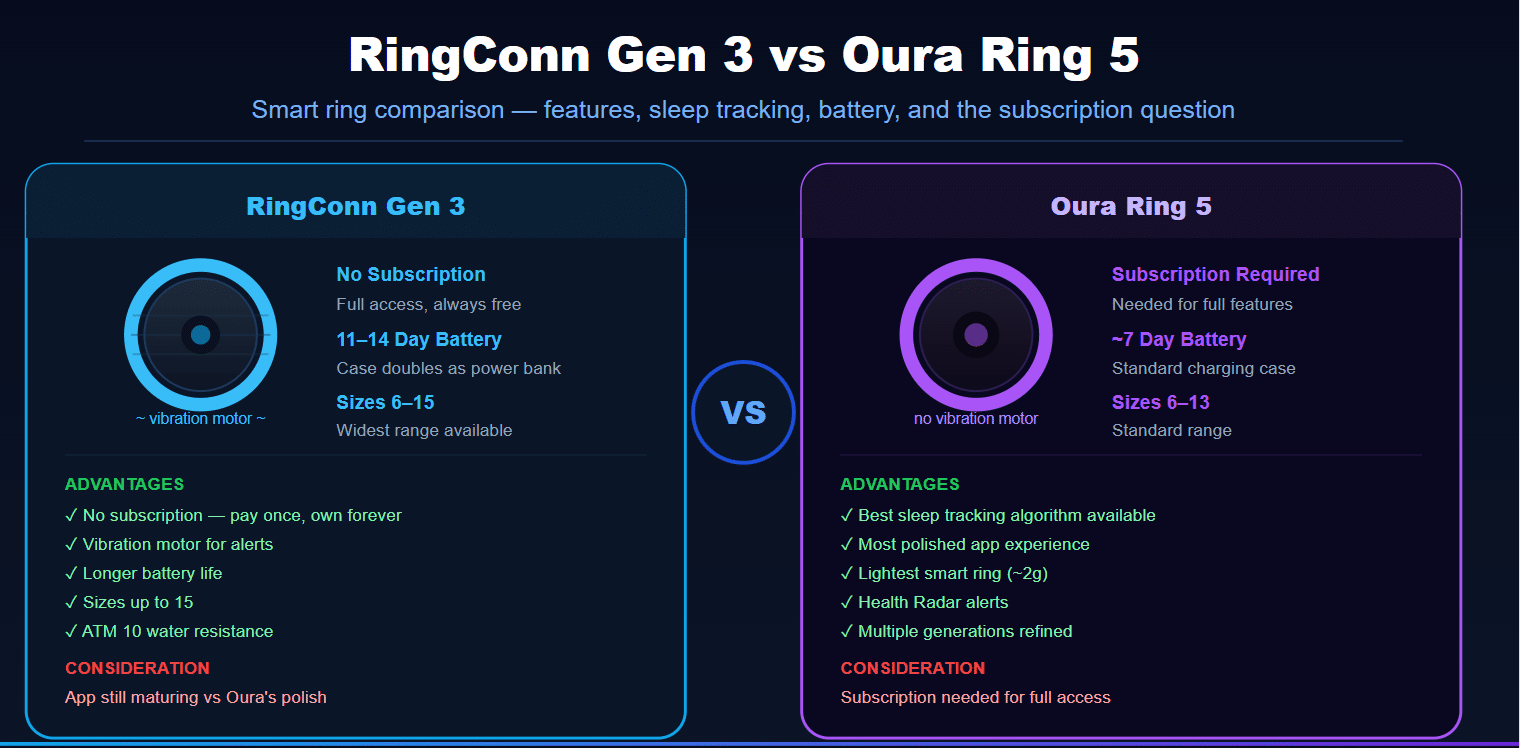
RingConn Gen 3 vs Oura Ring 5


Quick Overview
The Oura Ring 5 is the market leader in smart rings.
It has been refined through multiple generations, and its sleep tracking and readiness scoring are among the most polished of any consumer wearable.
It requires a monthly membership to access most of its features.
The RingConn Gen 3 is a fully capable smart ring that does almost everything the Oura does, adds a vibration motor the Oura lacks, and asks for nothing beyond the upfront purchase.
No subscription, ever.
Design and Build
Oura Ring 5
The Oura Ring 5 is small. It is about 6 millimeters wide and 2.3 millimeters thick, and it weighs around 2 grams.
Compared to the Ring 4, which it replaced, the Ring 5 is about 40 percent smaller in volume.
That is a meaningful difference.
Most people who switch from a Ring 4 say the Ring 5 feels like a completely different category of object on the finger.
The ring is made from titanium with a scratch-resistant coating.
In real-world testing over several weeks, reviewers consistently reported no visible scratches.
It comes in sizes 6 to 13.
Use a sizing kit before buying to find your fit, and fit matters because the sensors need consistent skin contact.
Colors include Black, Silver, and a few premium finishes.
The standard and premium colors use the same hardware.
The premium versions cost more for appearance only.
RingConn Gen 3
The RingConn Gen 3 is also 2.3 millimetres thick and weighs between 2.5 and 3.5 grams depending on size.
It is slightly heavier than the Oura Ring 5 in most sizes, though the difference is small enough that most people would not notice it day to day.
The ring uses titanium with a PVC-coated finish.
Available finishes include Future Silver, Royal Gold, Matte Black, Brushed Silver, and Brushed Rose Gold.
The Gen 3’s hand-brushed texture is new compared to the Gen 2 and gives it a more premium look.
Sizes run from 6 to 15, which is a wider range than the Oura. If you have larger fingers and have had trouble finding a smart ring that fits, the RingConn Gen 3 has an advantage here.
One thing reviewers noted: the RingConn Gen 3 can shift slightly on your finger when your hands are sweaty, which can move the sensors out of their ideal position.
The Oura Ring 5 sits more securely due to its tighter tolerances.
Both rings are IP68 rated.
The RingConn Gen 3 goes further with an ATM 10 water resistance rating, which is certified to 100 metres.
The Oura Ring 5 is certified to 100 metres as well. Both are completely safe for showering, swimming, and ocean use.
What Each Ring Tracks

Both rings track the same core health metrics: continuous heart rate, heart rate variability, blood oxygen, skin temperature, respiratory rate, and daily activity.
Both derive readiness and sleep scores from those inputs.
The overlap is significant.
If you placed both apps side by side on a given morning, they would show you many of the same data points.
Sleep Tracking
Sleep is where both rings are strongest, and it is the category most people buy a smart ring for.
The Oura Ring 5 tracks light sleep, deep sleep, and REM sleep, along with total sleep duration, sleep efficiency, time to fall asleep, and nighttime resting heart rate.
It tracks blood oxygen and respiratory rate continuously throughout sleep.
Skin temperature variation is measured against your personal baseline.
The app combines these into a Sleep Score and a Readiness Score each morning.
Oura developed its sleep algorithm over several generations.
Independent reviewers consistently rate it as the most accurate and consistent sleep stage detector available in a consumer ring.
The insights are clear, and the weekly trend data is genuinely useful for spotting patterns.
The RingConn Gen 3 tracks the same metrics. Sleep duration accuracy in independent testing was very close to Garmin and Whoop readings, averaging within eight minutes across multiple nights.
Reviewers describe sleep stage detection as good on most nights, with occasional misses of short naps and some overstatement of wake time during restless nights.
The honest comparison: the Oura Ring 5 has a slight edge in sleep stage precision, particularly for users who need to compare results against other devices.
The RingConn Gen 3 is genuinely good, and for most people tracking general patterns and trends, the accuracy difference isn’t meaningful in daily use.
Readiness and Recovery
Both rings give you a daily readiness score based on sleep, HRV, resting heart rate, and recent activity.
Oura calls it a Readiness Score. RingConn calls it a similar score in its app.
Both tell you in plain terms whether your body is ready for a hard day or needs recovery.
HRV is the most important input to readiness in both systems.
Both rings measure HRV overnight when your body is still, and readings are most stable.
Both personalise the score against your own baseline over time rather than comparing you to a population average.
Skin Temperature
Both rings track skin temperature overnight and compare it against your established baseline.
A notable increase above your baseline can signal early illness, hormonal shifts, or the effects of alcohol the night before.
This feature behaves similarly on both devices.
Vascular Trend (RingConn Gen 3 Only)

The RingConn Gen 3 includes a feature called Vascular Trend.
After a short survey and a manual blood pressure cuff reading to establish your baseline, the ring samples your vascular indicators roughly every 15 to 20 minutes throughout the day.
This is not a blood pressure monitor in the clinical sense.
It does not replace a cuff. It shows trend data over time, indicating whether your readings are rising, falling, or staying stable relative to your baseline.
Reviewers who used the feature found it interesting and consistent once the baseline was established, though it is most useful as a long-term wellness signal rather than a specific reading on any given day.
The Oura Ring 5 has a similar feature called Blood Pressure Signals, introduced with the Ring 5, which also requires a cuff baseline.
Both approaches are experimental rather than medically validated.
Vibration Motor (RingConn Gen 3 Only)
The RingConn Gen 3 has a vibration motor. The Oura Ring 5 does not.
This sounds small, but it is a meaningful practical difference.
The RingConn can alert you to inactivity reminders, sedentary warnings, and certain wellness notifications with a gentle buzz on your finger.
Wake-up alarm functionality and custom reminders are planned through a software update in the second half of 2026.
If you have ever wanted a silent nudge from a wearable without carrying your phone, the vibration motor on the Oura Ring Gen 3 is a feature the RingConn Gen 3 cannot offer.
Activity and Workout Tracking
Neither ring is built for serious athletes. Both detect activity automatically and log steps, active time, and estimated calories.
Both support automatic workout detection for common activities.
Neither ring has GPS. Route tracking is not possible without a phone.
For in-depth workout analysis, cardio load tracking, or performance metrics, a dedicated fitness tracker or smartwatch is a better fit.
Both rings are wellness devices first.
The App Experience
Oura App
The Oura app is polished and well-designed.
The dashboard clearly surfaces your Sleep Score, Readiness Score, and Activity metrics.
Tapping into each gives you the underlying data without overwhelming you.
The Oura app has been through many iterations and it shows.
Trend graphs over weeks and months are particularly good. Long-term patterns in HRV, sleep efficiency, and resting heart rate are easy to read and genuinely informative over time.
Without a membership, the app gives you only basic daily scores.
The full sleep-stage breakdown, HRV detail, temperature graph, and all insight features require an active subscription.
RingConn App
The RingConn app received a significant redesign in 2025 and is now cleaner than earlier versions.
A top-down layout puts your big-picture health summary first and lets you drill into detail below.
Reviewers describe it as somewhat busy in places, with a lot of data available but some screens requiring more navigation than they should.
Everything in the RingConn app is available from day one, with no subscription required.
All historical data, all trends, all features.
Subscription: The Most Important Difference
This is the part of the comparison that matters most for many buyers.
The Oura Ring 5 requires a membership to access most of its features. Without it, the ring still works and still syncs data, but you only see basic daily scores.
The detailed sleep breakdown, HRV data, temperature graphs, period prediction, and insights are all locked behind the membership.
Reviewers consistently treat the subscription as a practical requirement, not an optional extra.
The RingConn Gen 3 has no subscription. You pay once when you buy the ring.
Every feature the ring is capable of is available from day one and stays available indefinitely.
There are no tiers, no premium features, no locked data.
Over two years of use, the subscription cost adds up to significant extra spending on top of the ring’s hardware cost.
Some people find that completely worth it for the quality of the Oura experience.
Others prefer owning their health data outright without a recurring commitment.
Battery Life
The Oura Ring 5 is rated at 6 to 9 days. Real-world testing by reviewers consistently lands around 7 days, with a full charge taking about 80 minutes.
The charging case is small and easy to carry.
The RingConn Gen 3 is rated at up to 14 days. Real-world testing puts it at 11 to 14 days in typical use, with a full charge taking about 90 minutes.
The charging case for the RingConn Gen 3 also functions as a power bank, so it can charge the ring while you are travelling without needing a wall socket.
For anyone tracking sleep every single night, the longer the battery, the less you have to think about charging.
The RingConn Gen 3’s 11 to 14 days of real-world battery life is meaningfully more convenient than the Oura Ring 5’s 7-day average.
Who Should Buy the Oura Ring 5

You will get the most from the Oura Ring 5 if you want the most mature and precise sleep and recovery platform in the smart ring category and are comfortable paying for membership access.
You value the depth and clarity of the Oura app experience over time.
You prefer a slightly lighter and more minimal form factor on the finger.
You are tracking sleep data seriously and want the algorithm that reviewers consistently rate as the best in this category.
Nadia is 37 and has been struggling to understand why she always feels exhausted on Monday mornings despite sleeping eight hours over the weekend.
After three weeks with her Oura Ring 5, she can see it clearly in the app: her deep sleep on Friday and Saturday nights is far lower than the rest of the week, probably because she stays up later and the quality drops even when the quantity looks fine.
She needed that trend data.
The subscription is included in what she pays for.
Who Should Buy the RingConn Gen 3

You will get the most from the RingConn Gen 3 if you want a capable, well-made smart ring that gives you full access to all its features without a subscription at any point.
You prefer owning your health data outright.
You would use the vibration motor for activity reminders.
You have larger fingers and need sizes above 13.
You want a longer battery, so you charge less frequently.
Tariq is 29 and tracks his sleep and recovery as part of his training routine. He tried a subscription-based tracker before and resented the monthly cost, even when he found the data useful.
The RingConn Gen 3 gives him his HRV trend, sleep stages, readiness score, and vascular trend data every morning.
He does not pay anything beyond what he paid on day one.
Side-by-Side Comparison
| Feature | RingConn Gen 3 | Oura Ring 5 |
|---|---|---|
| Subscription | None, ever | Required for full features |
| Battery life | 11 to 14 days real-world | About 7 days real-world |
| Water resistance | IP68, ATM 10, 100m | IP68, 100m |
| Vibration motor | Yes | No |
| Weight | 2.5 to 3.5g | About 2g |
| Size range | 6 to 15 | 6 to 13 |
| Charging case | Also a power bank | Standard case |
| Sleep tracking | Very good | Excellent |
| App maturity | Good, improving | Very polished |
| Vascular trend | Yes (cuff baseline needed) | Blood Pressure Signals (similar) |
Pros and Cons
RingConn Gen 3
Oura Ring 5
Final Verdict
Both rings are genuinely good. Neither one is a poor choice.
If sleep tracking precision and app maturity matter most to you, and you are comfortable paying for membership access to those features, the Oura Ring 5 is the best smart ring available.
Its algorithm is the most refined in the category, and the app experience over months is excellent.
If you want full-featured health tracking with no ongoing costs, longer battery life, and a vibration motor the Oura lacks, the RingConn Gen 3 is the better value proposition.
Data quality is very close in everyday use, and the difference in sleep-stage precision is unlikely to matter for most people tracking general wellness trends.
The subscription question is not a small detail.
It is the defining difference between these two rings.
Answer that question for yourself first, and the right choice becomes clear.
Frequently Asked Questions
Which is better for sleep tracking, RingConn Gen 3 or Oura Ring 5? The Oura Ring 5 has a slight edge in sleep-stage precision, based on reviewers who have tested both. The RingConn Gen 3 is very good for sleep tracking, and the difference in accuracy is unlikely to affect day-to-day decisions for most users. If sleep tracking is the main reason you are buying a smart ring and you want the best available, the Oura Ring 5 is the answer.
Does the RingConn Gen 3 require a subscription? No. The RingConn Gen 3 has no subscription fees at all. Every feature the ring offers is available from the first day you wear it, with no recurring cost at any point.
Does the Oura Ring 5 work without a subscription? The Oura Ring 5 syncs data and shows basic daily scores without a membership. However, the full sleep-stage breakdown, HRV data, temperature graphs, and most detailed insights require an active subscription. Reviewers consistently treat the membership as a practical requirement for getting full value from the ring.
Which ring has better battery life? The RingConn Gen 3. It lasts 11 to 14 days in real-world testing. The Oura Ring 5 averages about 7 days. Both charge in roughly 80 to 90 minutes.
Can either ring track workouts accurately? Both rings detect common activities automatically and log active time and estimated calories. Neither has GPS and neither is built for serious workout analysis. For in-depth performance tracking, a dedicated fitness tracker or sports watch is a better fit.
Which ring fits larger fingers? The RingConn Gen 3 goes up to size 15, compared to size 13 for the Oura Ring 5. If you need a larger size, the RingConn Gen 3 is the only mainstream option that fits.
Is the RingConn Gen 3 as accurate as the Oura Ring 5? For most everyday health metrics, including resting heart rate, HRV, and skin temperature, the accuracy is very close. For sleep stage detection, the Oura Ring 5 is considered slightly more precise based on its longer development history. For general wellness tracking, both rings give you reliable data you can act on.
This article is for informational purposes only. Neither the RingConn Gen 3 nor the Oura Ring 5 is a medical device. If you have concerns about your health, please consult a qualified healthcare professional.
External reference: RingConn Gen 3 review — Notebookcheck
Luis Cooper

Hi, I'm Luis, the guy behind this site. I love wearing watches, especially ones that look great on small wrists (mine are about 6.3" around). The Watches Geek is dedicated to helping you learn about and buy watches that you will love wearing. I want this website to be the last destination for people to pick the best watches to fit their needs. You can find our unbiased reviews here on Thewatchesgeek.