Last Updated on October 16, 2026 by Luis Cooper
Your smartwatch shows your heart rate all day long.
A number on your wrist updates every few seconds, telling you how hard your heart is working.
But how accurate is it, really?
The honest answer is: it depends on what you are doing.
During a quiet evening on the sofa, it is probably very close.
During a set of heavy deadlifts, it might be ten or fifteen beats off.
During a steady morning run, it is somewhere in between.
Understanding where smartwatches get heart rate right, where they struggle, and why helps you use the data your watch already collects better.
How Accurate Is Smartwatch Heart Rate
How a Smartwatch Measures Heart Rate
Before getting into accuracy, it helps to understand what is actually happening under the sensor.
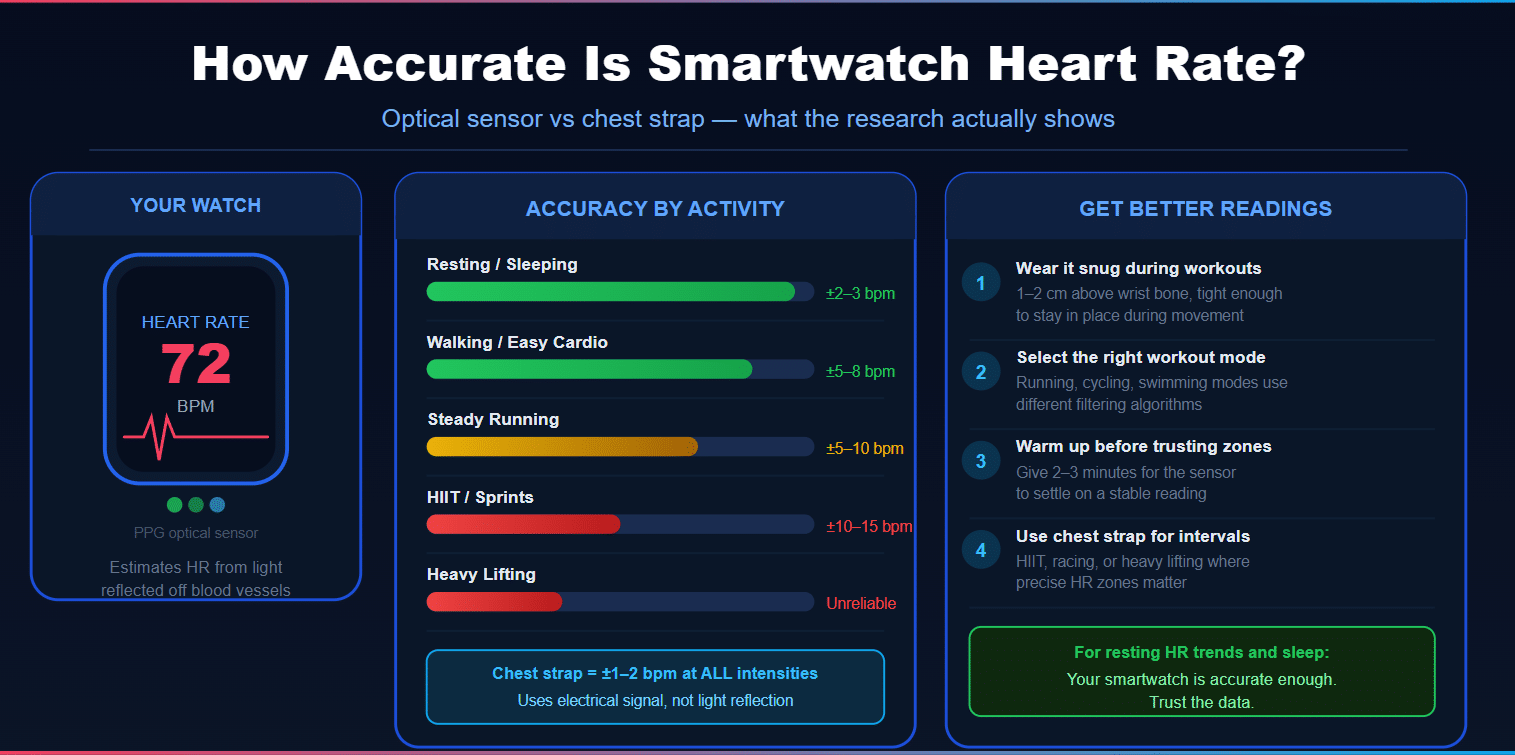
Almost all smartwatches use a technology called photoplethysmography, or PPG. It works like this: green LED lights on the back of the watch shine into your skin.
Blood absorbs green light well.
When your heart beats, blood flow in the tiny vessels under your skin increases briefly.
The sensor detects that pulse of increased absorption and counts it as a heartbeat.
The watch does this hundreds of times per second and uses an algorithm to turn those light readings into beats per minute.
This differs greatly from how a chest strap or medical ECG machine measures heart rate.
Those devices detect the actual electrical signal your heart produces with every beat.
That electrical signal is precise, direct, and not affected by movement, skin colour, sweat, or light.
PPG is a clever workaround.
It is non-invasive, comfortable enough to wear all day, and good enough for most everyday purposes.
But it is an estimate based on light reflection, not a direct reading of electrical activity.
That distinction matters when you start pushing the limits of what it can do.
Where Smartwatches Are Accurate
Resting Heart Rate
This is where optical sensors perform best.
When you are sitting still, lying down, or sleeping, your body is not moving, your wrist is steady, and the sensor gets a clean, consistent signal.
Studies comparing smartwatch resting heart rate with ECG readings have consistently found differences of about 2 to 3 beats per minute at rest.
For tracking trends over time, whether your resting heart rate is improving as you get fitter or rising in a way that might signal illness or overtraining, that level of accuracy is more than sufficient.
The long-term trend is actually more valuable than any single reading.
A resting heart rate that drops from 68 to 62 beats per minute over three months of consistent training is a meaningful signal, and your smartwatch is perfectly capable of capturing that change accurately.
Steady-State Cardio
Walking at a comfortable pace, easy cycling, a relaxed jog, slow swimming — these are situations where smartwatch heart rate performs well.
The body moves rhythmically, the wrist position stays relatively stable, and the algorithm has time to settle on an accurate reading.
During moderate exercise at 50 to 70 per cent of your maximum heart rate, most quality smartwatches read within about 5 to 8 beats per minute of a chest strap.
For general fitness tracking and staying in a broad training zone, that is accurate enough.
Sleep Monitoring
Overnight heart rate tracking is one of a smartwatch’s most reliable features.
The body is still for hours, movement is minimal, and the sensor runs continuously without interruption.
Resting heart rate measured during sleep is consistently one of the most accurate readings a wrist sensor produces.
Heart rate variability, which most modern smartwatches also measure overnight, is less precise from the wrist than from a chest strap, but the trends over time are still useful for tracking general recovery patterns.
Where Smartwatches Struggle
High-Intensity Interval Training
This is where optical sensors struggle most.
During HIIT, your heart rate changes rapidly, and your wrist moves quickly and unpredictably.
The algorithm that filters light reflections into heart rate readings cannot keep up with both rapid heart rate changes and movement noise at the same time.
At very high intensities, above 85 per cent of maximum heart rate, smartwatches can read anywhere from 10 to 15 beats per minute below the actual heart rate.
A watch showing 155 beats per minute during a hard sprint might be measuring a true heart rate of 168.
That is a meaningful gap if you are trying to train in a specific intensity zone.
The readings also lag.
During rapid intervals, the smartwatch often shows what your heart rate was 10 to 15 seconds ago rather than what it is right now.
Heavy Strength Training
Weightlifting creates two problems for wrist sensors.
First, gripping a barbell or dumbbell tightens the forearm muscles and compresses the wrist blood vessels, which interferes with the sensor’s ability to detect blood flow.
Second, the wrist moves and bends in directions that shift the sensor away from its ideal contact position on the skin.
During heavy sets of bench press, pull-ups, or rows, your smartwatch heart rate reading can be significantly off in either direction.
Some people see readings that are far too low because the sensor lost contact.
Others see temporary spikes that do not match how hard they are actually working.
Cold Weather
Cold temperatures cause your body to reduce blood flow to the skin surface to keep your core warm.
Less blood near the surface means a weaker signal for the optical sensor.
In cold conditions, heart rate accuracy tends to be lower, especially at the start of outdoor activities before your skin warms up.
If you exercise outdoors in the cold and notice an unusually low heart rate reading in the first few minutes of a run, this is likely why.
Tattoos and Skin Considerations
Dark tattoos directly under the sensor on your wrist can interfere with the green LED light, causing the sensor to misread or fail to detect a pulse reliably.
If you have a wrist tattoo and your smartwatch shows unusual or absent heart rate readings, the tattoo may be the cause.
Studies on the influence of skin tone on heart rate accuracy have yielded conflicting findings.
Some studies have found higher error rates for people with darker skin tones.
Others have found less pronounced differences.
Most major manufacturers have improved sensor performance across a range of skin tones in recent generations of devices, though this remains an area of ongoing improvement.
Does It Matter Which Smartwatch You Use?
Yes, but perhaps less than you would expect for everyday use.
Premium devices from Apple, Garmin, Samsung, and Fitbit have invested significantly in their sensor hardware and the algorithms that process the signal.
The difference between a high-quality modern smartwatch and a budget device is most visible during exercise, where better filtering algorithms reduce movement noise.
During resting and low-intensity activity, most modern smartwatches perform similarly well.
The gaps widen at higher intensities, where better hardware and better algorithms make a measurable difference.
The Apple Watch consistently performs well in independent tests for resting and moderate-intensity heart rate.
Garmin’s optical sensors in the Fenix and Forerunner lines are particularly well-regarded for their performance during running, though they face the same limitations during strength training and HIIT that all wrist-based sensors share.
No wrist-based optical sensor matches a chest strap at high intensity.
That is a fundamental limitation of the technology, not a specific brand’s shortcoming.
How to Get More Accurate Readings
Small adjustments make a real difference to how well your watch reads your heart rate.
Wear it snug during workouts. The biggest source of inaccuracy during exercise is the watch moving around on your wrist. Tighten the band so the sensor stays in consistent contact with your skin, but not so tight that it becomes uncomfortable or restricts circulation. A common recommendation is to position it about one to two centimetres above your wrist bone, slightly higher than you would wear it normally.
Select the right workout mode. Modern smartwatches adjust their sensing strategy based on the selected activity type. A running mode uses different filtering than a cycling mode. Choosing the closest available workout mode before you start helps the algorithm handle the movement patterns it is about to encounter.
Let it warm up. At the start of a workout, especially in cold conditions, give your watch two or three minutes before trusting the heart rate reading. The sensor needs time to establish a baseline signal against your skin.
Keep the sensor clean. Sweat, sunscreen, and lotion can build up on the sensor over time and reduce signal quality. Wiping the back of the watch with a damp cloth regularly helps maintain good contact.
Use a chest strap when precision matters. If you are training for a specific race, doing structured interval sessions where accurate heart rate zones matter, or lifting heavy, a chest strap paired with your watch gives you precision the wrist sensor cannot provide. Many smartwatches and fitness apps can receive heart rate data from a Bluetooth chest strap and record it alongside your other metrics.
When You Should Not Rely on Smartwatch Heart Rate Alone
Your smartwatch heart rate is a useful wellness tool. It is not a medical device.
For managing or monitoring a heart condition, recovering from a cardiac event, or following medically supervised exercise guidelines, smartwatch heart rate readings aren’t the right tool.
A doctor or cardiac rehabilitation specialist will use clinically validated equipment for that purpose.
If you experience symptoms during exercise, such as chest pain, unusual shortness of breath, dizziness, or a heart rate that feels significantly different from what your watch is showing, do not rely on the watch to assess the situation. Seek appropriate medical attention.
Irregular heart rhythm notifications on some smartwatches, including Apple Watch and some Fitbit models, are designed to prompt you to seek medical evaluation if they detect a pattern consistent with atrial fibrillation.
They are not a diagnosis.
A confirmed notification is a reason to see a doctor, not a reason to assume something serious is happening; likewise, the absence of an alert should not be taken as medical clearance.
Quick Reference: When to Trust Your Smartwatch Heart Rate
| Situation | Accuracy | Reliability |
|---|---|---|
| Resting and sitting | Very good (within 2–3 bpm) | High |
| Sleeping | Very good | High |
| Walking and easy cardio | Good (within 5–8 bpm) | Good |
| Steady running at moderate pace | Good | Good |
| High-intensity intervals | Often 10–15 bpm off | Low |
| Heavy strength training | Variable, often unreliable | Low |
| Cold weather start | Lower than usual | Lower |
| Over a dark wrist tattoo | May fail to read | Unreliable |
The Bottom Line
A smartwatch heart rate monitor is genuinely useful for the things most people actually want it for.
It can track your resting heart rate over time, help you stay in a moderate training zone during cardio, monitor your heart rate during sleep, and give you a general picture of how hard your body is working throughout the day.
It is not the right tool for anyone who needs clinical precision, trains at high intensity with strict zone requirements, or does heavy strength training where wrist movement and grip pressure interfere with the signal.
The sweet spot is using it for what it does well and reaching for a chest strap on the days when precision matters. Most people will never need to do that.
For everyday fitness and wellness tracking, what is on your wrist is accurate enough to be genuinely useful.
For a closer look at how individual devices handle heart rate tracking during sleep and recovery, our Fitbit Air review covers how a dedicated health tracker approaches this in daily use.
Frequently Asked Questions
Is smartwatch heart rate accurate enough for everyday fitness? Yes. For resting heart rate tracking, moderate cardio, and general wellness monitoring, modern smartwatches provide accurate, meaningful, actionable data. The numbers may not match a medical ECG exactly, but the trends over time are reliable and useful.
Why does my smartwatch heart rate seem wrong during exercise? Most likely because of wrist movement, band fit, or the type of exercise. High-intensity and grip-heavy activities are the hardest conditions for optical sensors. Wearing the band more snugly during exercise and choosing the right workout mode can help reduce the gap.
Is a chest strap more accurate than a smartwatch? Yes, significantly so, especially during high-intensity exercise. A chest strap reads the electrical signal of each heartbeat directly, which is not affected by movement or skin. For structured training or any situation where precise heart rate zones matter, a chest strap is the better choice.
Does skin tone affect smartwatch heart rate accuracy? Research has found mixed results on this. Some studies report higher error rates for people with darker skin tones, while others find less significant differences. Most major manufacturers have worked to improve performance across skin tones in recent years, but further research and improvement are still ongoing.
Can my smartwatch detect a heart attack? No. A smartwatch is not designed or cleared to detect a heart attack. If you feel symptoms of a heart attack, such as chest pain, pressure, or pain spreading to your arm or jaw, call emergency services immediately and do not wait for your watch to tell you anything.
How often does a smartwatch check heart rate? Most modern smartwatches measure heart rate continuously throughout the day, typically updating every few seconds. During tracked workouts, the sampling rate increases. Some devices let you choose between continuous monitoring and periodic checks to save battery.
This article is for informational purposes only and does not constitute medical advice. Smartwatches are not medical devices. If you have any concerns about your heart health, please consult a qualified healthcare professional.
External reference: Wrist-Worn and Arm-Worn Wearables for Monitoring Heart Rate — JMIR Cardio
Luis Cooper

Hi, I'm Luis, the guy behind this site. I love wearing watches, especially ones that look great on small wrists (mine are about 6.3" around). The Watches Geek is dedicated to helping you learn about and buy watches that you will love wearing. I want this website to be the last destination for people to pick the best watches to fit their needs. You can find our unbiased reviews here on Thewatchesgeek.