
Last Updated on October 19, 2026 by Luis Cooper
Most fitness trackers count steps and call it a day.
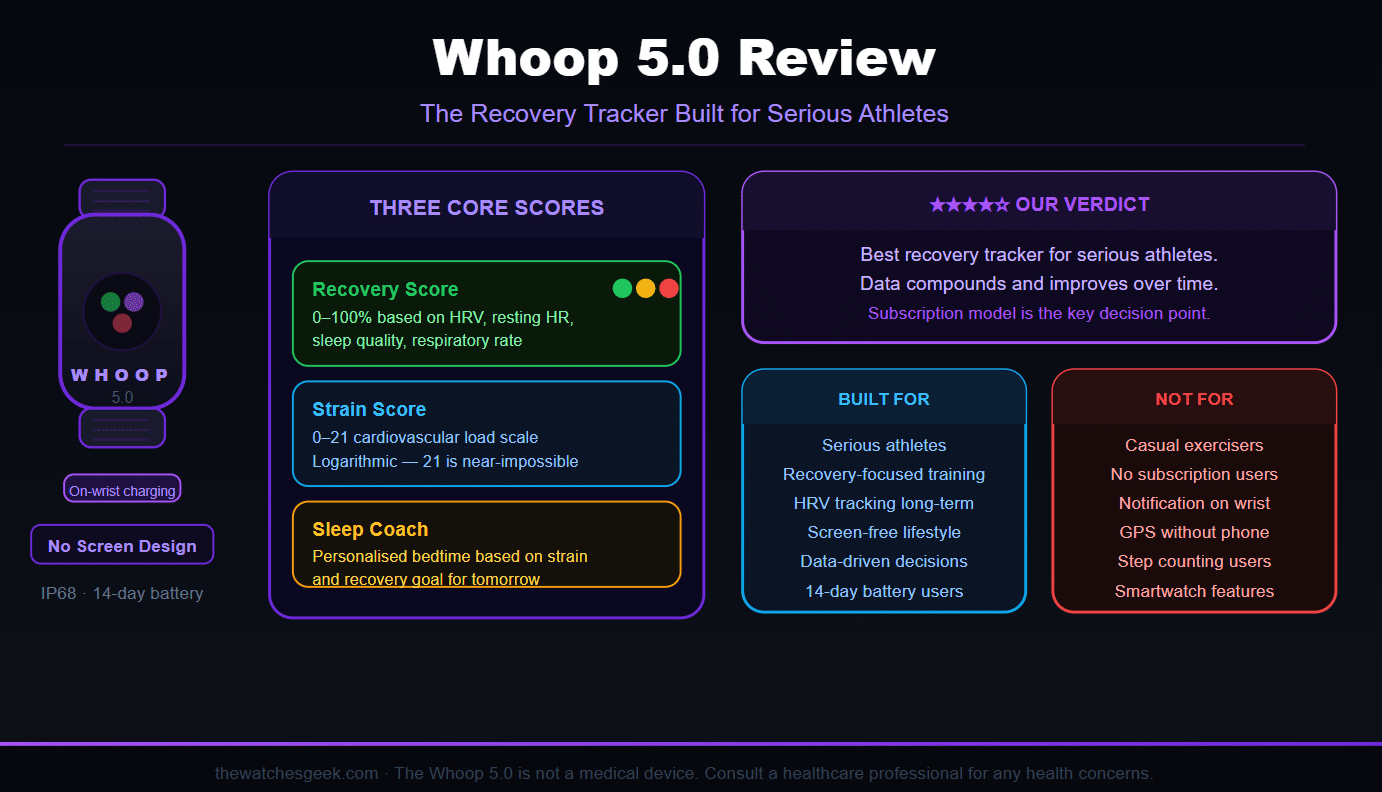
The Whoop 5.0 does not count steps at all. It is built for one thing: helping you understand how hard you pushed and whether your body has actually recovered from it.
There is no screen. No notifications. No smartwatch features. Just a band on your wrist collecting data around the clock and an app that turns it into three numbers every single morning.
For casual users, that sounds like a lot of effort for limited reward.
For anyone training consistently, trying to improve performance, or simply wanting to stop guessing whether they are ready for a hard session, those three numbers can change how they approach every day.
This review covers everything honestly.
What the Whoop 5.0 does, what it does not do, how the subscription model actually works, and who should and should not buy it.

What Is the Whoop 5.0
The Whoop 5.0 is a screenless fitness and recovery tracker launched in May 2025.
It comes from Whoop, a company that has built its entire product around one idea: cardiovascular load and recovery, measured precisely enough to tell you how ready your body is for more work.
Unlike most wearables, which you buy as hardware with an optional subscription, Whoop runs on a membership model. You pay for a plan, and the device comes included.
The device also stops working if you cancel.
That is an important detail, and it will come up again later.
The 5.0 is the most capable version Whoop has made, with upgraded sensors, a faster processor, significantly better battery life than its predecessor, and new metrics for long-term health tracking.
Design and Build Quality

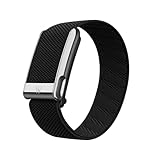
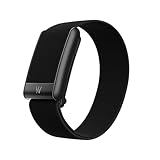
The Whoop 5.0 is genuinely small. The tracker itself is a small rectangular pod that sits inside a fabric band.
There are no buttons.
There is no screen. Nothing on the outside of the device lights up or displays anything.
The band options include Sportflex, Cloudknit, Superknit, Coreknit, and a premium Leatherluxe strap.
Most people start with Sportflex, which is lightweight, sweat-resistant, and comfortable enough for sleep.
Cloudknit is softer and the most popular for all-day wear.
One of Whoop’s genuinely useful design features is the Whoop Body line.
These are compression shorts, shirts, and sleeves with a built-in pocket that holds the tracker pod on your bicep, thigh, or torso instead of your wrist.
For activities where a wristband gets in the way, or for people who want wrist-based heart rate readings taken closer to the radial artery, the Body option is a real advantage.
The tracker is rated IP68 and is water-resistant to the same depth as most premium smartwatches.
You can shower, swim, and train hard without concern. The battery pack that charges it carries the same IP68 rating.
Charging is worth explaining because it is unusual and genuinely clever.
You do not take the Whoop off to charge it.
Instead, a small wireless battery pack slides over the band while you are wearing it and charges the device from the outside.
Charging happens while you sleep or sit at your desk.
You never lose a minute of tracking data because of a dead battery, which matters when sleep data is one of the things you are paying for.
What the Whoop 5.0 Tracks

Strain Score
Strain is Whoop’s signature metric and what separates it from most other trackers.
Every day, your Whoop calculates a Strain score between 0 and 21.
The number reflects your cardiovascular load, meaning how hard your heart worked and for how long across the full day.
It doesn’t just count your workout.
Every elevated heart rate moment, including stress at work, a long walk, and a difficult meeting, contributes to your daily Strain.
The scale is logarithmic.
The difference between a 15 and an 18 is enormous in terms of effort required.
A score above 18 means an extremely intense day of training.
A score of 21 is nearly impossible to reach in a single session.
Your Whoop also tracks Activity Strain for individual workouts separately from Day Strain, so you can see both the isolated effort of a specific session and the total load your body has carried.
Recovery Score
Every morning you wake up to a Recovery score between 0 and 100 percent, shown as green, yellow, or red.
Green (67 to 100 percent) means your body has recovered well and can handle high strain. Yellow (34 to 66 percent) means moderate training is appropriate. Red (1 to 33 percent) means rest or very light activity.
The score is calculated using four inputs: heart rate variability, resting heart rate, sleep performance, and respiratory rate. HRV is the most heavily weighted of the four.
The idea is that HRV reflects your nervous system’s state: high variability generally means you are well-recovered, low variability means you are still under stress from previous effort.
What makes this genuinely useful is that the Whoop builds a personal baseline over time.
A recovery score is not compared to a population average. It is compared to your own normal. This means the system becomes more accurate the longer you wear it.
Sleep Tracking
Sleep is a major part of Whoop’s recovery calculation.
It automatically tracks light sleep, deep sleep, and REM sleep, along with total sleep duration, sleep efficiency, and time to fall asleep.
It also tracks respiratory rate, skin temperature variation, and blood oxygen levels overnight.
The Sleep Coach is one of the more practical features.
It tells you what time to go to bed tonight based on when you need to wake up, your current sleep debt, and how much recovery you want to achieve.
If your goal is to be in the green tomorrow, it tells you the exact bedtime that gives you the best chance of getting there.
Sleep debt is tracked cumulatively. If you have been cutting your sleep short all week, the app shows you how much you owe your body.
Seeing a number tied to that deficit is surprisingly motivating for many users.
Heart Rate Variability
HRV is one of the most meaningful signals in endurance sports and recovery science, and the Whoop has been built around it from the beginning.
The device samples your heart rate 26 times per second using green and infrared LED sensors, which is a much higher sampling rate than most consumer wearables.
HRV is measured during sleep, when movement artifacts are minimal, and the reading is most stable.
Over weeks, you can see your HRV baseline change in response to training load, stress, alcohol, illness, and recovery quality.
Watching that number move in response to choices you make is one of the things long-term Whoop users consistently say keeps them engaged with the data.
Skin Temperature and SpO2
Skin temperature is tracked overnight and compared against your personal baseline.
A meaningful deviation can flag early illness, hormonal changes, or environmental effects.
Blood oxygen is also tracked through the night.
These are supporting metrics rather than headline features, but they add context to the recovery picture in a way that a single morning score alone cannot.
Stress Score
The Whoop 5.0 tracks a daily Stress score from 0 to 3 based on how much time you spend in elevated heart rate zones outside of deliberate exercise.
This is a newer addition to the platform, and many desk workers and high-pressure professionals find it unexpectedly relevant.
A day with high cognitive stress but no physical workout can show up meaningfully in your recovery the next morning.
Healthspan (Peak Tier)
Members on the Peak plan get access to Healthspan metrics, which include a Whoop Age and Pace of Aging calculation.
These use long-term trends in your HRV, resting heart rate, respiratory rate, and activity data to estimate how well your body is aging relative to your chronological age.
This is less useful for day-to-day training decisions and more interesting as a long-term health picture over months and years.
The Subscription Model: What You Need to Know
The Whoop membership is the part of this purchase that requires the most careful thought before buying.
There is no upfront hardware cost. The device is included with your membership. The plans are tiered, and each tier comes with different hardware.
The One plan includes the older hardware. The Peak plan is the one that includes the Whoop 5.0 and access to Healthspan features.
The Life plan includes the Whoop MG, a more advanced version with ECG and blood pressure insight capabilities.
There is no free version.
If you cancel your membership, the device stops working entirely.
This is the opposite of how most trackers operate, and it’s why many people interested in Whoop ultimately decide against it.
The three-month trial offered on some plans is genuine and worth using.
If you are on the fence, start there.
The data becomes most useful after four to six weeks, once the device has established your personal baselines.
By the end of three months, you will have a clear sense of whether the insights are changing how you train.
If you are an existing Google One AI Pro or Ultra subscriber, this does not apply to Whoop in the same way it does to Google Health Premium.
Whoop is an entirely separate service.
Battery Life
Battery life was the biggest complaint about the Whoop 4.0, which averaged three to five days.
The 5.0 has completely addressed this. Rated battery life is up to 14 days, and real-world testing by multiple reviewers confirms most people reach ten to fourteen days before the battery pack is needed.
Because you charge it on your wrist without removing the device, the practical experience of using the Whoop 5.0 is that you almost never think about the battery.
You slide the pack on for an hour while watching a film, you put it back on the shelf, and life continues.
What the Whoop 5.0 Does Not Do
The Whoop 5.0 has no screen. You cannot see the time, your heart rate, or any data on the device itself.
Everything lives in the app.
It does not count steps.
This is a deliberate choice by Whoop: they don’t believe step counting is a meaningful metric for serious training.
If you use step count as a measure of daily activity, the Whoop is not the right tracker.
There is no built-in GPS. Route tracking requires your phone.
Distance and pace during outdoor workouts are calculated from your phone’s GPS signal when available, or estimated from heart rate when not.
There are no smartwatch features. No messages, no calls, no music control, no Apple Pay or Google Pay.
None of it. The Whoop is a health and recovery tracker and nothing else.
The Whoop does not have FDA clearance for sleep apnea screening.
It tracks overnight blood oxygen and respiratory rate, but it cannot diagnose or screen for sleep apnea.
If you need that specific clearance, the Apple Watch Series 9 and later is one of the devices with it.
Who Should Buy the Whoop 5.0

You will get the most from the Whoop 5.0 if you train consistently and want to stop guessing whether to push hard or take it easy.
You care about recovery as much as performance.
You are willing to pay a recurring subscription in exchange for data that is genuinely personalized over time.
You exercise without looking at your wrist and prefer to review data after a session rather than during it.
Marcus is 41 and has been running five days a week for three years. He kept getting injured every time he ramped up his mileage.
After two months with the Whoop, he can see the pattern: his Recovery drops sharply after two consecutive high-Strain days, but only when his sleep the second night was under six hours.
Now he moves his rest day when those signals align. He has not had a running injury in eight months.
Who Should NOT Buy the Whoop 5.0
Do not buy the Whoop 5.0 if you are not ready to commit to a recurring subscription.
If you prefer to own a device outright with no ongoing cost, this model isn’t for you.
Do not buy it if you train casually or irregularly.
The Whoop’s value compounds over time through the baselines it builds.
If you exercise three times a month, the data will not be meaningful enough to justify the cost.
Do not buy it if you want a screen on your wrist for any reason, including checking the time, reading messages, or seeing your heart rate during a workout without taking out your phone.
Do not buy it if you need GPS on the device itself. There is none.
Every outdoor route tracking session requires your phone.
Do not buy it if you are looking for step counts as a core metric.
The Whoop does not offer them.
Do not buy it if you want a clinical-grade medical monitor.
The Whoop is not a medical device and cannot replace professional health assessment.
Whoop 5.0 vs the Competition
vs Fitbit Air:
The Fitbit Air requires no subscription, costs far less over time, and is a better fit for general wellness tracking and sleep monitoring.
The Whoop targets athletic recovery and provides deeper performance data if you train seriously.
For most people who are not dedicated athletes, the Fitbit Air offers more value for less ongoing cost.
See our full Fitbit Air review for a closer look at what it offers.
vs Oura Ring 5:
Both are screenless. Both require a subscription.
The Oura Ring 5 is stronger on sleep and recovery wellness in a more discreet form factor.
The Whoop 5.0 is stronger on strain tracking, athletic performance, and cardiovascular load.
If you are a serious athlete, the Whoop gives you more relevant data.
If sleep and general health trends are your priority, the Oura Ring competes closely.
vs Garmin (Fenix 9, Forerunner 570): Garmin watches have screens, built-in GPS, full sport tracking, and no subscription requirement.
Theyare better for athletes who need navigation and real-time performance data on the wrist.
The Whoop is stronger on recovery science and HRV depth.
These serve different needs, and for serious athletes, some users choose to wear both.
Final Verdict
The Whoop 5.0 is the best recovery tracker available if you are willing to accept what it is and what it is not.
What it is: a device built specifically for athletes and serious exercisers who want to optimize training load and recovery.
The Strain and Recovery system is genuinely sophisticated.
The HRV tracking is among the best in any consumer product.
The Sleep Coach is actionable in a way that most sleep trackers are not.
The battery and charging solution is clever and practical.
What it is not: a general-purpose health tracker, a smartwatch, or a good fit for anyone who trains casually.
The subscription model is the biggest barrier, and it is a legitimate one.
If you are comparing it purely on value for casual use, there are better options.
But if you train five or more days a week and recovery data would genuinely change how you plan your training, the Whoop 5.0 is in a different category from everything else at this level.
Check Amazon for current price
Frequently Asked Questions
Does the Whoop 5.0 have a screen? No. The Whoop 5.0 is completely screenless. All data is accessed through the Whoop app on your phone. Nothing on the device itself lights up or displays information.
Do you need a subscription to use the Whoop 5.0? Yes. The Whoop requires an active membership to function. The device comes with your subscription rather than being purchased separately. If you cancel your membership, the device will no longer work.
How long does the Whoop 5.0 battery last? Whoop rates the 5.0 at up to 14 days. Real-world testing by multiple reviewers confirms 10 to 14 days of typical use. The device charges on the wrist through a battery pack that slides over the band, so you never need to remove it to charge.
Can you shower and swim with the Whoop 5.0? Yes. The Whoop 5.0 is rated IP68, and the battery pack carries the same rating. It is safe for showering, pool swimming, and ocean swimming. Rinse with fresh water after pool or saltwater use.
What is the Strain score and how does it work? Strain measures your daily cardiovascular load on a scale from 0 to 21. It tracks how hard your heart worked and for how long across the entire day, not just during exercise. The scale is logarithmic, meaning the difference between a score of 17 and 21 represents an enormous increase in effort. A score above 18 indicates an extremely intense training day.
What is the difference between Whoop 5.0 and Whoop MG? The Whoop MG is a more advanced version available on the Life membership tier. It adds ECG readings and blood pressure insights, along with everything the 5.0 offers. The 5.0, included with the Peak tier, covers strain, recovery, sleep, HRV, skin temperature, and Healthspan metrics without the ECG and blood pressure hardware.
How accurate is Whoop 5.0 heart rate tracking? The Whoop samples heart rate data 26 times per second using both green and infrared LED sensors. In steady-state cardio, accuracy is comparable to high-end sports watches. During high-intensity interval training and strength training, optical wrist sensors in general can read lower than chest strap measurements. For most training decisions, the accuracy is sufficient. For clinical or research-grade precision, a chest strap remains the gold standard.
This article is for informational purposes only. The Whoop 5.0 is not a medical device. If you have concerns about your heart rhythm, sleep quality, or any health condition, please consult a qualified healthcare professional.
External reference: How Does Whoop Strain Work
Luis Cooper

Hi, I'm Luis, the guy behind this site. I love wearing watches, especially ones that look great on small wrists (mine are about 6.3" around). The Watches Geek is dedicated to helping you learn about and buy watches that you will love wearing. I want this website to be the last destination for people to pick the best watches to fit their needs. You can find our unbiased reviews here on Thewatchesgeek.