
Last Updated on October 12, 2026 by Luis Cooper
The most consistent complaint about smart rings — from everyone who has worn one — is not about the health data.
It is not about the app.
It is not even about sizing or fit.
It is the charger.
Every night, or every third night, or however long the battery claims to last before it actually runs out, the ring comes off the finger and sits on a charging dock.
For a device designed to track sleep, removing it every night to charge creates a data gap that makes overnight monitoring less complete than it should be.
The Ultrahuman Ring Pro launched in the US on June 20, 2026, with a direct answer to this complaint.
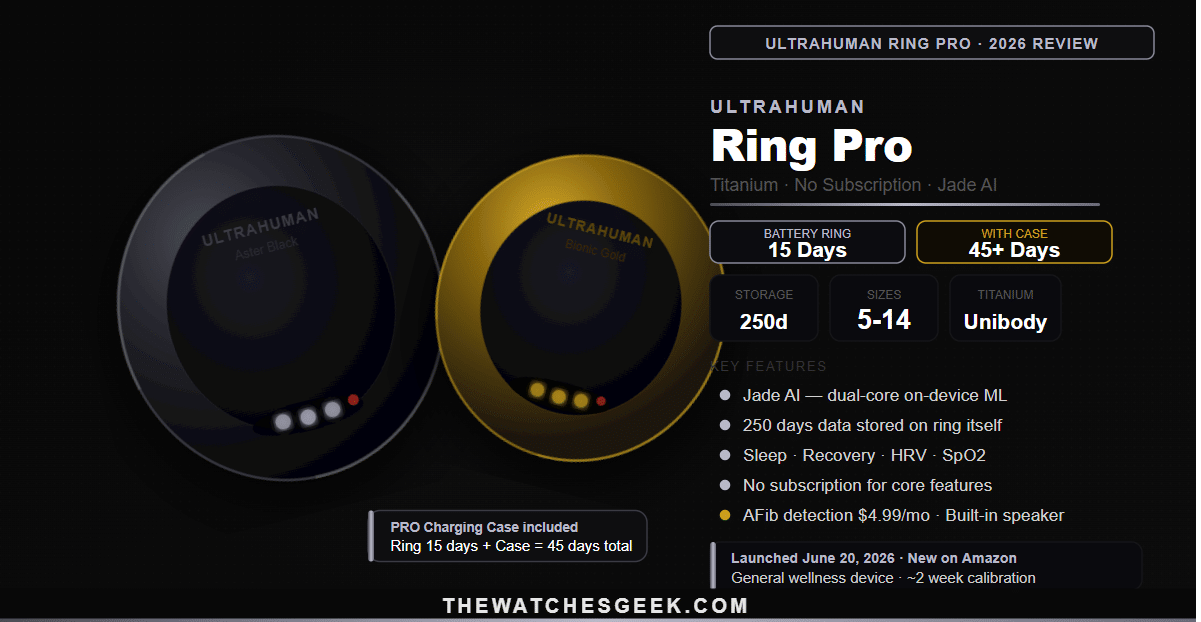
The ring alone lasts up to 15 days.
The PRO Charging Case that ships in the box holds enough charge to recharge the ring multiple times, extending total battery life to more than 45 days from a single wall-outlet charge.
A 44-year-old who travels consistently for work described tracking his health across six consecutive weeks of business travel without plugging the Ring Pro into a wall outlet once.
The ring charged from the case during flights.
The case charged from a hotel socket once across the entire six-week period.
He described it as the first wearable that behaved as his watch does —something he puts on and genuinely forgets about between charges.
Ultrahuman Ring Pro Review


Quick Verdict
The Ultrahuman Ring Pro is the longest-lasting smart ring on the market and the most technically ambitious—a dual-core processor, 250 days of on-device data storage, and a PRO Charging Case included in the box are features the category has never offered at any price.
It earns a genuine recommendation for buyers who want premium health tracking without a mandatory subscription and who specifically value battery endurance above other specifications.
The honest caveats deserve equal weight.
The ring is bulkier than its predecessor, the Ring Air and some wearers notice.
AFib detection—one of its headline features—requires an optional monthly payment on top of the ring purchase and uses a PPG optical sensor rather than a dedicated ECG, which is less clinically reliable than ECG-based alternatives.
And the ring requires approximately two weeks of continuous wearing before the data algorithms are calibrated to the individual wearer — reviews during the first two weeks should be understood as the watch learning, not performing.
The Legal Background That Makes This Ring Interesting
The Ultrahuman Ring Pro has a history that matters for US buyers.
In August 2025, the US International Trade Commission ruled that Ultrahuman’s previous Ring Air infringed Oura’s patents.
Import restrictions took effect in October 2025, removing Ultrahuman products entirely from the US market.
Ultrahuman responded by redesigning the Ring Pro with engineering changes it believes do not infringe the patents at issue.
In March 2026, US Customs and Border Protection cleared the Ring Pro for import, and pre-orders opened immediately in the US.
The ring began shipping on June 20, 2026.
This context matters because it explains why the Ring Pro is a significant redesign rather than an incremental update to the Ring Air — the legal pressure created an engineering opportunity that produced a genuinely different product.
Design and Build

The Ring Pro is built from a titanium unibody — a single piece of titanium machined to form the complete ring structure rather than assembled from multiple components.
Ultrahuman describes the titanium grade as comparable to materials used in aerospace and surgical applications.
Four finishes are available: Raw Titanium (brushed silver-grey), Aster Black (deep matte black), Bionic Gold (warm champagne tone), and Space Silver (polished silver).
Each finish is a PVD coating over the titanium base, adding colour without significant thickness.
The ring measures 2.65 millimeters thick and 4 millimeters wide.
The minimum weight is 3.3 grams for smaller sizes, increasing slightly for larger sizes because of the added titanium.
Woman and Home’s reviewer, who wore the ring for more than two weeks, described it as noticeably bulkier than the Ring Air — the Pro is physically larger than its predecessor, which is the trade-off for the larger battery and dual-core processor inside.
Sizes 5 to 14 are available. Ultrahuman’s sizing differs from standard jewellery sizing, and the company strongly recommends ordering the sizing kit before purchasing the ring.
The sizing kit is available separately on Amazon and allows the wearer to find the correct Pro-specific size by wearing sample sizers for 24 hours before choosing.
The Ring Pro includes ProRelease Technology, engineering in the ring structure that lets a medical professional safely cut it away from the finger if swelling or injury makes removal impossible.
This practical detail matters for any ring worn continuously around the clock—most standard ring designs cannot be safely removed if the finger swells significantly.
The PRO Charging Case — The Feature That Changes Everything
The PRO Charging Case ships in the box with every Ring Pro purchase. It is not a separate accessory.
The case looks like a small cylindrical canister, approximately the size of a thumb drive. Inside, a magnetic charging mechanism makes contact with the ring when it is placed in the case.
The case contains a battery rated for 45 days of Ring charges—meaning it can refill the Ring Pro multiple times before needing to be connected to a wall outlet.
The practical implication of having both a 15-day Ring battery and a 45-day case battery is total battery life that can extend beyond 60 days from a single wall-charging session—depending on how the Ring is used and how often it is topped up from the case.
For a traveler who charges the Ring in the case during an eight-hour flight rather than at a wall socket, the case serves as a portable charging unit that fits in a jacket pocket.
For someone on a hiking expedition or a long sailing passage without electrical outlets, the case provides weeks of ring charging from its own reserve.
The case also has an integrated LED charge indicator for both the case and the ring, stores up to a year of the ring’s data as a local backup, and can run firmware diagnostics without bricking the device if an update encounters a problem.
The Dual-Core Processor and Jade AI

The Ring Pro has a dual-core processor—a meaningful hardware upgrade from the single-core processing in the Ring Air and most other smart rings currently available.
The added processing power serves a specific purpose: running Ultrahuman’s on-device machine learning engine instead of sending health data to the cloud for analysis.
The system is called Jade, and it processes the ring’s sensor data locally on the ring itself, generating insights and alerts without requiring a network connection or cloud processing at every step.
In practice, this means Jade AI can detect anomalies in heart rhythm patterns and automatically trigger an AFib scan, respond to the wearer’s health data with proactive prompts in real time, and initiate specific PowerPlugs functions based on what the data shows—without the data leaving the device.
The 250 days of on-device data storage is a direct result of the dual-core architecture’s ability to manage and organize large volumes of health data efficiently on the ring itself.
Where previous smart rings could lose data if the phone wasn’t synced within a week, the Ring Pro stores nearly nine months of health metrics on the ring, regardless of when the last phone sync occurred.
Health Tracking — Core Features

All of the following features are available without any subscription or additional payment:
Sleep tracking divides overnight sleep into light, deep, and REM stages using heart rate, heart rate variability, and movement data. The Sleep Index provides a morning summary of stage distribution across the night, along with a score that reflects sleep quality, duration, and consistency.
Dynamic Recovery is Ultrahuman’s daily readiness system. Unlike static recovery scores that calculate once each morning, Dynamic Recovery updates in real time as the wearer’s activity and stress data come in throughout the day. If a recovery recommendation changes because of a difficult afternoon, the score reflects this immediately rather than waiting until the following morning.
HRV Status provides continuous overnight heart rate variability monitoring, tracking the subtle variation between consecutive heartbeats that reflects autonomic nervous system health and recovery state. Higher overnight HRV generally correlates with better recovery; a sustained downward trend over several days indicates accumulating stress or fatigue.
Stress Rhythm monitors physiological stress throughout the day using HRV patterns, identifies periods of elevated stress, and logs them in the app alongside other health data.
Ultra Age is Ultrahuman’s biological age estimate — a score that reflects how the wearer’s health metrics compare to population averages for their chronological age, updating as data accumulates over months of wearing.
Women’s health features include menstrual cycle tracking, period prediction and basic cycle-phase insights built into the core platform.
Respiratory and snoring analysis, developed in partnership with Sleep Cycle, monitors breathing patterns and snoring frequency overnight and reports the findings in the morning health summary.
Independent testing found that the AFib detection feature ran continuously in the background without generating false positives across a multi-week testing period, which is a positive finding for a feature that should alarm only when genuinely warranted. For a fuller understanding of what atrial fibrillation is and when clinical evaluation is appropriate, the American Heart Association provides clear guidance on cardiac rhythm conditions at heart.org.
AFib Detection — The Full Honest Explanation
AFib detection is one of the Ring Pro’s headline features, and it requires a careful explanation before it influences a purchase decision.
The Ring Pro monitors heart rhythm using PPG optical sensing — the same type of sensor used for heart rate and SpO2 monitoring. When the Jade AI detects patterns in the optical signal that suggest an irregular rhythm consistent with atrial fibrillation, it generates a report for the wearer to review.
This is different from ECG-based AFib detection.
An ECG sensor detects the heart’s electrical activity directly and identifies rhythm anomalies with higher clinical specificity than optical PPG-based methods.
The Ring Pro’s PPG approach is less clinically reliable than a dedicated ECG device.
Two additional details matter.
The AFib detection is not included in the base ring purchase — it is a paid PowerPlug add-on at $4.99 per month.
And the Ultrahuman Ring Pro, like every smart ring currently available, is sold as a general wellness device rather than a medical device. No smart ring currently holds FDA clearance as a medical device for AFib detection.
The AFib PowerPlug is powered by FibriCheck — a service that holds its own separate FDA clearance — but that clearance belongs to FibriCheck, not to Ultrahuman or the ring itself.
For a buyer who specifically needs clinical-grade AFib screening, a dedicated ECG device or a medical consultation remains the appropriate tool.
For a buyer who wants passive overnight rhythm monitoring that can flag unusual patterns for further investigation, the Ring Pro’s feature is a useful addition to the overall health picture — with the understanding of its sensing mechanism and wellness-only status.
The Two-Week Calibration Period
This practical detail has the most immediate impact on early Ring Pro wearers, and it appears in nearly every independent review.
The Ring Pro’s algorithms require about two weeks of continuous wear to calibrate to the wearer’s baseline biometrics.
During this period, the sleep staging, recovery scores, HRV readings, and other personalized health metrics are actively learning the wearer’s patterns rather than producing fully calibrated results.
Buyers who wear the ring for three days, see confusing or inconsistent data, and conclude the ring doesn’t work are typically judging the product during its calibration window.
The two-week figure is consistent across independent reviews and is disclosed in Ultrahuman’s setup documentation.
The practical implication is that you should wear the Ring Pro consistently for at least two weeks before the health data is reliable enough to draw conclusions about its accuracy.
This is longer than the calibration period most competing rings require.
Real-World Battery vs Official Claims
Ultrahuman rates the Ring Pro at up to 15 days of battery life.
Engadget’s independent testing with all features active — AFib detection, SpO2, continuous heart rate — achieved approximately 10 days of real-world battery.
A separate review by another publication found approximately 13.8 days with standard feature usage.
The 15-day figure seems achievable with lighter feature use and may reflect typical use rather than all-features-enabled testing.
For most buyers, the gap between the official 15-day claim and the 10-13 day real-world figure matters less than it would on other devices, because the PRO Charging Case’s 45-day reserve means the ring never actually runs to zero in normal use.
Topping up the ring from the case for an hour during the day extends continuous wear time indefinitely within the case’s charge capacity.
Ultrahuman Ring Pro vs Oura Ring 5 — The Main Comparison
The two most significant smart rings in the 2026 market are the Ultrahuman Ring Pro and the Oura Ring 5.
They serve the same general purpose but prioritize different design goals.
| Feature | Ultrahuman Ring Pro | Oura Ring 5 |
|---|---|---|
| Subscription | None for core features | Monthly membership |
| Battery ring | 15 days (10-13.8 real-world) | 6-9 days |
| Battery with case | 45+ days total | Dock only |
| On-device storage | 250 days | Sync-dependent |
| Processor | Dual-core, on-device ML | Standard |
| AFib | PPG-based, $4.99/month | Not available |
| Sleep algorithm | Good | Reputation stronger |
| Design | Bulkier than Ring Air | Lighter, 2g |
| Colors | 4 titanium finishes | Multiple |
| Calibration | ~2 weeks | Less |
The Ring Pro clearly leads on battery endurance, on-device processing power, and long-term cost for buyers who don’t need AFib monitoring.
The Oura Ring 5 leads in sleep algorithm maturity and the reputation of its health platform, backed by a longer research history.
For a complete breakdown of the Oura Ring 5’s Health Radar, AI Advisor, and Blood Pressure Signals feature, the full review at oura-ring-5-review covers the Oura platform in detail.
For buyers comparing subscription costs across smart ring platforms over two and three years of ownership, the guide at smartwatch-subscription-costs covers the full cost picture of every current wearable subscription.
Who should not buy this:
Buyers who specifically need ECG-based AFib detection should look at alternatives that carry a dedicated ECG sensor. Buyers who like the Ring Air’s profile and don’t want a bulkier ring should note the Pro’s larger size.
Buyers who want the most developed sleep algorithm and the strongest research backing for health insights should consider the Oura Ring 5.
Buyers in the calibration window who expect accurate data immediately should wait the full two weeks before evaluating the ring’s performance.
Specifications
| Feature | Details |
|---|---|
| ASINs | B0H1N5VLSN (Aster Black) / B0H1N3TWP1 (Bionic Gold) |
| Launch | June 20, 2026 |
| Material | Titanium unibody, PVD coating |
| Colors | Raw Titanium, Aster Black, Bionic Gold, Space Silver |
| Sizes | 5-14 (10 sizes) |
| Weight | From 3.3g depending on size |
| Thickness | 2.65mm |
| Width | 4mm |
| Processor | Dual-core with on-device machine learning |
| On-device storage | 250 days of health data |
| Battery ring | Up to 15 days |
| Battery real-world | 10-13.8 days depending on features |
| PRO Charging Case | Included — 45 days of ring charges |
| Total battery | 45+ days from one wall charge |
| Core features | Free — no subscription |
| AFib detection | Optional — $4.99/month PowerPlug — PPG-based |
| Haptics | Yes |
| Speaker | Yes — unique among smart rings |
| ProRelease | Yes — medical safety cut-away engineering |
| Calibration | ~2 weeks |
| Compatible | iOS and Android |
FAQs
Is the Ultrahuman Ring Pro available without a subscription?
Yes. The Ring Pro’s core health-tracking platform — including sleep staging, Dynamic Recovery, HRV Status, stress monitoring, SpO2, Ultra Age, women’s health tracking, respiratory and snoring analysis, and Jade AI health insights—is available indefinitely with the one-time purchase, with no subscription fee. Ultrahuman’s PowerPlugs are optional paid add-ons for additional features, including AFib detection ($4.99 per month) and Cycle and Ovulation Pro ($3.99 per month). These are genuinely optional features that the ring functions fully without — the subscription-free description of the Ring Pro applies to the complete core platform rather than a limited free tier that unlocks useful features behind a paywall.
How accurate is the Ultrahuman Ring Pro’s AFib detection?
The Ring Pro’s AFib detection uses optical PPG sensing, which monitors changes in blood volume in the finger to infer heart rhythm patterns. This is different from ECG-based detection, which reads the heart’s electrical activity directly. PPG-based rhythm analysis is less clinically specific for identifying atrial fibrillation than ECG measurement, so it produces results appropriate for general awareness screening rather than clinical diagnosis. Independent testing found that the feature did not generate false positives during a multi-week evaluation, which is a positive result for a feature whose value depends on not alarming unnecessarily. The AFib detection has not received the same FDA clearance as some competing platforms’ cardiac rhythm features in the US market, and any indication of an irregular rhythm from the ring should be followed up with a medical professional using appropriate diagnostic equipment rather than treated as a clinical finding.
How does the Ultrahuman Ring Pro sizing work?
The Ring Pro uses its own sizing system that does not align with standard jewellery ring sizing. A person who wears a standard size 7 ring in jewellery may require a different size in the Ring Pro. Ultrahuman strongly recommends ordering the sizing kit before purchasing the ring — the kit is available on Amazon and includes sample sizers in all 10 available sizes along with four colour chips representing the finish options. We recommend wearing the sample sizer for 24 hours rather than trying it on briefly, because finger size changes throughout the day with temperature, hydration, and activity, and the ring will be worn continuously under all these conditions.
Luis Cooper

Hi, I'm Luis, the guy behind this site. I love wearing watches, especially ones that look great on small wrists (mine are about 6.3" around). The Watches Geek is dedicated to helping you learn about and buy watches that you will love wearing. I want this website to be the last destination for people to pick the best watches to fit their needs. You can find our unbiased reviews here on Thewatchesgeek.