
Last Updated on August 11, 2026 by Luis Cooper
Look at any classic dive watch. The Rolex Submariner. The Omega Seamaster. The Seiko Prospex.
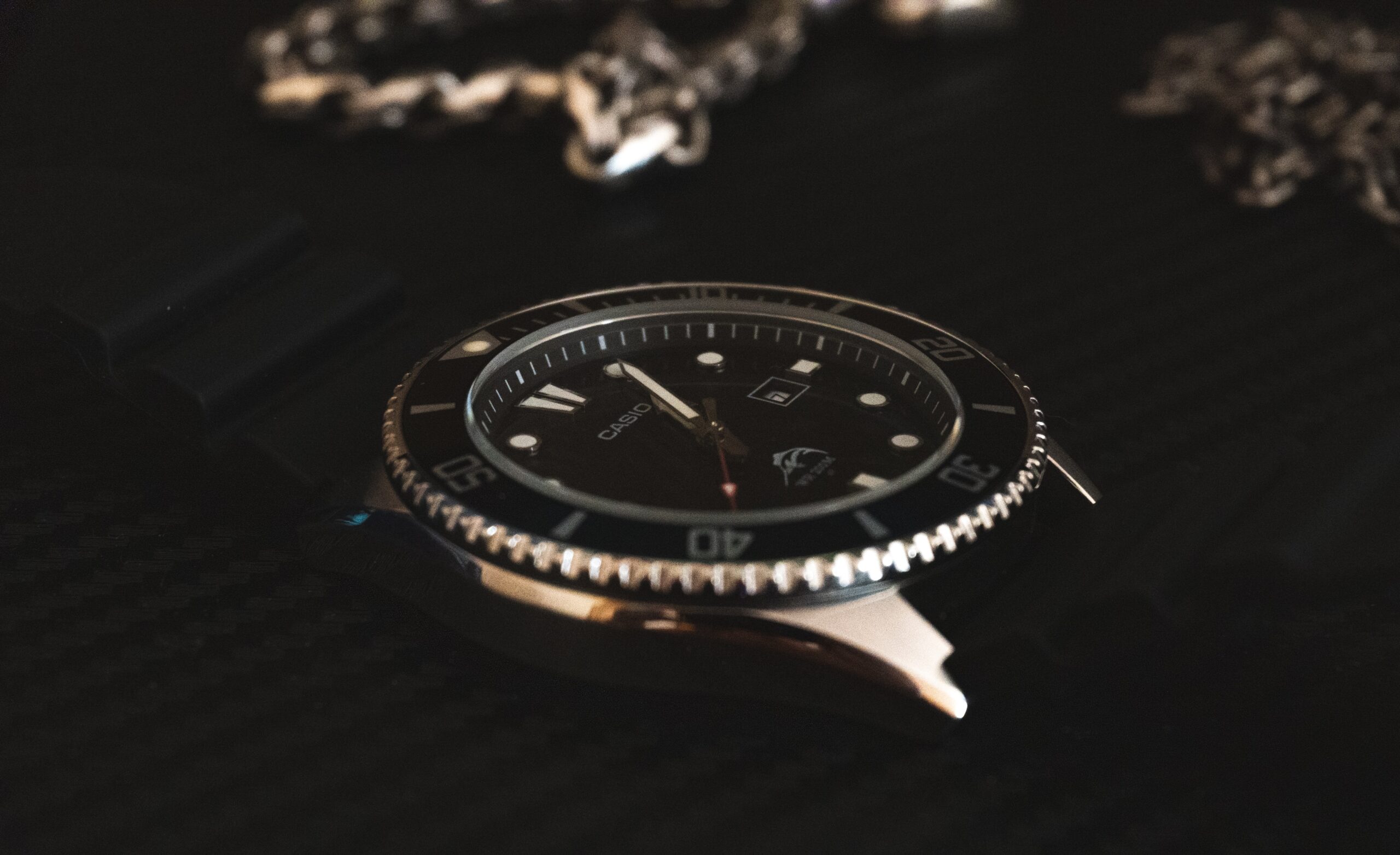
Every single one has a thick ring around the outside of the watch face that turns when you grip it and twist.
That ring is the rotating bezel.
And it is not there for decoration.
The rotating bezel is the one feature that separates a genuine dive watch from every other type of watch in the world.
Understanding why it exists also explains why dive watch design has not changed much since the 1950s.
When something works this well, you do not change it.
In this article, we will discuss why dive watches have rotating bezels.
Why do dive watches have rotating bezels?
The Problem a Rotating Bezel Solves
Before dive watches had rotating bezels, divers had a problem.
They needed to know how long they had been underwater. Not for comfort. For survival.
Scuba divers breathe compressed air from tanks on their backs. The deeper they go, the faster that air is consumed. Every diver calculates their safe bottom time before entering the water. Bottom time is simply the total amount of time you can spend at depth before you need to start ascending safely.
If you stay down too long, you risk decompression sickness. A diver ascending too quickly after too much time at depth risks nitrogen bubbles forming in the bloodstream. This is a serious medical emergency.
So a diver entering the water at a planned maximum of 30 minutes needs to know precisely when 30 minutes have passed. Underwater. With limited visibility. Possibly with gloves on. Under physical stress.
Doing mental arithmetic underwater is not an option. A rotating bezel removes the need for any arithmetic at all.
How the Bezel Actually Works
Here is how to use a rotating bezel. It is simpler than most people expect.
Before entering the water, the diver grips the bezel and rotates it so the triangular marker, usually a luminous pip filled with a glow-in-the-dark material called lume, lines up exactly with the minute hand on the watch.
That is the entire setup. One action. Takes three seconds.
Now the diver enters the water. Time passes. The minute hand continues moving around the dial. The bezel marker stays fixed where the diver set it.
When the diver wants to know how long they have been underwater, they look at the minute hand and read the number on the bezel closest to where the minute hand is pointing. That number is the elapsed time in minutes.
If the minute hand is pointing at the 20 on the bezel, the diver has been underwater for 20 minutes. No calculation. No counting. Just reading a number.
When a diver needs to be out of the water within a specific time, say they have calculated a maximum of 35 minutes, they set the bezel 35 minutes ahead of the current minute hand position. When the minute hand catches up to the bezel marker, the 35 minutes are up.
This is why early dive watch bezels are divided into 60 segments, one for each minute of an hour.
Why Unidirectional and Not Bidirectional
This is the detail that matters most for safety, and it is the reason every serious dive watch bezel rotates in only one direction.
The bezel on a dive watch rotates counterclockwise only. You cannot turn it clockwise. Try to push it the other way and it simply does not move.
The reason is straightforward.
Imagine a diver sets the bezel before entering the water and then something nudges the bezel during the dive. A current. A piece of equipment. The diver brushing against a rock.
If the bezel could rotate in both directions, that accidental knock could shift it clockwise. Clockwise movement would show less time elapsed than the actual time. The diver might believe they have more time remaining than they actually do. They stay down longer than is safe.
A bezel that only rotates counterclockwise can only move in one direction if knocked accidentally. Counterclockwise movement shows more time elapsed than actually passed. The diver thinks they have been underwater longer than they have. They ascend earlier than necessary.
Coming up too early is inconvenient. Coming up too late is dangerous.
Unidirectional rotation always errs on the safe side.
The History Behind the Feature
In 1953, Blancpain launched the Fifty Fathoms, the first production dive watch with a rotating bezel designed for timing underwater. It was developed in collaboration with the French Navy’s combat diver unit. “The people who most needed it were the ones who helped design it.
Every true dive watch is ISO 6425 certified, as defined by the international standard. A dive watch must have a unidirectional rotating bezel , or other elapsed time indicator. If a watch doesn’t have this feature, it can’t be officially certified as a dive watch per the standard (even if it’s water resistant to a certain depth).
This is why a watch rated to 200 metres of water resistance but without a rotating bezel is technically a water-resistant watch, not a dive watch. The bezel is a required functional component, not an optional accessory.
Ceramic vs Aluminum Bezels
Older dive watch bezels used aluminum inserts for the bezel. Aluminum is lightweight and takes colour and printing well, which is why the classic blue and black bezels of famous dive watches look the way they do. The limitation is that aluminum scratches and fades over years of wearing. The numbers can become difficult to read on a heavily worn aluminum bezel.
Modern dive watches increasingly use ceramic bezel inserts. Ceramic is significantly harder than aluminum. It resists scratching from the kind of daily contact that wears down an aluminum insert over time. Ceramic colours are baked into the material rather than applied to the surface, so they do not fade the way aluminum coatings do.
Ceramic bezels cost more to produce because the material is difficult to machine precisely. A ceramic bezel on a dive watch is generally a sign of the watch being from a higher production tier, though the functional purpose is identical to aluminum at either level.
External vs Internal Bezel
Most dive watches use an external rotating bezel. It sits on top of the watch case and turns with a grip and twist motion. Most external bezels have a ridged or knurled edge specifically so they can be gripped and turned even when wearing thick diving gloves.
A small number of watches, particularly some historical models and the Rolex Sea-Dweller at various points in its history, have used an internal rotating bezel instead. This type sits beneath the crystal, inside the watch, and is operated by a separate crown on the case side rather than by gripping the bezel ring itself.
The internal bezel cannot be accidentally moved by external contact during a dive because nothing touches it from outside. The practical drawback is that turning an internal bezel through a crown is a more deliberate process than gripping and turning an external bezel, which can matter when a diver is underwater with limited dexterity and wants to make a quick adjustment.
What About People Who Never Dive?
Most people wearing dive watches today are not divers.
The rotating bezel is still useful to them.
Any situation where you need to track elapsed time without starting a stopwatch benefits from a rotating bezel. You are at the gym and want to time your rest period between sets. Align the bezel with the minute hand when you sit down. When you want to start the next set, glance at the bezel. You are cooking something that needs 20 minutes. Set the bezel. When the minute hand reaches 20 on the bezel, the 20 minutes are up.
It is a manual countdown and count-up timer that requires no buttons, no settings, and no battery. For a watch that may already have no battery because it is a mechanical automatic, this is a particularly elegant solution.
The broader reason dive watches became popular as everyday watches has as much to do with their build quality as their bezel. A watch designed to be waterproof to 200 or 300 metres, shock resistant enough to handle physical activity, and legible enough to read under pressure is simply a very well-made watch that handles daily life more comfortably than a fragile dress watch. The rotating bezel comes along for the ride and turns out to be genuinely useful beyond the specific purpose it was designed for.
FAQs
Does every dive watch have to have a rotating bezel?
Under the ISO 6425 international standard for dive watches, yes. The standard requires a unidirectional rotating bezel or other elapsed time indicator as a mandatory feature. A watch must meet all ISO 6425 requirements to be officially certified as a dive watch. This includes a minimum water resistance of 100 metres, shock resistance, anti-magnetic properties, and the rotating elapsed time indicator. A watch with 200 metres of water resistance but no rotating bezel meets the water resistance requirement but not the full dive watch certification standard. For a closer look at which dive watches meet and exceed the ISO 6425 standard across different budgets and brands, the full guide at best-titanium-watches covers several ISO-certified dive watches in detail.
Why is the rotating bezel marked to 60 and not 12 or 24?
The bezel tracks elapsed time in minutes, not hours. A diver’s bottom time is measured in minutes, not hours, because the intervals that matter for safety are minutes. The safe dive time at recreational depths is typically calculated in minutes, decompression stops are measured in minutes, and ascent rates are calculated per minute. Marking the bezel to 60 mirrors one full revolution of the minute hand around the dial, which means one setting covers a full hour of potential timing in one-minute increments. A bezel marked to 12 or 24 would be measuring something different and would not serve the elapsed time tracking function that dive bezels are designed for.
Can a rotating bezel replace a dive computer?
No, and it was never designed to. A rotating bezel tracks elapsed time. That is all it does. A dive computer tracks depth continuously, calculates nitrogen saturation in real time, generates decompression schedules based on the actual dive profile, and alerts the diver to ascent rate violations. A rotating bezel gives you one number: how long you have been underwater. In the early decades of recreational diving, that one number combined with pre-calculated dive tables was the standard tool for dive planning. Today, dive computers provide dramatically more information and have become the primary safety tool for modern divers. The rotating bezel remains a reliable mechanical backup that requires no battery, no maintenance, and no calibration. It is the simplest possible answer to the question of how long have I been down here, and simplicity is a virtue when you are underwater and something goes wrong with your electronics. The Professional Association of Diving Instructors provides guidance on dive planning tools and standards for recreational divers at padi.com.
Related posts:
Luis Cooper

Hi, I'm Luis, the guy behind this site. I love wearing watches, especially ones that look great on small wrists (mine are about 6.3" around). The Watches Geek is dedicated to helping you learn about and buy watches that you will love wearing. I want this website to be the last destination for people to pick the best watches to fit their needs. You can find our unbiased reviews here on Thewatchesgeek.